
Hello hello, dear reader!
I’m writing from behind my desk on a cold morning in the Netherlands. House slippers on, jeans a bit too tight because I made pizza last night and ate all the leftovers. (Recipe is in my illustrated cookbook, btw!)
I’ve been writing a lot lately: not just for my illustrated recipe Substack, but also for a new kids book pitch. I finished my most recent published project in early November: illustrating and writing about birthday traditions from around the world, including birthday foods and sweets. More on that soon!
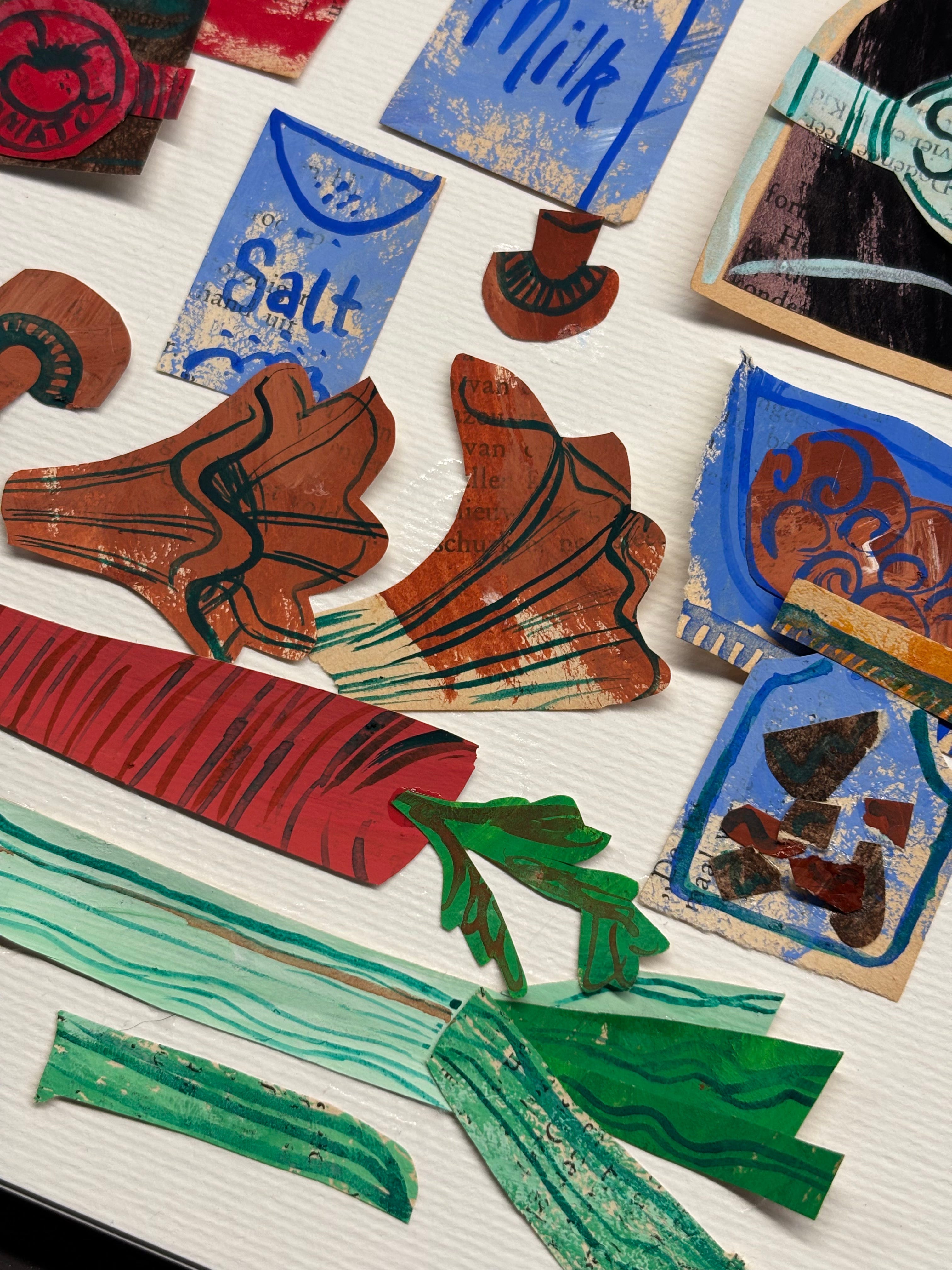
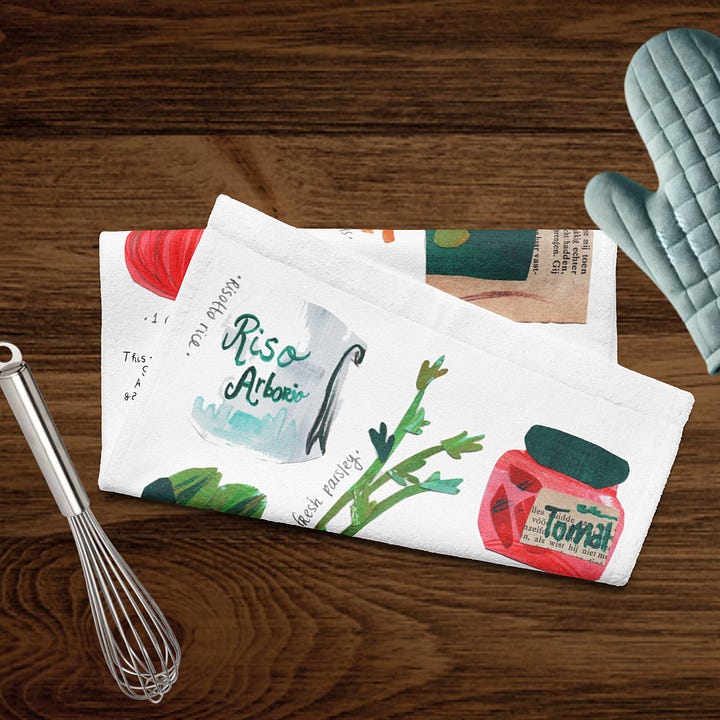
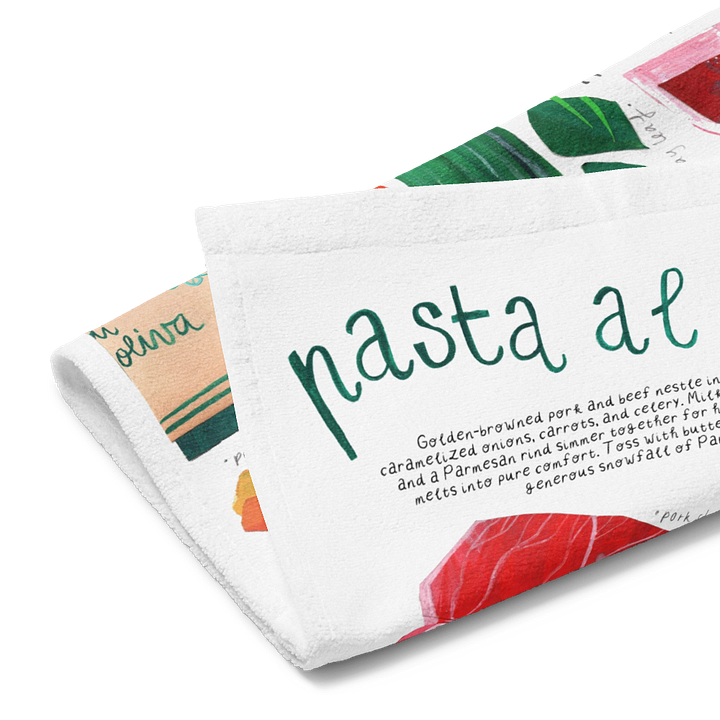
I’ve also worked on some client work and on my Etsy shop, which is filled to the brim with new illustrated goodies! Among which these illustrated recipe kitchen towels, which were very much requested. Check them out!
In my personal life, it’s been a typical winter with a three-year-old: the occasional mild cold, the occasional flu, and many sessions of creating hearty comfort foods. Recently I made french onion soup and roast veggies and fed all my friends while we played D&D and watched Dutch Bake-Off. I’m grateful for these people who tolerate my rants about whatever I’m currently obsessed with. (Right now it’s Restoration England and the French beauty trend of wearing stick-on beauty marks during Louis XIV’s reign.) Speaking of absolutist monarchs: things that piss me off are usually very good creative fuel. Let’s talk about something that irks me every holiday season, the food hierarchy of the holiday table. In some households, as rigid as Louis XIV’s chokehold on nobility. In others, as loose as Charles II’s libertine morals. (I swear I’m making a point here…)

Picture the typical Dutch Christmas table: the gourmet set with everyone grilling their own steaks and chicken skewers, or a massive beef Wellington centerpiece, or roast chickens. And your vegetarian friend? They’re eating... what, exactly? Slimey mushrooms from the gourmet plate? Maybe some bread if they’re lucky?
I had a journey with this myself. For years, my winter dinner parties revolved around boeuf bourguignon: that three-hour labor of love where beef becomes butter-tender in red wine, where the whole house smells like thyme and bay leaves, where friends would volunteer to do dishes just to be invited back. I grew up in a Dutch household where meat was present but never precious. When I became vegetarian, the transition felt natural. But that first winter without my signature stew? That felt like losing a piece of my hosting identity. Here’s what I’ve learned since: the magic of that bourguignon was never really about the beef. It was about time, technique, and building layers of flavor so deep they taste like comfort itself. The meat was just along for the ride.
And here’s what really matters: Food inclusion isn’t just about allergies or dietary preferences. It’s about saying “I see you, your body matters, your choices matter, and you deserve to feast too.” It’s radical hospitality. It’s the opposite of the scarcity-mindset, hierarchical bullshit that society wants us to believe about who deserves abundance.
So this month, I’m sharing the mushroom stew that replaced my bourguignon. Plus, we’re diving deep into umami: that fifth taste that’s been democratizing deliciousness across cultures for literally thousands of years.
Here’s something that should make you raise an eyebrow: Umami was “discovered” by Japanese chemist Kikunae Ikeda in 1908, but people across Asia, Africa, and South America had been cooking with umami-rich ingredients for millennia. The word umami (うま味) literally means “pleasant savory taste” in Japanese.
Ikeda identified the chemical responsible, glutamate, in kombu seaweed, but let’s be clear: People didn’t need a white lab coat to know that fermented soybeans, aged cheese, ripe tomatoes, mushrooms, and fish sauce made food taste incredible. Western culinary institutions just took their sweet time acknowledging it as a legitimate taste category alongside sweet, sour, salty, and bitter.
So much of what gets labeled as “gourmet” or “sophisticated” in Western cuisine is just... ingredients and techniques that many cultures have been using forever. What I love about umami is that it’s proof that humans everywhere figured out how to make the most of what they had. Can’t afford meat? No problem: ferment some beans. Limited protein sources? Dry some mushrooms. Need to preserve vegetables through winter? Ferment them and unlock umami in the process.
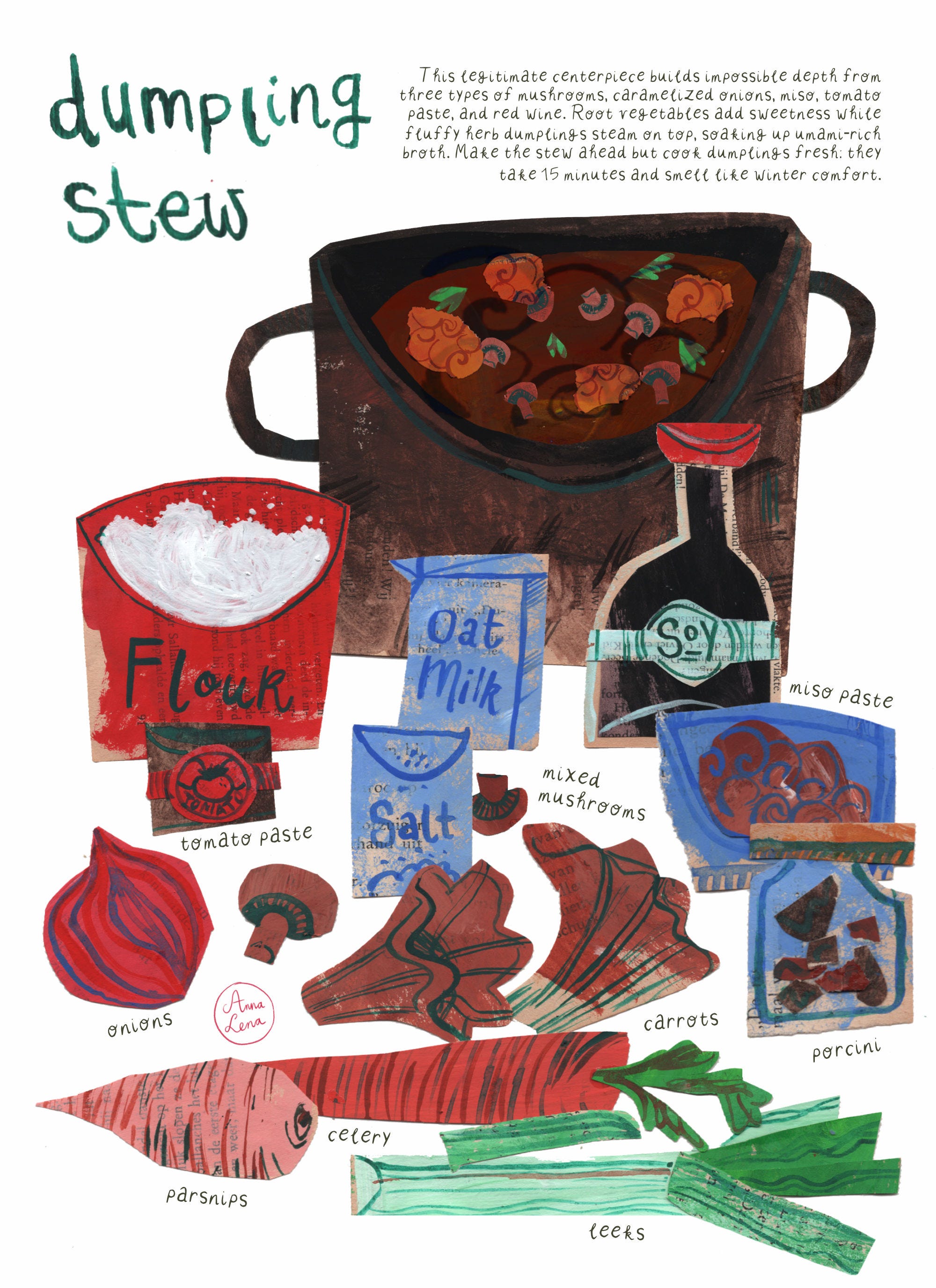
Serves 6-8 as a main course
This isn’t a side dish trying to be a main. This is a legitimate centerpiece: layers of caramelized vegetables, three types of mushrooms building impossible depth, and fluffy herb dumplings that soak up all that umami-rich broth.
For the stew
Base:
3 tbsp olive oil
2 large onions, diced
4 cloves garlic, minced
2 leeks (white and light green parts), sliced
3 carrots, cut into thick coins
2 parsnips, cut into thick coins
3 celery stalks, sliced
500g mixed mushrooms (portobello, cremini, shiitake), roughly chopped
150g dried porcini mushrooms
2 tbsp tomato paste
3 tbsp white miso paste
2 tbsp soy sauce or tamari
2 cups red wine (use a good one you’d drink)
6 cups vegetable stock
3 sprigs fresh thyme
2 bay leaves
2 sprigs fresh rosemary
Salt and black pepper
Aromatics for depth:
1 tbsp dried mushroom powder (or grind dried porcini)
1 tsp smoked paprika
For the herb dumplings
200g all-purpose flour
2 tsp baking powder
1/2 tsp salt
3 tbsp fresh herbs, minced (mix of parsley, thyme, chives)
100ml oat milk (or any plant milk)
3 tbsp olive oil
Black pepper to taste
Here’s what most people get wrong about vegan centerpieces: they try to replicate meat. But umami doesn’t belong to meat, it’s a flavor profile built from glutamates, and vegetables are full of them.
Place the dried porcini mushrooms in 2 cups of just-boiled water. Let them sit while you prep everything else. This soaking liquid will become the backbone of your stew’s depth. Don’t you dare throw it away.
Heat your largest, heaviest pot over medium-high heat. Add olive oil. When it shimmers, add the onions with a big pinch of salt.
Here’s where patience becomes alchemy. You want these onions deeply caramelized: golden brown, sticky, concentrated. This takes 15-20 minutes. Don’t rush it. Stir occasionally, scraping up the fond (those brown bits) from the bottom. That fond is flavor.
When the onions are properly caramelized (mahogany colored), add the garlic and leeks. Cook another 3 minutes until fragrant.
Add your fresh mushrooms. They’ll release water—that’s fine. Let them cook down, stirring occasionally, until they’ve given up their water and started to brown. About 8-10 minutes.
Add tomato paste and cook for 2 minutes, stirring constantly. It should darken and smell sweet-savory. This is caramelizing the tomato paste, another layer of umami.
Stir in the miso paste, mushroom powder, smoked paprika, and soy sauce. Cook for 1 minute, stirring to coat everything.
Pour in your red wine. Use a wooden spoon to scrape up every bit of fond from the bottom of the pot. This is called deglazing, and it’s where all that stuck-on flavor gets released back into your stew.
Let the wine reduce by half, about 5 minutes. You should be able to smell it getting sweeter and less alcoholic.
Strain your rehydrated porcini mushrooms (save that liquid!). Roughly chop them and add to the pot.
Add carrots, parsnips, and celery. Stir everything together.
Pour in the porcini soaking liquid (slowly, leave any grit at the bottom of the bowl) and the vegetable stock. Add thyme sprigs, bay leaves, and rosemary.
Bring to a boil, then reduce to a gentle simmer. Partially cover and cook for 30-40 minutes, until vegetables are tender but not falling apart.
Make the dumplings
In a bowl, whisk together flour, baking powder, salt, and black pepper. Stir in the minced herbs.
In a small bowl, combine oat milk and olive oil.
Pour the wet ingredients into the dry and stir just until combined. Don’t overmix - lumpy is fine. Lumpy is good. Overmixed dumplings are tough dumplings.
Taste your stew. Adjust salt and pepper. Remove the herb sprigs and bay leaves.
Using two spoons, drop dollops of dumpling batter onto the surface of the simmering stew, you should get 12-14 dumplings. They should sit on top, not sink in.
Cover the pot completely and simmer for 12-15 minutes. Do not lift the lid. The dumplings cook from the steam, and lifting the lid releases that steam.
After 15 minutes, check: dumplings should be puffed, cooked through, and slightly crispy on top where they weren’t submerged.

P.S. If you’re making this for Christmas and want to prep ahead: make the stew completely the day before, but don’t add the dumplings until you’re ready to serve. Reheat the stew, bring it to a simmer, then make fresh dumpling batter and cook them on top. They only take 15 minutes and your house will smell incredible.
Now that you’ve made this stew, here is how to bring it to the table.
If you’re hosting: Make this the centerpiece. Don’t relegate it to “the vegan option.” Put it in the middle of the table and watch what happens.
If you’re a guest: Offer to bring this. Not as a burden, but as a gift!
If you’re learning: Practice these techniques. Caramelizing onions, building umami, making dumplings: these are skills that will transform everything you cook.
My newsletter is free forever for everyone, but I like to give people the opportunity to dive a little deeper or just support my work for the price of a yummy baked good a month. That’s why the rest of this story is for paid subscribers - you’re super welcome to try it for a bit!
You’ll get:
A behind the scenes collage art time lapse: See how I created these artworks!
Savoury world tour: A deep-dive into umami traditions across cultures with historical context
International stew history: The political and social history of stew from medieval Europe to Indigenous North America
Illustrated bonus goodie: The Guide to an Umami Pantry printable! You can also get it in my Etsy shop. It also includes fun history facts about these ingredients which is my favourite thing ever!
Studio notes: Work-in-progress shots, updates on my new book pitches and client work, and the reference books I used for this research
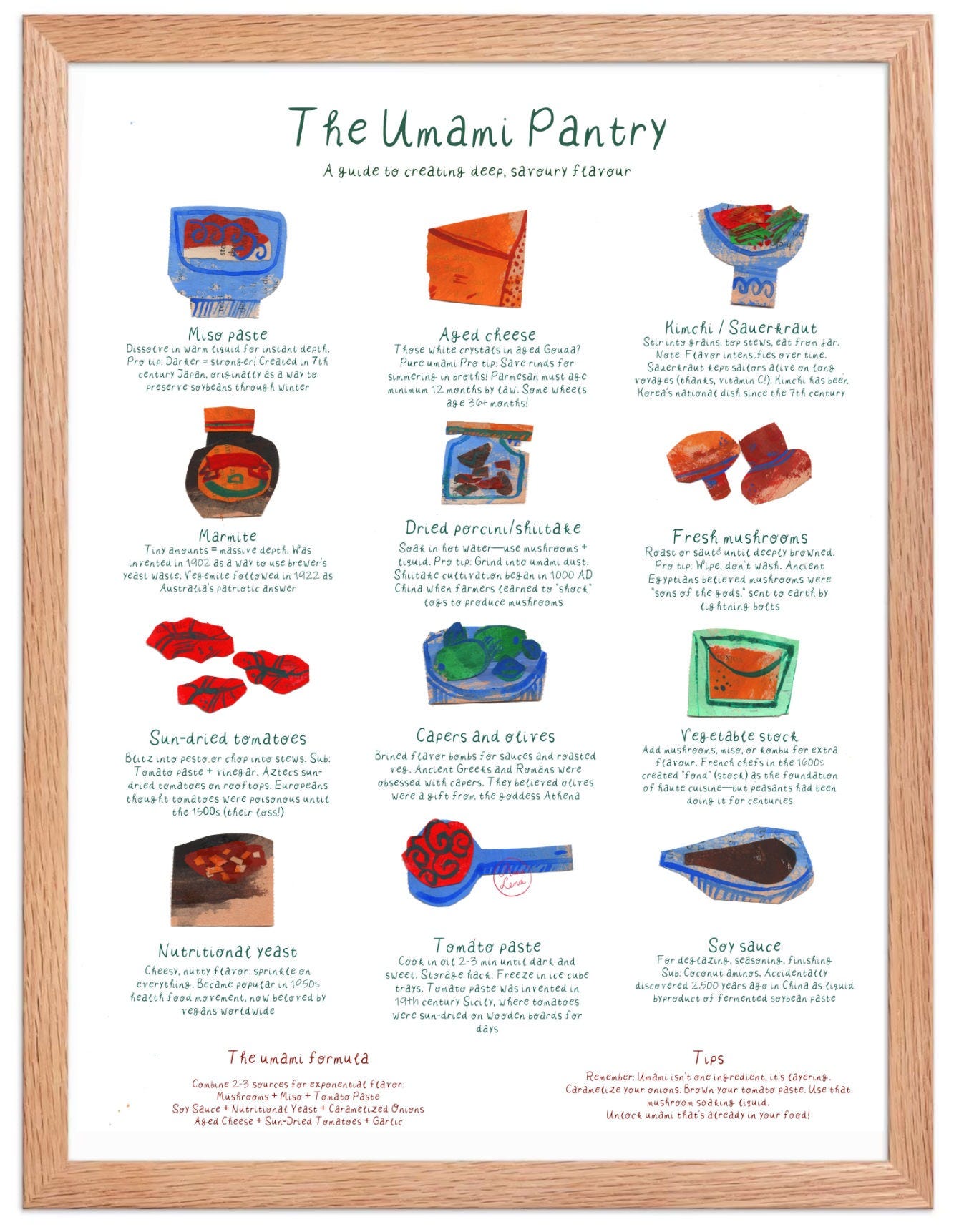
Printable for paid subscribers below, but also available on Etsy!
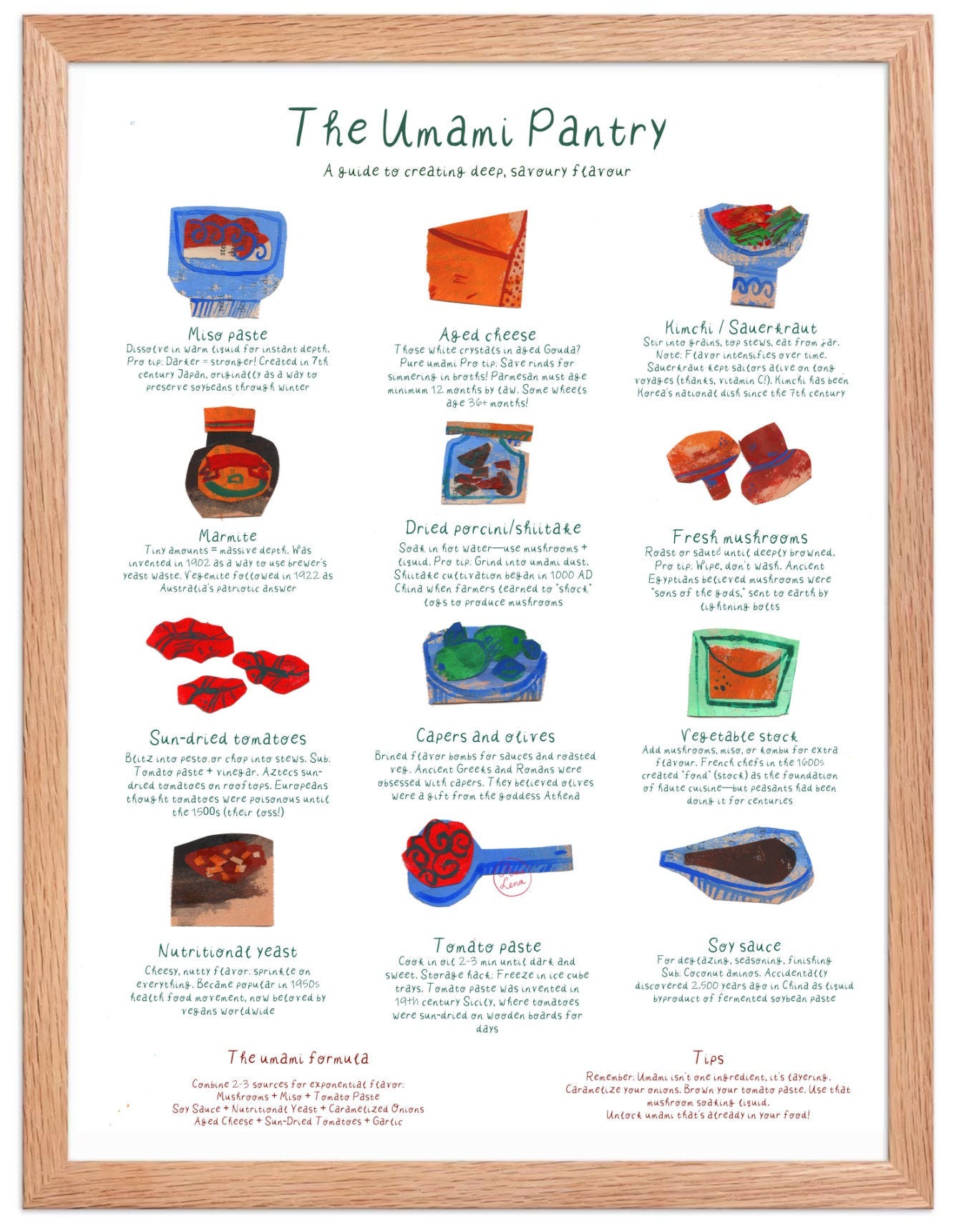
Paid subscribers: get extended food histories, recipe variations, illustrated kitchen guides, quarterly collectible food references, and studio access.
Founding members: get everything above PLUS a year-end illustrated cookbook with all 12 months of recipes.
📖 My mini cookbook This Better Pan Out collects my favorite illustrated recipes in one printable booklet → Get it here
🎨 Recipe prints, botanical art, and kitchen goods at my Etsy shop → annalenamakes.etsy.com
🌸 Learn my collage illustration techniques with the Floral Collage Course → Start creating
📚 Kids’ nonfiction books about food lore and history → Browse books
Until next time, may your kitchen smell like hearty goodness and herbs, and may all your stew be enormously equalizing.
x, Anna Lena
P.S. Want to learn my collage illustration techniques? Check out my Floral Collage Course — same process I use for food art, just with flowers!
Comments
Nothing yet. Say the first thing.
Sign in to join the conversation.