
Hello gorgeous humans,
October passed like a whirlwind! I’ve finished up a children’s book project, shipped a lot of illustrated cookbooks and recipe art prints, and have been drawing cabbages for a community project in my municipality. Random and delightful? Yes and yes. Also, I’m planning interesting illustrated stories and recipes to share with you this upcoming year—I love it when a plan pans out long-term—and working on some book pitch ideas to send out next year.
Now that we’ve caught up a little bit on the personal side, let’s dive into today’s absolutely fascinating story about how gingerbread went from ancient medicine to medieval monopoly... Stay tuned for a brand-new illustrated recipe, a thrilling tale, and some extra goodies for you, too!
Picture this: It’s around 2000 BCE in ancient China, and someone is chewing on a gnarly root that tastes like spicy fire and makes their upset stomach feel better. This is humanity’s first encounter with ginger (Zingiber officinale), and honestly? It’s been a wild ride ever since.
Ginger didn’t start out as a cookie ingredient: it was MEDICINE. Ancient Chinese texts documented ginger’s use for treating nausea, inflammation, and digestive issues thousands of years ago. The ancient Greeks and Romans got their hands on it via those legendary spice routes we love to romanticize, but here’s the kicker: it was so expensive that only the wealthy could afford it. We’re talking luxury-good-status, like owning a rolex but in root form. (Now I’m imagining a root rolex and I like it)
By the time ginger reached medieval Europe (roughly 11th century), it had become one of the most sought-after spices. In medieval England, one pound of ginger cost the same as a sheep. A WHOLE SHEEP. Let that sink in while you’re casually (sheepishly) sprinkling ground ginger into your next batch of cookies.
So when did someone look at this expensive medicinal root and think, “You know what? Let’s bake it into bread”? The ancient Greeks get credit for early forms of gingerbread, which they sold wrapped around pieces of bread in markets, making this basically the original energy bar. But the gingerbread we recognize today? That started taking shape in medieval Europe around the 11th-13th centuries.
Here’s where it gets interesting: Medieval gingerbread wasn’t the soft, cake-like stuff or the crispy cutout cookies we know today. It was more like a dense, preserved confection, somewhere between a very firm cookie and a hard candy. This made sense because it could last for months without refrigeration (which is handy, considering the access to refrigeration was.. a challenge to say the least). Honey acted as a natural preservative, and the spices helped mask any off-flavors from ingredients that weren’t exactly fresh by modern standards. I promise I’m sharing a recipe that does adhere to modern taste buds, but there is a medieval version in here too if you’re thinking: I wanna make that, so keep reading…
The earliest European recipes combined breadcrumbs or ground almonds with honey and spices—especially ginger, but also cinnamon, cloves, and pepper. Some versions were so hard they were essentially edible decorations. Which brings us to...
Here’s where this story gets absolutely bonkers, and honestly, very on-brand for medieval Europe: Gingerbread became SO valuable and SO culturally important that entire guilds formed around it. (Something I can’t shake when it comes to old-timey German, French and Dutch stories is that these countries freaking loved to make everything into an admin chore and… I cannot relate.)
In 17th-century Europe, you couldn’t just decide to make and sell gingerbread. Oh no. You needed to be part of an official guild, and these guilds held monopolies on gingerbread production. In some German and French cities, only guild members were legally allowed to bake gingerbread, except for Christmas and Easter when regular people got temporary permission to make it at home. Imagine being arrested for illegal cookie production! Call me a cookie commie, but the idea seems a bit far-fetched.
There was a flipside to this exclusivity, though: Gingerbread guilds grew so specialised, that they created artistic, elaborate designs: ornate molds, gold leaf decorations, intricate shapes. Gingerbread even became a status symbol at royal courts! Monarchs commissioned custom gingerbread portraits. Queen Elizabeth I is famously said to have had gingerbread figures made to resemble her visiting dignitaries, which is either the ultimate compliment or the most passive-aggressive hosting move in history, depending on how you look at it. I would not hold it against any monarch to use baked goods to do either!
The German city of Nuremberg became particularly famous for its Lebkuchen (a type of gingerbread), and the bakers there formed one of the most powerful guilds. They guarded their recipes like state secrets, probably because they basically were state secrets. These recipes represented economic power, after all.
Fun fact: The famous gingerbread houses we associate with Christmas? Those became popular in Germany after the Brothers Grimm published “Hansel and Gretel” in 1812, which featured that iconic candy-and-gingerbread house in the forest. The story basically created a whole new trend in gingerbread architecture. I somehow always thought it would be the other way around! (I wrote a book for kids about food history in which this tale plays a role, btw!)
Ginger history & medicinal use:
https://www.mccormickscienceinstitute.com/resources/history-of-spices
https://www.tandfonline.com/doi/full/10.1080/09064710.2019.1606930
Medieval gingerbread & guild history:
https://www.delightedcooking.com/what-is-the-history-of-gingerbread.htm
https://aleteia.org/2024/12/15/how-monks-invented-germanys-beloved-christmas-cookie
https://www.sewhistorically.com/medieval-nurnberger-lebkuchen-recipe/
Now here’s the good news: You no longer need guild membership or royal permission to make gingerbread. In fact, I’ve got a vegan recipe that’s soft, perfectly spiced, and absolutely delicious—the kind that would’ve made medieval bakers weep with envy (and possibly try to sue you for unauthorized baking).
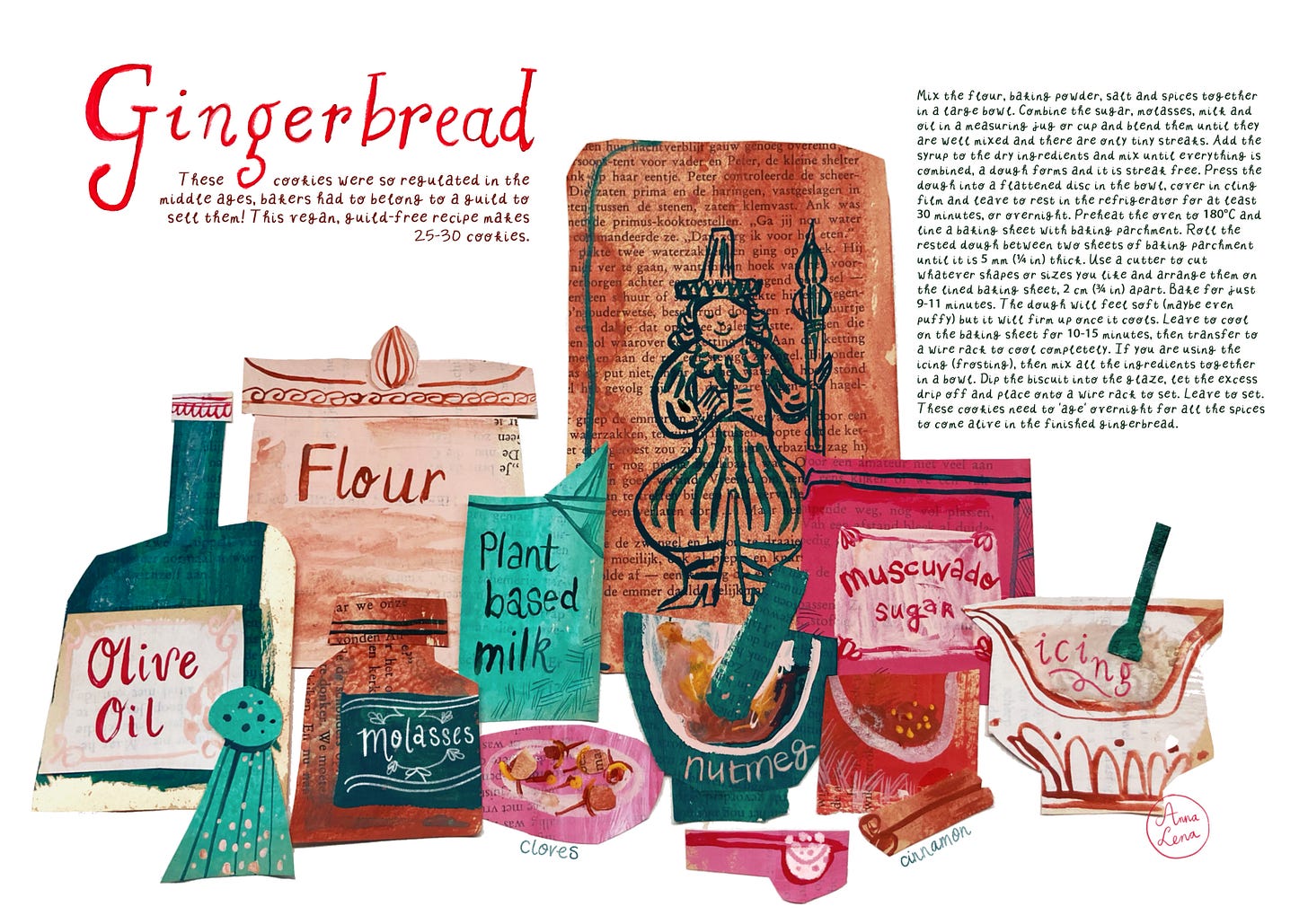
Makes 25-30 cookies
GINGERBREAD
320g (11.3 oz) plain all-purpose flour
4g (1 tsp) baking powder
1g (¼ tsp) salt
2g (½ tsp) ground nutmeg
2.8g (½ tsp) ground cinnamon
4g (1 tsp) ground ginger
2g (½ tsp) ground cloves
90g (3.2 oz) muscovado sugar
28g (1 oz) molasses or dark treacle
70g (2.5 oz) plant-based milk
60g (2 oz) extra virgin olive oil
Icing (optional, but is it really ever optional?)
300g (10.6 oz) icing (confectioners’) sugar
65g (2.3 oz) water
4g (1 tbsp) vanilla bean paste
Method:
Mix the flour, baking powder, salt and spices together in a large bowl.
Combine the sugar, molasses, milk and oil in a measuring jug or cup and blend them until they are well mixed and there are only tiny streaks. This is the syrup.
Add the syrup to the dry ingredients and mix until everything is combined, a dough forms and it is streak free.
Press the dough into a flattened disc in the bowl, cover in cling film (plastic wrap) and leave to rest in the refrigerator for at least 30 minutes, or overnight.
Preheat the oven to 180°C (fan 350°F/gas 4) and line a baking sheet with baking parchment.
Roll the rested dough between two sheets of baking parchment until it is 5 mm (¼ in) thick. Use a cutter to cut whatever shapes or sizes you like and arrange them on the lined baking sheet, 2 cm (¾ in) apart.
Bake for just 9-11 minutes. The dough will feel soft (maybe even puffy) but it will firm up once it cools. Leave to cool on the baking sheet for 10-15 minutes, then transfer to a wire rack to cool completely. Store in an airtight container for up to a week.
If you are using the icing (frosting), then mix all the ingredients together in a bowl. Dip the biscuit into the glaze, let the excess drip off and place onto a wire rack to set. Leave to set.
Little tip for you: These cookies need to ‘age’ overnight for all the spices to come alive in the finished gingerbread.
My newsletter is free forever for everyone, but I like to give people the opportunity to dive a little deeper or just support my work for the price of a baked good a month. That’s why the rest of this story is for paid subscribers - you’re super welcome to try it for a bit!
You’ll get:
A behind the scenes collage art timelapse: See how I created these artworks!
Medieval gingerbread fairs history: The fascinating social world of gingerbread festivals, courting rituals, and why these weren’t just markets but THE place to be seen <3
Illustrated spice guide: A beautiful kitchen reference card showing perfect ratios for gingerbread spices, plus what each spice does to flavor and texture. Including a PDF download!
Bonus medieval recipe: An actual 15th-century gingerbread recipe, adapted for modern kitchens
Studio notes: Work-in-progress shots, updates on my new book pitches and client work, and the reference books I used for this research
Paid subscribers: for extended food histories, recipe variations, illustrated kitchen guides, quarterly collectible food references, and studio access.
Founding members: get everything above PLUS a year-end illustrated cookbook with all 12 months of recipes.
Creating these illustrated food history stories is part of my full-time freelance practice, including the kids book projects I do, and there are several ways you can help keep these monthly journeys coming:
Want more illustrated food history?
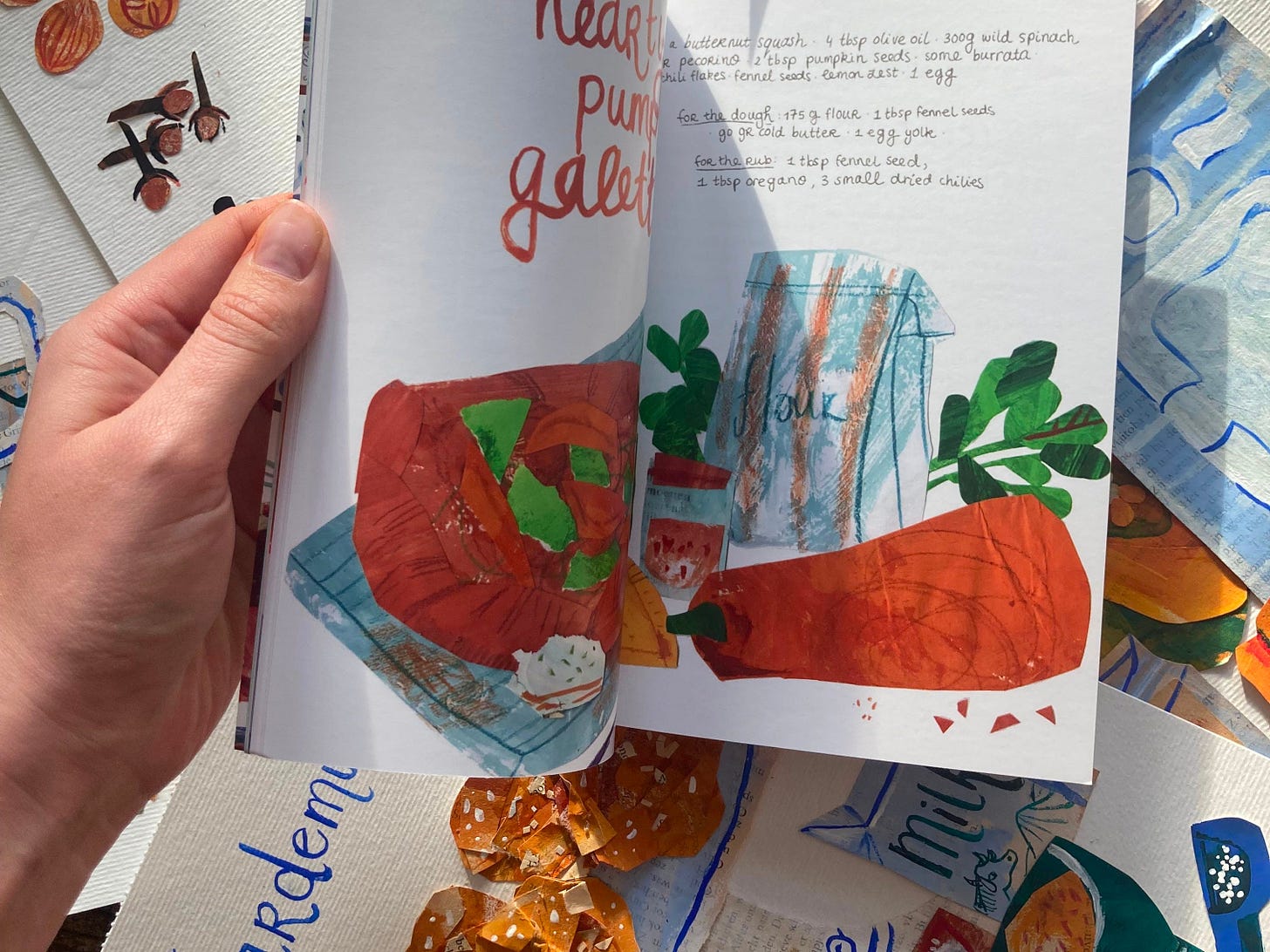
📖 My mini cookbook This Better Pan Out collects my favorite illustrated recipes in one printable booklet → Get it here
🎨 Recipe prints, botanical art, and kitchen goods at my Etsy shop → annalenamakes.etsy.com
🌸 Learn my collage illustration techniques with the Floral Collage Course → Start creating
📚 Kids’ nonfiction books about food lore and history → Browse books
Upgrade your subscription:
Extended food histories, recipe variations, illustrated kitchen guides, quarterly collectible food references, and studio access await for founding members aka The Kitchen Table.
Whatever feels right for you, I’m grateful you’re here reading about medieval guild monopolies and vegan baking with me!
December brings the story of how ‘Umami is the great equalizer’: bringing stew recipes to you that truly celebrate the holiday spirit, regardless of dietary restrictions, food preferences based on convictions, and ideas to create a truly welcoming dinner table for anyone and everyone. I’m into it, hope you’re into that as well. Build longer tables et cetera et cetera.
Until then, may your kitchen smell like ginger and cloves, and may all your baking be deliciously unauthorized.
x, Anna Lena
Loved this story? Hit subscribe for monthly illustrated journeys through food history, and check out my Etsy shop at annalenamakes.etsy.com for illustrated kitchen goods and my cookbook “This Better Pan Out.” For more food history adventures, including books for kids, visit annalena.nl.
P.S. Want to learn my collage illustration techniques? Check out my Floral Collage Course — same process I use for food art, just with flowers!
Comments
Nothing yet. Say the first thing.
Sign in to join the conversation.