
BERLIN — For some four decades, Volkswagen led the auto market in China, which at one stage accounted for more than half its annual profit. Its boxy Santana became the first major mass-produced German car in China in 1983, and became the standard taxi and even police car.
As China grew richer, government officials began riding around in black Audis, while the nouveaux riches took to VW’s flashier brands, like Porsche and Lamborghini.
When, in 2015, Beijing unveiled its “Made in China 2025” strategy to become a global leader in industrial sectors including cars and machinery – inspired by Germany’s “Industry 4.0” plan – VW and other German companies doubted that China would be able to compete on quality or technology.
Fast forward to today: VW is in a deep crisis. Its market share in China, the world’s largest car market, fell to less than 10 percent last year. It has been usurped by BYD, the “Made in China 2025” powerhouse that overtook Tesla last year as the world’s top EV seller, and another Chinese automaker, Geely.
It’s no longer worrying about technology theft. It’s investing in China so it can access China’s cutting-edge technology.
The consequences are now showing up in Germany’s labour market.
German employer associations estimate 400,000 industrial jobs have already been lost over the past three years, roughly 300,000 of them attributable to Chinese competition, and Germany continues to lose 10,000 to 15,000 industrial jobs a month.
VW announced last month that it would lay off 100,000 people and close four assembly plants – the largest restructuring in automotive industry history.
Across a week of conversations in Brussels and Berlin with officials, experts, parliamentarians and representatives of both business and unions, a clear message emerged: There is now broad consensus across Germany, and Europe as a whole, underestimated China and its ability to make good on its ambitions.
The German experience raises a question – and offers a lesson – for New Zealand: What happens when Beijing decides it no longer wants to depend on foreign suppliers in sectors it’s been assumed it always will?
There are many differences between Germany (and Europe as a whole) and New Zealand when it comes to trade.
For one, the European Union runs an enormous trade deficit with China: It hit a record €360 billion (NZ$719 billion) in 2025, or a record €1bn a day, according to official trade data. The EU now exports more to Switzerland than it does to China.
New Zealand, on the other hand, ran a trade surplus of more than $1.5 billion with China last year.
Second, cars and dairy clearly aren’t equivalent. But New Zealand could face reduced demand even if China never becomes a world-class dairy exporter. It only has to substitute some imports with domestic production.
China is now pursuing food self-sufficiency, and it views this as a national security issue.
Leader Xi Jinping, who comes from a generation with a living memory of famine, has repeatedly declared that the rice bowls of China’s 1.4 billion people “will always be firmly held in their own hands.”
Xi doesn’t want China caught short on food if the political winds change or other factors disrupt food supplies.
In fact, pork is so socially and politically important in Chinese diets that Beijing maintains a “strategic pork reserve” so it can manage prices in times of disruption, like swine flu outbreaks.
Now it’s attempting to ensure food security across other crops and products, and this isn’t just aspirational. Crop yields have been steadily rising.
The structural challenges to achieving this goal are real and significant. Expanding production of land- and water-intensive practices like dairy farming is an enormous challenge for a country with relatively little arable land.
But the lesson from VW’s experience in China is that no one should underestimate China’s ability to do difficult things when Beijing sets big targets.
“They’ve done lots of things in the past that were considered impossible,” said Jacob Gunter, head of the economy and industry programme at the Mercator Institute for China Studies in Berlin.
That ambition is now showing up in the same institutional playbook China used to build a global EV champion: five-year plans, state investment, and a willingness to absorb years of losses to get there.
Beijing last month laid out a plan not to eliminate food imports but to make them a choice rather than a necessity. It plans to do this by modernising dairy farming, raising productivity, improving quality and food safety – much of it by using technology.
China has a long way to go, and it’s not like it’s going to stop buying New Zealand dairy products overnight.
Its dairy industry is not as efficient as New Zealand’s dairy sector and it has not been performing particularly well: China’s domestic dairy production surged by 27 percent between 2018 and 2023 – part of the self-sufficiency drive – but this contributed to a glut, which depressed prices and forced smaller farms out of business.
Rather than abandoning domestic production, Beijing is doubling down and issuing instructions to consolidate and strengthen the industry rather than let the market correct on its own.
At the same time, it’s diversifying suppliers to avoid depending on any single trade partner in the event of disputes or climate shocks – the same hedging strategy it used with other commodities.
Take soy beans. Beijing’s progress here has been visible: It has dramatically boosted domestic production of soy beans – which are used for pig feed – and invested in Brazil and Argentina so it has a variety of suppliers. As a result, the US’s market share has fallen from 41 percent in 2016, at the start of the Trump administration and the first trade war with China, to 18 percent last year.
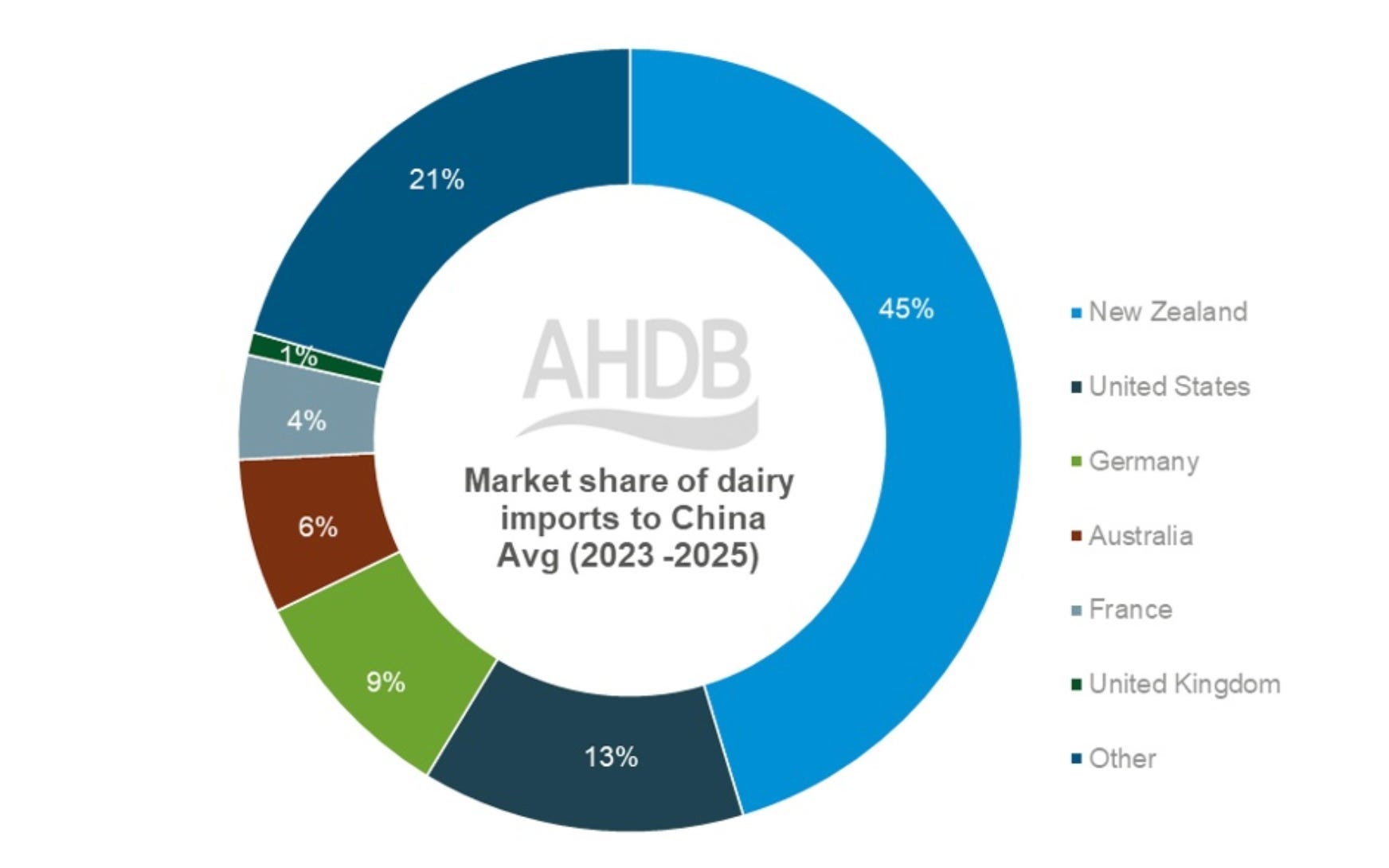
New Zealand’s exposure to changes in the Chinese market is huge. China doesn’t have to become New Zealand – it only has to become a little less dependent on New Zealand.
New Zealand remains heavily dependent on China as an export destination for primary goods – China buys about one-third of New Zealand dairy exports, underpinned by strong Chinese demand for premium food commodities.
Other countries also export dairy products to China (including Germany), but New Zealand’s advantage has never been simply producing milk. It’s been producing food that Chinese consumers trust.
New Zealand still has a brand advantage in China, where consumers associate the yellow butter and cheese produced by grass-fed cows with high quality – as opposed to the lighter dairy produced by China’s grain-fed cows. And Fonterra is focusing more on higher-value products like cream, cream cheese, butter and cheese.
Fonterra’s China chief executive Teh-han Chow has suggested China will still need to import about 30 percent of its dairy needs through 2030, even if domestic milk production keeps growing around 6 percent a year.
But what if the models are wrong? What if China moves up the quality and safety scales? What if New Zealand’s dairy industry leaders are giving themselves the same reassurances that German auto executives were a decade ago?
The German carmakers weren’t ignorant: Beijing had clearly and publicly signalled its ambitions, and set out the policies and created the investment needed to achieve it.
Their mistake was complacency. They’d been so successful for so long and they didn’t believe a competitor from a low-end-manufacturing-dominant economy could rival German quality and technology. They thought their brand and their legacy would endure.
The question for New Zealand now isn’t whether China will eventually need to import less dairy. It’s whether New Zealand will recognise the change before it shows up in the export statistics.
No posts
Comments
Nothing yet. Say the first thing.
Sign in to join the conversation.