
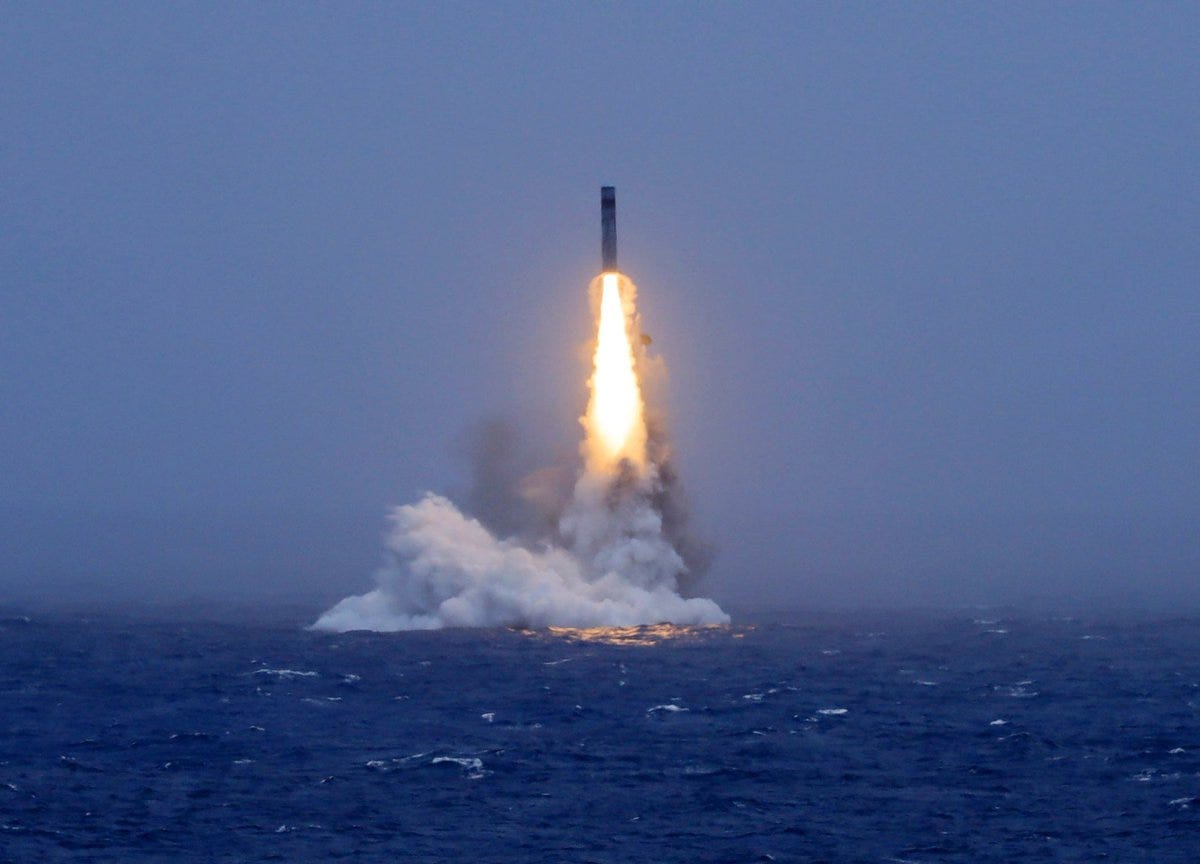
China launched a missile into the Pacific Ocean yesterday — undoubtedly an alarming turn of events in our neighbourhood. Analysts say China is trying to send a signal to the United States. Here’s some context and commentary.
China test-fired a nuclear-capable intercontinental ballistic missile carrying a dummy warhead into the Pacific Ocean at 4:01pm NZT Monday. A spokesperson for the People’s Liberation Army-Navy said the “strategic missile” was launched from a submarine and landed within the target zone in the Pacific. It landed north-east of the Solomon Islands.
China tried to present the launch as normal operation practice. “This test launch is a routine arrangement of the annual training of the Chinese PLA Navy,” Senior Captain Wang Xuemeng said in the statement. “The Chinese side has already notified relevant countries in advance. This test launch complies with international law and international practice and is not directed at any specific country or target.”
This is the second time in two years that the PLAN has conducted an intercontinental ballistic missile test in the Pacific Ocean. The previous launch was in September 2024, into waters near French Polynesia.
Japan, Australia and New Zealand were all notified in advance of the launch. All three countries condemned it.
The missile was launched the same day that Australian Prime Minister Anthony Albanese and his Fijian counterpart, Sitiveni Rabuka, signed a new bilateral defence agreement. The Ocean of Peace Alliance is Fiji’s first mutual defense treaty and Australia’s fourth (it also has treaties with the United States, New Zealand and Papua New Guinea last year.) But it was not likely related to the signing, given that missile launches are dependent on weather and other factors.
Lyle Morris at the Asia Society Policy Institute in New York said that the test was a major development and indicates that China is moving toward a significantly more survivable and longer-range sea-based nuclear deterrent capability.
It is noteworthy that China pre-notified Japan, New Zealand, and Australia, but not the U.S., Morris said, calling it “primarily a signal to the United States.”
It means the PLAN is capable of targeting the continental United States from bastions close to Chinese waters. The launch appears intended to demonstrate an operational sea-based nuclear deterrent and to show China is progressing with its nuclear triad.
Most importantly, the launch demonstrates that China’s nuclear deterrent is no longer centred solely on land-based missiles. This should give the PLAN confidence in its sea-based nuclear deterrent.
This will also make chairman Xi very happy. Conducting an open-ocean launch implies confidence in submarine crews, command and control, and missile reliability.
Analysts say that while the test poses a more immediate threat to countries in the Indo-Pacific region, the launch probably was intended as a signal to the United States.
“I think that the Chinese strategy is to explicitly showcase strategic nuclear capabilities to impress upon the United States China’s growing strategic power. In Beijing’s view, that would make Washington more aware of the risk of getting involved in major conflict with China,” said Tong Zhao, an expert on China’s nuclear weapons program at the Carnegie Endowment for International Peace, told the Washington Post.
Zhao said the missile’s flight path near U.S. missile-tracking facilities in Guam and the Marshall Islands added weight to the view that the launch was meant as a signaling exercise. “The fact that the Chinese missile flew near those places means Beijing is not particularly worried about the technical parameters of the missile being collected by the United States,” he said.
John Blaxland, professor of international security at the Australian National University and a former Australian military intelligence officer, agreed that Beijing was testing not only its own capabilities, but the reactions from countries in the region as well as the United States.
“What China is doing, like they’re doing with Taiwan, is probing and testing and incrementally acclimatising intrusive, assertive, authoritarian behaviour,” he told the New York Times.
No posts
Comments
Nothing yet. Say the first thing.
Sign in to join the conversation.