
The existence of the United Assault Brigade of the National Police of Ukraine, aka Liut (“Rage”), surprises Westerners. But they have one of the best reputations in the army, and their own medics.
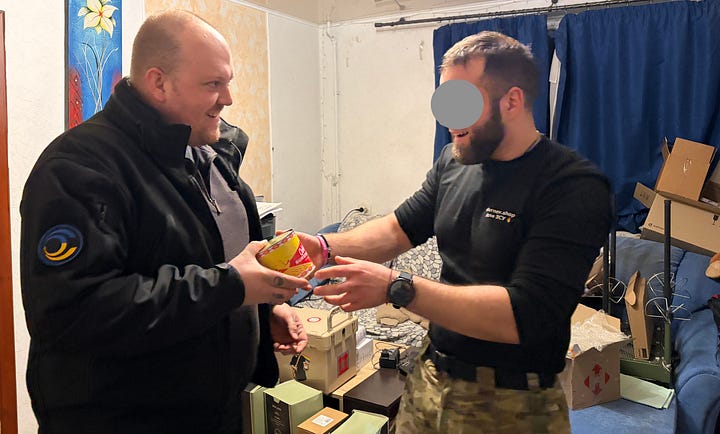
I briefly stopped by the house with Operation Change back at the beginning of March, when they delivered aid such as heated blankets for the wounded, power banks, nitrile gloves and wet wipes. Later, I went back and asked Otto, deputy commander of the tactical evacuation company of which this platoon1 is part, how the medics operate.
Otto: I’m a deputy commander, and have three tactical evacuation platoons in my command. Those carry out medevacs [evacuation of wounded soldiers] and go to the field to provide assistance near the contact line. And one more platoon, which evacuates the wounded on ground-based drones, which also deliver medical supplies to dangerous areas.
Do medical platoons always live in private houses like this?
Well, in Kramatorsk a lot of medics live in flats. We were lucky to find a private house. Up to ten people live here at a time, at the moment.
Where is everyone right now? [The house was empty except for us drinking tea in the kitchen.]
Some of the platoon personnel are preparing to go out into the field. We have a rotation to the forward positions coming up. Others are on duty in medevac units.
This [house] is our control point for everything related to medical and tactical evacuation along this part of the front. It’s the centre from which we manage positions on the contact line and medics in the field, track wounded personnel, and coordinate the movement of units.

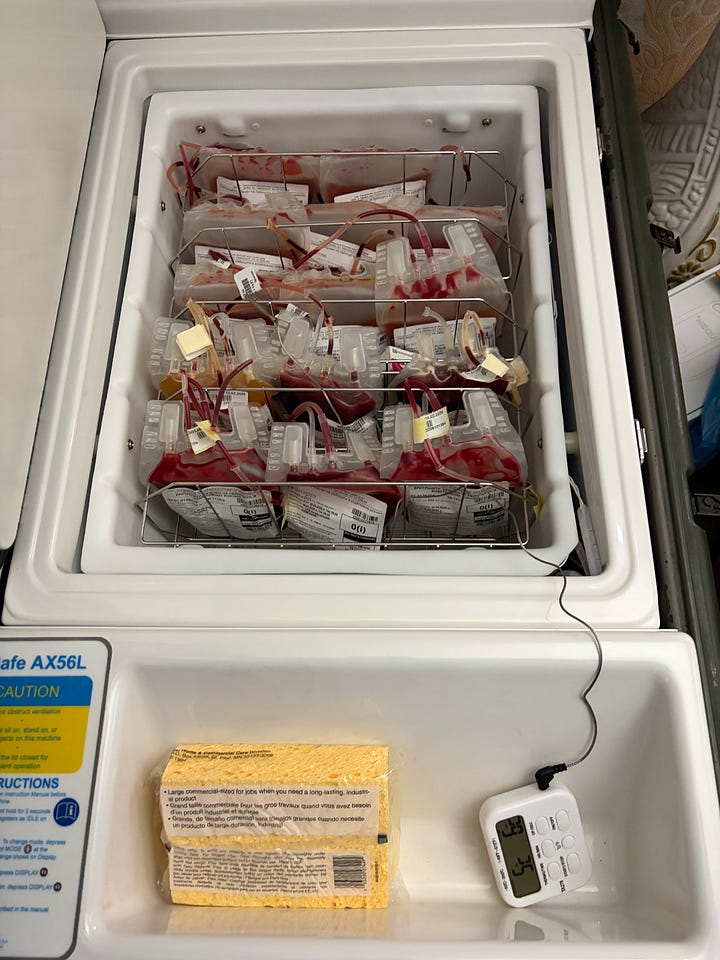
Living in a house is always good, because you can use it for storage. That’s important for medics because we always have a lot of equipment. This [above] is a great piece of equipment for storing blood; it doesn’t let you get a mistake [i.e. confuse one bag, or blood type, with another]. It does a great job of keeping the temperature stable. Unfortunately, though, it can’t be purchased in Ukraine.
How does medical evacuation work?
Our system works like this: the victim gets first aid from his comrades, or does it himself. It helps that our infantry undergo some medical training. An infantryman knows how to help himself, how to put on a tourniquet, what to do with an individual first-aid kit, what the first-aid kit contains. And his comrades help him.
Most of the time there’s an internet connection at the position [dugout or other fortification near the contact line], and we can carry out so-called telemedicine. That’s when a medic makes a video call to the position and assesses the victim, and whoever is at hand can give more help under the medic’s guidance. For example, adjusting tourniquets.
Then the wounded are evacuated to forward medical points, which are usually basements or relatively safe locations near the contact line. Now, for example, the contact line is near Kostiantynivka, and we have two such points in Kostiantynivka itself. At these locations, two medics work with equipment and blood supplies, providing more comprehensive care.
Evacuation is a lengthy process now, because armoured evacuation vehicles can only move under certain conditions, due to enemy activity. So evacuation can take up to a week, with medics overseeing care remotely in that time.
Using drones for evacuation is quite new.
Yes, but unfortunately, the need to carry wounded people hasn’t gone away. Infantry units evacuate their own wounded before drones are used. And drones can’t always be used.
Sometimes you can only go out at night, sometimes only in the day. It depends on [airborne] FPV drone activity. When you put a wounded person on a drone, you’re responsible for whether they make it or not.
Most injuries are now caused by drones as well? Airborne FPVs…
Artillery hasn’t disappeared – there are still many shrapnel wounds, a lot of fractures. But probably about 70% of injuries are caused by FPV drones.
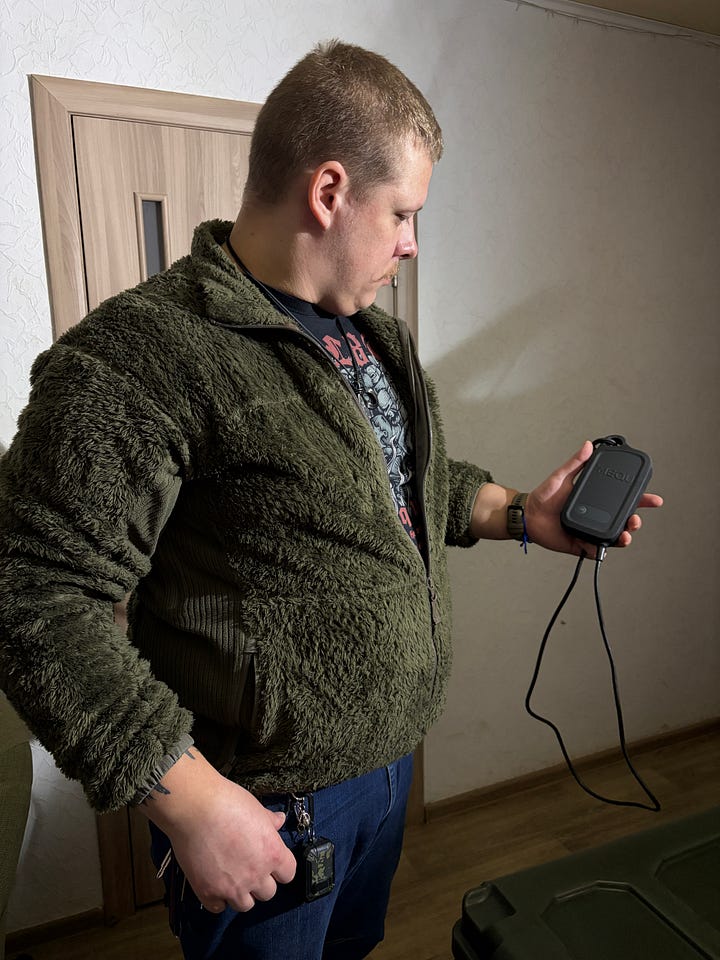
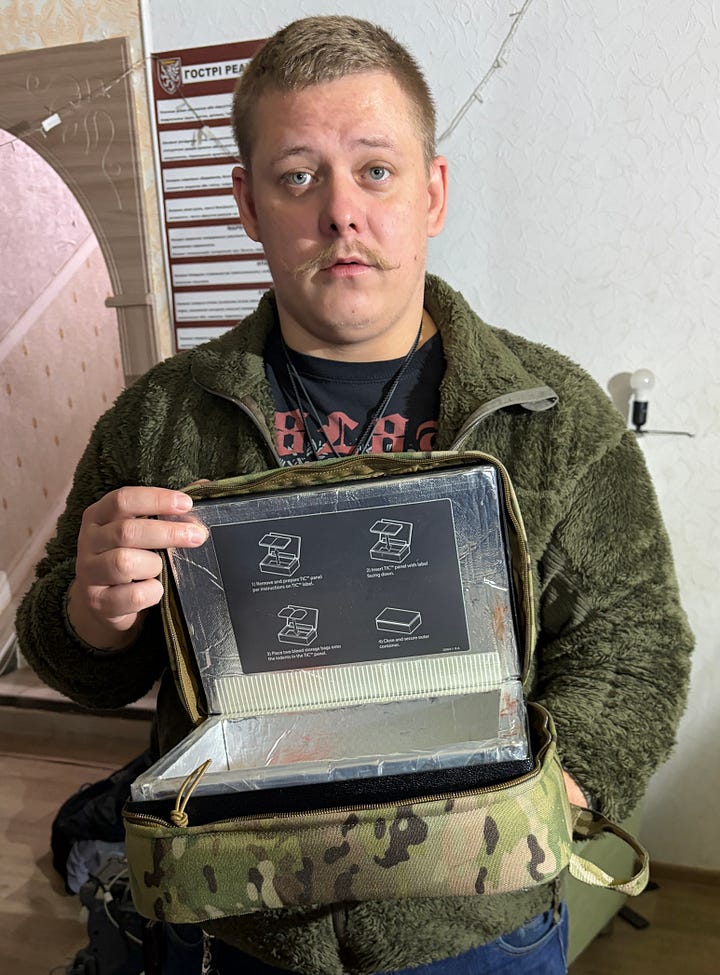
This is a Golden Hour2 bag, a special bag for carrying two units of blood. We use them for transporting blood to forward positions. It’s very good for keeping blood at the ideal storage temperature of four degrees.
And you can’t get them officially in Ukraine, unfortunately. It’s hi-tech and unfortunately very expensive. This bag is worth $1,600.
We also use ultrasound probes in tactical conditions, Butterfly and Philips Lumify. Very good devices. All medics who go into the field are trained to perform ultrasound examinations according to the EFAST [Extended Focused Assessment with Sonography in Trauma] protocol. That means searching for internal bleeding and monitoring diagnostics during resuscitation.
Often injured soldiers die in the trenches because it’s too difficult to evacuate them.
Yes, unfortunately that happens sometimes. Not very often, as their comrades usually manage to carry them out. Sometimes those carrying the wounded also get injured, and we end up with three or four injured soldiers instead of one, but they do get the soldier to us.
Sometimes, though, it’s simply impossible to evacuate someone. If the enemy knows the position, they control the situation. A group carrying a wounded soldier can easily be killed, as they will be under attack all the way.
Once the patient reaches a forward medical point, regardless of the tactical situation, they will stay there until evacuation becomes possible, by armoured vehicle, land drone, or on foot. Then they are moved to a pickup point and taken to a stabilisation point where surgeons and medical staff provide the full spectrum of medical treatment.
After that, they’re evacuated through the hospital system. Patients with amputations are transported directly to the Superhumans [rehabilitation] centre in Lviv.
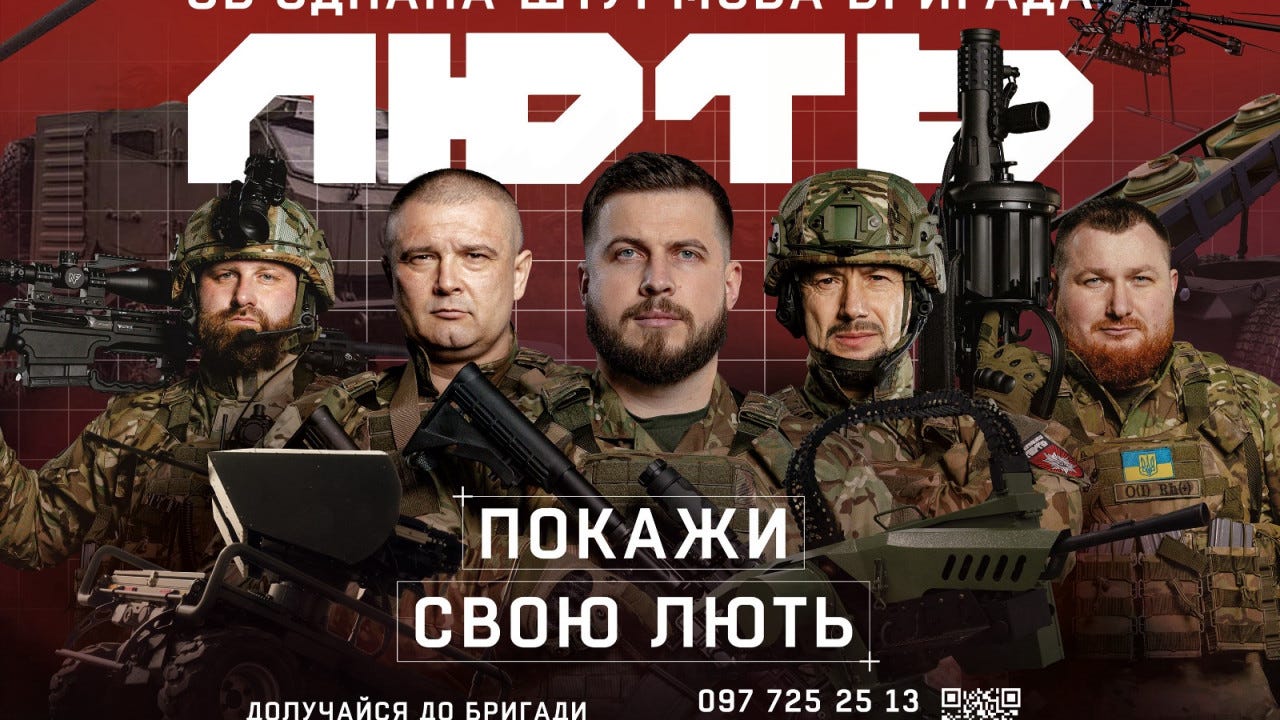
Readers may find it strange that police are fighting a war.
We find it strange too [laughs]! Until 2022, I worked in a police department. I worked from nine to six and had a regular weekend, a regular schedule. But unfortunately after the full-scale invasion, I felt that had to change. I saw this as my only option.
Our entire brigade consists of volunteers. They are police or civilians who wanted to join. They don’t come through being called up , or through the military commission, they join on a voluntary basis. A person who joins our brigade becomes an officer or a regular policeman and can resign. If I want, I can resign and fourteen days later I’ll be a civilian.
Did you have a medical role in the police before the full-scale invasion?
No. We had basic medical training but I’d never heard of TCCC or the MARCH protocol or anything like that. When I moved to a special unit, I studied medicine from scratch. Then I became the medic for an assault group.
Throughout 2022, we were deployed in the Kherson area, as I went on missions as the medic of an assault group. Then I became a medevac medic.
Does Liut work with the rest of the army?
Yes, absolutely. It makes no difference to us whether a fighter is from Liut or another brigade.
Liut have a very good reputation. You fought at Bakhmut, for example.
In Bakmut, and Chasiiv Yar, and Klishchiivka. Since the brigade was formed in 2023 – actually even earlier, when we were still a regiment – we’ve operated in the Bakhmut area, and Vovchansk, Selidove-Pokrovsk, Kurakhove and Toretsk directions – I don’t know, a lot!
Before the brigade was formed, when we were battalions, we operated in the Kherson and Zaporizhzhia areas. Other battalions that later became part of the brigade were also in Bakhmut and the Kharkiv direction. Many places.
How many women are in the brigade?
I don’t know exactly… Around forty per cent of the medical services. And there are women in leadership positions. For example, the commander of the platoon that lives here is a woman, as is the commander of another of the platoons under my command. These women go to the positions, work in the field, on an absolutely equal basis. There’s no distinction, man or woman you’re a police officer, a police medic.
Of course, it’s different when people go on leave. Then you become a man or a woman. Here, everyone is the same.


Do medics fight?
Unfortunately, yes. When you join a tactical evacuation company, or our medical service as a whole, you become a police officer. And if you join our brigades, you become a special forces police officer. You have more skills, better training. The main principle of tactical medicine is that first you are a fighter, then everything else.
We deploy people to positions near the contact line. They are trained both as medics and as fighters capable of holding defensive positions. Situations vary, unfortunately; the enemy infiltrates towns and direct clashes can happen. Members of the brigade have been wounded in small-arms fire, during direct contact with the enemy.
How long do you spend in the positions?
We plan rotations of fourteen days, but they often stretch to about a month due to difficulties with vehicle access or because units have to move on foot.
What’s most needed from Western donors?
Medical evacuation vehicles are what’s most needed because they don’t last long, due to bad roads and attacks. Medics are always a priority target for the enemy, unfortunately.
We also need equipment that isn’t officially available in Ukraine – like MEQU blood warmers. Our brigade can only procure things that are available through official channels. So we’re always looking to obtain certain things through volunteers – the actual blood warmers, refrigeration units and related consumables. Also oxygen concentrators, which aren’t officially available in Ukraine, but we use them.
People in the West sometimes send out-of-date medications, which I understand is a problem.*
It’s not about whether we want them, but unfortunately they are forbidden by law. A stabilisation point is an official unit of the Ministry of Health. We need all the right documents, we have to comply with all the ministry rules. Everything is very strictly defined there, and we’re clearly not allowed to use unapproved equipment. Though of course out in a field position a medic will use whatever resources they have to save someone’s life, regardless of the restrictions.
*A persistent and enduring problem, at that. I’ve referred to it before, and once received an email in which a senior UK doctor patronised me at length along the lines of ‘Now, if you were seriously injured, wouldn’t you want out-of-date medication rather than nothing?’ Yes, folks, I would, but out-of-date medication legally cannot be accepted into Ukraine and will be thrown away (after Ukrainians have wasted their time sorting and handling it). Sometimes it will get through, but it can also result in an entire consignment of aid being rejected at the border.

There are also serious problems with poor-quality tourniquets?
In our brigade, at the moment, we don’t have issues with tourniquets. We officially procure CAT (Combat Application Tourniquets) and SOF (Special Operations Forces) tourniquets recommended by the TCCC committee, But I know that in some units there are problems because standard-issue first-aid kits often contain low-quality, usually Chinese-made, tourniquets, which unit medics then have to replace with something reliable.
Earlier, when brigades were just being formed, the kits they were issued really did contain such tourniquets. But in each regiment of our brigade, there is medical evacuation platoon responsible for replacing them with proper-quality equipment.
High-value medical equipment is one of the most important things we can donate to Ukraine, and second-hand but serviceable kit is usually welcome. If you have items to donate in the UK, please contact Harrison Silver at Mission Ukraine UK on harryukrainemission@gmail.com. In Scandinavia, email info@operation-change.org. Or DM me for contacts elsewhere.
I asked Jack Bon Holly to explain the structure of the relevant parts of the Army: “The Ukrainian Ground Forces follow the standard Western/NATO-style hierarchy of: platoon → company → battalion for basic tactical units.
However, unlike the traditional NATO model (where battalions form regiments, regiments form brigades and brigades form divisions), Ukraine’s post-2014 reforms made the brigade the primary self-sufficient combat formation. A Ukrainian brigade is formed directly from several battalions (typically 3-5 operational battalions plus artillery, reconnaissance, engineer, logistics, medical and support units), skipping the regimental level entirely for most units. This means the designation of ‘regiment’ (whilst used in the earlier stages of unit growth) is abandoned entirely when sufficient battalions are available to form a brigade.
This brigade-centric design (similar to many NATO armies) gives brigades greater independence and flexibility. Ukraine has also shifted toward corps-level groupings of 4-7 brigades and skipped the formation of divisions within their structure.”
The first 60 minutes following a battlefield injury are considered the most critical, where prompt, high-quality medical intervention gives a casualty the highest chance of survival.
Comments
Nothing yet. Say the first thing.
Sign in to join the conversation.