
"I had such a good stretch today!"
In my early days of teaching yoga, hearing this phrase from students would leave me feeling slightly deflated. Had I reduced this profound practice to mere physical stretching? Was I diluting or removing the higher dimension of the practice and swapping into a simple exercise routine?
Thanks for reading Anitha Sapuru Bellary’s Yoga Newsletter! Subscribe for free to receive new posts and support my work.
It took me years to realize that my students were describing something far more accurate than I initially understood. They weren't just stretching their hamstrings—they were stretching their entire being. What I had dismissed as superficial was actually a profound recognition of yoga's transformative power.
Yoga as the Ultimate Stretch
Both ancient texts and modern practitioners grapple with the same fundamental question: What is yoga? Is it a state of being or a path to that state? When we examine the Bhagavad Gita, we find each chapter ending with the word "yoga," suggesting it encompasses both journey and destination.
Yoga is indeed both—a clear, lucid state of awareness like a pristine lake that perfectly reflects our true nature, and simultaneously, any practice that leads us to this clarity. In this light, yoga becomes the ultimate stretch, expanding us beyond our perceived limitations in every dimension of our existence.
The Journey of Stretching Through Practice
Let me take you through a typical yoga class and reveal the stretching that occurs at each moment:
Stretching Into Connection
As we gather—whether online or in person—those initial greetings and warm acknowledgments immediately stretch us beyond our individual boundaries. We move from isolation into community, from self-protection into co-regulation. When we set intentions or share affirmations, we stretch ourselves toward our highest aspirations, literally raising our consciousness to meet our deepest values.
Consider how this feels: arriving at class perhaps stressed or scattered, then gradually settling into the shared rhythm of breathing and movement with others. This is our first stretch—from separation into unity.
Stretching Into Self-Acceptance
The practice then invites us to stretch into self-acceptance. We begin exactly where we are—tight shoulders, racing mind, whatever condition we've brought to the mat. This isn't about immediate change but about expanding our capacity to be present with what is. From this foundation of acceptance, we stretch toward growth, using ourselves as the reference point. Practice gives us opportunity to study ourselves intimately and helps us commit to the practice for the long haul. We take ownership and personal responsibility to our growth.
This stretch from self-judgment to self-compassion becomes the fertile ground where all other transformation becomes possible.
Stretching the Physical Body
Yes, we do stretch our muscles, but notice how much more is happening. As we move through standing poses, balancing challenges, seated forward folds, and gentle backbends, we're not just increasing flexibility. We're stretching our relationship with discomfort, our patience with process, our willingness to stay present when things feel difficult.
Watch how your body responds as you hold Tree pose —your legs might be shaking, off balance, but you're simultaneously stretching your capacity to remain steady, maintaining equanimity, making micro adjustments, amidst challenge. The physical postures become a laboratory for life's bigger lessons.
Stretching Energy and Breath
As we synchronize movement with breath, we stretch from unconscious, shallow breathing into conscious, life-giving pranayama. Each inhale stretches our capacity to receive; each exhale stretches our ability to release. We're literally stretching our life force, building the bridge between involuntary bodily functions and conscious participation in our own vitality.
Notice how this feels during a challenging sequence—perhaps your breath wants to become shallow and quick, but you stretch it into long, steady rhythms that support your movement and calm your nervous system.
Stretching Awareness Inward
In restorative poses and moments of stillness, we stretch our attention away from external distractions and toward internal wisdom. This isn't escape from the world but expansion of our capacity to access deeper layers of knowing. We stretch from reactive consciousness to responsive awareness.
Picture yourself in Child's Pose—externally, you might appear to be simply resting, but internally, you're stretching into profound listening, feeling the conversation between your body, breath, and deeper self.
Stretching Attention and Focus
Throughout class, we repeatedly stretch our attention back to the present moment. When the mind wanders to tomorrow's meeting or yesterday's conversation, we gently stretch our focus back to the sensation of the current pose, the rhythm of the breath, the teacher's guidance.
As psychologist William James observed, "The faculty of voluntarily bringing back a wandering attention, over and over again, is the very root of judgment, character, and will." Each time we redirect our attention in yoga, we're strengthening this fundamental capacity that serves us far beyond the mat.
Stretching Into Unity
In the deepest moments of practice—perhaps in a long-held pose or during meditation—we stretch beyond the sense of "doing" yoga into "being" yoga. The boundary between practitioner and practice dissolves. We're no longer performing Triangle Pose; we become the perfect balance of stability and expansion that Triangle represents.
This is the stretch from duality into unity, from separation into wholeness.
Stretching Into Pure Awareness
Finally, in Savasana, we stretch into the recognition that we are the awareness itself—not just the body that moves, the breath that flows, or the mind that thinks, but the conscious presence that witnesses and supports all experience. This is perhaps the most profound stretch of all: expanding our identity from the limited to the limitless.
The Timeless Map for Modern Practice
What we've just traced through a single yoga class is actually the systematic progression outlined in Patanjali's eight-limbed path: yama (ethical conduct), niyama (personal observances), asana (physical postures), pranayama (breath regulation), pratyahara (withdrawal of senses), dharana (concentration), dhyana (meditation), and samadhi (union).
Each "stretch" we experience in class corresponds to these classical stages, revealing how even the most contemporary yoga class, when practiced with awareness, naturally unfolds according to this ancient wisdom.
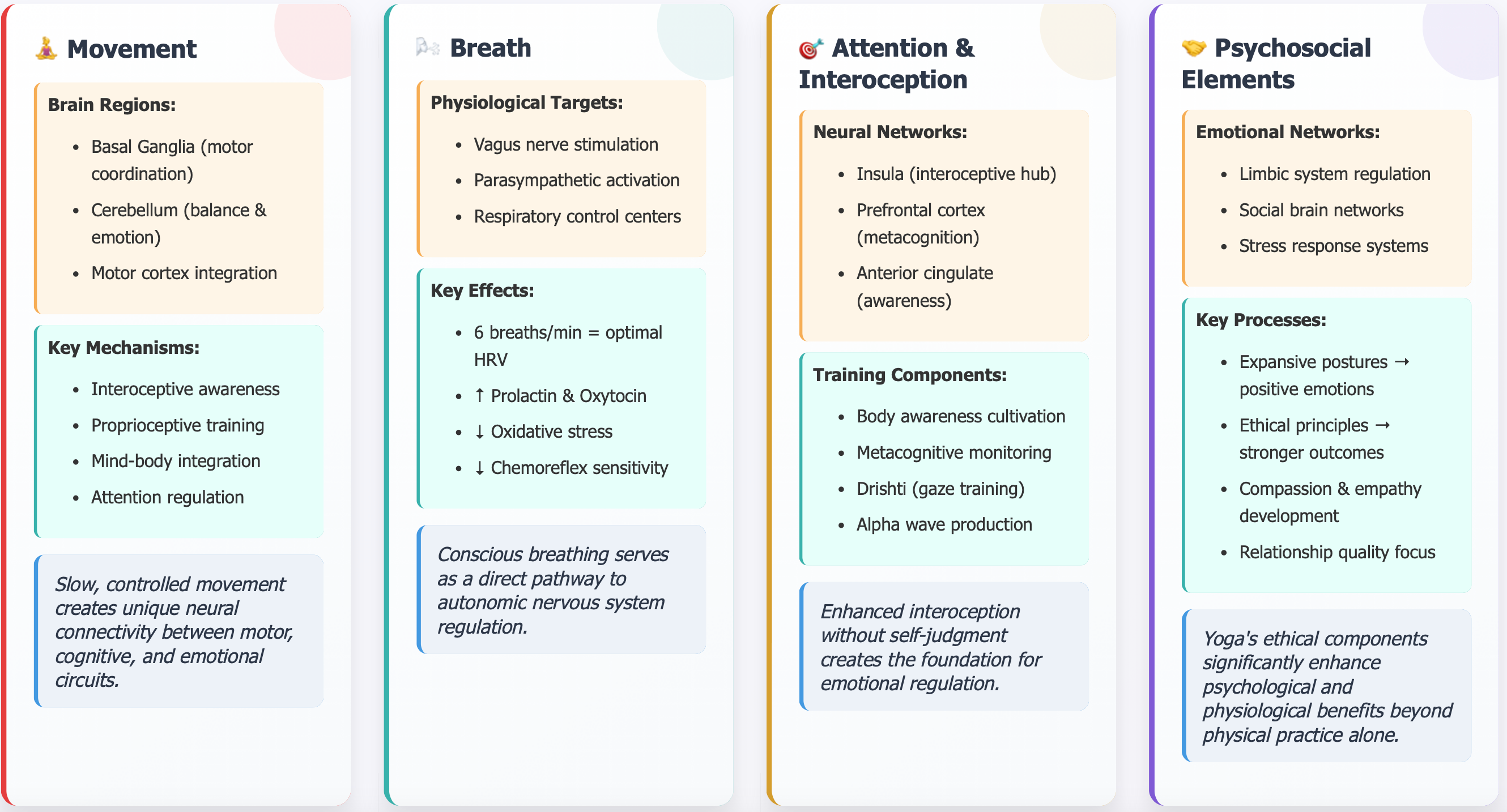
Modern neuroscience confirms what the sages knew: these practices work both from the bottom up (body influencing mind) and top down (consciousness influencing physiology), creating integrated transformation across all dimensions of our health and well-being.
Returning to the Mat, Returning to Life
When we taste even a moment of this integrated awareness—this state of balanced mind free from mental fluctuations—that memory calls us back to our mat again and again. More importantly, it begins to infuse our daily life with the same quality of presence and expansion.
So the next time you hear someone say, "I had such a good stretch," smile with recognition. They're describing nothing less than the complete stretching of human potential—the very essence of yoga itself. In a world that often feels contracted and limiting, this sacred stretch becomes both our practice and our gift to the world.
The question isn't whether what we're doing in yoga class is "real" yoga. The question is: Are we awake enough to recognize the profound transformation happening in every breath, every posture, every moment of practice?
Now, that's a stretch worth taking.
"Next time you're in class, notice which type of stretching resonates most with you. What do you discover?"
Thanks for reading Anitha Sapuru Bellary’s Yoga Newsletter! Subscribe for free to receive new posts and support my work.
Comments
Nothing yet. Say the first thing.
Sign in to join the conversation.