
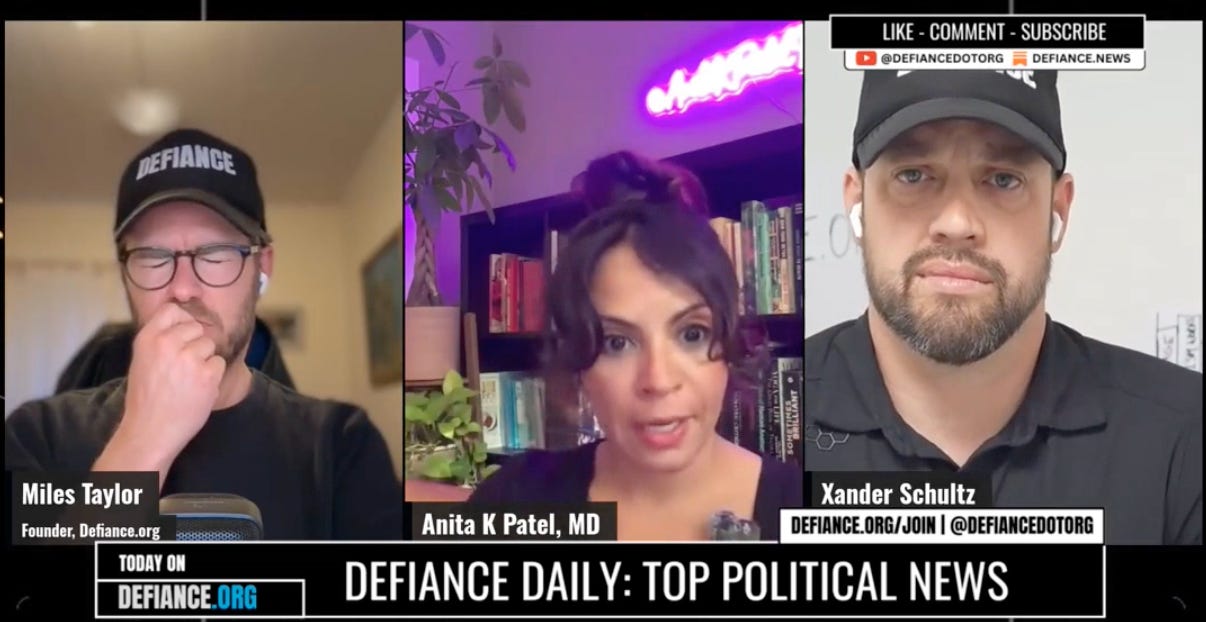
I have been sitting in anger and fear since the Executive Order (EO) was announced. While Trump, the megaphone for the EO, fell asleep on camera during the announcement. This came as measles cases hit a 35-year high. My anger was on full display when I joined the team (with my faves and co-founders of this nonprofit, and ) to discuss the consequences of the anti-science, RFK-fueled anti-vax EO. I think my feelings are summed up in a question I recently posed to readers on Substack:
“Parents, do you want your advice from a man with a brain worm who is responsible for children dying in Samoa during a measles outbreak fueled by his anti-vax propaganda, and a man who can’t stay awake during a widely broadcast announcement about our children’s health?”
OR
“Pediatricians and public health experts who spent years (a decade, in my case) training after college to make sure your children have science-backed care to help them live and thrive.”
This is what’s at stake. If you want to know more about what happened in Samoa, I wrote a full Substack on what he did to cause the deaths of far too many children in a short period of time, which you can find here. This is the man leading our country’s public health and the safety net that protects our children.
The real consequences of this EO can only be found in the stories of children I have cared for, and I’m going to walk you through one particular case to bring this point home. (Details have been adjusted to protect patient privacy, and I’ve combined elements from several children I’ve cared for with these conditions to further protect anonymity.)
Patient A was a 5-year-old with an older brother in college. He came to the ER with a headache, lethargy, and photophobia (any light was extremely painful). We knew he likely had meningitis and needed a lumbar puncture (LP, or “spinal tap” as TV shows call it). This part I will never forget: my attending told me to put on a face shield before I performed the LP (I was a resident at the time). We always wear a mask, sterile gloves, and a gown, but a face shield isn’t standard. I did what I was told, because one thing I’ve always been good at is listening to experts.
A few minutes into the procedure, I understood exactly why. Pure pus shot out at me. The brain wasn’t just surrounded by pus, it was under so much pressure that simply placing a needle in the space around the spinal cord (which communicates with the space around the brain) caused a forceful release of infection that splattered my face shield.
This child lived. But 10–15% of children with true Neisseria meningitidis won’t survive their illness despite treatment. Those who do survive often carry lifelong impairments: hearing loss, developmental and cognitive delays, seizure disorders, hemiparesis, and cranial nerve palsies (the nerves that control your face). None of these outcomes are mild. They’re severe, and they can last a lifetime.
One more detail: meningococcal meningitis can kill, or cause any of the impairments above, within 24 to 48 hours of symptom onset. Worse, early symptoms mimic a normal viral illness, so the “treat rather than prevent” philosophy that seems to be this administration’s main public health strategy won’t save your child.
The worst part of this story: Patient A’s older brother never received either of his meningitis vaccines, normally given at ages 11–12 with a booster at 16. There’s also a second meningitis vaccine (MenB) that’s already offered under shared decision-making, with routine dosing reserved for high-risk populations. We couldn’t confirm who exposed this 5-year-old, but the most likely source was his older brother, closely cohabitating with college classmates, one of the reasons we specifically recommend vaccination before college, since the peak age for meningococcal disease is 16 to 24.
Thanks for reading The State of Pediatrics! This post is public so feel free to share it.
That was a lot (sorry, as usual!). Here’s the TL;DR on what the EO is pushing:
1. Vaccines still universally recommended: measles, mumps, rubella, diphtheria, tetanus, pertussis, polio, Hib, pneumococcal disease, HPV, and varicella.
Two things worth noting: there’s no separate “measles,” “mumps,” or “rubella” shot commercially available in the U.S., it only comes combined. And despite this administration citing “European guidelines” as the gold standard, some European countries don’t require HPV or varicella vaccination. I don’t think that’s the right call: these vaccines prevent cancer (HPV) and chicken pox, which can cause severe disease in infants, and neurological complications and shingles later in life, especially in the disease-friendly environment the U.S. finds itself in right now.
2. Vaccines demoted to high-risk populations only: RSV monoclonal antibodies, hepatitis A, hepatitis B, meningococcal B, meningococcal ACWY, and dengue.
This includes ending the universal birth dose of hepatitis B, which drove drastic reductions in perinatally acquired hep B infections — infections that leave more than 90% of infected babies with chronic hepatitis B for life.
3. Vaccines demoted to “shared clinical decision-making,” or what I call “federally deemed optional”: COVID, rotavirus, influenza, hepatitis A, hepatitis B, and meningococcal disease.
FYI: hep A, hep B, and meningococcal vaccines appear in both the “high-risk” and “shared decision-making” tiers, because they’re recommended when a patient is deemed high-risk.
Worth noting: the AAP won a federal case in March blocking similar measures when this administration first tried to push these changes through in January. It’s yet another example of this administration pursuing what it wants despite overwhelming scientific and legal evidence against it.
The most important message today: no one has taken your child’s vaccines away. The EO doesn’t change anything immediately, it directs HHS to reassess the vaccine schedule within 90 days.
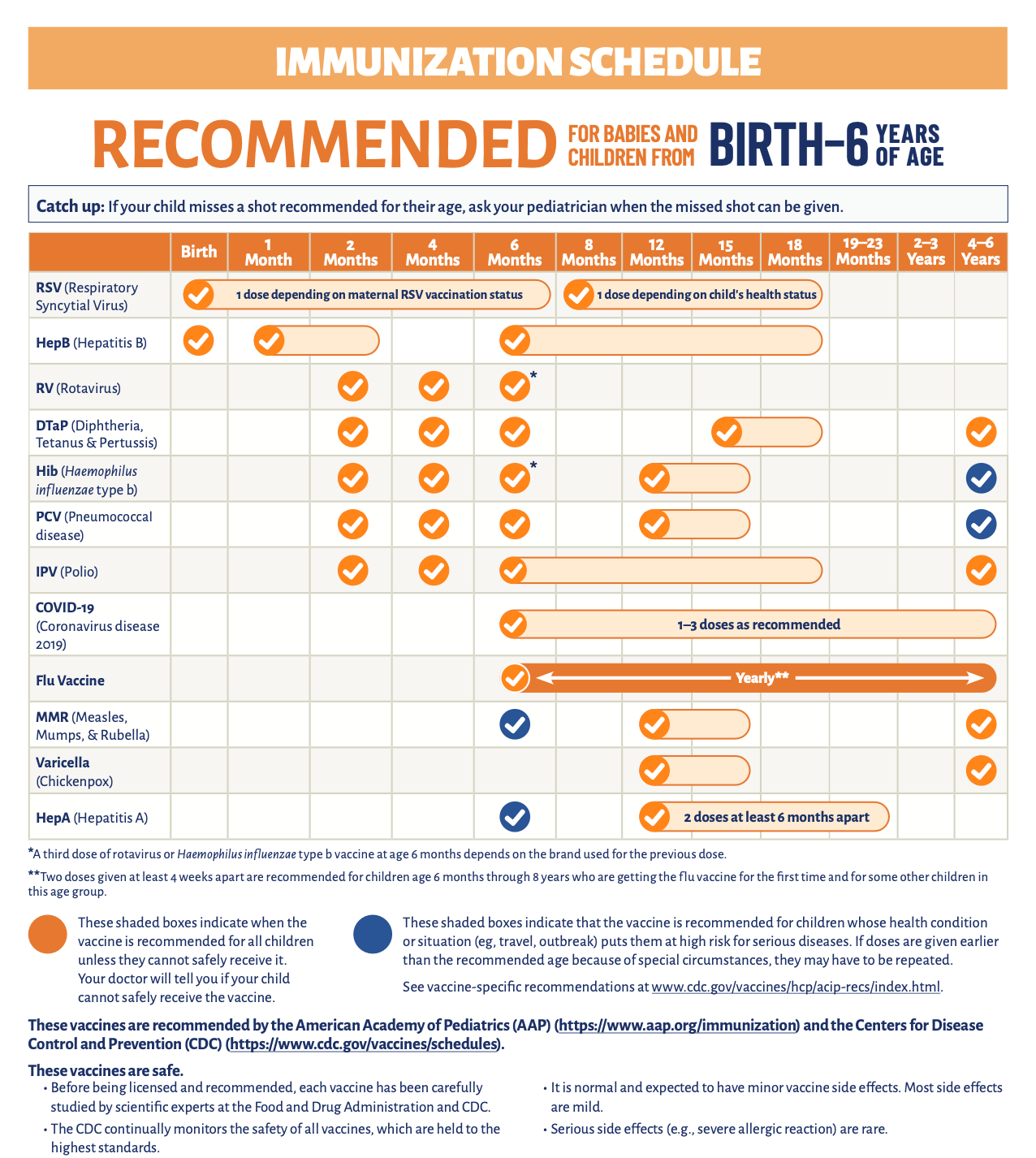
The AAP still recommends all 18 diseases be covered for your children, and so do most states. States also decide which vaccines they require for school enrollment; this EO doesn’t change your child’s requirements for school this year. Your pediatrician should still be following the AAP vaccine schedule, I recommend screenshotting the schedule below to bring to your next appointment.
Insurance still covers all vaccines, including those now labeled “shared clinical decision-making.” My one real concern: RFK fired the former ACIP members, so the reconstituted committee may move to approve these changes. We still have a few layers of protection: states can maintain coverage under state-regulated plans regardless of what ACIP decides; even if ACIP approves the EO’s directives, the rules won’t take effect until 2028 for most people, giving the AAP time to fight, and win, again; and even if these measures pass, insurers can still choose to cover these vaccines, as many did with the COVID-19 vaccine. The patients most at risk, my patients, are the ones covered by Medicaid, CHIP, and the Vaccines for Children program, because those programs follow the ACIP schedule directly.
Here’s what you can do today:
1. Call your reps and senators through the Capitol switchboard: (202) 224-3121
“Hi, I’m a constituent from [ZIP]. Please oppose the executive order splitting up and reducing the childhood vaccine schedule. It’s not backed by science, and it orders MMR shots that don’t even exist in the U.S. Keep kids’ vaccines evidence-based, and codify the AAP vaccine schedule into state law to protect our children. Thank you.”
2. Donate to Stand Up for Science, an organization doing the real work to protect our public health infrastructure
3. Subscribe to my Substack for more actions in your inbox, today!
The State of Pediatrics is a reader-supported publication. To receive new posts and support my work, consider becoming a free or paid subscriber.
Comments
Nothing yet. Say the first thing.
Sign in to join the conversation.