
On the morning of June 29th, 2026 a blurb appeared on my phone about a retraction in the vaunted New England Journal of Medicine. The link led to a short notice on the NEJM webpage:
The two academic authors of the article by Jayne et al., Avacopan for the Treatment of ANCA-Associated Vasculitis, N Engl J Med 2021;384:599-609, request retraction of the article because, according to an ongoing Food and Drug Administration investigation conducted after publication, and without the knowledge of these two authors, the primary end-point assessments in nine patients were readjudicated after database lock and trial unblinding. This was not disclosed in the article and is inconsistent with proper research conduct. The editors therefore retract the article.
The statement is an admission that a clinical trial submitted to the FDA was manipulated. This was a trial published in 2021 in the NEJM, and it was the positive result of this trial that led to FDA approval of the drug. The FDA approval is what in turn induced Amgen, one of the largest pharmaceutical companies in the world, to acquire the company that developed this drug for $3.7 billion. Four years later the study that initiated this cascade of events has been retracted at the request of the study authors because it turns out the data was manipulated.
What happened? How did the primary end-point data manipulation come to light? Who was responsible? And when did the FDA know?
You would think the science journalists who cover this beat would be all over these questions. But the week the NEJM retracted the foundational trial behind a drug linked to eight deaths, the health news cycle was dominated by speculation about whether an unnamed 79-year-old had obtained an experimental obesity drug through FDA compassionate use.
But this is an exquisitely important story to tell because it points to major gaps in the regulatory framework of the vaunted “best-in-class” US FDA drug approval process that are being exploited by the pharmaceutical industry to the tune of billions of dollars a year. Even worse than the dollars wasted is the toll borne by desperate patients suffering serious harm by taking drugs that may not even work.
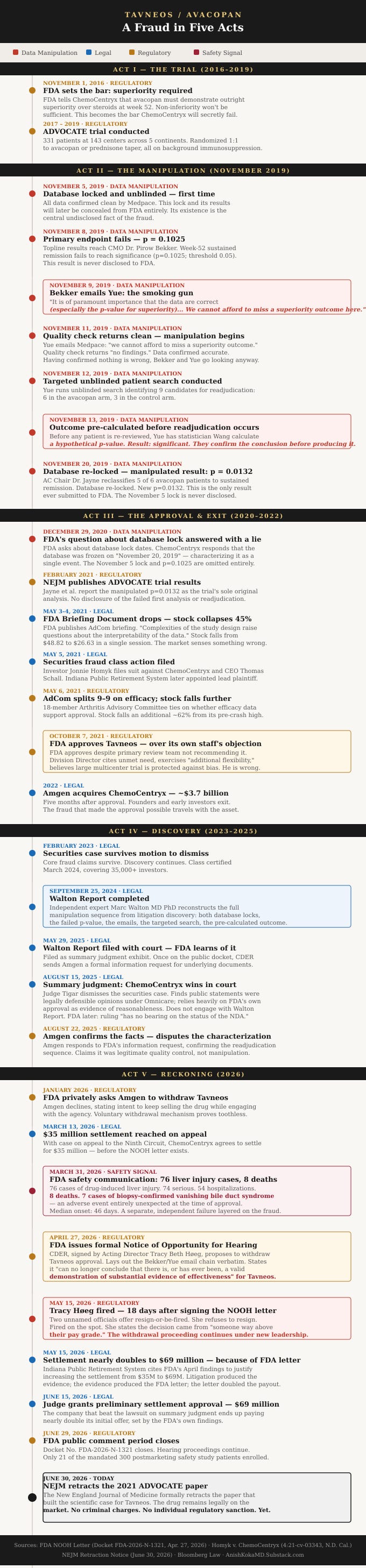
On the morning of May 4, 2021, the company ChemoCentryx opened at $48.82 on the stock exchange and closed the day at $26.63. Forty-five percent of the company’s value vanished in a single session, and it disappeared for a specific, traceable reason: the FDA had just published its Advisory Committee Briefing Document for avacopan, the company’s only drug. Buried in the regulatory prose was a sentence that the market was responding to: the “complexities of the study design,” the FDA wrote, “raise questions about the interpretability of the data to define a clinically meaningful benefit.” Two days later, on May 6, the eighteen-member Arthritis Advisory Committee convened to vote on whether avacopan should be approved at all. On the narrowest question — whether the efficacy data actually supported approval — the panel split 9 to 9. A tie. The market responded quickly. The stock, which had already shed nearly half its value, fell again, down more than sixty percent from its pre-briefing high before the week was out.
At that moment traders and investors were in the dark on what the data actually showed. They were simply trying to get a read of the room from the regulators who did have access to the data and were about to decide on the coveted FDA stamp of approval. There may be no more valuable stamp than the FDA stamp that allows a drug to be on the US market. If you’re a company that has a single drug, an approval will create generational wealth for company founders and investors. A non-approval means you are worth nothing. The stakes could not be higher.
As it stood, ChemoCentryx was heading to the bottom of the ninth inning down two runs. But the FDA decision wasn’t on the books yet. There was still time.
While the regulatory game was playing out, another game was just starting. On May 5, 2021, the day after the stock collapse, investor Jonnie Homyk filed suit against ChemoCentryx and CEO Thomas Schall alleging the company had made false and misleading statements about the safety, efficacy, and application for FDA approval of the company’s single product: avacopan.
Defendants told investors that the ADVOCATE results confirmed avacopan’s core value proposition and demonstrated that the drug was far safer, but no less effective, than steroid-based therapy. Further, Defendants told investors that “all” of the Company’s interactions with the FDA in connection with its New Drug Application (”NDA”) for avacopan, which was built on the ADVOCATE data, had been “straightforward and routine” and that the agency had raised no serious or unexpected issues that might jeopardize approval with the broad label ChemoCentryx sought.
There are roughly a dozen firms that specialize almost exclusively in securities fraud class actions — Bernstein Litowitz (who ran the ChemoCentryx case), Robbins Geller, Kessler Topaz, Pomerantz, Rosen Law, Hagens Berman, Labaton Sucharow, Block Leviton (who filed the original Homyk complaint). These firms run essentially automated surveillance of every publicly traded stock, every day. When a stock drops sharply — typically anything over 10-15% in a single session, especially when accompanied by a news event that could constitute a “corrective disclosure” — an algorithm flags it and a junior associate starts pulling SEC filings, press releases, analyst reports, and news coverage within hours, sometimes within minutes. The question they’re asking is narrow and specific: did the company say something that turned out to be false, and did investors buy stock at an inflated price because of it? If the answer looks plausibly yes, they start drafting a complaint before the trading day ends.
If it sounds like ambulance chasing in the pejorative sense, you wouldn’t be wrong, but this private regulatory mechanism meant to catch financial securities fraud is the only reason the foundational trial that led to avacopan’s FDA approval now stands retracted.
The moment ChemoCentryx stock crashed, every securities firm in the country was simultaneously calling the treasury offices of pension funds that they knew held the stock — CalPERS, state teacher retirement systems, municipal pension funds, union funds — pitching them on serving as lead plaintiff, on a contingency basis, with the law firm fronting all costs and taking a percentage of recovery if they win.
This matters because finally there’s a player in the game with millions of dollars at stake to evaluate the veracity of a company’s data claims, and with the power to subpoena internal company documents. The FDA can send information requests to companies. It doesn’t have the authority, budget, or institutional incentive to go through internal company communications. A plaintiffs’ firm on contingency does.
But ChemoCentryx had time on their side. Discovery takes years. Meanwhile, the regulatory process marched on.
Five months after the crash, on October 7, 2021, the FDA approved avacopan — brand name Tavneos — for adjunctive treatment of ANCA-associated vasculitis, a rare and serious autoimmune disease that attacks small and medium blood vessels. The approval happened despite the tied committee vote. It happened despite something the public didn’t know at the time and that only became clear from FDA’s own later accounting: the agency’s primary review team had not recommended approval. Even without knowledge of anything improper in the trial conduct, the reviewers tasked with the first-line assessment of ChemoCentryx’s application had significant doubts about whether the company had cleared the bar Congress requires — substantial evidence of effectiveness from adequate and well-controlled trials.
The approval went forward because the FDA Division Director overseeing the application believed, according to FDA’s own later letter on the matter, that “additional flexibility was warranted” given the disease’s rarity and the lack of good treatment alternatives to long-term steroid use. He also believed that a trial as large and as global as ADVOCATE, with its 331 patients spread across 143 centers on five continents, was inherently less vulnerable to the kinds of selection and measurement bias that plague smaller studies. Scale, he thought, was its own kind of protection.
He would turn out to be dead wrong. But in the short term, his decision was an immediate financial windfall for the company that bet everything on one drug.
Amgen acquired ChemoCentryx for $52/share five months after approval in a $3.7 billion deal. Founders and early investors got their exit. The lawsuit was now Amgen’s problem. And the lawsuit progressed at a snail’s pace, but progress it did. The plaintiffs’ lawyers eventually retained an independent expert named Marc Walton to examine how ChemoCentryx had handled the ADVOCATE trial’s data. His report, completed in September 2024, pieced together what actually happened after the trial completed.
The ADVOCATE trial of avacopan was a straightforward design on paper: 331 adults with ANCA-associated vasculitis, randomized one-to-one to either avacopan or a tapering course of prednisone, with everyone in the trial also receiving standard background immunosuppression. There were two primary endpoints. The first, remission at 26 weeks, only needed to show avacopan was no worse than steroids — a low bar, and one the company cleared comfortably. The second, sustained remission at 52 weeks, needed to show avacopan was actually better than steroids. The FDA had told ChemoCentryx as far back as 2016 that this was non-negotiable: non-inferiority wouldn’t be good enough at the 52-week mark. The whole commercial premise of the drug — a steroid-sparing alternative for a disease where steroids themselves cause serious harm — depended on clearing that second, higher bar. Avacopan couldn’t just be non-inferior to standard steroid therapy. It had to be better.
On November 5, 2019, the trial database was locked and unblinded for what the company would later represent to FDA as the only such event in the study’s history. It was not. Three days after that lock, the unblinded topline results landed on the desk of Dr. Pirow Bekker, ChemoCentryx’s Chief Medical Officer. They were not good. The primary endpoint — sustained remission at week 52, the one that mattered, the one FDA had specifically required to show superiority — had failed. The two-sided p-value came back at 0.1025, comfortably above the 0.05 threshold the trial’s own pre-specified statistical plan required for significance. By the standard the company had agreed to before it knew the answer, avacopan had not beaten steroids.
The next day, Bekker emailed Dr. Huibin Yue, ChemoCentryx’s Director of Biostatistics. The subject was the integrity of the data — ostensibly. “It is, of course, of paramount importance that the data are correct,” he wrote, with the phrase “especially the p-value for superiority” underlined for emphasis in the original. Then: “We cannot afford to miss a superiority outcome here.”
Yue, in turn, emailed the lead biostatistician at Medpace, the contract research organization running the trial’s data management. His message struck the same note. They could not afford to miss a superiority outcome. The p-value was close to significant. They needed to make sure the data and analysis were correct.
A quality check ran. It came back clean. No findings, no errors, nothing wrong with either the data or the math. The 0.1025 was real.
This should have been the end of it. A null trial that sent researchers back to the drawing board. That’s not what happened. Having been told there was nothing wrong with the result, Bekker and Yue went looking for a way to change it anyway. Yue ran a targeted search of the unblinded database, looking specifically for patients with a clean disease-activity score who had nonetheless been adjudicated as not in remission, on the theory that something — glucocorticoid use, missing data, a clerical mishap — might justify reclassifying them. He found nine candidates. Six were in the avacopan arm. Three were in the control arm.
What happened next is the whole story. Before any of the nine patients were actually re-reviewed, Yue had an independent statistician run a hypothetical analysis: what would the p-value look like if five of the six avacopan-arm patients flipped to “sustained remission,” and none of the three control-arm patients did? The answer came back on November 13: statistically significant. They knew what result they needed before they went and got it.
The readjudication itself was handled, on its face, properly — sent to David Jayne, the trial’s blinded Adjudication Committee chair, who reviewed the nine cases without knowing which arm any patient was in. He reclassified five of the six avacopan patients to sustained remission. He did not request readjudication of the three control-arm patients’ week-52 status at all, because — and FDA would later note this explicitly — it was already obvious that doing so couldn’t change the outcome. Two of the three control patients had terminated the trial too early to be evaluated for sustained remission in the first place; the third’s prior glucocorticoid use precluded a favorable reclassification by the trial’s own rules. The search for patients to re-examine had been, structurally, a search for patients who could only move the result in one direction.
The database was locked a second time on November 20, 2019. The endpoint was rerun. This time the two-sided p-value came back at 0.0132 — statistically significant, this time in the right direction. And this was the only analysis of ADVOCATE’s primary endpoint that ChemoCentryx ever submitted to the FDA. The agency reviewed it, debated it, eventually approved a drug on the strength of it. Nobody at FDA knew a first analysis had ever existed, let alone that it had failed.
The trial’s own governing document for the adjudication process — the Adjudication Committee Charter — had anticipated and explicitly forbidden almost exactly this. Readjudication after database unblinding was barred outright. The charter’s logic was the logic of blinding in trials generally: once you know which patients got the drug, every subsequent judgment call you make is contaminated by that knowledge, consciously or not. ChemoCentryx’s own scientists had agreed to this rule in writing, years before they broke it.
ChemoCentryx’s stock, battered by the May 2021 crash, recovered through the back half of the year as approval drew near and then arrived. The market that had been spooked by the FDA in May had, by autumn, apparently been proven wrong — the drug got through, the company had a commercial product, the worst fears appeared to have been overblown.
Five months after approval, in 2022, Amgen acquired ChemoCentryx for roughly $3.7 billion, completing a pattern that is now common enough to be its own genre: a small company built around a single asset for a rare disease, where the entire firm’s survival depends on one trial clearing one regulatory bar, gets that approval, and gets acquired by a company with the balance sheet to commercialize it at scale before anyone has had the chance — or, in this case, the access — to look closely at how the approval was actually obtained. The incentive structure here isn’t subtle. A single-asset company facing a make-or-break trial has, relative to a diversified pharmaceutical giant running a dozen programs at once, dramatically more to lose from a negative result and dramatically less to lose, reputationally and financially, if a manipulated positive result isn’t discovered until after the founders have already cashed out.
In ChemoCentryx’s case, the deal closed while a quieter, mostly unnoticed private legal process was already underway that would eventually bring the full picture to light.
The Walton Report, completed in September 2024, laid out essentially the entire sequence above: the first database lock, the failed p-value, the emails, the targeted search, the hypothetical analysis run before the real one, the second lock, the result that made it into the NDA. It was only eight months later, though, that the public first heard about the startling revelations when the report was filed with the court as part of summary judgment briefing in May 2025. For the first time since this saga started, the story of the data manipulation was no longer confined to a ChemoCentryx server.
The pace of events quickened. The FDA, made aware of the report, sent Amgen a formal information request in July 2025, asking for the underlying emails and documents. Amgen’s response, filed the following month, confirmed the factual core of the Walton Report. The company did not dispute that the events had happened. It disputed that they amounted to misconduct, characterizing the readjudications as legitimate quality control rather than result-shopping.
On August 15, 2025, a federal judge granted summary judgment in ChemoCentryx’s favor, finding that the company’s public statements during the relevant period were legally defensible opinions under the prevailing securities-law framework, which gives wide latitude to good-faith interpretations of ambiguous data. The judge relied heavily on the fact that company officials and the FDA were aligned on the same conclusions. The court did not meaningfully engage with the Walton Report’s manipulation findings, deeming them outside the scope of the specific claims being litigated. By the most visible legal measure available at the time, ChemoCentryx had won. The company that was on the ropes in May 2021 had, by the summer of 2025, both completed its acquisition and beaten the lawsuit that grew out of that very crash.
This may very well have been the end of the story if the FDA had also chosen to ignore the Walton Report. But the team now asking hard questions of Amgen was a different team than the one that had presided over approval of the drug in 2021.
Patrizia Cavazzoni had been the head of CDER when it signed off on avacopan. Cavazzoni was an industry insider — she joined the FDA in 2018 after spending nearly two decades in senior roles at Eli Lilly, Sanofi, and Pfizer. Six weeks after leaving the FDA on January 10, 2025, she rejoined Pfizer as Chief Medical Officer and Executive Vice President, taking charge of Pfizer’s regulatory, pharmacovigilance, and safety functions — on the other side of the regulatory relationship she had occupied when she approved Tavneos. She has made no public statement about the NOOH letter, the Walton Report, the manipulation findings, or the eight deaths attributed to a drug she approved.
The FDA CDER head now asking Amgen some hard follow-up questions in light of the Walton Report was Tracy Beth Høeg, a physician and trained epidemiologist — an outsider with zero industry connections.
In January 2026, the FDA privately asked Amgen to voluntarily withdraw Tavneos from the market. Amgen said no. The company stated its intent to keep selling the drug while it engaged with the agency, and pointed, when pressed by reporters, to its own confidence in the data — the same data the Walton Report had by then dismantled in granular detail.
On March 31, 2026, FDA made public a postmarketing safety review identifying seventy-six cases of drug-induced liver injury associated with avacopan, seventy-four of them serious, fifty-four resulting in hospitalization, eight resulting in death. Seven of the cases involved vanishing bile duct syndrome, a severe and at the time of approval entirely unexpected complication — the progressive disappearance of the liver’s bile ducts. This was not the manipulation story. This was a separate, independent reason the drug’s risk-benefit calculus had gone bad, layered directly on top of the fraud question.
Then on April 27, 2026, CDER sent ChemoCentryx — now wholly owned by Amgen — a formal Notice of Opportunity for a Hearing, proposing to withdraw Tavneos’s approval entirely. The letter, signed by Acting CDER Director Tracy Beth Høeg, laid out the Walton manipulation timeline that had now been corroborated independently by the FDA: the first lock, the p-value of 0.1025, the “we cannot afford to miss a superiority outcome” email, the targeted search, the hypothetical p-value run in advance, the second lock, the reported p of 0.0132. The letter stated plainly that the agency could no longer conclude there was, or had ever been, a valid demonstration that the drug worked. It noted, separately, that the original review team’s objections — the ones the Division Director had overridden back in 2021 — now looked less like institutional caution and more like correct judgment that had simply been overruled.
Høeg signed the NOOH letter on April 27, 2026. On May 15, 18 days later, two unnamed FDA officials came to her office and offered her the choice to resign or be fired. When she refused to resign, she was fired on the spot — by a decision she said came from “someone way above their pay grade.” The person who put her name on the most significant drug-fraud withdrawal notice the FDA has issued in years was fired 18 days later.
The plaintiffs in the securities case, having lost at summary judgment, had appealed to the Ninth Circuit. Facing a now-hostile FDA that had already asked them to withdraw the drug, Amgen reached a settlement in March 2026 for $35 million — before the NOOH letter existed. The plaintiffs’ lawyers went back to court with the NOOH letter in hand and asked for $69 million. The judge agreed. The company that beat the lawsuit on a summary judgment that relied heavily on FDA alignment with the company’s conclusions ended up paying nearly double, largely because the FDA had changed its position based on the evidence the lawsuit itself had generated.
Litigation produced the evidence; the evidence produced the regulatory letter; the regulatory letter produced the settlement. None of these three institutions — the courts, the agency, the company — fully closed the loop on its own. Together they closed it almost by accident.
The public comment period on FDA’s withdrawal proposal closed on June 29, 2026. The next day, the New England Journal of Medicine formally retracted the 2021 paper that first reported ADVOCATE’s results to the world — the paper that, more than any single document, had built the scientific case for a drug now accused of having been approved on fabricated statistics.
As of today, Tavneos remains a legally marketed drug in the United States. Amgen has not withdrawn it. The company continues to state its confidence in the medicine’s safety and effectiveness. The withdrawal hearing FDA offered has not yet happened; nothing in the process so far guarantees the drug actually comes off the market, only that the agency believes it should.
Some will laud this as a regulatory success, but an honest appraisal is hardly flattering. The FDA’s own approval process did not catch the manipulation. It was a private civil suit related to securities fraud that led to the disclosure of data manipulation, and the whole process took almost five years to come to light. That’s five years of a drug being prescribed to patients that didn’t actually clear the FDA efficacy bar.
And this doesn’t even touch on the severe liver toxicities uncovered in postmarketing surveillance. It has become commonplace in the rare-disease, small-n trial ecosystem for the FDA to conditionally approve a drug but require a postmarketing study to evaluate safety outcomes. The most recent annual report for the ongoing mandated study shows only 21 of the planned 300 patients have been enrolled. This isn’t an attempt to assess safety. It’s a middle finger to a toothless, slow-moving regulatory establishment.
The real victims here aren’t regulators, pharmaceutical companies, or plaintiffs’ lawyers. It’s patients. Doctors prescribed a potentially non-working drug to desperate patients. 74 serious liver injury cases have been uncovered to date. 54 hospitalizations. 8 deaths. 7 cases of biopsy-confirmed vanishing bile duct syndrome.
The larger question this saga begs is how often this happens. Is this an edge case, or is data massaging to get a positive trial result a common occurrence? I have no idea, and more importantly, the FDA has no idea either.
Anish Koka is a cardiologist. He writes about medicine and health care policy. You can find him on @X: Anish Koka MD (Cardiology)
No posts
Comments
Nothing yet. Say the first thing.
Sign in to join the conversation.