
I recently was asked to moderate a session on the changing medical malpractice market in Pennsylvania — a topic I have a lot of interest in, but have very little deep understanding of. The panel consisted of individuals that normally work on the defense side of medical malpractice for physicians and institutions. Moderating the discussion as a physician required going down a rabbit hole to learn the jargon used in the space as well as a brief history of tort law in Pennsylvania. Down the rabbit hole we go.
In preparing for the panel discussion, the first thing I did was to try to get a handle on some primary data sources for national malpractice insurance data. That primary data source comes from the the National Association of Insurance Commissioners — a regulatory body to which every U.S. medical malpractice carrier must file audited financial statements — which for the last eighteen years now has published an annual document called the Countrywide Summary of Medical Professional Liability Insurance.
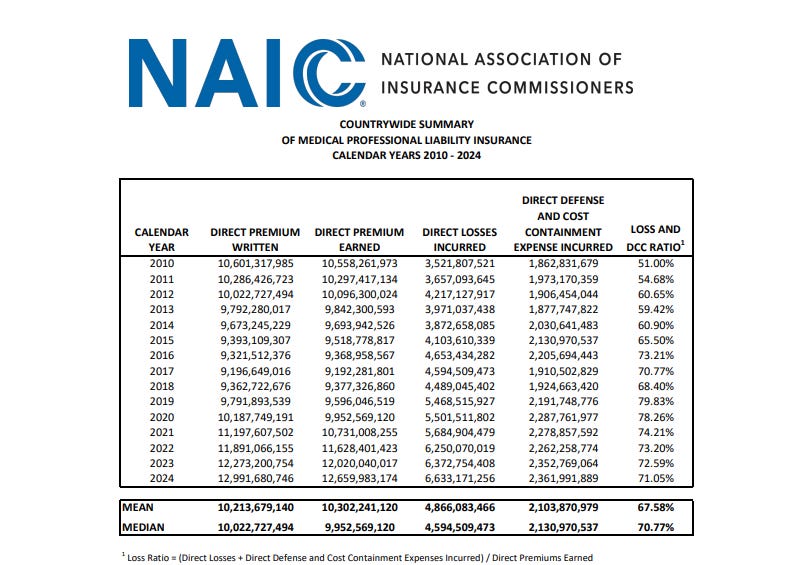
Its a long, dry document with unfamiliar words that require translation.
Direct Premium Written
This is the dollar value of the premium that all medical malpractice carriers in a given state collected for policies sold in that calendar year. If a Pennsylvania physician renewed a $20,000 policy on July 1, 2024, the carrier records $20,000 of direct premium written in 2024. Across the entire state, NAIC reports that PA carriers wrote about $911 million in 2024.
The word direct means before reinsurance — gross of any risk the carrier transferred to a reinsurer downstream. NAIC’s tables are reported on the direct basis because that is the cleanest measure of the dollars actually flowing into the state’s medical liability market.
Reinsurance
Reinsurance is insurance for insurance companies. The carrier that wrote your policy doesn't carry the full risk alone — it pays another company, the reinsurer, to take on a slice of the worst-case losses in exchange for a slice of the premium. The carrier you write your check to is called the primary or direct carrier; the company standing behind it is called the reinsurer.
Direct Premium Earned
Premium written and premium earned are not the same thing. If you sold that $20,000 policy on July 1, only half the policy term has elapsed by December 31. The carrier has written $20,000 but only earned $10,000. The other $10,000 sits on the balance sheet as unearned premium — a liability the carrier owes the policyholder if the policy is cancelled.
Premium earned is the cleaner denominator for measuring whether premium dollars are actually covering claims, because it reflects the risk the carrier was actually exposed to during the calendar year.
Direct Losses Incurred
Losses incurred is not money that was actually paid out in cash during the calendar year. It is the carrier’s actuarial estimate of what it ultimately owes for events that occurred during the policy period — including claims that have been reported, claims that have been reported but are still being defended or negotiated, and claims that the carrier knows are coming but have not yet been filed. That last category is called IBNR — incurred but not reported.
Medical malpractice has a long tail. A surgical event in 2024 may not produce a lawsuit until 2027 and may not settle until 2030. The carrier cannot wait until the cash leaves the door to book the loss; that would understate the cost of doing 2024 business. Instead, every year the actuaries reassess every open and projected claim and book the change to current-year losses incurred.
This is also why losses incurred can move dramatically when the legal environment changes. The 2023 Pennsylvania change in legislation on venue lawsuits may be brought, for instance, did not change the underlying medical events — but it did change the carriers’ projected liability on those events, which forced reserve strengthening, which showed up as larger losses incurred for that calendar year.
Direct Defense and Cost Containment Expense (DCC)
Lawyer fees, expert witnesses, depositions, court reporters, document review — the entire apparatus of defending a malpractice case. DCC is broken out from losses because it is the cost of being in the malpractice insurance business, distinct from money paid to plaintiffs.
In high-severity specialties this number is enormous. A complex obstetric or neurosurgical case tried to verdict can cost the carrier $750,000 to $2.5 million in pure defense expense — money spent regardless of whether the doctor wins or loses.
Putting It Together — The Loss & DCC Ratio
NAIC defines the loss & DCC ratio as:
(Direct Losses Incurred + Direct DCC) ÷ Direct Premium Earned
In short: Of every dollar of premium the carrier earned in this calendar year, how many cents went to (a) money paid or projected to be paid to injured patients, plus (b) money paid to lawyers to defend doctors against those claims?
This ratio is the cleanest single measure of whether a malpractice insurance market is functioning. The traditional industry rule of thumb:
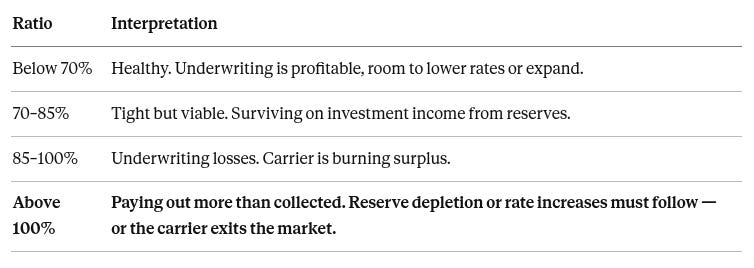
Not included so far is the cost of a carrier doing business : claims-handling staff, IT, marketing, agent commissions, premium taxes, regulatory fees, executive overhead, and the cost of holding the regulatory capital that state insurance commissioners require. Those missing pieces typically add 20–25 cents on the dollar.
So a carrier needs the loss & DCC ratio to run well below 75% — to be sustainably solvent on underwriting alone. They can operate above 100% for a year or two on the strength of investment income from reserves, but no carrier can do it indefinitely. If you’re over a 100%, you can either raise rates, pull out of the state, or fail.
A Brief History of How We Got Here
The Loss and DCC ratio has steadily climbed from ~50% in 2010 to over 70% in recent years. As the Loss & DCC ratio goes up, premiums go up. Why that happened has everything to do with the changing legislative landscape as it applies to medical malpractice. 2010’s startlingly low numbers had everything to do with a reform package that took the better part of a decade to enact, and which Pennsylvania physicians today are watching come undone in real time.
The pre-MCARE crisis
By the late 1990s, Pennsylvania’s medical liability environment was widely described as in crisis. Roughly 2,700 medical malpractice cases were filed in the Commonwealth each year. Premiums for high-risk specialties — obstetrics, neurosurgery, orthopedics — surged into the six figures. Carriers like PHICO Insurance, the largest medical malpractice insurer in the state, became insolvent. Physicians warned publicly that they were leaving Pennsylvania, and many did.
The political conditions for reform were therefore unusually bipartisan. Hospitals, the medical society, and the business community all wanted relief. The trial bar resisted but recognized the politics had shifted against them. By early 2002, the Legislature was prepared to act.
The MCARE Act (March 2002)
In March 2002, the Pennsylvania General Assembly passed the Medical Care Availability and Reduction of Error Act by an extraordinary vote of 196–1 in the House and 49–0 in the Senate. To have that kind of a margin on a contested issue with active opposition from the politically powerful trial bar, signals the depth of consensus that existed at the time for fundamental change to medical malpractice.
The Act itself did several things. It created the MCARE Fund — a state-administered excess insurance layer funded by assessments on physicians (yippee), sitting above each physician’s primary commercial coverage. It lowered the primary coverage limits required of primary care physicians and certain specialists, reducing the dollar burden of compulsory coverage. It established the Patient Safety Authority and required hospitals to file structured patient-safety reports. It aslo created an Interbranch Commission on Venue, charged with recommending procedural reforms to the Pennsylvania Supreme Court.
That last detail matters more than it sounds, because the most important reforms of the MCARE era did not come from the statute itself.
The 2003 procedural rules: Certificate of Merit and venue carve-out
Under Pennsylvania’s constitutional structure, procedural rules of court are reserved to the Supreme Court — not to the Legislature. The General Assembly can pass substantive law, but it cannot dictate how cases are filed and venued. In 2003, acting on the Interbranch Commission’s recommendations, the Pennsylvania Supreme Court adopted two procedural rules that turned out to do more work than the entire MCARE statute combined.
Pa.R.C.P. 1042.3 — Certificate of Merit. Within 60 days of filing a medical malpractice complaint, the plaintiff’s attorney must file a one-page certificate stating that “an appropriate licensed professional” has supplied a written attestation that there is a reasonable basis to conclude the defendant’s care fell outside professional standards and caused harm. Failure to comply is grounds for dismissal. The intent was to filter out frivolous cases at the front door.
Pa.R.C.P. 1006(a.1) — the venue carve-out. A medical professional liability action could be brought only in the county where the cause of action arose — that is, where the alleged malpractice occurred. This was the most consequential procedural reform of the era. Before it, plaintiffs could file in whichever county had the most plaintiff-friendly jury demographics, regardless of where the medical care actually happened. After it, a malpractice case arising in Lancaster had to be tried in Lancaster.
The Legislature also passed a duplicate statutory venue rule, but the Commonwealth Court struck it down in North-Central Pennsylvania Trial Lawyers v. Weaver (2003), holding that venue is a procedural matter exclusively within the Supreme Court’s authority. That holding still governs today, and explains why current legislative efforts to restore the venue rule face constitutional headwinds.
What the reforms produced
The combination worked, and the data is unambiguous. The Pennsylvania Legislative Budget and Finance Committee, studying the 1996–2018 period, reported:
Statewide annual filings dropped from approximately 2,700 to about 1,500.
Medical malpractice filings decreased by 44.9% between the 2000–2002 and 2015–2017 periods.
Compensation paid for negligence claims against physicians fell 13.7% between 2003 and 2018.
Filings in Philadelphia and Allegheny Counties — the historical jury hellholes — fell sharply, with smaller surrounding counties absorbing modest increases.
Pennsylvania carriers stabilized. Premiums compressed. Physicians stopped leaving. For roughly twenty years, Pennsylvania had one of the more functional medical liability environments in the country — and the NAIC loss-ratio data through 2018 reflects that period of relative health.
The 2022 dismantlement
That period ended on August 25, 2022, when the Pennsylvania Supreme Court issued an Order — without an accompanying merits opinion — repealing Rule 1006(a.1) effective January 1, 2023. Medical malpractice actions are now subject to the same general venue rules as any other civil action, meaning a case may be filed in any county where any defendant — including any institutional defendant — “regularly conducts business.” Because most modern Pennsylvania care is delivered through large multi-county health systems, virtually any institutional defendant “regularly conducts business” in Philadelphia and Allegheny Counties, even when the alleged negligence occurred elsewhere.
The first-year results were not subtle. Medical malpractice filings in the Philadelphia Court of Common Pleas roughly doubled, from 275 in 2022 to 544 in 2023. Approximately 41% of those 2023 Philadelphia filings involved care that was actually delivered in another county — Bucks, Montgomery, Delaware, Chester, Berks, Lancaster, even further afield.
The Certificate of Merit rule remains in place, as does the MCARE Fund. But the venue carve-out — the most economically consequential single piece of the 2003 procedural reform — is gone. And the data reflects the financial echo of that change, arriving on the carriers’ books two to four years after the legal events that produced it.
The loss-ratio curve from 2010 to 2024, and the premium increases that have followed flows from this legislative battle. The financial fingerprint of a reform regime that worked for two decades, was dismantled in stages, showed up in the carriers’ audited financial statements, and now in physician premium payments.
Now to the numbers
With the vocabulary and the legal history now in hand, the picture that emerges on the malpractice climate across the United States is not subtle.
In 2010, the U.S. medical malpractice industry was at its post-tort-reform peak. The wave of state reforms enacted between 2002 and 2005 — including Pennsylvania’s MCARE Act — had stabilized claim frequency. Premiums had compressed. Carriers were profitable. The countrywide loss & DCC ratio that year was 51.0%. Healthy.
It has marched in one direction since.
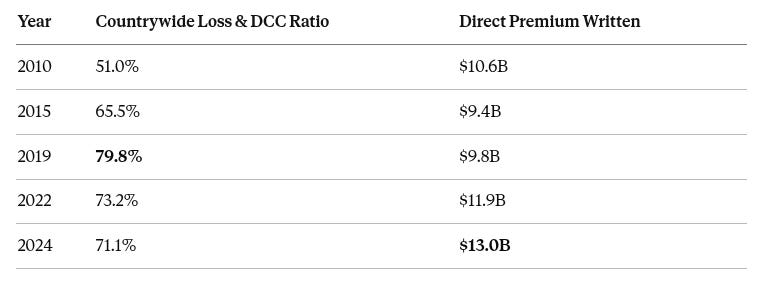
Two things happened in parallel. First, the ratio climbed steadily through 2019, when it hit a peak that anyone in the industry now refers to as the inflection point — the year carriers collectively recognized the soft market was over. Then, starting around 2020, the carriers began raising rates aggressively. Direct premium written rose from $9.8B in 2019 to $13.0B in 2024, a 33% increase in five years. The fact that the loss ratio came down to 71% during that surge of rate increases is not a sign of recovery. It is a sign of how rapidly losses have been growing — fast enough that even a 33% premium hike could only chip a few points off the ratio.
This is what insurance professionals call a hardening market. Premium goes up. Carriers write less new business. Reinsurance costs rise. Some carriers simply leave certain states. Physicians find their existing carrier non-renewing them, or quoting an unaffordable replacement number, or attaching exclusions and consent-to-settle clauses that were unheard of five years ago.
Pennsylvania, specifically
The Pennsylvania story by the numbers is startling.
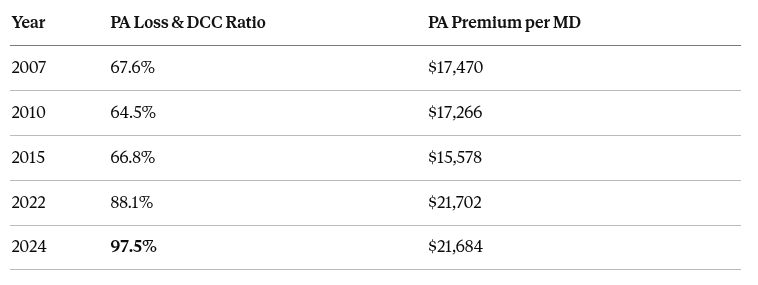
Between 2010 and 2015 — the years immediately after MCARE matured — Pennsylvania’s per-physician premium burden actually fell. That was the reform working as designed.
The trajectory since 2018 is the trajectory of a market in distress. The ratio crossed 80% in 2019, 88% in 2022, and arrived at 97.5% in 2024. That last number is the carriers’ own audited statement, filed under penalty of perjury with the Pennsylvania Insurance Department, that for every $1.00 of premium they earned in PA last year, $0.975 went out the door in claims and defense. With unavoidable overhead on top of that, every Pennsylvania medical malpractice carrier wrote calendar-year 2024 business at an underwriting loss.
The premium per physician in PA is not the highest in the country — that distinction belongs to New York, where it has bumped along around $22,000–$24,000 for the entire eighteen years. But the trajectory of the PA loss ratio is among the worst. New York’s ratio is high but stable around 80%; Pennsylvania’s is moving briskly through territory New York occupied a decade ago, in the wrong direction.
The reform anchors
To understand what a functioning market looks like, look at the three states with the most durable tort reforms.
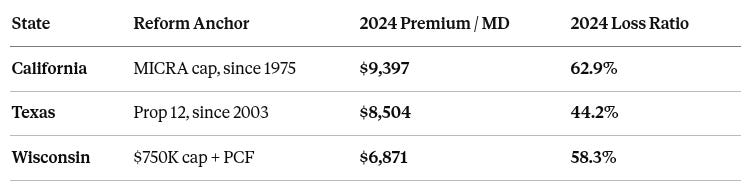
Wisconsin physicians pay roughly one-third of what Pennsylvania physicians pay, per doctor, per year. The Wisconsin loss ratio is below 60%, which means insurers are profitable, premiums are stable or declining, and the system is not in distress. California’s MICRA cap, originally enacted in 1975, was modernized in 2022 with a graduated increase to $750,000 by 2034 — but the cap remains. California’s ratio is 63%; its per-physician premium burden is less than half of PA’s.
The dollar gap between PA and Wisconsin in 2024 is roughly $14,800 per physician per year. Spread across PA’s approximately 42,000 active physicians, that is over $620 million in annual premium that PA physicians collectively pay above what Wisconsin’s reform regime supports — money that, in a functioning market, would be available for clinical care, capital reinvestment, or simply not being charged in the first place.
The State by State Story
To get a more granular sense of how this plays out by state, I built a composite climate score for all 51 jurisdictions that combines three primary-source measures: the state's cap structure (whether and how damage caps exist or have been struck), the per-physician premium burden from the NAIC tables, and the American Tort Reform Association's litigation environment ranking. States scoring above 45 on the 0–75 composite I designate red — hostile climates where reform has been struck, capped, or never enacted, and where premium burden plus litigation environment compound the underwriting problem.
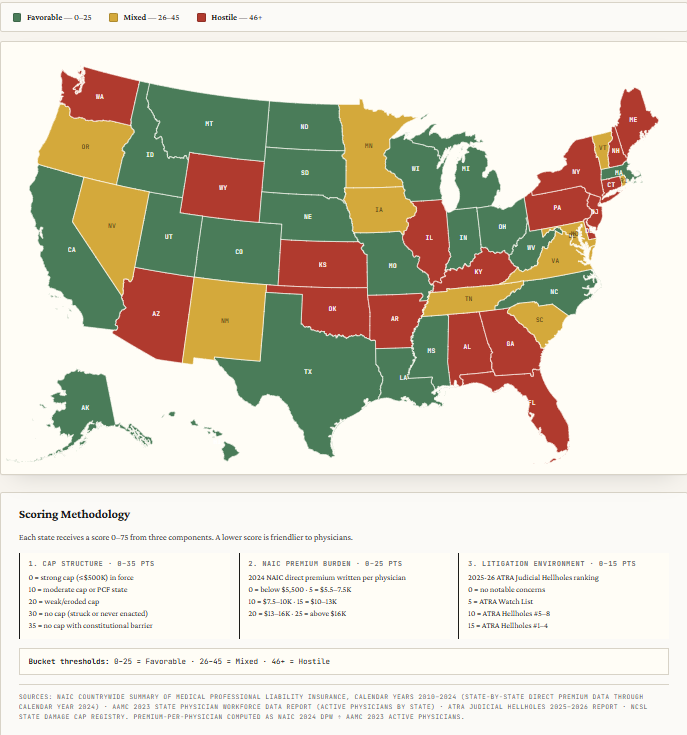
Between 2010 and 2015, the count of red states actually fell, from 12 to 8, as carriers digested the post-2002 reform wave and the system found a new equilibrium.
That recovery is over.
Eighteen states now sit in the hostile-climate bucket. That count has more than doubled since 2015. Pennsylvania has been in the red bucket continuously since 2010 — the premium burden and litigation environment never gave it a path out, even during the years when the venue rule was working.
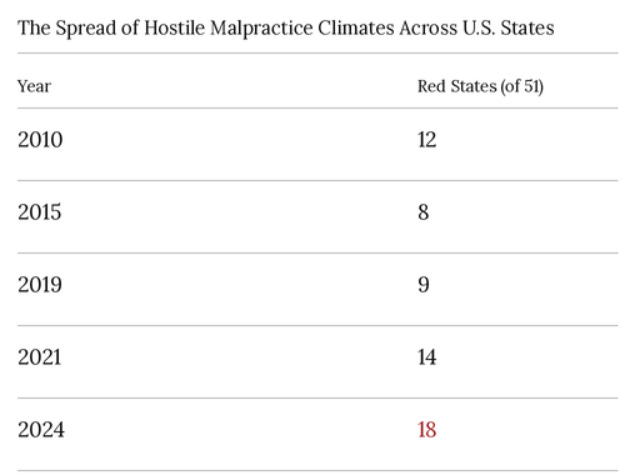
Eighteen states now sit in the hostile-climate bucket. That count has grown by ten in five years. Pennsylvania crossed into the red bucket in 2021 — about two years after the loss-ratio data first signaled distress, and two years before the venue-rule reversal began producing measurable filing-volume effects.
The red-state spread is the tort-reform equivalent of an epidemiological surveillance curve. It tells us that the dysfunctions visible in Pennsylvania are not a one-state story. They are a national pattern, accelerating, and the reform consensus that produced the 2002–2005 wave has not been rebuilt.
What This Means for Physicians
Three things.
The premium is not the gouge. The verdict is. Carriers have spent the last five years raising rates as fast as state insurance commissioners will allow, and the result is a loss ratio that has barely budged. The pressure on premiums is downstream of an underlying liability environment that has gotten dramatically more expensive — driven by venue changes, the spread of nuclear verdicts, the rise of third-party litigation funding, and the reversion of states like PA, FL, IL, and KY toward pre-reform conditions. When physicians frame the premium increase as the problem, they are arguing about the symptom, not the root cause.
Loss ratio is the number that cannot be spun. Every other figure in the malpractice debate has a counter-narrative. Claim frequency? The plaintiffs’ bar will tell you it reflects real injury. Verdict size? They will tell you it reflects life-care needs and inflation. Premium? They will tell you it reflects insurer gouging. The loss ratio is the carriers’ own audited statement of cost, filed with regulators, with no upside to overstating. When PA’s loss ratio reaches 97.5% — when CT’s reaches 132% — that is the carriers themselves saying, in the only language regulators will accept: the math at current premium levels does not work.
The states that did the hard work of reform are still benefiting from it. California, Texas, and Wisconsin are not magic. They are states that enacted, defended, and in CA’s case modernized real legal-system reforms — caps, certificate-of-merit requirements, periodic-payment statutes, patient compensation funds. Twenty to fifty years later, their physicians are paying a fraction of what Pennsylvania physicians pay, on a sustainable underwriting basis, in a stable market that retains carriers and offers competitive options. That is not the gift of geography. That is the dividend of legal infrastructure that was built and has been maintained.
Pennsylvania once had that infrastructure. The MCARE Act and the venue carve-out worked, and the data from 2010 through 2018 shows that they worked. They were dismantled — the venue carve-out by judicial order, the broader environment by a series of jury verdicts that crossed thresholds previously thought to be ceilings. The loss ratio is the financial echo of those dismantlements arriving on the carriers’ books, two to four years after the legal events that produced them.
The infrastructure can be rebuilt. Some of the most achievable pieces — a tightened Certificate of Merit with named, sworn experts, structured periodic payments for catastrophic future-medical awards, statutory methodology for noneconomic damages — would not require a constitutional amendment and could plausibly pass the General Assembly in three to five years if there were a coalition behind them.
That coalition does not currently exist. It is one of the things physicians can build, and the data in this post is a reasonable place to start the argument.
Data: National Association of Insurance Commissioners, Countrywide Summary of Medical Professional Liability Insurance, calendar years 2007–2024. Per-physician calculations use the AAMC State Physician Workforce Data Report, 2023 vintage. Composite climate scoring also draws on the National Conference of State Legislatures cap registry and the American Tort Reform Association's 2025–2026 Judicial Hellholes report.
An interactive version of the underlying charts and the 51-state climate map is available here.
Comments
Nothing yet. Say the first thing.
Sign in to join the conversation.