
If you run a café, tea stall, cloud kitchen, or catering business, you already know the scene: a customer’s regular cup goes soft in their hand, buckles at the base, or drips onto a counter three sips in.
It’s a small failure with a big cost. A leaking cup means a refund, a scalded hand, a one-star review, or a wholesale order that gets returned. Multiply that across a few hundred cups a day, and “just a cup problem” starts eating into margin and reputation.
The good news is that cup failure is almost never random. It comes down to a short list of material, design, and handling issues most of which are easy to check for before you place your next bulk order.
This guide walks through why a regular paper cup leaks or loses shape, how a regular coffee cup differs from a regular tea cup or regular paper glass, what Indian regulations say about them in 2026, and exactly what to check before you commit to a supplier.
What Is a Regular Cup?
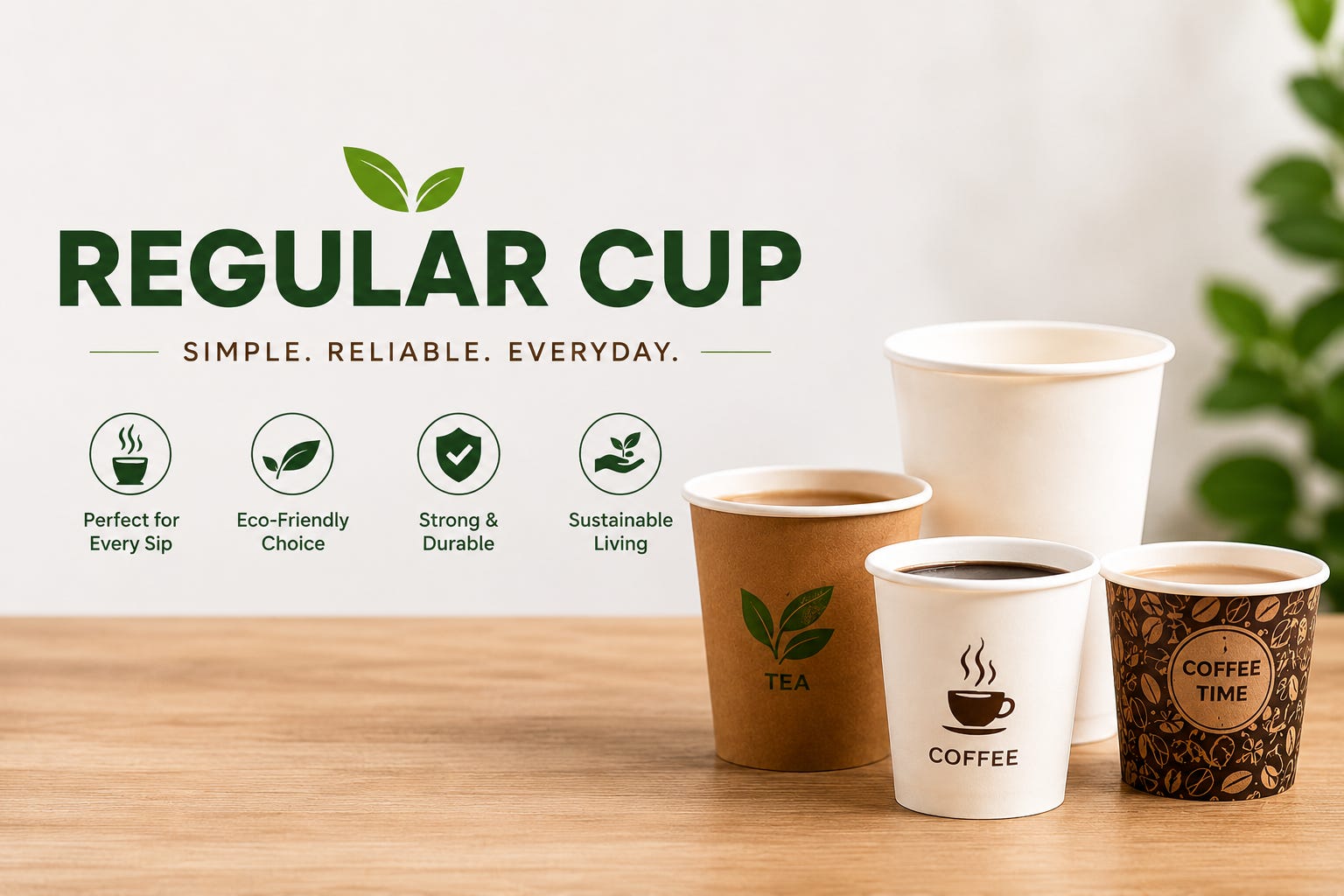
A regular cup is a standard single-serve disposable drinking cup, usually made from paperboard lined with a thin polyethylene (PE) or PLA film, used for hot or cold beverages. “Regular” typically refers to the standard 150–250 ml size, as opposed to jumbo or specialty sizes, and covers what vendors also call a regular coffee cup, regular tea cup, or regular paper glass.
Why Does a Regular Cup Leak or Lose Shape? 7 Common Reasons
Most complaints trace back to one of these seven issues. Some are about the raw material, others are about handling after the cup leaves the factory.
1. Paperboard That’s Too Thin (Low GSM)
GSM (grams per square metre) tells you how thick and rigid the base paperboard is. Industry listings for single-wall cups commonly run from around 135 GSM at the lightweight end up to 340 GSM for premium, better-insulated cups, with 210–280 GSM being a typical mid-range for everyday food-service use.
A cup below that range for its size will flex, bulge, or buckle once it’s holding hot liquid — even if the lining itself is fine.
2. A Poor-Quality or Too-Thin Lining
The lining (PE or PLA) is what actually stops liquid from soaking into the paper. If it’s applied unevenly, too thin, or made from a lower-grade resin, hot liquid will find the weak spots within minutes.
This is the single most common cause of a regular coffee cup that feels fine when empty but goes soggy the moment you pour tea or coffee into it.
3. A Weak Bottom Seal or Side Seam
Run a finger along the side seam and the base of an empty sample cup. A raised, uneven, or loosely bonded seam is a strong predictor of leaks under pressure, even when the paperboard and lining are both acceptable on their own.
4. Liquid Hotter Than the Cup Is Rated For
Most single-wall paper cups are rated for a defined temperature ceiling. Filling a cup rated for warm beverages with liquid closer to boiling point accelerates lining breakdown and softens the paperboard from the inside out.
5. Storage in Hot or Humid Conditions
Paper cups absorb ambient moisture. Cups stored in a humid godown, near a kitchen exhaust, or in direct sunlight can lose structural strength before they’re ever filled — a common, overlooked issue for businesses in India’s coastal and monsoon-affected regions.
6. Using a Single-Wall Cup for the Wrong Job
Single-wall cups are lightweight and cost-effective for quick, short-duration service. But held for longer, or used for very hot drinks, they soften faster than a double-wall cup, which uses a second paperboard layer for extra rigidity and insulation.
7. Unverified or Substandard Raw Material
Not every supplier discloses the grade of virgin pulp, recycled content, or resin they use. Cheaper, uncertified inputs are the most common reason a batch that looked fine in a sample doesn’t perform the same way at scale.
Regular Coffee Cup vs Regular Tea Cup vs Regular Paper Glass: What’s the Difference?
In the Indian market, the same basic product often gets sold under different names depending on the beverage and the region a regular coffee cup, a regular tea cup, or (especially for South Indian filter coffee) a regular paper glass or regular coffee glass. The core construction is usually similar; what changes is size, wall type, and lining.
Feature Single-Wall (PE-Lined) Double-Wall (PE-Lined) PLA-Lined (Compostable) Best for Quick-service tea/coffee, short hold time Sit-down cafés, longer hold, hot beverages Eco-conscious brands, events, exports Leak resistance Moderate — depends on GSM and seam quality High — extra layer adds rigidity Moderate to high, depends on coating quality Heat handling Needs a sleeve for very hot drinks Insulated; comfortable to hold without a sleeve Comparable to PE at moderate temperatures Relative cost Low Medium–High Medium–High Storage space Compact Roughly double the storage space of single-wall Compact, similar to single-wall Environmental profile Harder to recycle due to plastic lining Same lining concerns as single-wall, plus more material use Compostable under industrial conditions with proper certification
If your business serves filter coffee, chai, or any hot beverage that customers hold for more than a couple of minutes, double-wall or a well-lined PLA cup is usually the safer default over a thin single-wall regular cup.
Is a Regular Cup Safe in India? What the Rules Say in 2026
Business owners sourcing regular paper cups in India need to be aware of two separate regulatory threads.
Food-safety compliance. Under the Food Safety and Standards (Packaging) Regulations, disposable packaging that touches food or beverages — including paper cups — must be made from food-grade material meeting FSSAI and Bureau of Indian Standards (BIS) specifications, and FSSAI has recently classified food-grade packaging as a “critical” checkpoint during inspections. In practice, this means asking any supplier for documentation, not just a verbal assurance of “food grade.”
The single-use plastics angle. India’s Plastic Waste Management (Amendment) Rules, 2021 banned a list of single-use plastic items — including plastic cups and glasses — from July 1, 2022. Whether that ban extends to PE-laminated paper cups (which are roughly 95% paper but still carry a plastic film) has been contested; at least one state High Court has upheld that laminated paper cups fall within the ban because of their plastic lining, even though enforcement varies by state and municipality. If you operate in a state actively enforcing this interpretation, it’s worth checking current local guidance or moving toward certified compostable (PLA) cups.
The health angle. A widely cited 2020 study from IIT Kharagpur found that hot liquid (85–90°C) left in a PE-lined paper cup for 15 minutes released around 25,000 micron-sized microplastic particles, along with trace heavy metals, as the lining degraded under heat. For a business, the practical takeaway isn’t to panic — it’s to avoid the cheapest, thinnest lining available and to ask suppliers about lining thickness and composition, especially for cups meant to hold very hot beverages.
How to Choose a Reliable Regular Paper Cups Supplier: A Buyer’s Checklist
Before you commit to a bulk order, run new suppliers — and even repeat suppliers introducing a new batch — through this checklist:
Ask for the GSM specification in writing, matched to your cup size and beverage temperature.
Request a physical sample, not just a spec sheet, and test it with your actual hot beverage for 10–15 minutes.
Check the seam and rim by hand — a smooth, tight seam and even rim curl are good signs; roughness or inconsistency is not.
Confirm the lining type (PE, PLA, or aqueous/water-based coating) and ask whether it’s certified food-grade.
Ask for FSSAI and BIS compliance documentation, not just a printed logo on the box.
Clarify single-wall vs. double-wall based on your actual hold times, not just price per piece.
Check dimensional consistency across a sample batch — diameter and rim tolerance affect whether lids seal properly.
Ask about storage conditions at the supplier’s warehouse, especially during monsoon months.
A Familiar Scenario: A Small Spec Change, A Big Drop in Complaints
Here’s a pattern many Indian food-service operators will recognise, even if the exact numbers differ for your business.
A café switches from an unbranded, unspecified “regular cup” to a supplier who can confirm GSM, lining type, and seam quality in writing. Within a few weeks, staff stop reaching for a second cup to double-cup hot drinks, spill-related complaints drop, and the per-cup cost increase is offset by fewer wasted cups and fewer refunds.
The lesson isn’t that expensive cups are always better — it’s that knowing exactly what you’re buying, rather than choosing on price alone, is usually what fixes leaking and shape-loss problems for good.
Frequently Asked Questions About Regular Paper Cups
What GSM should a regular paper cup have? For everyday hot-beverage use, look for paperboard in the 210–280 GSM range; lighter cups (135–200 GSM) suit short-duration cold drinks, and heavier stock (280–340 GSM) suits premium, longer-hold hot cups.
Why does my regular coffee cup turn soggy or leak within minutes? This is almost always a lining issue — the PE or PLA film is too thin, unevenly applied, or degrading under heat faster than expected, sometimes combined with a weak base seal.
Are regular paper cups with plastic lining banned in India? Plastic cups and glasses are banned nationally from July 2022, and laminated (PE-lined) paper cups have been held by at least one High Court to fall under that same ban due to their plastic content; enforcement varies by state, so it’s worth checking current local rules or shifting to certified compostable options.
Single-wall or double-wall — which stops leaks better? Double-wall cups generally resist leaking and shape-loss better for hot beverages held for more than a few minutes, thanks to the extra paperboard layer, though they cost more and take roughly double the storage space.
How can I test a new regular paper cup batch before a bulk order? Fill a sample with your actual hot beverage, let it sit 10–15 minutes, and check for softening, leaking at the seam or base, and any change in odour or taste — then repeat with a few samples from the same batch to check consistency.
What’s the difference between PE-lined and PLA-lined regular cups? PE (polyethylene) lining is the traditional plastic-based option, effective but not easily recyclable or compostable; PLA lining is a plant-based, industrially compostable alternative that performs comparably at moderate temperatures when properly certified.
About This Guide
This guide is maintained by [Your Company Name]’s packaging and quality team — the people who review GSM specifications, lining certifications, and supplier samples for our regular cup, regular coffee cup, and regular paper glass ranges every week. If you’re publishing this on your own site, replace this section with your business’s actual sourcing experience, team credentials, or relevant certifications — genuine, verifiable expertise is what search engines and readers actually trust.
Key Takeaways: Getting Your Regular Cup Order Right
A regular cup leaks or loses shape for a short list of reasons: thin paperboard, weak lining, a poor seam, liquid too hot for the cup’s rating, humid storage, the wrong wall type for the job, or unverified raw material.
Before your next order, ask for GSM in writing, test a real sample with your actual beverage, and confirm FSSAI/BIS documentation rather than relying on price alone.
Get these basics right, and your regular cup stops being a recurring complaint — and starts being one less thing you have to think about. If you’re ready to compare specifications side by side, [reach out to our team / browse our regular paper cup range] for samples and documentation.
Comments
Nothing yet. Say the first thing.
Sign in to join the conversation.