
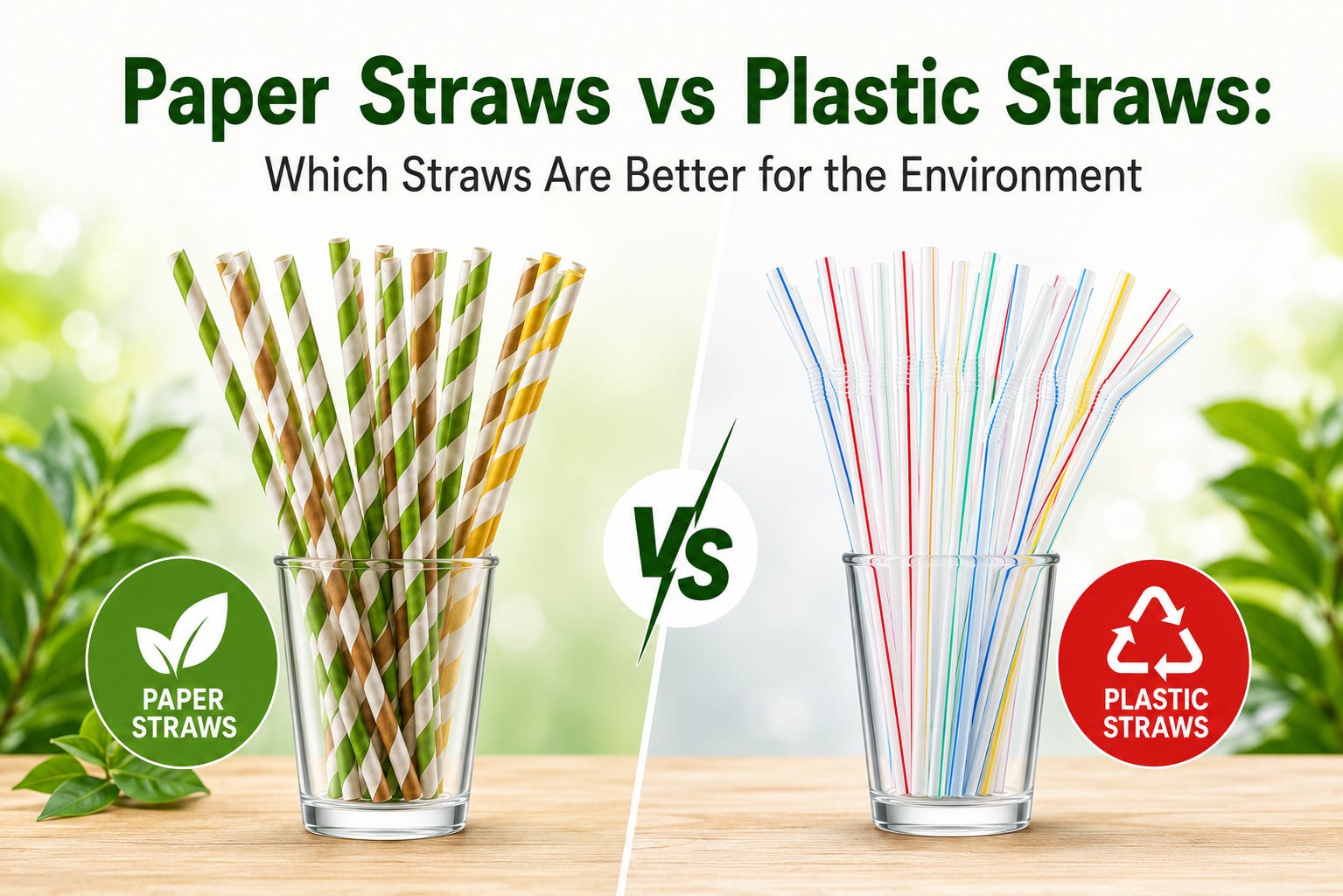
If you run a café, restaurant, or beverage brand in India, you’ve probably already switched to paper straws — you didn’t have much choice after the 2022 single-use plastic ban. But a question keeps surfacing from customers and procurement teams alike: are paper straws actually biodegradable, or is that just packaging talk?
It’s a fair thing to worry about. You’ve absorbed a higher per-unit cost, dealt with soggy-straw complaints, and told customers this switch was “better for the planet” — only to see headlines questioning whether paper straws break down at all, or whether they carry chemicals of their own. Before you re-evaluate your supplier or your messaging, it’s worth separating what the research actually shows from what’s just assumed.
This guide walks through the real biodegradability data, the PFAS controversy, how paper straws stack up against plastic and other alternatives, and what compliant sourcing looks like for a business operating under India’s current packaging rules.
Are Paper Straws Biodegradable?
Yes — uncoated paper straws are genuinely biodegradable, typically breaking down within two to six weeks in composting or natural conditions, compared to roughly 200 years for a plastic straw. However, some paper straws use water-resistant coatings that can contain PFAS (”forever chemicals”), which don’t break down and can complicate that biodegradability claim. The material matters more than the marketing label.
What Paper Straws Are Actually Made Of
Most commercial paper straws are made from food-grade kraft paper, wound into a tube and bonded with a food-safe adhesive. To stop them from turning to mush in a cold drink, manufacturers apply a thin water-resistant coating — usually a wax, a plant-based polymer, or in some cases a fluorochemical layer.
That coating is the whole story here. An uncoated or plant-polymer-coated straw behaves very differently, from a decomposition standpoint, than one treated with certain fluorinated coatings. This distinction gets lost in most marketing copy, and it’s the source of a lot of the current confusion.
How Paper Straws Break Down
In a composting environment, untreated paper straws lose structural integrity within days and fully decompose within a few weeks, since the cellulose fibers are broken down by naturally occurring microbes. In open landfill or ocean conditions, the process takes longer but still completes in a matter of months rather than centuries.
Compare that to a standard polypropylene plastic straw, which persists in the environment for roughly two centuries, slowly fragmenting into microplastics rather than fully disappearing.
The PFAS Complication: What the Research Actually Found
This is where the “are paper straws biodegradable” question gets more nuanced. A 2023 study led by researchers at the University of Antwerp, published in Food Additives & Contaminants, tested 39 straw brands across five materials. It found PFAS in the large majority of paper straws sampled — a higher detection rate than in plastic straws in the same study.
The lead researcher noted that this finding matters because PFAS are extremely persistent chemicals, meaning a straw coated with them isn’t fully biodegradable in practice, regardless of the paper base. An earlier 2021 University of Florida analysis reached a similar conclusion, detecting PFAS compounds in the majority of plant-based straws it tested, with a portion of those compounds shown to leach out under beverage-like conditions.
The important caveat for business owners: PFAS wasn’t found in every brand. Researchers believe contamination often comes from the coating process, recycled paper stock, or the water used in manufacturing — not from the paper itself. Steel straws were the only material to consistently test PFAS-free across these studies, and reputable paper straw makers have since moved toward certified PFAS-free coatings to address exactly this concern.
What this means practically: biodegradability isn’t a yes/no property of “paper straws” as a category — it depends on the specific coating your supplier uses. Ask for documentation, not just a “biodegradable” label on the box.
Paper Straws vs Plastic Straws: A Business Comparison
Factor Paper Straws Plastic Straws Decomposition time 2–6 weeks (uncoated) ~200 years Legal status in India Permitted Banned under SUP Rules since July 1, 2022 Cost per unit (bulk) Higher — typically 3–5x plastic Lower, but no longer a legal option for most food businesses Microplastic risk Minimal High — fragments rather than fully decomposing PFAS risk Possible, coating-dependent Also possible, material-dependent Shelf/drink life Softens after 20–40 minutes Holds up indefinitely Customer perception Generally seen as eco-conscious Increasingly seen as non-compliant/outdated Compostable certification available Yes (IS 17088 in India) Rare
For most Indian food and beverage businesses, this comparison is now somewhat academic — plastic straws aren’t a legal option regardless of preference. The real decision is between paper and other compliant alternatives.
The Effect of Plastic Straws on the Environment
It’s worth remembering why this shift happened in the first place. India generates several million tonnes of plastic waste annually, and single-use items like straws — cheap, disposable, and rarely recycled — were identified as a disproportionate contributor to litter and marine pollution relative to their utility. That’s the reasoning behind the Ministry of Environment, Forest and Climate Change’s 2022 notification banning the manufacture, sale, and use of plastic straws nationwide, under the Plastic Waste Management Amendment Rules.
Plastic straws don’t fully biodegrade; they photodegrade into progressively smaller fragments, eventually becoming microplastics that persist in soil and water for generations. That’s the core environmental case that paper and other alternatives were meant to solve — even if the solution turned out to be more complicated than “just switch the material.”
Plastic Straw Alternatives Beyond Paper
Paper isn’t the only compliant option, and depending on your business type, it may not always be the best one.
Bamboo straws — Reusable, sturdy, but require washing between uses; better suited to sit-down restaurants than takeaway.
Stainless steel straws — Durable, PFAS-free in every study to date, ideal for dine-in service; not practical for single-use or delivery.
PLA (plant-based bioplastic) straws — Compostable under industrial conditions, hold up well in cold drinks, but require certified composting facilities to break down properly.
Sugarcane bagasse straws — Made from sugarcane fiber waste, biodegradable, increasingly used by Indian FMCG and QSR brands.
Glass straws — Premium, reusable, best for cafés and bars rather than high-volume delivery.
Each of these solves a slightly different problem — cost, durability, or drink-holding time — so the right choice depends on your service format more than any single “best” material.
What This Means If You Run a Business in India
Under India’s Plastic Waste Management Rules, plastic straws have been banned since July 1, 2022, and enforcement responsibility sits with the Central Pollution Control Board and state pollution boards. If your business serves food or beverages, using a compliant alternative isn’t optional.
Two things are worth checking with any straw supplier before you place a bulk order:
FSSAI food-contact compliance — straws touching food or drink should meet the relevant Indian Standard specifications for food-grade paper (such as IS 6615/IS 1776), not just claim to be “food safe.”
Compostability certification — genuinely compostable straws in India are certified under IS 17088. A “biodegradable” claim without this certification is worth double-checking, since it isn’t independently verified.
A practical example: A mid-sized quick-service restaurant chain switching straw suppliers after the 2022 ban found that its first low-cost paper straw batch softened within 15 minutes in cold beverages, triggering customer complaints. Moving to a supplier with IS 17088 certification and a documented PFAS-free coating resolved both the durability issue and the “is this actually eco-friendly” question from customers — at roughly 20% higher cost per unit, which the business absorbed into its overall packaging budget rather than passing on per drink. This is a fairly typical trade-off: certified, better-coated straws cost more, but reduce both compliance risk and reputational risk.
Common Myths About Paper Straws, Debunked
Myth 1: “All paper straws are equally biodegradable.” False. Coating type determines this, not the paper base alone.
Myth 2: “Paper straws are automatically PFAS-free because they’re not plastic.” False. Multiple independent studies found PFAS in a majority of paper straw samples, usually from the coating.
Myth 3: “Switching to paper straws alone makes a business sustainable.” Not by itself. Straws are a small fraction of a business’s total packaging footprint; cups, cutlery, and takeaway containers usually matter more.
Myth 4: “Paper straws are banned too, like plastic.” False. Paper straws are explicitly permitted under India’s SUP rules — only plastic straws were banned.
Myth 5: “Compostable and biodegradable mean the same thing.” Not quite. Biodegradable means it breaks down naturally over time; compostable means it breaks down into non-toxic components within a defined timeframe under specific conditions, and is a stricter, certifiable standard (IS 17088 in India).
Frequently Asked Questions
Q1: Are paper straws biodegradable in landfills, or only in compost? Uncoated paper straws will biodegrade in both settings, though the process is slower in landfill conditions due to lower oxygen and microbial activity than in an active compost pile.
Q2: Do paper straws contain harmful chemicals? Some do, primarily in their water-resistant coating. Independent testing has found PFAS in a majority of paper straw brands sampled, though concentrations were generally low and consumer exposure from occasional straw use is considered limited by the researchers involved.
Q3: How long does it take a paper straw to decompose? Typically two to six weeks in composting conditions for an uncoated straw; longer, but still a matter of months, in general landfill conditions.
Q4: Are paper straws more expensive than plastic straws for my business? Yes, generally 3–5 times the per-unit cost of plastic, though this is now a moot comparison for most Indian food businesses since plastic straws are banned.
Q5: What’s the most eco-friendly plastic straw alternative for a restaurant? It depends on service format: bamboo or steel for dine-in, sugarcane bagasse or certified paper for takeaway and delivery, and PLA where cold-drink durability matters most.
Q6: Is bagasse or PLA better than paper for biodegradability? Bagasse straws are compostable in home or industrial settings; PLA typically requires industrial composting facilities to break down within a reasonable timeframe, so check what’s available in your city before choosing it.
Key Takeaways
Uncoated paper straws are genuinely biodegradable, decomposing in weeks rather than centuries.
The PFAS coating issue is real but supplier-dependent — it’s not a reason to avoid paper straws outright, but a reason to vet your supplier.
In India, plastic straws are banned; paper, bamboo, steel, PLA, and bagasse are the compliant options, each suited to different service formats.
Look for IS 17088 compostability certification and FSSAI food-contact compliance before placing a bulk order, rather than relying on packaging claims alone.
If you’re sourcing straws for your business, ask your supplier directly for their compostability certification and coating composition — it’s the single fastest way to separate a genuinely biodegradable paper straw from one that just says so on the box.
Comments
Nothing yet. Say the first thing.
Sign in to join the conversation.