
Hello, and welcome to Animated, where I share a weekly dose of animation, gift‑wrapped for you to share with friends and family. I’ve spent this week researching and writing an animated piece that will hopefully fill you with loveliness this week. As ever, my newsletter is free, but if you enjoy what you read and would like to support it, don’t let me stand in your way of buying me a coffee.
Another animation this week in my series of public service announcements. This time it’s the Canadian House Hippo campaign. This was genius.
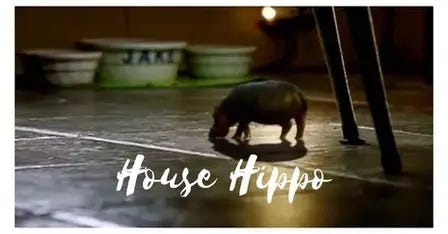
The house is quiet, and the lights are off. The kitchen is still, as a cat sits on the floor, watching something move just out of sight. A small shadow darts across the tiles, quick, low and purposeful.
The narrator tells you what you’re seeing is calm, authoritative and familiar. Importantly, it sounds like the truth.
“The North American House Hippo is found throughout Canada and the eastern United States.”
Nothing about The House Hippo asks for your attention as it already assumes it has it.
First aired in Canada in 1999, the House Hippo public service announcement was produced by Concerned Children’s Advertisers as a media literacy lesson. It shows a tiny, fictional hippopotamus living in ordinary homes, feeding on crumbs, nesting in bedroom closets, and sleeping for most of the day. It is presented as a nature documentary, observational, unhurried and well-informed.
For most of its runtime, it does hurry, and this is what struck me as different.
Unlike earlier public information campaigns that announce themselves as instruction, the House Hippo pretends not to be one. There are no rules, warnings, or even lists of things to do. It simply shows you something plausible enough to accept.
The hippo is both small and cute. The footage is imperfect as the shadows fall correctly, and the sound design is naturalistic. It’s really clever as the animal’s behaviour fits the logic of the world it inhabits.
If you’ve ever lost a mitten, if you’ve ever found crumbs where you don’t remember leaving them, the idea doesn’t feel impossible.
That is both the trap and the lesson.
The House Hippo teaches skepticism. Not through instruction, but through experience and you are allowed to believe, well, briefly, and then asked to reflect on why you did. The reveal here comes gently in a soft voice at the end, which acknowledges what just happened:
“That looked really real. But you knew it couldn’t be true, didn’t you?”
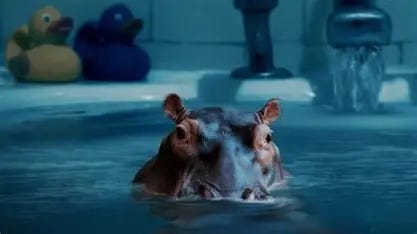
There is no scolding here or accusation; the ad assumes intelligence. It congratulates the viewer on questioning what they saw and then invites them to keep doing so after the ad, as it’s good to think about what you’re watching on TV and ask questions about it.
What’s remarkable to me is how little the House Hippo relies on fear. The hippo is harmless, cute, and the cat is mildly curious. The stakes are low, which, for me, is precisely why the message lands.
This campaign emerged at the end of the 1990s, just as digital media were accelerating, cable television was ubiquitous, and advertising was becoming increasingly sophisticated. Children were consuming more content than ever, often without guidance.
How do you teach someone to doubt without making them cynical? Seemed to be the question here, and the House Hippo’s answer was to let them be fooled, but safely.
Animation and visual effects play a crucial role here, but they are deliberately understated. The hippo was created using modified stock footage, rotoscoped and composited into live‑action environments. Shadows, focus, and colour were carefully matched so the creature appeared to belong in the space with nothing drawing attention to the trick itself.
This restraint really matters, as the ad doesn’t show you how the illusion is made; it shows you how easily the illusion works, and perhaps that is why the House Hippo has endured.
Unlike McGruff, whose message had to evolve with changing forms of crime, the House Hippo’s lesson only became more relevant. Amazingly, in 2019, it was reintroduced by MediaSmarts as part of a campaign addressing online misinformation, fake news, and digital manipulation. The hippo was the same; it was just the context had changed; the message hadn’t.
Don’t believe everything you see.
What is understood, quietly, without alarm, is that the most dangerous messages are not the loud ones; they are the calm, authoritative, well‑produced ones, the ones that sound like documentaries and look familiar.
The House Hippo does not tell you what to think; it asks you to notice how you think, and it does this so cleverly.
Placed alongside the other figures in this lineage, the House Hippo feels like an evolution, as it neither instructs behaviour nor demands vigilance. What it does well is simply plant a doubt and then trust it to grow.
The House Hippo says something quieter and harder than many other public service announcements; it asks why you believe what you believe, before it disappears into the shadows, leaving you alone with the thought.
Thanks for reading Animated. If you feel that someone else might like to read it, please feel free to share. Thank you.
No posts
Comments
Nothing yet. Say the first thing.
Sign in to join the conversation.