
Hello, and welcome to Animated, a weekly dose of animation, gift-wrapped for you to share with friends and family. This week, I have been delving deep into a piece which I hope will bring some joy to your Sunday. My newsletter is free, but if you like what you read and feel the urge to support it, coffee helps keep the research flowing.
As I continue my look at animation in public service announcements, I delve into one I hadn’t come across before in my research, as it was a very American animation. I would have been the right age but the wrong continent :) I hope you enjoy.
McGruff Takes a Bite
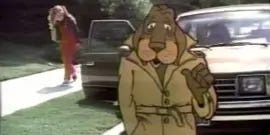
McGruff is not a soft approach. He doesn’t sugar-coat the moment with a tune or ease you in with a jovial nudge. When he appears, it’s already too late for that; instead, he stands in shadow with his trench coat buttoned and his hat pulled low with a voice roughened by cigarettes and long nights.
McGruff didn’t shout, and he didn’t scare. He spoke like someone you were meant to listen to, and for a long time, America did.
By the time McGruff the Crime Dog first appeared in 1980, the cultural ground had shifted away from an atomic age of Duck and Cover, where danger arrived from the sky, or the post‑war caution of Tufty or Charley, where accidents lurked at the edge of play. This was a world where danger lived next door, or, at least, where it felt like it did.
Crime in the United States had become a dominant public anxiety throughout the 1970s, with relentless news coverage and sensational stories filling magazines and evening broadcasts. A mixture of high‑profile murders, kidnappings, and drug panic created a sense that crime was everywhere and, even worse, ordinary people were powerless to stop it.
The Advertising Council and the newly formed National Crime Prevention Council were not trying to frighten the public into submission. In fact, they explicitly rejected fear‑based campaigns. What they wanted instead was public participation, where they checked locks and looked out for each other, the impact of small actions repeated millions of times, and, for that, they needed a guide.

In Steps McGruff
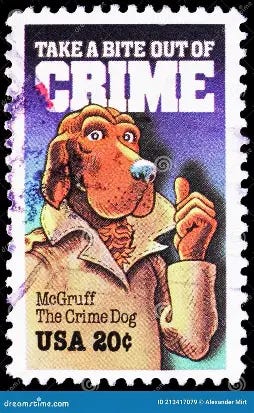
McGruff was deliberately designed in opposition to both authority figures and superheroes. He isn’t a policeman, and he doesn’t arrest anyone or burst through doors to stop crimes. He arrives after the scenario and tells you what you should have done.
That’s the key point here, as McGruff doesn’t prevent crime, but he teaches you how to handle situations.
Visually, for me, he’s a fascinating hybrid. A bloodhound, a breed associated with tracking and patience, dressed like a hard‑boiled detective. He borrows heavily from noir cinema and television: Columbo’s rumpled persistence, the world‑weary tone of private eyes who’ve seen too much. He appears tired, but not cynical, concerned, but not alarmist.
Animation plays a quieter role here than in earlier campaigns. McGruff isn’t fully animated chaos like Bert. He exists in a restrained, almost static space. Often framed in close‑up and speaks directly to the camera with minimal movement to get the audience to focus on his message.
His message is always practical: lock your doors, light your street, don’t open to strangers, report suspicious activity.
What McGruff offers is not safety, but agency. This is where the campaign subtly diverges from its predecessors. McGruff teaches responsibility, and, crucially, that shared responsibility.
Crime, McGruff insists, is not just something that happens; it is something that communities allow or resist through everyday behaviour. Clean parks are safer parks, and neighbours who know each other notice when something is wrong. It tells us that prevention is social, not heroic.
This framing really mattered, as unlike earlier public information films aimed primarily at children, McGruff now spoke to everyone. Adults were no longer background figures preparing shelters or enforcing rules; they were the audience, and that implication was uncomfortable: if crime continued, it was partly because people hadn’t done enough.
McGruff doesn’t shout this or accuse anyone. He simply states it, gravel‑voiced and steady. “Together, we can…”
When I was doing my research, that word - together does a lot of the heavy lifting in the campaigns, which I found clever.
Time After Time
Over time, the campaign adapted and McGruff addressed drugs, child abduction, bullying, and even later cybercrime. All with that some core tone. Calm, direct and slightly disappointed. He never seems to panic because panic would undermine the idea that crime is manageable through collective effort.
What’s remarkable, looking back, is how enduring the character became, as McGruff was not tied to a single fear, moment, or specific threat, like nuclear war or road safety; his main remit was permanent vigilance.
McGruff, I think, represents a shift in how public information campaigns started to understand their audience. No longer passive recipients of danger, but more than citizens were expected to participate in their own protection.
That expectation is heavy, of course, and it carries an implicit burden that if something goes wrong, perhaps you missed a sign. Perhaps you didn’t lock the door. Perhaps you didn’t look out for your neighbour.
McGruff doesn’t say this outright, as he doesn’t need to; like all the best public information characters, he works through tone, not instruction, just the collection of good habits, continuously.
Maybe that’s why he feels different, because unlike the others, McGruff never lets you off duty.
I hope you enjoyed this dive into McGruff, and thanks for reading Animated. If you feel that someone else might like to read it, please feel free to share. Thank you.
Comments
Nothing yet. Say the first thing.
Sign in to join the conversation.