
We just won big. Our campaign, Communities Against Factory Farming, has stopped our third factory farm in 8 months and saved thousands of calves from living out their lives in dark sheds. Read on to learn more but if you are able to help us get our next win donate here!
Dear Friends,
We all know our food system has been rigged in favour of big agribusiness for a loooong time. Factory farming has grown by over 20% in the last decade alone, and that’s just the megafarms we can count. Today, just ten large agribusinesses control the majority of intensive farmed animal facilities across the UK. 85% of farmed animals - well over one billion animals - are kept in factory farms per year. And that expansion has happened in defiance of virtually every available bit of science and logic. It’s destroying our nature, it’s poisoning our communities, it’s altering the climate, and it’s led to suffering on a scale most people would find genuinely unbearable if they had to look at it directly.
Oh, and it’s cost 14,000 farming jobs while it was at it. Real farming jobs. Gone. Replaced by intensification and consolidated into the hands of a handful of corporations.
So when the industry tells you “this is about jobs”... you can tell ‘em: have a word with yourself.
But here’s where it gets more interesting. Because in a system this big and this messy, with factory farm developers, objectors, planning law, environmental law, local councils, and planning officers all grinding against each other - it’s not always a grand conspiracy. Sometimes it’s just a cock-up.
When we speak to decision-makers at the council level, that’s genuinely what they tell us. They’re tired, stretched thin, and underfunded. And when a high-powered consultant rocks up with a glossy proposal, a stack of technical documents and very confident energy, it can be genuinely hard to find the time and the capacity to question every shiny claim they make. These councils are on the front line and they are not getting the support they need.
But that’s why communities across the UK are joining this movement and supporting their councils to make the brave choices.
We are proud to announce that by organising a stiff resistance, together with local residents, we have overturned planning permission for an intensive dairy calf shed at Northcombe Farm. By doing this we have together saved the lives of thousands of calves who would have gone into these sheds.
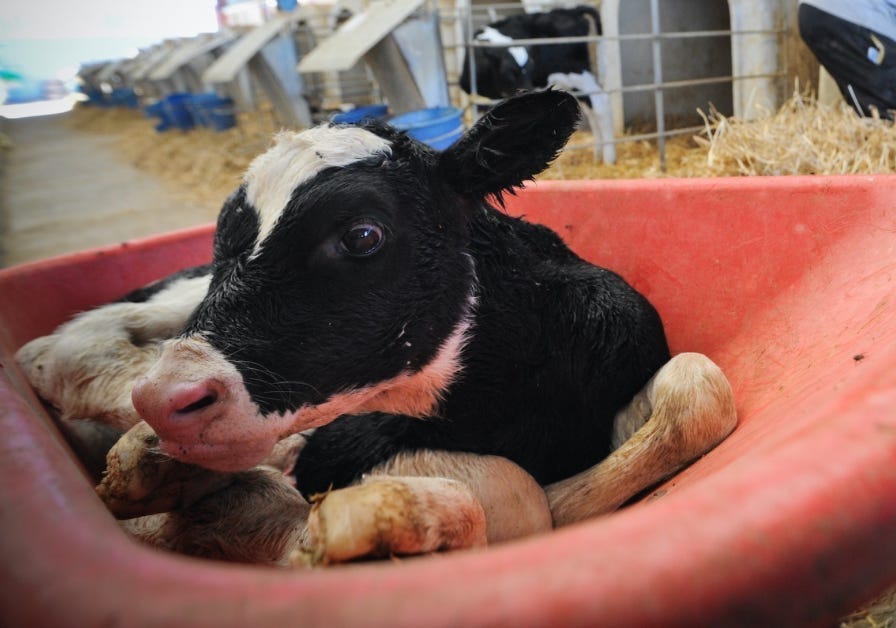
East Devon District Council has formally conceded the permission was granted unlawfully and the High Court has quashed it. The shed would have housed 200 calves at a time, reared for a nearby dairy operation, and it got waved through despite over 700 objections and pleas from local residents.
Donate to secure our next win.
This is our third intensive farm approval overturned in eight months, following successful judicial reviews of intensive chicken farms in North Norfolk and Newcastle-under-Lyme. Supported by our team, communities on the frontline who get organised keep racking up wins. And we want to tell you exactly how this one unravelled, because it tells you everything you need to know about the industry we’re up against.
The developer’s pitch to the council went something like this: yes, we want to build a large new livestock shed... but don’t worry, because it’s replacing an existing poultry shed, and poultry produces more emissions than cows. So on balance, this is actually better for the environment, there we go, Bob’s your uncle (if massive multinational supply chains could be our uncles).
It’s a neat bit of logic. Plausible-sounding. The kind of claim that arrives wrapped in technical language in a thick planning document.
Except there was no evidence that the poultry business was closing and being replaced at all! In fact, the risk was that the poultry unit would continue to co-exist with the new dairy set-up. (Planning law requires any new development to be assessed against what’s called a “fall-back position”; essentially, what would happen on that site if permission weren’t granted. Here, that was supposed to be the existing poultry shed. But the council never established whether it was still in use, or whether it was actually going to close. Without that, the whole emissions comparison was built on nothing.)
Our legal team - barrister Alex Shattock, instructed by Matthew McFeeley and Katherine Wood at Richard Buxton Solicitors - began legal action to take it to the High Court. The council conceded before we even got there. Matthew McFeeley put it plainly afterwards: the council had “not lawfully considered the additional impacts” of what it was approving and had relied on “unevidenced assumptions about a lack of impacts.”
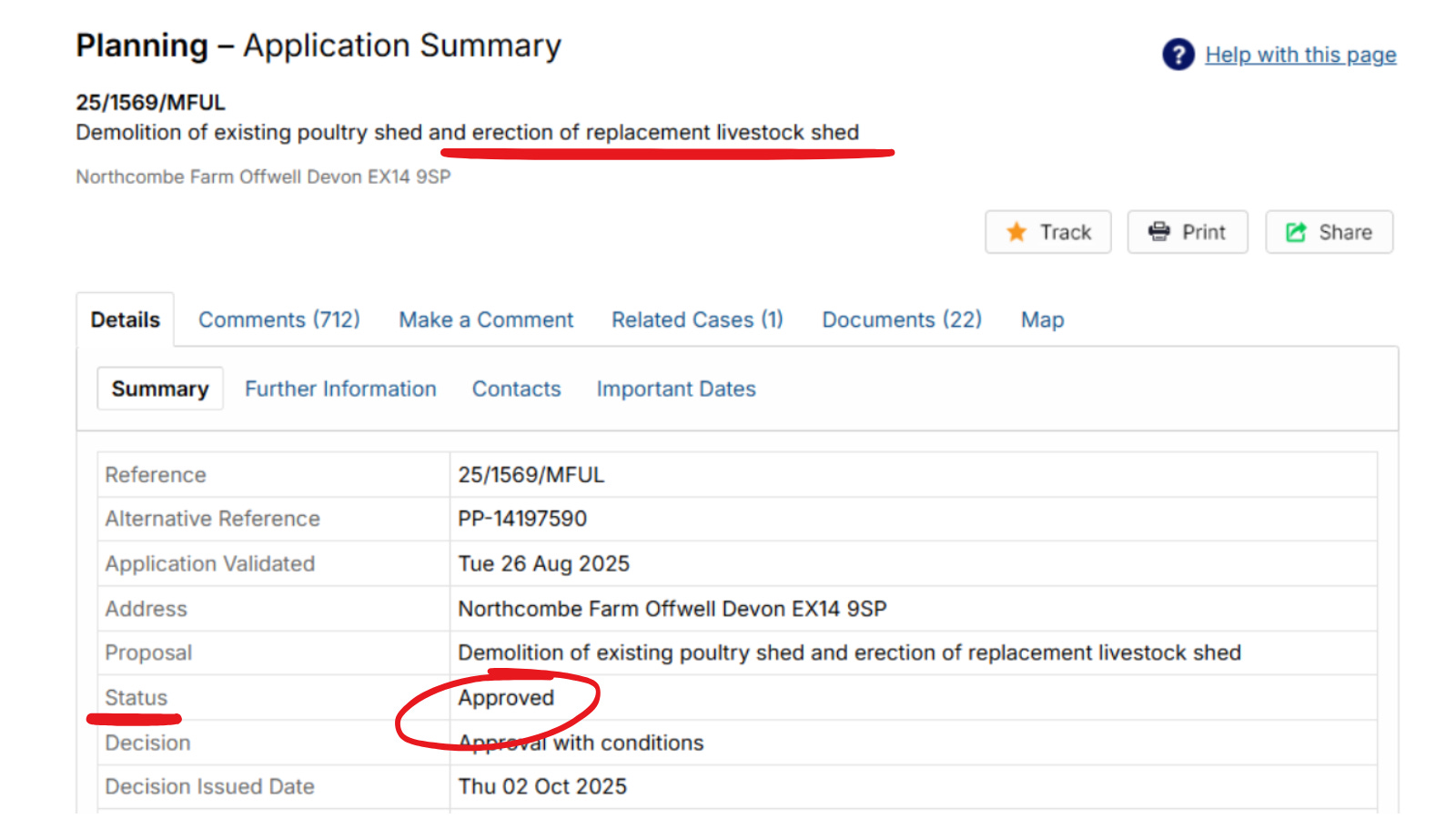
In other words, they took the developer’s word for it. We didn’t.
Catherine Cannon, a teacher from Exeter who spent her weekends leafleting her community to raise awareness, framed what’s at stake better than we could. She pointed to the National Emergency Briefing released last month by Professor Paul Behrens, which called for a shift to “healthy, plant-rich diets” and more resilient farming methods, and said bluntly that expanding intensive animal agriculture is “completely the wrong direction of travel.” She’s right. And she made the point that’s been nagging at all of us: “It shouldn’t take community campaigns and legal threats for councils to do the right thing. They should be the ones leading the way.”
We’ll keep making sure they do.
Why do factory farm approvals keep falling apart?
Here’s the pattern we keep seeing, and it’s worth naming plainly: farm planning applications are riddled with exactly this kind of inconsistency we have seen at Northcombe. Assumptions nobody tested. Claims that only hold up if nobody looks closely. Environmental arguments that fall apart the moment you ask a single follow-up question.
Maya Pardo, our Legal Strategy Coordinator at CAFF, has watched this play out case after case. As she puts it, the impacts of modern dairy production - “methane that warms the climate, ammonia that harms wildlife and locals, and manure that runs off into rivers” - are “repeatedly overlooked in planning decisions.” Residents are left feeling unheard. The environmental burden keeps growing. And the industry keeps betting that nobody will look hard enough to catch them at it.
This isn’t an accident. It’s the product of decades of impunity. Farming conglomerates have been getting waved through for so long that their planning work has become genuinely sloppy, and our communities, the environment and the animals all suffer for it. This kind of behaviour depends on nobody calling it out.
We call it out. Every time. And we’re getting faster at it.
The head of the Association of Independent Meat Suppliers (AIMs) argued our campaigning is “the biggest existential threat” to their industry “outside disease and biosecurity.” We’ll take that. They’re not wrong, we are a major threat to factory farming.
But we would gently point out that while we may be the biggest threat the Meat Industry faces, we are not the biggest threat to UK food security in general. That title belongs to none other than Factory Farming itself: whether you consider the disease outbreaks which threaten our biosecurity, or the climate shocks, and the ensuing ecological collapse that intensive farming is actively generating. We’ll leave them the crown on that one.
Our movement is the one fighting for the nation’s food security. We are fighting for good British food, grown locally, grown well, in ways that don’t poison rivers, warm the climate, rely on untold animal suffering, and hollow out rural communities. The UK government’s own national security assessment, released last month, was unambiguous: food production is the leading cause of terrestrial biodiversity loss, and Britain cannot currently feed itself on the diets and farming systems we have. Expanding intensive animal agriculture isn’t the answer to food security. It’s the threat to it.
Together we are on a tear. We’ve gotten these three wins in eight months. Beyond that, in the year since the inception of Communities Against Factory Farming, we have successfully delayed or blocked EVERY other factory farm expansion we’ve taken on. We have a legal strategy that’s working and councils are starting to pay attention. An industry that, for perhaps the first time, is looking over its shoulder.
Check our website, and if we are battling factory farm expansion in your areas, join us as a volunteer!
Each of these wins means lives kept out of dark sheds, and communities who can breathe again. We won’t rest in our mission but neither does Big Ag. Northcombe will be redecided again soon and we need to be ready to bring another judicial review.
Our next judicial review will require barristers, solicitors, expert witnesses, and court fees. The industry has deep pockets and a vested interest in grinding us out.
We will keep bringing these challenges until the true costs of intensive farming can no longer be ignored, until communities finally get the protection and transparency they deserve. But we can only do that with your support.
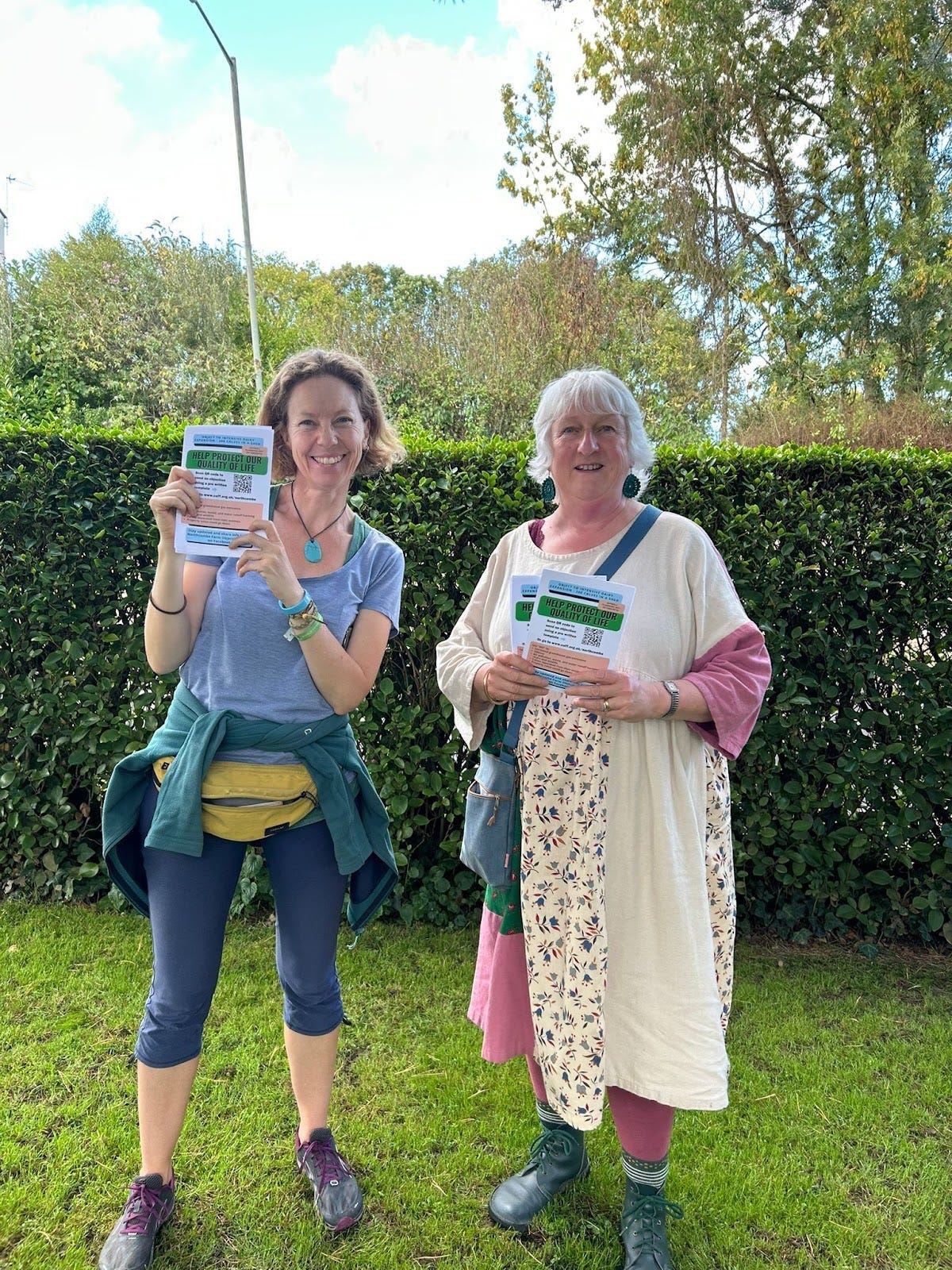
Residents fighting the good fight
PS: If you can make a regular donation that makes a huge difference in making us a sustainable campaign machine! :)
Thank you for standing with us. Our combined efforts in getting this win have saved the lives of thousands of calves who would have gone into these sheds. Now we keep moving forward.
In solidarity,
Animal Rising with Communities Against Factory Farming
No posts
Comments
Nothing yet. Say the first thing.
Sign in to join the conversation.