
Three weeks ago, Animal Politics published Do Dogs Have Friends?, an exploration of the science behind canine social bonds, sparked by a question from New York dog trainer Liz Keller. The response from readers led directly to a follow-up, Why Has Dog Training Been Slow to Catch Up With Modern Science?, which examined the gap between decades of canine behavior research and the training methods still widely practiced across an unregulated industry.
That article summarized the current scientific consensus. Clinical experience is another source of knowledge, particularly when practitioners spend years working with the most behaviorally challenging dogs. Sometimes those experiences raise questions the published literature has not yet fully addressed.
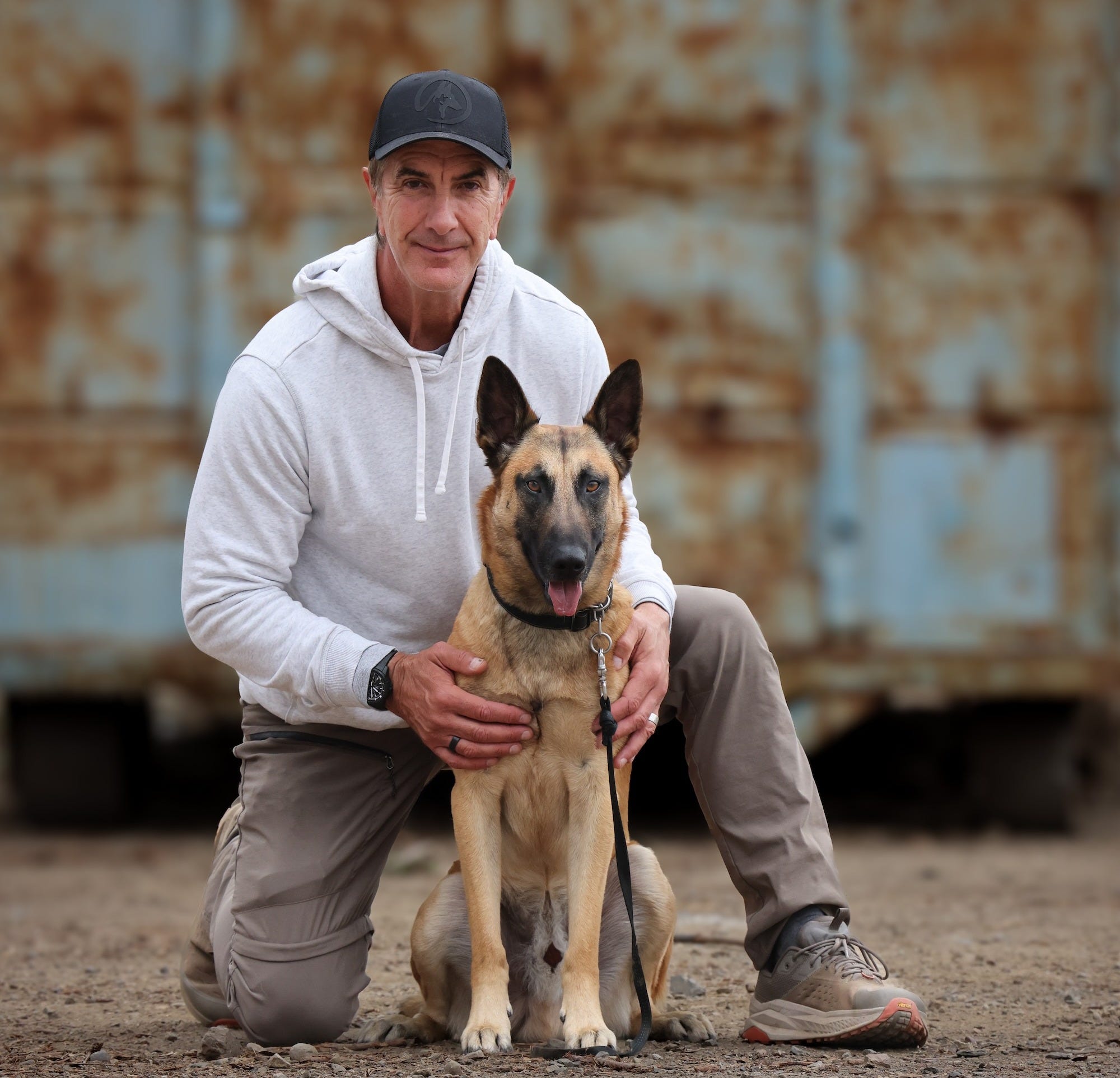
Among the trainers who responded was Robert Cabral, founder of Bound Angels, who was also referred to in the follow-up piece. Cabral has spent more than twenty years working with dogs many training approaches are not designed around: dogs surrendered as a last resort, labeled unadoptable, or one incident away from euthanasia. Animal Politics first featured his work in Breaking the Cycle: Transforming Dog Shelters for a Brighter Future, where he spoke candidly about shelter reform and the dogs that cannot always be saved.
Cabral’s response to the American Veterinary Society of Animal Behavior (AVSAB)–piece was direct. He questioned whether research based partly on owner surveys can fully capture real-world behavior, argued that certification standards may test theory more than hands-on competence with genuinely dangerous dogs, and said that a strict positive-only framework has, in his experience, failed some of the dogs it aims to protect.
He also referenced Nacho, a dog whose case became a flashpoint years ago when Cabral faced public criticism for using a brief period of correction-based training, an intervention he has always maintained saved the dog’s life. When asked to revisit that story specifically, Cabral pushed back. Not because the story is untrue, but because one case invites an argument that cannot be settled: what might have worked, in theory, that was never actually tried.
He offered a broader account instead: a pattern formed over two decades of working with high-risk dogs.
What follows is that account, in Cabral’s own words. It is not a rebuttal to the science covered in the previous two AMAs, nor an argument that positive reinforcement is wrong. It is a firsthand view from a trainer working at the point where research recommendations meet dangerous, frightened, or profoundly damaged dogs and the immediate decisions their cases can demand.
The interview reflects Cabral’s views, experience, and professional judgement. Animal Politics includes them alongside, not in place of, the scientific literature discussed in the previous two articles. Readers can decide where his experience reinforces, challenges, or expands upon that literature.
Animal Politics: Over twenty years working with shelter and behaviorally complex dogs, what pattern have you seen in cases where positive-only methods failed?
Robert Cabral: I do not like to point fingers at one particular school of training. My concern is with rigid thinking, especially when online debates make it seem as though there is only one acceptable answer for every dog.
All training should begin with a positive approach. I believe the biggest flaw in training is believing that there is only one way to train every dog, be that purely positive or any other methodology. The training that most commonly fails dogs is “no training” or training that doesn’t offer a complete spectrum approach. Never saying NO or always using an e-collar (or any other tool) is extremely flawed.
I’ve seen dogs failed by trainers who approach every dog with a prong collar and I’ve seen training fail by trainers who believed a treat and a pat on the head would solve everything.
The dog should not pay the price for our loyalty to a training label.
What is often overlooked is how the dog experiences the training. Is it productive for the dog? Is the dog learning or does the dog take the training as a personal offense? Will this dog benefit from this learning experience?
Animal Politics: What does a shift to balanced methods actually look like in practice, in terms of how corrections are used, how brief, and how paired with reward?
Robert Cabral: I do not put much stock in the labels “balanced” and “purely positive.” My focus is whether the training is fair, clear, and effective for the individual dog. Dogs need to understand what earns reward and what does not.
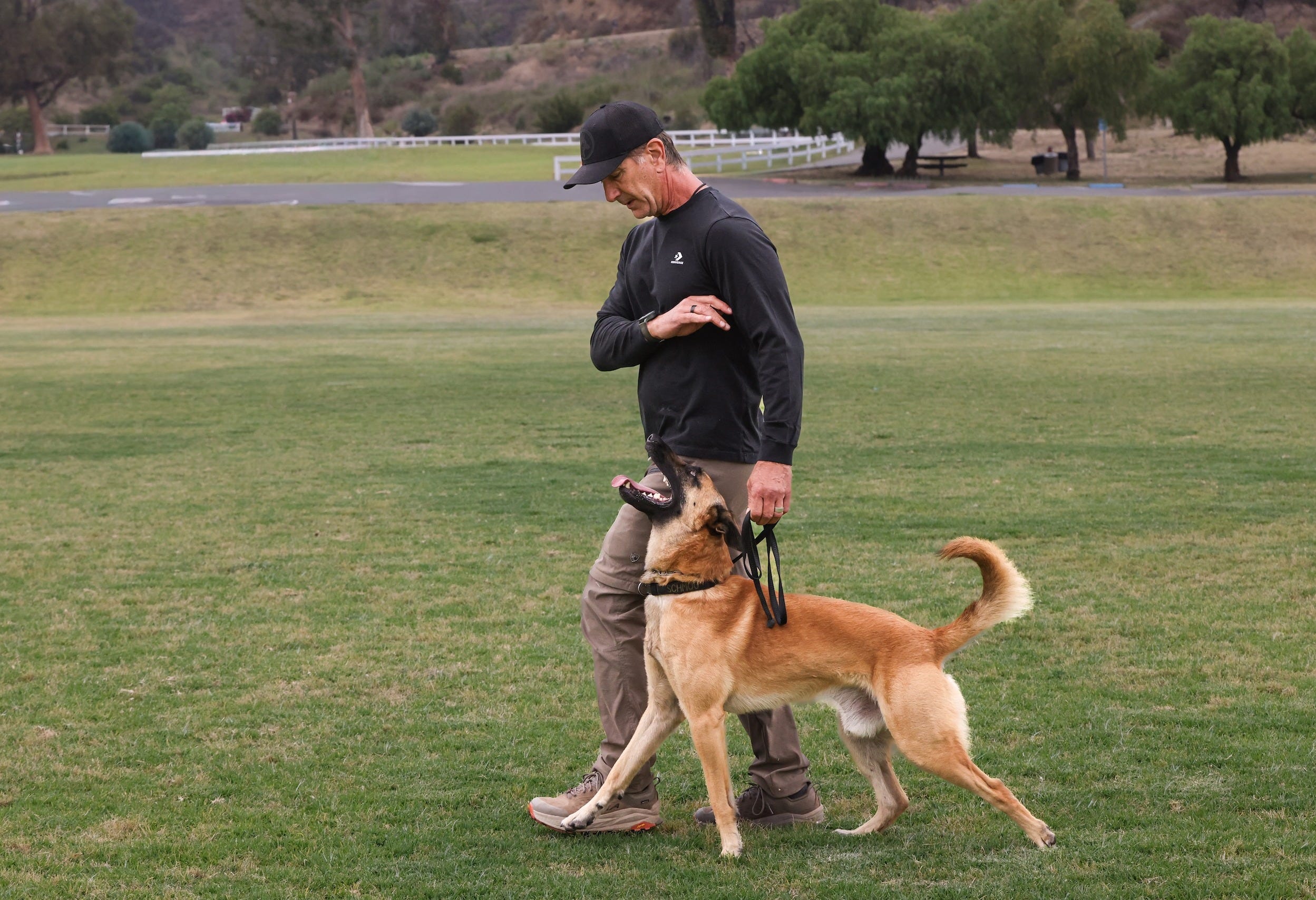
Corrections are used to interrupt unsafe or unwanted behavior and then to guide the dog to the correct behavior. We teach dogs through luring and shaping. We reward this experience to mark it in the dog’s mind and make it meaningful. The training experience should be enjoyable if we want the dog to learn. The trainer’s job is to find what makes learning meaningful and rewarding for that particular dog. Then we can move toward testing and proofing the trained behaviors.
With the exception of severe aggression or potential self-harm, we don’t correct a dog for something they don’t know. We teach it first and then start to proof it. If a dog does not respond correctly, it does not earn the reward. When it makes the correct choice, we mark and reward that choice.
A correction is designed to help a dog differentiate between the incorrect and the correct. Once it is correct we move to the reward phase.
Animal Politics: Our recent AMAs focused primarily on dogs living in stable homes with committed owners. Shelter dogs often arrive frightened, overstimulated, grieving, or facing euthanasia if they cannot improve quickly. How should readers think differently about behavior work in that environment?
Robert Cabral: I believe behavior is behavior. The main difference to consider is the amount of time a dog is given in a shelter environment. Oftentimes, the dog is stressed and acting differently in a shelter setting. What matters most at that point is “we need to make a decision IF this dog should be given a chance?” Can we spend 10 minutes evaluating the dog and testing the waters? I believe a positive approach is still 100% in order as long as we are able to pair it with structure.
For those unfamiliar with municipal shelters, countless dogs enter every day, and every day some are killed. Keeping a dog with behavioral problems alive is rare. Shelters often do not have months to rehabilitate a dog or board-and-train programs that can take dogs home. You are dealing with a triage mentality. This does not excuse heavy-handed training, but it does mean staff must quickly determine what may help a dog and whether there is a safe path forward.
I have trained many dogs in shelters using positive training. I have trained dogs in peoples’ homes that needed more structure than some in the shelter setting. Every dog deserves fair training. The difficulty in a shelter is that we often know little about the dog’s history, triggers, or coping skills. We have to protect staff, the public, and the dog while learning who that dog is.
Animal Politics: How do you personally judge whether a correction is working versus causing harm?
Robert Cabral: Corrections are not designed to do harm to the dog, they are designed to block incorrect behaviors. If the correction stops the unwanted behavior and helps reduce future recurrences, it is working. Corrections are designed to be teaching tools, a method of communication.
A dog learns through the consequences of its choices. The trainer must make the desired choice clear and worthwhile.
It is important to stress that rewards must be something the dog likes. If I am using a tug toy as a reward for a dog that does not like to tug, that is no reward, and I should not expect the dog to work for it. A dog with little food drive may not work as diligently for a treat as it will for a toy.
Effective training means connecting with the dog at the dog’s level. That individual connection is often the difference between following a protocol and actually reaching the dog in front of you.
Animal Politics: AVSAB’s current position states that aversive methods “should not be used under any circumstances.” How do you respond to that language, and do you think funding on both sides of this debate shapes which research and which voices get heard?
Robert Cabral: Funding can influence what gets studied, how it’s framed, and which questions receive attention. That’s true across many fields, which is why I think it’s important to look at the totality of evidence and compare it with real-world outcomes.
AVSAB approaches these issues primarily from a veterinary behavioral perspective, while my work has been in shelters and with high-risk dogs in real-world settings.
My concern with “under any circumstances” is the emergency a handler cannot always prevent. A dog may suddenly lunge toward traffic, another dog, or a person. Responsible trainers should use distance, management, equipment, and planning to reduce those risks. But they also need to be honest about what must happen in the seconds when safety is at stake.
They go on to state: “Animals with challenging behavior disorders such as aggression should be treated with effective, compassionate, and humane methods... There are no exceptions to this standard.” But in my view they offer too little practical guidance for the emergency situations trainers sometimes face.
In an earlier position statement, AVSAB allowed punishment as a limited option after reward-based methods and environmental management had been given adequate effort, provided it was part of a broader behavior modification plan administered by someone who understood the potential risks. I believe the shift to an absolute prohibition reflects a broader philosophical change. My concern is that blanket rules may not account for every high-risk, real-world case.
Dog training is not one-size fits all.
No one is advocating heavy-handed training. My view is that, in limited situations, a fair correction may involve temporary stress while ultimately leading to greater safety and freedom for the dog.
No training approach is completely free of stress. The responsibility is to minimize unnecessary stress while giving the dog the best realistic chance of safety and freedom.
Animal Politics: Funding bias is a legitimate concern across science. Do you believe that concern applies equally to privately funded trainers, equipment manufacturers, online education businesses, and social media platforms that profit from promoting particular training philosophies? How do you guard against confirmation bias in your own work?
Robert Cabral: There are countless situations like you mention. There are online training courses as well in person dog training courses that market aggressively to aspiring trainers. They preach a one-size-fits-all approach. There are franchise training companies that train people quickly and turn them out with a set program for every dog.
Some rely on a fixed tool or protocol for every dog. That is poor training, whatever label it carries.
The bottom line is that rigid, dogmatic approaches on either side are flawed.
Animal Politics: You have described rigid thinking as a danger on both sides. What checks do you use in your own work to make sure a successful outcome does not simply confirm what you already believe? Do you use video review, follow-up from adopters, consultation with other trainers, or any written measure of behavior change?
Robert Cabral: My first measure is simple: did the dog’s behavior actually improve, and did it stay improved? That’s what matters to me. I also rely heavily on follow-up, when possible. In shelter work, I look at whether the dog was successfully adopted and remained successful in the home. Sometimes that is not possible due to privacy issues, but I try.
With private clients, I follow up to see if the behavior has truly changed, not just during the lesson but weeks and months later. I also talk with other experienced trainers all the time. I’m always open to learning a better way if it produces better results. My goal has never been to prove I’m right, it’s to help the dog in front of me.
Animal Politics: You pointed out that several of the studies cited in this debate, including findings on stress in aversively trained dogs, are based on owner-reported surveys rather than controlled behavioral observation. Why does that distinction matter, and what would better evidence actually look like?
Robert Cabral: Survey-based research should carry less weight when it relies on owners who may not have training in canine behavior or stress signals.
Often they are the pet owners themselves. While they know their dogs better than anyone, most have not been trained to identify subtle body language, stress signals, or behavioral changes that trained professionals are taught to recognize.
Owner surveys can identify patterns worth studying, but they are not, by themselves, the same as direct behavioral observation conducted by experienced professionals.
Even when researchers directly observe dogs, interpreting stress is not always straightforward. One dog may refuse food because it is anxious, another because it has already eaten, and another because food simply is not a strong motivator. Those differences matter when interpreting behavior.
A second question is whether short-term stress predicts long-term welfare or long-term outcomes. For example, a dog trained in livestock or rattlesnake avoidance may experience stress during training but avoid a life-threatening situation later. Is the temporary stress of a vaccination worth the protection it provides? Is the discomfort of surgery justified by the long-term outcome? Those are the kinds of questions I think research should also address.
Animal Politics: Many of the published studies on reward-based versus aversive training do rely on owner questionnaires, but others include direct behavioral observation, physiological measures such as cortisol, or controlled experimental designs. Are you arguing that the survey-based studies should carry less weight, or that the entire body of evidence should be discounted?
Robert Cabral: The studies that include direct behavioral observation, physiological measures, or controlled experiments are stronger evidence than owner surveys. I don’t dismiss them.
My hesitation comes from how much they can tell us about the kinds of dogs I see every day. Working with thousands of dogs with different genetics, histories, environments, and levels of risk is very different from studying a more controlled group.
Controlled research and daily field experience answer different parts of the question. I believe both should inform how we work with dogs.
Animal Politics: Have you had direct discussions with AVSAB members about these concerns? If not, what evidence would persuade you that their recommendations reflect more than ideology?
Robert Cabral: I can’t say with certainty that the Veterinary Behaviorists I’ve helped were AVSAB members. I can say they were rational people who were stuck with their own dogs and needed help.
The usual recommendations often include medication when appropriate, management, and gradual exposure to the trigger. The issue is that in the real world, we cannot always control the stimuli or the environment. When we can, gradual exposure can be useful. The problem comes when we cannot.
That is where practice becomes difficult. In theory, we keep a dog-aggressive or reactive dog at a ten-meter distance from other dogs until we can help the dog settle. In reality, we may attempt that and a person approaches from behind with another dog.
Animal Politics: Is there research supporting balanced methods that you’d consider more rigorous, or is the case for balanced training built primarily on documented outcomes and trainer experience? I ask because I want to hold every source in this series to the same standard of evidence.
Robert Cabral: I don’t believe a single study should establish a universal rule for every dog or every circumstance.
The evidence becomes more persuasive when different researchers, working in different settings with different populations of dogs, continue reaching similar conclusions.
The challenge is that dogs vary enormously in breed, temperament, history, environment, and handling. Those variables don’t make research impossible, but they do make it harder to determine whether the same conclusions apply equally to every individual dog and every situation.
Animal Politics: Science rarely deals in absolute proof. It builds confidence by accumulating evidence from different methods over time. Would you agree that the question is not whether any single study is definitive, but whether the overall weight of evidence points in one direction?
Robert Cabral: I agree. The problem is when people treat the study that supports their preferred view as the final word. It should be obvious to us on either side of an argument that one single study is never enough, and confidence grows when findings are repeated and supported by different forms of evidence.
Animal Politics: If research cannot fully reproduce the conditions you describe, what would a persuasive body of evidence look like to you? For example, would you want long-term follow-up of comparable high-risk dogs, transparent descriptions of each intervention, independent video review, bite and placement outcomes, and measures of both safety and welfare?
Robert Cabral: The kind of evidence I’d find most persuasive would follow comparable high-risk dogs over time, clearly document the methods used, include independent behavioral assessments, and report long-term outcomes such as bite recurrence, placement success, and quality of life.
Even then, I don’t think research replaces sound clinical or professional judgment. It should inform that judgment, not eliminate the need to evaluate the individual dog in front of you.
Animal Politics: Earlier, you argued that many veterinary behaviorists rely too heavily on medication. Some would respond that medication is intended to reduce anxiety enough for learning to occur, rather than replace training altogether. What have you seen in your own work, and where do you think medication fits, if at all, alongside training?
Robert Cabral: Medication can be a short-term helper for dogs that need training. But keeping dogs in an induced state to prevent behavior is not a complete solution.
We don’t criticize a doctor for prescribing medication when it’s appropriate. We also don’t criticize a physical therapist for making someone do difficult exercises. Both can be necessary.
Medication may help create a calmer state for learning. Training, management, and appropriate boundaries still have to teach the dog what behavior is expected.
Medication can reduce anxiety or arousal, but it doesn’t teach the dog what behavior is expected. Training, including reinforcement, management, and, depending on one’s philosophy, corrections, is what teaches behavior.
Animal Politics: What happens to a dangerous or seriously reactive dog when positive-only is applied for too long without success?
Robert Cabral: If dangerous behavior repeatedly succeeds in creating distance from a person, dog, car, or other trigger, it may become more practiced and harder to change.
This is where we need to focus on the dog’s response to the interaction. A behavior that is not addressed may become stronger and stronger. Aggression can have different causes, including fear, frustration, guarding, pain, prior learning, or a need to create distance. The trainer has to understand what is driving the behavior.
Unless we can teach the dog that it can be safe and make better choices, the dog may continue to rely on behavior that has worked in the past.
Animal Politics: Is there a case from your years of work that best illustrates this pattern, one where you saw a dog go from crisis to a genuinely good outcome?
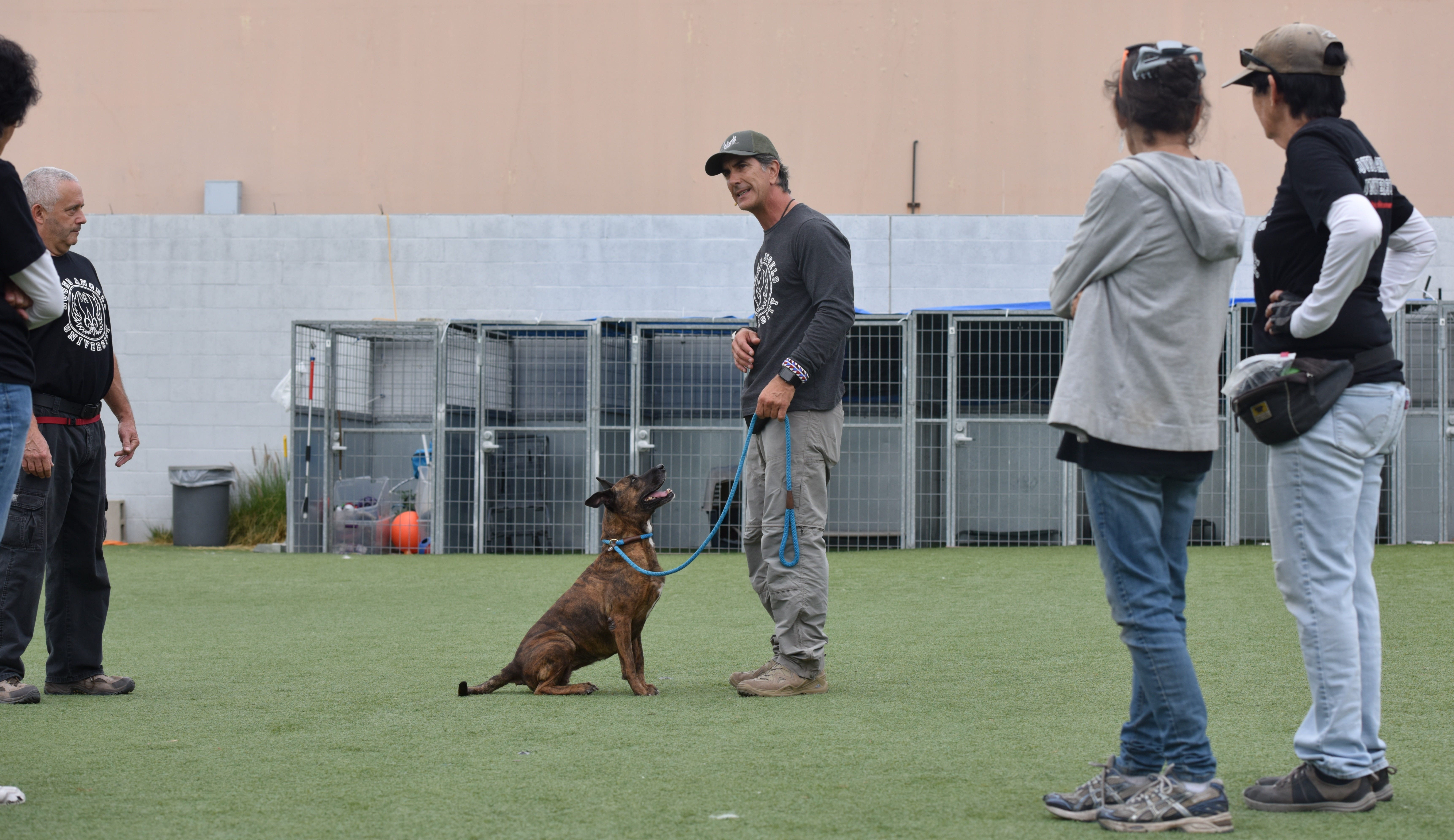
Robert Cabral: There are many. I was just looking through videos the other night of some training I did at the Ventura Shelter many years ago. We were working near the behavior kennels where the dogs are housed when they have serious behavior problems, basically before they are killed. We took several severely aggressive dogs out and briefly worked with them. I was given a short amount of time to see if any of these dogs showed enough potential to be saved. Many showed potential. Interruptive behavior, reward and clear communication helped many of these dogs.
There are countless dogs I’ve worked with and rescued including Zeus who made a monumental transformation with fair training. Zeus was slated to be put down in a local LA City shelter. I worked with him for about 30 days and placed him in a home where he lived for more than ten years until he died of cancer.
One of my own dogs, Boots, was severely aggressive to both people and dogs, and due to be put down in another LA City Shelter. He lived with me and my dog Silly until he died of heart failure.
You yourself witnessed the dog at Yavapai, Nacho, who was scheduled to be put down. I believe I worked with that dog for 15 minutes and showed more progress in that time than months of previous work. Nacho was scheduled to be killed by the time my plane took off. Instead he had a very happy life.
The Nacho case also brought intense public criticism. My concern is that public debate can become so focused on defending a philosophy that people stop looking honestly at the dog, the circumstances, and the outcome.
Editor’s Note: Animal Politics’ editor, then executive director of Yavapai Humane Society, witnessed Cabral’s intervention and reversed Nacho’s euthanasia decision afterward. Nacho was later transferred to Lake Havasu Humane Society, where he became a shelter mascot and was ultimately adopted.
Animal Politics: You’ve mentioned you’ve called out bad practices among balanced trainers too, and that you don’t even use the term “balanced” anymore. Why not, and what worries you about how that label gets used?
Robert Cabral: I hate labels. Labels can become a substitute for judgment.
There are people in the “balanced” group that are very heavy handed and then use the term balanced to hide behind.
Training should begin with positive interactions, relationship-building, teaching, and guidance.
We use teaching corrections to help a dog learn right from wrong. I have seen good trainers across disciplines who are willing to learn, grow, and put the dog ahead of the label.
Animal Politics: Many reward-based trainers would respond that “purely positive” is itself a straw man, because modern learning theory includes negative punishment, management, extinction, differential reinforcement, and environmental control. Are you responding to the science itself, or to how some trainers interpret it in practice?
Robert Cabral: I’m responding to how it’s applied in the real world. A lot of trainers say they’re not “purely positive,” but in practice they avoid fair corrections because of ideology. I have no issue with learning theory. My issue is when theory gets elevated above experience and common sense. Dog training isn’t about defending a philosophy. It’s about doing what works fairly for the dog in front of you.
Animal Politics: Listening to you, it sounds as though you are arguing against ideological rigidity rather than against positive reinforcement itself. Is that a fair summary?
Robert Cabral: 100 percent fair. I have no problem with positive reinforcement. In fact, I use that approach more than any other in my training, whether with my dog, client dogs or shelter dogs. Everything starts with positive reinforcement and relationship-building, then goes from there.
Rigid thinking can prevent trainers from responding to the dog in front of them.
Animal Politics: Can you think of an example where published behavioral research genuinely changed or improved your own training over the past twenty years?
Robert Cabral: Not directly. My biggest improvements have come from hands-on experience rather than published behavioral research. That does not mean research has no value, but I do not look to it to tell me how to train dogs. I use it to understand ideas, then test those ideas in the real world. If they work consistently across many dogs, I keep them. If they do not, I move on.
Animal Politics: Looking back over your career, is there something you once believed strongly about dog behavior that you later changed your mind about?
Robert Cabral: I’ve come to appreciate the relationship with the dog even more. Years ago, when most of my work was focused on serious behavior cases, I focused more on getting the behavior. In recent years, I’ve added more obedience and fun training, and I use more patience in the small details.
I have come to value the smallest details in training.
I spend more time breaking complex things into bite-sized pieces. We turn them into little games, then put the pieces together. The result is more enjoyable training and a stronger connection.
Experience has made me more patient, more precise, and fairer than I was twenty or thirty years ago. I am also fortunate to have friends among competition trainers in protection, agility, and obedience. Our exchange of ideas and approaches gives me tools to keep learning.
Animal Politics: What would you want a new trainer, or a worried dog owner, to understand about when and why these methods matter?
Robert Cabral: I have a simple test: Would you want to train with you on the other end of the leash? Giving a correction is certainly not the worst thing to befall a dog. Clear and fair corrections followed by reward and more freedom are a gift that every dog deserves.
Dogs rely on us for guidance.
It is our job to help them succeed in a human world. Owners should learn how to communicate clearly, reward what they want, manage risk, and get qualified help when the behavior is beyond their ability or presents a safety concern.
Animal Politics: You’ve said publicly that there’s nothing new in dog training, just variations on the same theme. If that’s true, what do you think has actually changed in the dog training industry over your career: how people talk about methods, how they market them, and how owners understand them?
Robert Cabral: It is important to understand that just because something is new to one person, that doesn’t mean that it is a new concept. Yes, we understand the brain science of dogs better, but science has given us more ways to observe and describe how dogs learn and connect with us.
As for training, we have long known that dogs learn better when they enjoy the process. We know that negative experiences can become lasting memories.
When I say there is nothing new in dog training, I am referring to foundational principles of learning. Dogs still learn through the same mechanisms they always have. What changes is how individual trainers package, teach, combine, or emphasize those principles. That is marketing, not invention. A trainer becoming better at applying an old principle does not make the principle new.
Science helps us observe, test, and refine how those principles are applied.
Animal Politics: Is there anything about this debate that you think both sides get wrong?
Robert Cabral: Yes, 100 percent. It is the ego. These “sides” are more focused on winning their ideology than helping dogs. Like any movement, there are people on both sides who become dogmatic. Those are the voices that tend to dominate online.
Neither extreme is right. Some people claim any correction will permanently damage a dog; others claim e-collars are essential to save dogs. I do not accept either position as a universal rule.
If we do not start focusing on dogs and give up the goal of proving there is only one way, we will lose, and the biggest losers will be the dogs.
I have spent more than 20 years working in and with shelters. I have never used a tool other than a slip lead in a shelter. I have used e-collars and prong collars in my private life and see their benefit when used properly. I have used positive training methods successfully and prefer them whenever possible.
Dogs are extremely complex, yet uncomplicated. We need to meet them where they are. We need to give them what they need, not what we think they need. We need to keep the dog, rather than our need to be right, at the center of the work.
I would rather be wrong and help a dog than force my position to be right and harm or lose a dog.
Animal Politics: That sounds remarkably similar to what many veterinary behaviorists say about individualized treatment plans. Is the real disagreement less about individual dogs and more about where different trainers believe the boundaries should be?
Robert Cabral: I think the disagreement is more about philosophy than the individual dog. I don’t believe any one method should be off the table because of ideology. Every dog is different, and the trainer’s job is to choose the fairest, most effective approach for that dog, not force every dog into the same training philosophy.
Animal Politics: If you were responsible for a large municipal shelter facing severe overcrowding and limited staff, what would your behavior program look like? What would you prioritize during the first thirty days?
Robert Cabral: To think that a behavior program would help a shelter facing severe overcrowding is a fantasy. A behavior program cannot solve an intake crisis on its own.
The measures most likely to reduce intake include enforcement of illegal breeding laws and targeted spay-neuter programs. Fair behavior assessments can help shelters make better placement and safety decisions, though assessments have real limitations.
Good assessments and follow-up can help reduce repeat shelter entry and improve placement decisions.
Animal Politics: You are right that behavior work cannot solve an intake crisis by itself. But while a shelter works on enforcement, targeted sterilization, and reducing intake, what are the minimum behavior and safety practices that should be in place? For example, how would you approach intake observation, kennel handling, bite-history review, staff safety, enrichment, foster placement, rescue partnerships, and euthanasia decisions?
Robert Cabral: Let’s take these step by step:
Intake observation should be weighed by observation as well as relinquishment information gathered from the people relinquishing (if possible). For strays, I look at basic confidence, environmental issues, dog-to-dog issues, issues with people / handling. These things can be addressed in training, but I want to know what we’re dealing with early on. Safety for staff and the public should remain the highest concern.
There should be basic protocols in place for safe handling of dogs in and around kennels as well as other dogs and basic leash handling skills can go a long way to ensure more safety.
Bite history review should be taken seriously (even though people lie about this at relinquishment). Reading basic canine body language and using caution is critical especially during the first few days when dogs can be highly stressed. Stress can skew behavior dramatically. This is why off-premises walks by trained volunteers and staff can give us additional insight as to the personality of the dog.
Enrichment is mainly designed to make the stay in the shelter less stressful and I’m a huge fan. Things like playgroups, puzzles, music, lick mats and stuffed kongs all help to ease mental strain on dogs in shelters. This will serve to reduce stress, but a biting dog will still bite even if the stress is alleviated. Enrichment can reduce stress and may reduce behavior problems associated with the shelter environment, though it does not resolve every serious safety concern.
Foster placement and rescue partnerships can be the lifeblood of saving dogs as long as these partners are willing to follow some training protocols to make dogs more adoptable. Basic obedience training is one of the most important things that will help reduce repeat shelter entry. Socialize and train these dogs and they are ready for their forever homes.
Euthanasia is sadly a decision that is made by shelters and sometimes not in the dogs’ best interests. For dogs suffering or extremely aggressive (where they pose a severe risk) it can be an understandable decision when training and placement is not available… and some placement where dogs are kept alive simply to avoid euthanasia - I disagree with that. A dog needs and deserves a quality of life. The saddest outcome is when healthy, young, well-behaved dogs are killed for lack of space.
This interview does not overturn the body of research discussed in the previous two AMAs. Nor does it settle one of the most contested debates in dog training. What it does highlight is something equally important: science informs practice, but practice also raises questions science has not yet fully answered.
Throughout this series, one theme has become increasingly clear. Dogs living safely in loving homes are not always the same as dogs arriving at shelters frightened, traumatized, or one incident away from euthanasia. Those environments may require different timelines, more intensive management, closer assessment, and difficult judgment calls. Whether they also justify different training interventions remains the central question, one that should be answered with greater transparency about methods, welfare, safety, and long-term outcomes.
If there is one lesson from this three-part series, it is that good science should inform good practice, and good practice should continue to test and refine our understanding of the science. Dogs deserve nothing less.

Ed Boks is the former executive director of animal care and control agencies in New York City, Los Angeles, and Maricopa County, and a past board member of the National Animal Control Association. His work has appeared in the Los Angeles Times, New York Times, Newsweek, Real Clear Policy, Sentient Media, and now on Animal Politics, a lively community spanning 49 states and 75 countries.
Animal Politics is reader-supported. If this reporting matters to you, a paid subscription is the most direct way to keep it going.
No posts
Comments
Nothing yet. Say the first thing.
Sign in to join the conversation.