
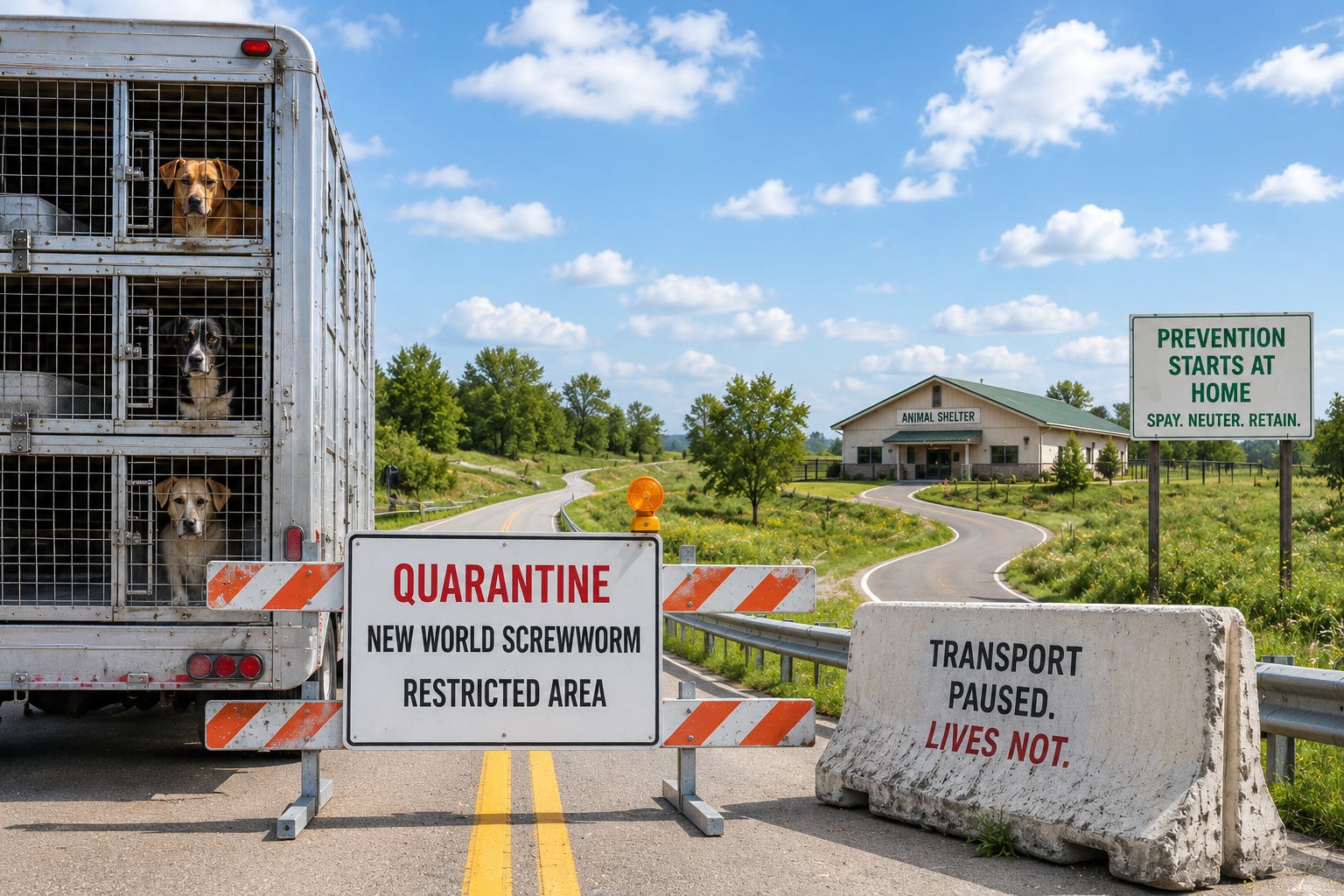
On a June morning in South Texas, shelter directors were watching the map, not the intake numbers. As states issued different transport restrictions in response to New World Screwworm, every new order had the potential to disrupt the movement of animals across state lines.
The scramble to understand those transport restrictions, and the tools national organizations developed to interpret them, reveal something important about how modern animal welfare works.
Consortium: The network of national nonprofits, foundations, corporations, consultants, academic programs, and media-facing institutions whose funding priorities, performance metrics, and reputational incentives collectively shape how shelter crises are defined, financed, and managed.
Shelter Dependency: The degree to which a community relies on animal shelters and rescue organizations to absorb unwanted, homeless, or displaced animals.
Incentive Ecosystem: A system in which independent organizations, each pursuing their own missions and interests, produce similar outcomes because they respond to the same incentives.
Incentive Trap: A situation where the rewards, funding streams, metrics, or career benefits inside an animal‑welfare system consistently favor downstream crisis management and movement of animals over upstream prevention and structural reform.
Prevention Deficit: A persistent gap between the resources, policies, and institutional attention devoted to upstream prevention and those devoted to downstream crisis management, resulting in continued dependence on shelters, transport, and other reactive interventions.
Bottleneck Test. An analytical tool used to distinguish between interventions that expand a shelter’s capacity and those that reduce the need for that capacity. It asks: If this intervention succeeds, will shelter dependency decline next year? If the answer is no, the intervention is likely relieving a bottleneck within the shelter system rather than reducing the upstream causes of shelter dependency.
The terms above are not theoretical. They describe a system that has transformed animal welfare over the past two decades and continues to shape how the field responds to crisis.
One recent example shows how that system works.
In September 2025, the Association for Animal Welfare Advancement (AAWA) announced that it was partnering with Animal Policy Group (APG), a lobbying and advocacy firm, to help shelter leaders track and respond to legislative and regulatory developments affecting animal welfare.
As part of that partnership, APG later developed a New World Screwworm map for AAWA’s members, translating state proclamations and federal continuity‑of‑business standards into a three‑category dashboard of transport restrictions.
This article examines that partnership and map as a case study of how a consortium, a shelter‑dependent system, an incentive ecosystem, and an incentive trap operate in real time.
New World Screwworm is the stress test. AAWA’s partnership with APG illustrates the response the organization elected to prioritize: helping members navigate transport restrictions rather than question the field’s dependence on transport in the first place.
Editor’s Note: Animal Politics submitted questions to AAWA on 07/16/26 regarding the partnership, the map's design, and whether consideration was given to measuring community transport dependence. AAWA was offered the option to request additional time if needed.
Questions were also submitted to Animal Policy Group via their online submission portal. No response was received from either organization by publication. This piece will be updated should either organization respond.
New World Screwworm did not invent the weakness in our shelter system. It exposed it. In Texas, a parasitic fly turned what had looked like a solution into a liability. A shelter world that has come to depend on constant movement as proof of compassion suddenly discovered what happens when animals cannot move.
In June, Texas officials began drawing a New World Screwworm infested zone across parts of the state and tightening rules on moving warm blooded animals out of those counties. For dogs and cats, the outbreak was more than a livestock story. It was a stress test of no kill by transport, which works right up to the moment transport is no longer possible. In my earlier piece, I argued that a parasite had simply revealed the fragility of a system built on shipping animals away in order to call itself humane.
Over the past two years, I have argued, in a series of investigations, that national animal welfare organizations increasingly operate within a system of incentives that rewards managing crisis more than preventing it. Those investigations examined the evolution of national transport strategies, the retreat from targeted spay/neuter investment, and the incentives embedded within contemporary shelter metrics.
Screwworm reveals how that system responds under stress.
Now that the weakness is visible, the question is who the field has asked to manage it. Shelter leaders did not turn to USDA or a public university. Their professional association turned to a lobbying and advocacy firm.
The Association for Animal Welfare Advancement (AAWA) describes itself as the international society for leaders of community animal shelters and animal control agencies. In September 2025, AAWA announced a formal partnership with Animal Policy Group, an advocacy firm that monitors more than 2,500 bills a year and sells government relations and policy strategy to animal health and pet industry clients. The association presented this as good news. Policy has become too complex to track in house. Advocacy has become specialized. APG, they wrote, will help members follow legislation and respond quickly when rules change.
In July 2026, AAWA promoted a new New World Screwworm “interactive monitoring map” developed by APG as part of that partnership, encouraging members to bookmark and share it as an easy way to track state‑level responses and transport restrictions.
In practice, that means a lobbying firm now stands between local shelters and the original screwworm orders, translating state proclamations and federal continuity of business standards into three traffic light categories on a national map.
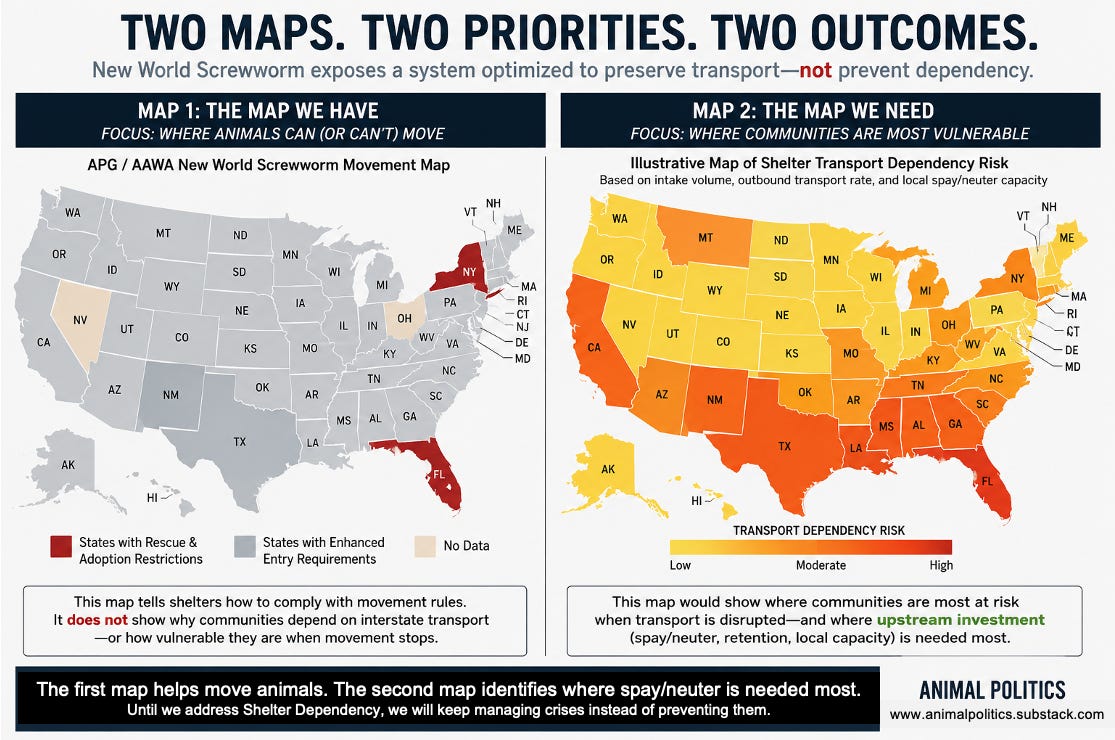
To understand how this new interpreter is shaping the story, I began clicking through the map. Texas. New Mexico. California. Montana. New York. And one quiet gray state where the legend offers only two words: “No Data.”
The map looks simple at first glance. It is a movement dashboard, not a disease surveillance or prevention map. The legend offers three categories: “States with Rescue & Adoption Restrictions,” “States with Enhanced Entry Requirements,” and “No Data.” Nearly the entire country sits in the middle band. Only two states, Florida and New York, are marked as places where rescue and adoption are formally restricted. A scattered handful, including Ohio and Nevada, are labeled “No Data,” as if a lack of mapped information were just another status on the board.
Click on Texas and the picture changes to a pop up with text. It summarizes Governor Abbott’s disaster proclamations and the Texas Animal Health Commission’s orders that draw an infested zone across multiple counties and prohibit warm blooded animals from leaving that zone without prior authorization.
It lists the conditions for movement: inspection by veterinarians or NWS certified inspectors, special movement certificates, and explicit statements that animals are free of screwworm infestation. The reality inside Texas is an internal outbreak and a quarantine. On the map, it becomes one state among many under “Enhanced Entry Requirements.”
New Mexico sits in the same category. Its pop up quotes the Livestock Board’s Emergency Animal Health Declaration, which authorizes broad emergency powers and insect control operations after the first confirmed case in a dog. It then describes movement rules from an infested zone that mirror USDA’s continuity of business playbook: inspection, treatment, movement certificates, and surveillance until officials declare eradication. Again, the label is “Enhanced Entry Requirements.” Inside the state, this is an activated emergency plan and a compact infested zone. On the national map, it is a shade of gray.
California and Montana are different. Neither has an infested zone, but both have drawn firm lines around their borders. California requires inspection within seven days, electronic certificates of veterinary inspection, entry permits, and bans on alternate movement documents for animals coming from infested zones. Montana has issued a detailed order that sets conditions for animals from restricted or infested states, including treatment windows, inspection statements, and strict timing for certificates. For shelters and rescues that move animals across state lines, these are significant changes. On the APG map, they are also “Enhanced Entry Requirements.”
Only in New York does the category match what most shelter leaders would experience as a hard stop. The state’s declaration bars dogs and cats from any state with an infested zone from entering for rescue, adoption, transfer, or sponsorship. It requires inspection, treatment, and tight documentation for any domestic animal movement. Here the label is “States with Rescue & Adoption Restrictions,” and the language matches.
Then there is Ohio. Click, and the pop up reads only two words: “No Data.” Whether that reflects an incomplete database, a reporting lag, or simply the absence of applicable guidance is unclear. Either way, the map illustrates that users are relying on an intermediary’s interpretation rather than the underlying state or federal documents themselves.
The map necessarily reflects editorial choices about what information matters most. Those choices plausibly reflect the institutional priorities of the organizations that commissioned and built it.
For AAWA, the incentive is clear. The association hears from directors who do not have policy staff and cannot track dozens of state orders in the middle of an outbreak. It promises to make advocacy “more accessible” and to step up support for members who feel overwhelmed by legislation. Partnering with a firm that sells exactly that service allows AAWA to say that someone is watching the horizon for them. It lets the association offer a tidy product, a help desk phone number, and reassurance that expert eyes are on the problem.
For Animal Policy Group, the incentive is also clear. APG is a government relations and policy consulting firm that focuses on animal health and pet industry clients. It monitors thousands of bills across fifty states and three countries and markets its ability to turn that monitoring into strategy and results. Building a screwworm map for AAWA’s members is a way to extend that brand into the shelter world. The map sits under APG’s data and research hub and is framed with an invitation to get in touch for more help. Every click on a state is also an introduction to the firm that now translates screwworm regulations for shelters. The map therefore functions as both a policy resource and a demonstration of APG’s expertise.
Together, the incentives point toward a particular kind of tool. It is detailed enough to be useful, but it is built around movement and compliance rather than prevention and structural reform. It tells you when and how animals can still move, what paperwork you need, which states have barred specific rescue pathways, and which tiles have not yet been translated. It does not tell you how dependent your community has become on outbound transport, how many animals are backed up in counties behind an infested zone, or how much money has been put into treatment and local capacity compared with transfers.
This does not mean AAWA or APG set out to suppress questions of shelter dependency. It means the map reflects the expertise and incentives of the organizations that built it, and those incentives do not currently reward measuring shelter dependency.
If this intervention succeeds, will shelter dependency decline next year?
If the answer is no, the intervention is relieving a bottleneck within the shelter system rather than reducing the upstream causes of shelter dependency.
Institutions tend to optimize for what they are rewarded to do. Viewed through the lens of institutional incentives, the outcome is not surprising. A lobbying firm whose expertise is regulatory navigation naturally develops tools that emphasize regulatory navigation. A professional association whose members increasingly rely on interstate transport as one tool for achieving “no-kill” looks for ways to preserve that movement in the face of new restrictions. The result is a national screwworm dashboard designed to help shelters navigate movement restrictions while leaving broader questions of transport dependence largely unexplored.
The screwworm resources are full of the word “prevention.” Staff are told to check wounds, apply ointments, learn the signs of infestation, and follow parasite protocols. USDA and APHIS outline careful steps to keep larvae from spreading from one animal to another. None of this is trivial. It is real downstream prevention, inside a system that has already been built.
Upstream prevention asks a fundamentally different question. It asks why that system looks the way it does. It asks why we prefer to move animals across states instead of funding spay and neuter at home, why we tolerate a landscape where a single quarantine can expose hundreds of thousands of animals to renewed risk of euthanasia. That kind of prevention is largely absent from the screwworm map or accompanying guidance. The outbreak is treated as a threat to be managed so the transport model can continue, not as a reason to retire that model in favor of something less fragile.
The missing statistic is not how many animals can still cross state lines.
It is the degree to which communities have become dependent upon interstate transport, so dependent that a single quarantine threatens their ability to save lives.
That is a measure of shelter dependency, and it is the metric that still isn’t on the map.
The partnership did not create this incentive trap. It entered an existing ecosystem where transport based solutions, retail adoption pipelines, veterinary education investments, and national crisis narratives already lean toward protecting downstream infrastructure.
PetSmart Charities and Petco Love have spent years investing in retail adoption partnerships and transport programs that keep corporate outlets stocked with adoptable pets.
Maddie’s has invested heavily in shelter medicine, veterinary education, and innovation. By comparison, long-term investment in targeted spay/neuter as the primary population-management strategy has occupied a less prominent place within its recent national incentives.
Best Friends and ASPCA have built national transport programs and data platforms that emphasize moving animals to available capacity across shelter systems. As this publication has reported over the past two years, this pattern reinforces a downstream model of animal welfare while drawing comparatively less attention to reducing the need for transport through upstream prevention.
In that context, a lobbying firm experienced in navigating animal policy now offers shelter guidance on how to keep animals moving within an increasingly complex regulatory environment.
Taken individually, each of these investments can be justified on its own merits. Viewed collectively, however, they reveal a consistent pattern: expanding downstream capacity has attracted substantially more institutional attention than reducing the need for that capacity.
Screwworm exposes that weakness and the consortium, once again, moves to manage it in ways that defend movement, rather than retire that model in favor of upstream prevention. The emphasis remains on making the transport system more resilient rather than making communities less dependent upon it.
The important question is not whether the transport network survives screwworm.
It probably will.
The larger question is why so much institutional creativity is devoted to preserving a downstream system, while comparatively little is invested in reducing the need for it.
New World Screwworm did not expose a transportation problem.
It exposed a prevention deficit.
Until incentives reward prevention rather than crisis management, each new emergency will produce another downstream solution.
Systems tend to produce the outcomes their incentives encourage. Change the incentives, prioritize upstream prevention, and the prevention deficit begins to disappear.
If you’ve been reading Animal Politics for a while, you’ve probably noticed that certain ideas and phrases appear again and again. That’s intentional.
Words shape policy. Policy shapes incentives. Incentives shape outcomes.
Over the past two years, this publication has gradually developed a vocabulary for describing how modern animal welfare works, not simply how it presents itself, but how its incentives, metrics, and institutions interact to produce the results we see.
To make that vocabulary easier to reference, I’ve updated the Animal Politics Lexicon (as of 07/19/26) and am making it available to subscribers as a downloadable companion to Animal Politics’ articles.
Whether you’re a shelter leader, policymaker, advocate, journalist, or simply someone trying to understand why the same problems continue to recur, I hope you’ll find it useful.
Thank you for supporting Animal Politics. Your subscription makes investigations like this possible.
Download: The Animal Politics Lexicon (Updated Edition)
Ed Boks is the former executive director of animal care and control agencies in New York City, Los Angeles, and Maricopa County, and a past board member of the National Animal Control Association. His work has appeared in the Los Angeles Times, New York Times, Newsweek, Real Clear Policy, Sentient Media, and now on Animal Politics, a lively community spanning 49 states and 75 countries.
Animal Politics is reader-supported. If this reporting matters to you, a paid subscription is the most direct way to keep it going.
No posts
Comments
Nothing yet. Say the first thing.
Sign in to join the conversation.