
TL;DR Berlin Edition: Some of my favorite moments from last week in Berlin ❤️🔥
💤 It’s so hot again that Willy is sleeping under the bed instead of on it. Willy is my dog.
👀 Which means this week’s question is less where I was than where I wasn’t. I wasn’t at Holly Herndon & Mat Dryhurst’s opening in Düsseldorf. I wasn’t at Juergen Teller’s opening at CFA in Berlin. And I didn’t make it to the Schinkel Pavillon to see C.B. Evans’s exhibition.
🤝 I made a pact with myself: I’m not going to another panel about AI slop. (I would moderate one, though.)
❓ Throughout the week, I kept wondering what had happened to the discourse around contemporary art and culture. It feels like everyone is having a different conversation. I also spoke with Mat Dryhurst about how the attention economy is affecting the production of art and culture, and about who is an artist today, and who isn’t.
Read my interview with Mat Dryhurst for SLEEK: Who Shapes Culture? Mat Dryhurst on AI, Protocols, and the Future of Art
😳 C/O Berlin is now showing The Lure of the Image, an exhibition that was previously on view at Fotomuseum Winterthur. Unfortunately, it also reveals how difficult it is for institutions to keep pace with the discourse around images on the internet.
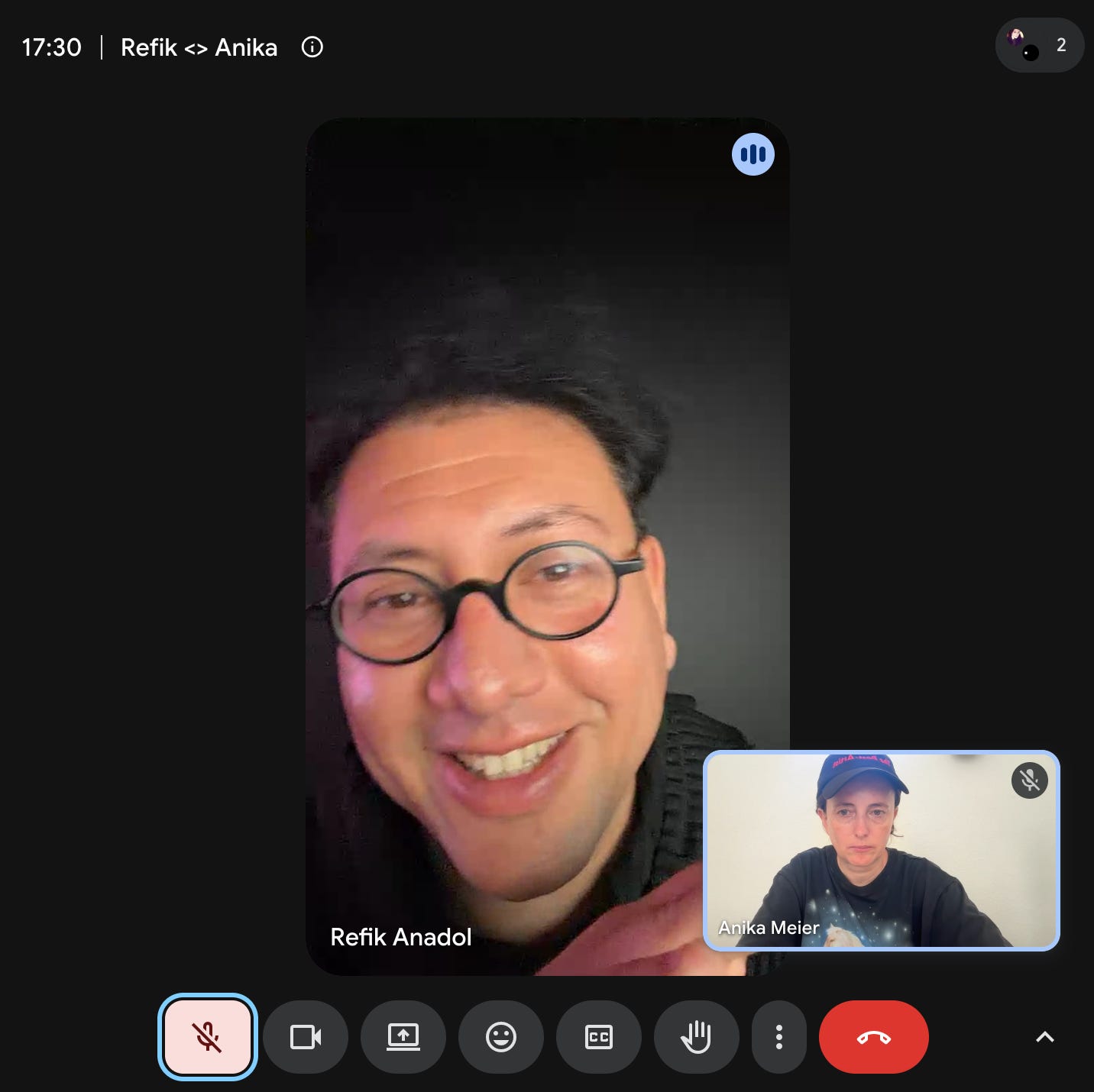
💭 I spoke with Refik Anadol for the opening of Dataland about why so-called AI art needs its own institution, one that operates at a different pace.
🌐 I spoke with Ed Fornieles about what it was like to grow up on the internet, and how the internet, and with it his artistic practice, has changed over time.
❣️ My favorite quote of the week came from LIL Internet during his artist talk at Soho House, hosted by Spike: “Everyone’s a machine pleaser now.”
🎙️ What I’m looking forward to most next week is the opening of Goodbye Sadness, Hello Sadness, the group exhibition at Pace in Berlin. Friedrich Kunath gave me a preview of the bar he built for the exhibition. It’s a replica of the bar in his studio in Los Angeles, and it will actually be open during the exhibition. I also spoke with Friedrich Kunath about his profession. He said he’s a fan.
A few years ago, when NFTs were still new and exciting, panels were mainly about explaining what the blockchain is, at least at German cultural institutions. So I would sit on those panels and listen to the speakers before me explain what the blockchain is and how it works. When it was my turn, I would say something along the lines of, “Well, this isn’t Germany’s Best Blockchain Explainer,” and then not explain what the blockchain is all over again. So when I went to a few events about AI slop, including one last week, it felt like déjà vu. One I could gladly do without. And yes, I made a pact with myself: I’m not going to another panel about AI slop. (I would moderate one, though.)
At the panel I attended in Berlin last week, each panelist gave a lengthy explanation of what AI slop is. They discussed whether AI slop is content or not, and whether someone should intervene to stop people from consuming so much AI slop on the internet. Boris Eldagsen, the only artist on the panel, would have liked to talk about how artists work with AI. But the conversation quickly moved on, because the panel was supposed to be about AI slop.
Before I get back to the story, this post isn't about finding the best definition of AI slop. If you'd like to read more about the topic, here are a few examples:
“Slop is the media that attention networks prompt humans to make.” – Mat Dryhurst, Who Shapes Culture? Mat Dryhurst on AI, Protocols, and the Future of Art, SLEEK, 2026
“2 + 2 = 6-7” – Hito Steyerl, Art in the Age of Authoritarian Chatbots, lecture, Agora: A Gathering of Art and Philosophy, 2025
“When I hear the term AI slop, I imagine it pertains to lazy art-making with a lack of discernible regard for the output.” – Kevin Abosch
“The most potent embodiment of mid-ness might be what is now called ‘AI Slop.’ The term describes the default content generated by AI models. AI slop is hard to pin down, but like pornography, you know it when you see it. Like a fast casual food bowl, mass market action movie, or fabricated pop diva, AI slop is made to please the largest possible audience, yet satisfies no one. It prioritizes its economic function above all else, filling a void with minimum viable content, ignoring any aesthetic, nutritive, or meaningful possibility.” – K Allado-McDowell, Am I Slop? Am I Agentic? Am I Earth?, The Long Now Foundation, 2025
“The AI slop aesthetic is more than a technical artifact or cultural curiosity. It’s the consumer-facing product of computational capitalism—created by transforming human culture into a standing reserve of data. Each uncanny image, synthetic influencer, and AI-generated article is part of a much wider transformation. Slop is waste, but it’s also fuel.” – Kate Crawford, Eating the Future: The Metabolic Logic of AI Slop, e-flux Architecture, 2025
After the weeks leading up to Art Basel, the discussions around Zero 10 and digital art in Basel, and then returning to Berlin and attending a series of very different events, I kept coming back to the same question: What had happened to the discourse around contemporary art and culture? It feels like everyone is having a different conversation. There may be more discourse than ever before, but there is no longer a shared frame of reference. How do you find common ground when some people are terminally online and others would rather not be online at all? Or when some people are only active on Twitter, others on Instagram, and some only on Bluesky?
There used to be major debates in the arts and culture sections of daily and weekly newspapers. A handful of critics would argue with each other about exhibitions and books. Those days are long gone. Today, everyone is talking, but no one seems to be talking to each other. More often than not, they're starting from entirely different premises. And in the end, it mostly comes down to a few questions: Where do I get my information? Where do I spend my time online and on social media? Which community do I feel part of, and which conversations do I follow? And I notice it most whenever the conversation turns to NFTs. If you don't spend much time on Twitter, or at least some time there, you'd probably think NFTs are no longer a thing.
Some people are talking about AI slop and slopaganda. Others are talking about the history of digital art, while others have long since folded digital art into the history of contemporary art. Institutions are still busy explaining social media phenomena from the past few years (e.g. The Lure of the Image), while Refik Anadol is opening his own institution (Dataland) so he can move at a different pace. Then there are people like LIL Internet, who are thinking about what a different internet could look like, while others have come to terms with being machine-pleasers.
Maybe what is falling apart isn’t the discourse, but our shared present.
And a reminder: if you’d like to escape doomscrolling, you can watch the online exhibition I curated for CIFRA.
Take care,
Anika
Comments
Nothing yet. Say the first thing.
Sign in to join the conversation.