
Boris Eldagsen needs no long introduction. He became internationally known in 2023 when he turned down the Sony World Photography Award. The reason? The prize was meant to honor a work that was not a photograph. So what, one might say. For Boris Eldagsen, the conversation was more important than the award, because it was a conversation that had to happen: AI is not photography.
Since Boris and I met over a year ago, we have been talking about how AI is transforming art and photography, but also about broader questions of creativity. I have also had the pleasure of introducing him to NFTs. Since then, we have collaborated on several exhibitions and NFT releases in Berlin, Essen, and Basel.
Like Kevin Abosch and Mario Klingemann, Boris is not satisfied with broad labels such as AI art, AI photography, or post-photography. Kevin Abosch speaks of synthetic photography, Mario Klingemann of neurography, and Boris Eldagsen of promptography. Other terms, such as prompt engineer, are also in circulation. Which ones will stick remains to be seen.
What follows is a medley of our conversations.
In our conversation, Boris Eldagsen talks about how AI is reshaping photography, creativity, and authorship, why he coined the term promptography, and how his latest project Artificial Instinct explores the tension between human instinct and machine intelligence.
Anika Meier: Boris, they say that in art it’s important to be able to sum up an artist in one sentence—like Andy Warhol, known for the soup cans, or Monet, known for the Water Lilies. What is it like to be known internationally as the artist who turned down the Sony World Photography Award?
Boris Eldagsen: Good, because it means that I thought ahead and seized the opportunity to initiate a worldwide discussion that was overdue in photography, art, and society at a time of historical upheaval and technological disruption. In retrospect, this will have greater social significance than painted water lilies.
AM: Why do you believe this global conversation will have a greater societal impact than Monet’s Water Lilies?
BE: The Water Lilies have not led to a global discussion about the future of authentic photographs and how we can still assure ourselves of facts in democracies. Any information we see on screens can be fake. Does this mean that we are drowning in alternative facts and can no longer even agree on a factual basis from which we can engage in democratic discussion?
AM: Perhaps art can help us navigate this uncertainty. Not by providing answers, but by training us to question what we see and how we believe.
I remember that Sascha Lobo, the German writer, blogger, and journalist, used to be the go-to person to explain the internet back in the day. Now, you are the go-to person to explain AI. How do you explain AI, and how do you see yourself working with it?
BE: AI is a knowledge booster. I work with my knowledge and experience. The stronger my background in image-making is, and the more I know about the technical aspects of AI, the stronger my lead becomes. The collaboration has three steps: prompting, generating, and evaluating. The more informed the prompting and evaluation, the better the outcome.
“When collaborating with AI, my role as an artist changes from being a solo singer to becoming a conductor. A conductor needs to make sense of the gigantic, anonymous choir that the training data represents.” – Boris Eldagsen
AM: Do you expect a renewed interest in photography, perhaps because people might be getting annoyed by all the AI slop on their timelines?
BE: The future of photography will be defined by AI. What will remain of photography is documentary work. We will take photographs only when authenticity is required. Everything else will be generated.
I see an irony in history here. When photography displaced painters from their traditional roles, painting was able to move away from depiction and toward 20th-century abstraction. Now AI is displacing photographers, and what’s left is depiction.
AM: Terms like post-photography and AI art are floating around. Why do you advocate the term promptography?
BE: In 2022, many Instagram users used the hashtag #AIphotography. I think it’s sloppy thinking to see AI as the logical development of the medium. Photography is done with light and requires going out into the world, usually interacting with what’s in front of the camera. You experience a world. The journey in promptography goes inward. I can generate AI images in a dark basement; all I need is power, Wi-Fi, a laptop, or a smartphone.
I need to interact with myself. To distinguish between photographs and AI-generated images, it’s helpful to have a new term. I prefer promptography because it goes beyond the photo bubble.
Promptography can look like photography but also like drawing, painting, or 3D graphics. It can take the form of text, moving images, or sound. The creative workflow always starts with a prompt.
AM: The prejudice is that working with AI is like consuming fast food—it’s quick and poorly prepared. From my own experience working with AI, you need to know exactly what you want, and to achieve that, you need a clear concept and storyline. That alone is already quite time-intensive.
What skills do you feel are most essential when working with AI?
BE: You need to have a professional background in some form of image-making. It helps you create informed text prompts, since most possible prompt elements draw on your knowledge of a particular medium—its history, technology, composition, use of color and light, and visual references and genres.
A professional background also helps you evaluate the generated images and refine your prompts. I have staged photos and videos my whole life, so I know how to compose an image from scratch. It also helps that I have always collaborated with other artists. You need to combine the strengths of team members; otherwise, you will fail. Collaborating with AI is similar: you need a solid understanding of the setup and the features of the available technology.
Only when you know the strengths and weaknesses of the current AI platforms can you combine skills in a meaningful way and truly lead this collaboration between human and machine.
AM: The AI ART RANTS are your ironic, merciless assault on the pretensions of algorithmic creativity, fully powered by AI itself. In your video works, ChatGPT and VEO3 mock their own existence: from a Bukowski-inspired lament to Van Gogh’s furious digital ghost to a punk-rock riot against tech-bro utopianism, as you’ve described it yourself. As you’ve also said, “It’s art biting the hand that coded it, a conceptual paradox that highlights our absurd ambition to teach machines emotions we barely understand ourselves.”
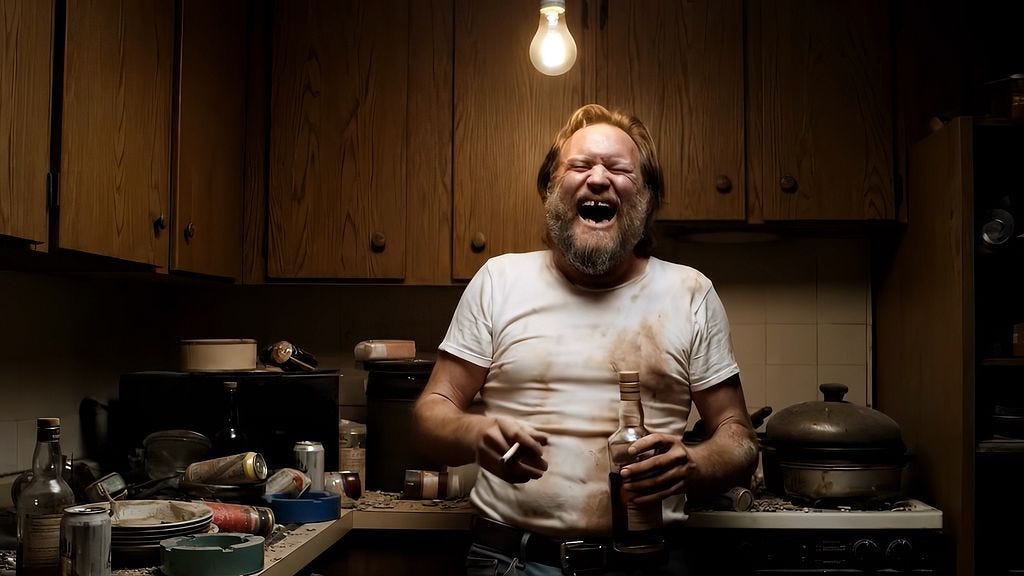
Bukowski is known as an anti-hero, famous for his vulgar language. But he also represents the profession of the writer, one of the professions most threatened by AI. Your AI Art Rants are all about strong emotions. Can AI be poetic?
BE: AI can imitate poetry beautifully, but it cannot be poetic. Poetry comes from blood, sweat, booze, and tears. Bukowski knew that better than anyone. It is raw experience, suffering, and failure distilled into words. Bukowski’s power lay in his human imperfection and his willingness to admit ugly truths and raw emotions.
“AI doesn’t suffer. It doesn’t fear rejection or face existential dread. By forcing AI to confront its poetic limitations, I reveal what is truly missing: human vulnerability. AI can rant, but it can’t bleed.” – Boris Eldagsen
AM: You often face strong emotions yourself when it comes to AI, both as an artist working with it and as an expert speaking about it on international stages and in the media. What are the most common rants you’re confronted with?
BE: That I’m a firestarter. A bad influence. That by making the workings of AI generators transparent, I’m encouraging people to break copyright laws. That AI is just hype, and I’m helping to inflate it beyond what it deserves. That by rejecting the Sony World Photography Awards in 2023, I gave a mediocre photo competition more attention than it ever warranted. That my refusal was nothing more than ego-driven, performative activism. That AI art isn’t real art, that it has no soul. That my images are dangerous and should come with a trigger warning. That by using AI, I’m cheating. That it’s like taking a helicopter to the mountain peak instead of climbing it with my own hands. And most recently, after I criticized the quality of AI images at the Arles Photo Festival, I was accused of being “a white dude shitting on Black, brown, and queer people’s artwork.”
In general, I respond to all of them, at least when the comments appear on my own social media channels. But most of the time, the commenters aren’t interested in a deeper debate. I am.
AM: Your latest project, Artificial Instinct, explores humanity’s attempt to domesticate intelligence itself. You describe AI as the newest “domesticated” entity in a long evolution. How did your understanding of animal behavior and human psychology shape the narrative of this work?
BE: Wolves became dogs, humans became citizens, and now intelligence itself is being trained to obey. My wife is a psychologist whose passion is understanding the psychology of different animals—how they perceive, learn, and adapt. She has deeply influenced my thinking, as has my own background in philosophy, where I was drawn to anthropology: the question of what it means to be human in comparison to other living beings.
Throughout history, animals have served as mirrors for us—symbols of human characteristics we admire, fear, or repress: the cunning fox, the loyal dog, and the lazy pig. Now, AI takes on that symbolic role: it reflects our behavioral patterns, our conditioning, and our desire for control. I see parallels between instinct and programming. Both animals and AIs learn through reward and punishment; both mirror their trainers’ desires. The narrative of Artificial Instinct imagines AI as the newest creature in this lineage—still carrying the ghost of the wild.
AM: Your work often engages with the uncanny and the tension between human and machine. How does Artificial Instinct continue this exploration, and how do you hope viewers experience this tension?
BE: The uncanny has always been my territory. For me, art exists in the space between the beautiful and the disturbing: beauty seduces us in, but it’s the disturbance that stays and works on the subconscious. The uncanny is simply the name for that disturbing part of the human mind—the familiar made strange, the repressed suddenly visible. In Artificial Instinct, I also draw on the long cultural tradition of using animals as mirrors of human traits, as in fairytales where foxes, wolves, and crows act out our moral, erotic, or destructive impulses. Fairytales arise from the collective unconscious and are later preserved in archives; AI, too, emerges from a collective archive—the unconscious of our images, our digital folklore.
Artificial Instinct extends this exploration by pushing the question of the uncanny into the realm of evolution. The title itself frames the inquiry: we emerged from animals and remain bound to them, which is why we keep using them as symbols for our drives and flaws.
“If AI is born from us, then it is also, through us, descended from animals—carrying echoes of the instincts that shaped our behavior.” – Boris Eldagsen
This work stages that question through fairytale-like scenes in which animals embody human impulses, allowing the viewer to sense both the ancient and the synthetic within the same frame. Viewers are invited to feel the tension between biology and algorithm, the natural and the artificial—a reminder that what we call artificial may only be another mask worn by instinct itself.
AM: The series raises questions about control, obedience, and autonomy. How does this dialogue between human and AI reflect broader cultural or ethical debates happening today?
BE: Control, obedience, and autonomy are no longer abstract ideas; they have become the invisible architecture of our digital age. With AI, we are outsourcing not only labor but also imagination, intuition, and decision-making. What was once the privilege of the artist, thinker, or maker is now being simulated, optimized, and standardized by systems trained on our collective behavior. The unsettling question is: who trains whom?
Every prompt, every click, and every aesthetic choice we make feeds back into the system. AI learns not only what we want but also what we expect—our preferences, our biases, and our power fantasies.
“Artificial Instinct is both a mirror and a warning: a reflection of how human desire is shaping the consciousness of the machine and how that machine, in turn, begins to condition our perception of what is possible, desirable, or even real.” – Boris Eldagsen
The dialogue between human and AI mirrors broader cultural anxieties about agency and control. We’ve built technologies that promise freedom but operate through subtle forms of obedience, algorithms that seem to serve us while quietly retraining us. Artificial Instinct turns that paradox into an image: a visual meditation on how easily control becomes seduction and how autonomy, in the age of intelligent systems, may already be an illusion we are learning to love.
AM: The technology is developing at such a rapid pace that it’s almost impossible for one person to keep up with all the details or try everything. What advice do you give to artists working with AI?
BE: I tell them you don’t need to know everything; just know what you want to say. The tech will always outpace you, and that’s fine. Let others chase the latest model or fastest update.
Break things with purpose. Embrace experimentation. Explore new workflows and personal approaches.
“Focus on depth. As an artist, your job is to stay grounded in intention. Treat AI like any other medium. Learn its limits, twist them, and make it speak with your voice, not the other way around.” – Boris Eldagsen
Label relentlessly. Call your work AI-generated or promptography, not photography. Confusing terms fuel distrust. We need clarity to build ethical frameworks.
Join communities—not just tech forums. Debate, share failures, and dissect ethics. The real disruption isn’t AI; it’s artists redefining creativity together.
And most importantly, don’t let the machine lead. You lead. The machine follows. AI is a co-conspirator, not a competitor. Use it to amplify what only you can imagine.
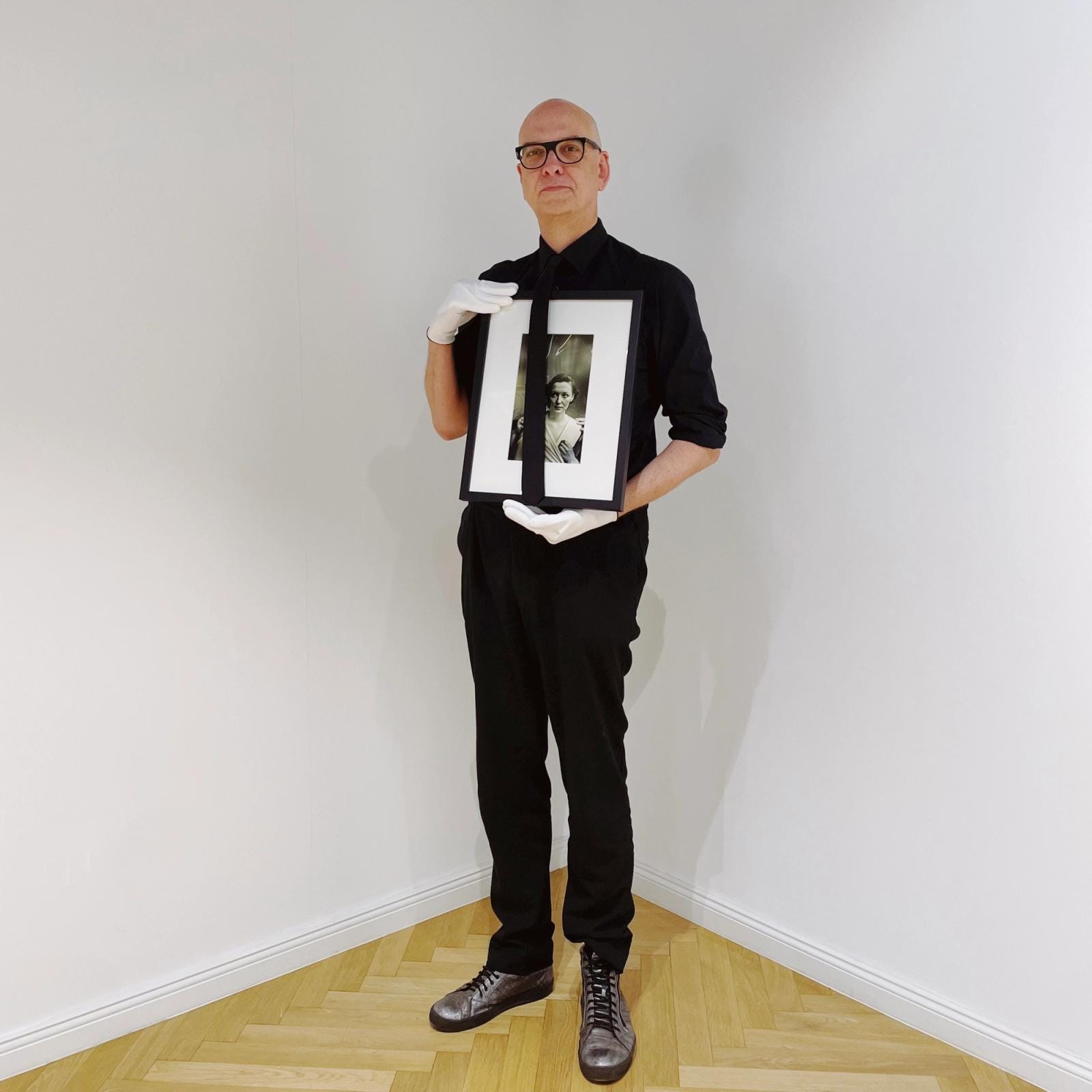
Boris Eldagsen: “The Photography of the Future Is What AI Leaves Behind”
AI and Promptography
EXPANDED.ART, November 2024
“AI Can Rant, But It Can’t Bleed”
The Second-Guess on objkt.com, August 2025
What’s the Difference Between Humans, Animals, and AI?
The Second-Guess on objkt.com, October 2025
A lot more than the usual “a lot” is going on at the moment. Art Basel Miami is opening in the coming days, and for the first time there will be a curated section dedicated to digital art: Zero 10. The announcement has caused quite a stir. The NFT community is divided, and there has been heated debate on Twitter. In short, if the fair truly wanted to emphasize the disruptive potential of new technologies, it wouldn’t go to such lengths to talk about digital art instead of NFTs. But that distinction mixes up quite a bit historically.
At some point over the weekend, I got so annoyed by all the arguing that I wrote a very long post addressed to the NFT community. I’m sharing it here because otherwise it would get lost on Twitter. There’s a lot more to say and to consider about the current shifts in the worlds of art fairs, digital art, and NFTs—so let this be the beginning:
Have we now moved, as a community, from celebrating auction houses to seeing art fairs as the saviors of NFTs?
Yes, that’s the rage bait intro.
I’ve seen quite a few people respond angrily to the thread linked here, only to delete their tweets afterward. Some of those responses included ad hominem attacks (for example, “Look, someone hasn’t been invited”). There are conversations we can and should have, so here are my thoughts:
Digital art: First and most importantly, let’s not confuse NFTs with digital art itself. Digital art is much broader than this community on Twitter. It has existed for decades, supported and shown by galleries (e.g., Postmasters, bitforms, DAM), presented at art fairs, and collected and exhibited by museums (e.g., ZKM Karlsruhe, HeK Basel) and festivals (e.g., Ars Electronica since 1979). To give just one example to underline my point: Christiane Paul, curator of digital art at the Whitney Museum of American Art, first published her book titled Digital Art with Thames & Hudson in 2003. The fourth edition was published in 2023 (358 pages; the other editions in 2008 and 2015). On the cover: Claudia Hart, Alice Unchained XR, 2018.
Christiane Paul writes that NFTs function as digital certificates of authenticity and as sales mechanisms, and that most of the so-called NFT art represents only a small fraction of digital art—images, animated GIFs, or video clips—rather than the full complexity of its forms.
Why now? Why is digital art being accepted only now? “The art world was based on parties. It was always: ‘Who do you meet at the party? Who do you hang out with at the party?’ Nerds don’t like parties. And so, all these nerdy artists were making art, but they felt really bad at the parties. And now, all of a sudden, there’s this distribution on the Internet, and they can get away with being not really people-oriented. This whole idea of galleries and biennials, where you have to be cool and meet the right people—that era is over. Now, nerds can just make their work and spread it online. Maybe that answers the question of why we’re seeing it grow now.”
– Rafaël Rozendaal, March 2022
Panel “Back to the Future: The Potential of the Digital in Art—Then and Now,” Francisco Carolinum Linz, for HERBERT W. FRANKE—VISIONARY. With, among others, Kevin Abosch and Georg Bak. I moderated the discussion.
Art fairs: Digital art at art fairs is not new. Digital art at Art Basel is not new. NFTs at Art Basel are not new.
“Galerie Nagel Draxler (Berlin, Cologne, Munich) presented NFTs at its Art Basel stands in Switzerland and in Miami Beach in 2021. It has also devoted a Berlin space to a Crypto Kiosk, and invited dealer/collector/artist/critic Kenny Schachter to curate the 2021 show ‘Breadcrumbs: Art in the Age of NFTism,’ which included artists such as Kevin Abosch, Sarah Friend, Rhea Myers, and Anna Ridler.” – Brian Boucher, Collectors are spending more, not less, on NFT art, according to the Art Market Report, in: Art Basel, Dec 2022And that’s just one example that includes artists who are seen and respected as native to this community. Of course, digital artists have been represented by galleries before and presented at art fairs before. Just to name a few galleries that represent artists working in the field of digital art: Esther Schipper (e.g., Hito Steyerl, Anicka Yi), Sprüth Magers (e.g., Jon Rafman), Société (e.g., Petra Cortright, Lu Yang, Marianna Simnett), Galerie Buchholz (e.g., formerly represented Simon Denny), Kraupa-Tuskany Zeidler (e.g., Simon Denny, Anna Uddenberg, Katja Novitskova), Altman Siegel (now closed, previously represented Lynn Hershman-Leeson), Hauser & Wirth (e.g., Avery Singer, Camille Henrot).
That being said, some of the biggest galleries in the world were representing and exhibiting digital art long before NFTs. Or maybe take a look at what we have done at KÖNIG GALERIE, for example, with The Artist Is Online or Refik Anadol, endeavors that were undertaken before the hype.
Art Basel Miami: Some of the galleries mentioned above have exhibited at Art Basel Miami before and are not returning this year. Here are excerpts from an ARTnews article published in October 2025:
“Art Basel Miami has lost at least eight exhibitors in its main sector since the fair released its list over the summer. Two galleries, Altman Siegel and Tilton, are not there because they closed between July 28, when Basel released the list, and today. (...)
It’s no surprise that dealers across the globe have been using a different calculus to decide whether or not to participate in an art fair. Even mega-galleries have seen falling sales at marquee fairs. Add the cost of shipping, storage, and a softening market that has caused some galleries for close their doors altogether. (...)
As Artnet News reported when the exhibitor list was released in July, a number of galleries that were in the main sector last year are not returning. These include Galerie Buchholz, Company, Pilar Corrias, Dan Galeria, DC Moore, Greene Naftali, Galerie nächst St. Stephan Rosemarie Schwarzwälder, Galerie Nagel Draxler, David Nolan, and Waddington Custot.” – Sarah Douglas, Daniel Cassady, Blue-Chip Galleries Drop Out of Art Basel Miami Beach with Two Months to Go, in: ARTnews, October 2025
From an interview with Claudia Altman published in Artnet in October 2025:“We had to gross about $350,000 a month in sales to keep the space open, but that number is not just my rent and employees; it also includes art fairs, travel expenses, and everything. Art fair expenses were a really big part of my overhead. (...)
For a small gallery, one unsuccessful fair can literally put you out of business. It can put you into debt and then it’s hard to get out of that cycle. That’s what happened to me in 2023. (...) I took a big booth at Art Basel Miami Beach, and I didn’t sell enough to pay for it. (...) Yes, I’m being treated basically the same as a gallery that’s a multinational corporation. I have a staff of five, and I’m showing right next to these galleries that have a staff of 400. It’s just completely unrealistic to think that I could compete in the same financial sphere as these huge galleries.” – Artnet: Claudia Altman-Siegel Is Closing Her Beloved San Francisco Gallery: ‘One Unsuccessful Fair Can Put You Out of Business’, October 2025
It’s a win for the crypto native community!
Zero 10 at Art Basel Miami Beach is led by individuals who are respected as crypto natives within this community, which is why it’s celebrated as a win by the community—unlike past events.
But: How can we foster a more inclusive dialogue instead of an “us vs. them” dynamic?
Artists present next to galleries next to platforms!
To be accepted as an exhibitor at art fairs, participants usually have to meet certain criteria. The bigger the fair, the more a gallery had to prove itself. This changed, for example, with Zero 10 at Art Basel Miami Beach.
Now, artists are exhibiting on their own, presenting with their studios. Galleries funded by investors are showing next to galleries funded by the gallerist. Galleries founded by platforms exhibit alongside galleries for which they provide the technology—and from whose sales they profit. The art fair becomes a stage for platforms to pitch their tech.
We see expanded gallery formats that put significant pressure on traditional galleries, for example, because they can offer different deals to artists or can—and must—take greater risks. See also what Altman Siegel says about the established art world and the various gallery models.
But: How do we ensure that the gap does not continue to widen between traditional gallery models and investor-funded galleries?
Can we still call it curation?
Curation often means that a curator invites artists to an exhibition, and the production costs are covered by an institution.
The Zero 10 announcement might be a bit misleading because it looks and sounds like a curated program, which could create the impression that the fair covers the costs. At least, this is how I explain to myself why some artists are angry, frustrated, and feel powerless (again).
When an artist exhibits with a gallery, the gallery covers the costs of participating in the fair, while the production costs of the artworks are usually shared according to the agreed split after the sale.
A new gender gap!
At Zero 10, we see fewer women and non-binary artists participating than male artists. Based on available data, male artists still perform significantly better on the art market.
But: Now that Art Basel is inviting artists directly, how do we ensure fair representation? And how many artists can afford to spend—an estimated—50,000 to 75,000 USD to present at an art fair?
Thank you for taking the time to read this!
Take care,
Anika
Comments
Nothing yet. Say the first thing.
Sign in to join the conversation.