
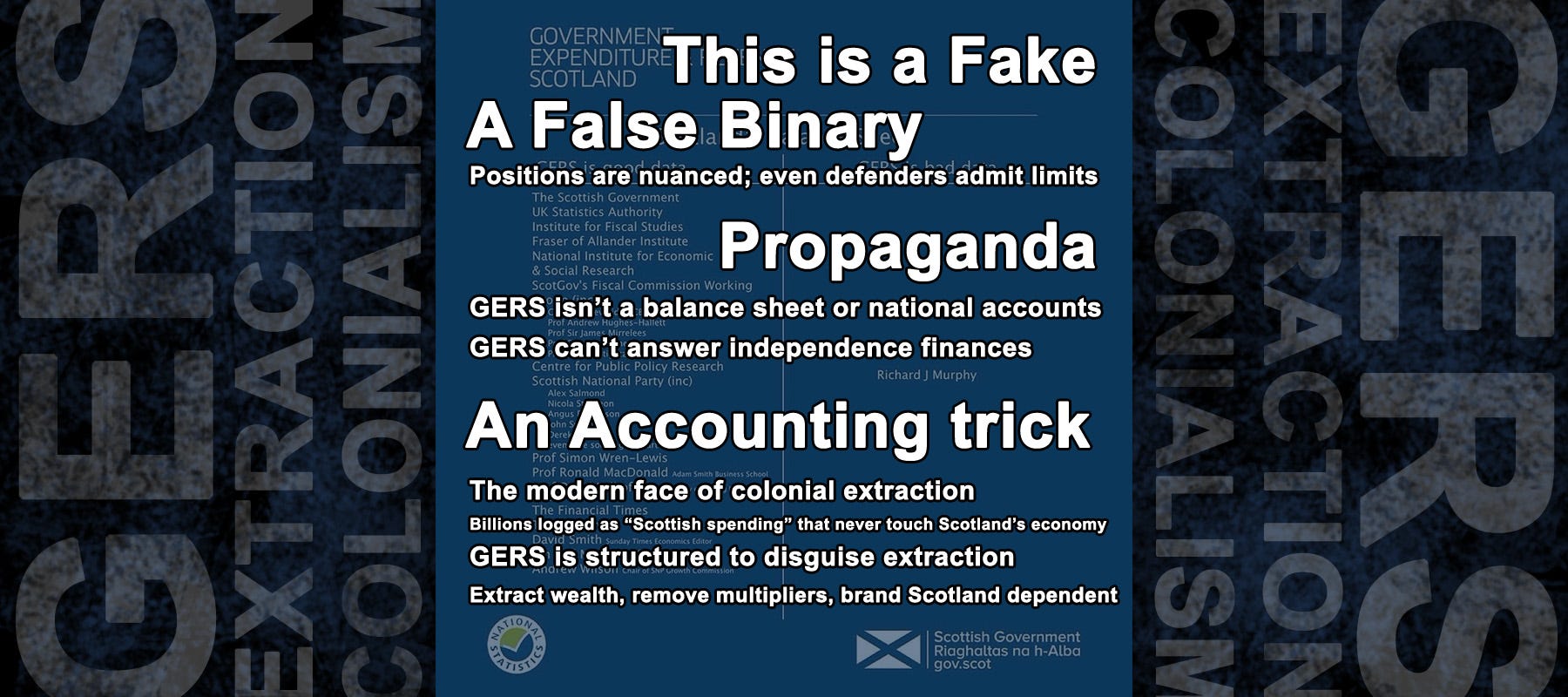
Introduction — The Deficit That Wasn’t
Every year, headlines scream that Scotland runs a £15 billion deficit. But what if that number was never a measure of Scotland’s economy to begin with?
“Government Expenditure and Revenue Scotland” (GERS) is treated by media, politicians, and even the Scottish Government as gospel. Yet beneath its spreadsheets is a constructed narrative — one that sits atop a century without a dedicated Scottish fiscal series, and a long history of resource extraction and accounting choices that shape the result.
This article argues that GERS is less an economic description than a political artefact that normalises dependency.
What Is GERS? A Political Document in Disguise
GERS is not a record of what Scotland actually earns and spends. It is an estimate based largely on UK-wide data, with revenue and expenditure apportioned to Scotland by statistical formulae.
Introduced in 1992 by Scottish Secretary Ian Lang.
Launched amid rising constitutional debate after the 1989 Claim of Right.
A private letter from Lang to the Prime Minister (cite) indicates an intention to counter nationalist economic claims.
GERS also assigns large elements of UK-wide, non-identifiable spending to Scotland (e.g., debt interest, parts of defence and central administration) even when the spending occurs outside Scotland.
Result: a persistent paper deficit driven by allocation choices, not a set of Scottish national accounts.
A Century Without a Scottish Fiscal Series
From 1900 to 1921, Westminster’s Finance Accounts reported Scotland’s revenue and expenditure.
Scotland recorded surpluses in multiple years.
Significant portions of Scottish revenue were allocated to “Imperial Services” (military, debt, empire) rather than spent in Scotland.
Only a share of revenue was disbursed domestically.
In 1921 the separate reporting ceased. Between 1922 and 1992, no regular, official Scottish fiscal series was published. By the time GERS appeared in 1992, that gap had erased public memory of Scotland’s earlier fiscal strength and normalised UK-framed apportionment as the only lens.
The Real Numbers: What the UK Suppressed
Historical data shows Scotland ran substantial surpluses in the early 20th century. These were never reinvested at home—no sovereign wealth fund was created, no structural development plan enacted.
Using a conservative reinvestment assumption of 3.5% annual yield from 1980 onward, retained surpluses plus later oil revenues would produce a, versus an actual estimate of £190 billion. This is not a fantasy number—it’s a modest, credible uplift showing that Scotland performs well even under constraint but has been structurally prevented from reaching the level of comparable nations.
A less conservative scenario—akin to a Norway-style fund—using 5% annual reinvestment generates a 2024 GDP of £428 billion. That would place Scotland above Norway and approaching Ireland in absolute GDP, illustrating how control over fiscal levers and resource revenues could have transformed Scotland’s position.
Note on counterfactuals. From 1922 to 1992, Scotland’s fiscal record was not published as a separate Scottish series, removing the evidence needed to trace extraction over time. In decolonial accounting, when a series is cut off, counterfactual modelling is used to gauge the order of magnitude of what was removed. It does not predict the future or claim certainty; it quantifies loss under transparent assumptions.
Takeaway. The point is not to claim Scotland would be an economic superpower. It is to show that full control over revenues and investment decisions would have materially changed outcomes—and that the present gap is a direct consequence of extraction and centralised control. This range quantifies the suppressed potential hidden by the 1922–1992 blackout and the post-1992 GERS regime.
How GERS Manufactures a Deficit
GERS produces its headline deficit via three mechanisms:
1. Revenue estimation
Major taxes are apportioned to Scotland by statistical models rather than recorded from Scottish receipt data.
North Sea revenues are presented on two bases: excluding North Sea and including a geographic share of North Sea. Choice of basis materially affects the balance.
2. Expenditure allocation
Large elements of UK-wide, non-identifiable spending (e.g., debt interest, parts of defence, central administration) are allocated to Scotland by population or similar shares.
This counts spending for Scotland even when the expenditure occurs outside Scotland, reducing the scope for local multiplier effects.
3. Weak or missing local multipliers
When spending is allocated to Scotland but delivered elsewhere, it yields limited or no local multiplier in Scotland (fewer Scottish jobs, contracts and supply-chain effects).
Taken together, these features are analogous to the historic “Imperial Services” pattern: costs are centrally incurred and assigned to Scotland, while the benefits often accrue elsewhere — a hidden drain in accounting terms.
Toolkit: How to Defuse GERS in Debate
1. Core rebuttals
“GERS is not a set of Scottish national accounts—it’s a UK administrative estimate using apportionments.”
“It allocates spending to Scotland that may never enter the Scottish economy.”
“A private letter from Ian Lang indicates political intent to counter nationalist claims—context matters.” (Footnote/citation)
2. Redirect questions
Why was there no regular, separate Scottish fiscal series from 1922 to 1992?
Why doesn’t GERS publish origin-based tax receipts and place-of-expenditure accounts for Scotland?
Why was no sovereign wealth fund created from North Sea revenues?
3. Framing shift
The issue is not merely “accuracy”; it’s that apportionment choices and non-identifiable allocations can mislead when GERS is used to judge an independent Scotland’s finances.
Note: Always remember most of the hard-core online Unionist minority who wave GERS around as if it’s some sort of virility symbol don’t understand it themselves — they are simply using it as a shield performatively and parroting talking points and propaganda lines. They’re not interested in debate — they’re defending an increasingly fragile position.
They’re not the ones who need to be persuaded, in fact they can’t be persuaded because their position isn’t rational or evidence based. It’s the silent majority out there who may be persuaded to question that we need to influence.
From Deficit to Discipline: How GERS Keeps Scotland in Its Place
For over three decades, GERS has shaped public understanding of Scotland’s economy. But this was never simply about numbers. GERS is not just a fiscal document; it functions as a political instrument. Its continued publication reveals structural extraction within the Union and a deeper reality:
The Scottish Government remains structurally subordinate to the system it claims to oppose.
1. GERS and Constitutional Discipline
GERS originated in a highly political context in the early 1990s, amid rising constitutional debate. Its method relies on apportioning UK-wide revenues and non-identifiable expenditures to Scotland, including items incurred and delivered outside Scotland. The effect is a persistent paper deficit shaped by allocation choices rather than by a set of Scottish national accounts. In public debate, critics of this method are often framed as “GERS deniers,” which narrows the permissible range of discussion.
2. Exposing GERS Exposes the Union’s Structure
Interrogating GERS reveals how the Union’s fiscal architecture works:
Costs are allocated without Scottish control over many underlying decisions.
Revenues are modelled, not recorded from Scotland-specific receipts.
Expenditure delivered elsewhere can be counted as Scottish, limiting local multipliers.
The dataset is then used to present underdevelopment as subsidy.
The methodological critique implies a constitutional one: Scotland is treated in accounting terms as a subordinate unit, not as a self-governing state.
3. Why Does the Scottish Government Still Publish It?
Here lies the structural contradiction: the Scottish Government chooses to publish GERS annually and generally presents it without a parallel, formal critique or alternative national-accounts framework. Doing so confers legitimacy on a UK-framed series. Declining to publish or heavily qualifying it would implicitly contest the broader constitutional frame in which Scotland is analysed.
4. Elite Capture and Colonial Management
Decolonial literature describes how limited devolved powers can produce a local political class aligned with the status quo. Leaders may speak the language of national identity while operating inside the administrative logic of the centre, where reward flows to continuity rather than rupture.
The price of proximity to power is silence.
The cost of continuity is complicity.
5. What GERS Really Measures
GERS is not a measure of Scotland’s independent economy. It primarily measures how UK accounting choices allocate revenue and cost to Scotland. In practice, it captures:
Value extraction (through central allocations),
Suppressed accountability (through non-identifiable lines and modelling), and
Manufactured consent (by normalising a paper deficit as fate).
In this sense, GERS can be read as the accounting language of managed subordination—a mirror held up by the UK state and held in place by a Scottish Government unwilling to contest the frame.
Final Words
GERS is not just a set of numbers; it is a set of choices. As long as those choices are accepted as reality, the illusion of dependency will continue to outrun the truth of sovereignty. No statistical series can resolve a constitutional question.
Not because Scotland is too poor
But because it is still governed as if it were.
Comments
Nothing yet. Say the first thing.
Sign in to join the conversation.