
There’s a version of the story we’ve all been told.
There's a lone genius in a dark room, lit by candlelight or the blue glow of a screen monitor, with a vision so singular and complete that it arrives fully formed, needing only time and will to bring it to the world. It's Kubrick alone with his obsessions. Spielberg with a storyboard and a certainty. The auteur myth is seductive because it's clean. One person. One vision. One masterpiece.
But the research tells a different story.
Musician Brian Eno has a word for what actually drives great creative work: scenius. The idea is that breakthroughs don’t come from isolated individuals. They come from an ecology of talent. People who support each other, challenge each other, steal and refine each other’s ideas. The individual still matters. It just turns out they were never really alone.
Walter Isaacson spent years tracing the origins of the digital revolution for his book The Innovators and found the same thing. “There are thousands of books celebrating people we mythologize as lone inventors,” he wrote. Every major breakthrough he investigated — every invention we’ve credited to a single name — was actually built collaboratively.
MIT researcher Alex Pentland took it even further. After studying what actually predicts creative output, he found it wasn’t talent, or knowledge, or raw intelligence. It was how often people casually bumped into each other. The hallway conversation. The coffee pot. The accidental collision of two people thinking about different problems. That’s where the breakthroughs were born.
And in his book Group Genius, researcher Keith Sawyer spent 15 years studying jazz ensembles, theater companies, and corporations and reached the same conclusion: every invention we attribute to a lone genius actually originated in collaboration. Not some of them. All of them.
So, when people hear “AI filmmaking” and picture someone typing a prompt that spits out a masterpiece like Avatar, they are carrying the same myth into a new era.
And of course it couldn’t be further from the truth.
What Ron Howard and Wes Walker are actually doing with their AI-assisted documentary is not that. It’s a team that helped a renowned director with two decades of experience choose between a menu of looks that AI helped generate, then working with artists to refine the one that serves the story. The iterations are faster, which leads to more options and thus more creative freedom, but it is still deeply, fundamentally human work. The tools may look different, but the collaboration is inherently the same.
Here’s a 2 minute preview of how Ron and Wes used AI to elevate the artwork in recreations on an upcoming documentary:
That was the through line of my second year attending this conference. Last year felt like an industry asking questions, this year felt like an industry in motion. The crowd was bigger (overwhelming), the sessions were denser (one big sales pitch after the other), the wifi was ironically down for most of it.
It was genuinely overwhelming and draining. Multiple talks or demos running simultaneously in packed soundstages. I was at least grateful to run into some familiar female faces.
There’s a palpable sense that something has shifted.
So, let’s dive into what what I took away for from the 4th Annual AI On the Lot conference yesterday.
Albert Cheng of Amazon MGM Studios on copyright, crew size, and why he’d rather make 10 shows than one
O.T. Fagbenle and Rob Friedman on responsible AI use, indie filmmaking, and why data never greenlit La La Land
Justin Wilkes and Wes Walker on the AI Super Bowl commercial that started a DGA investigation and ended a partnership — and the Ron Howard moment that reframed everything
Six AI studios on the business models, workflows, and house styles defining the next era of production
Keynote Chat: Amazon MGM Studios, AI, and the Future of Filmmaking
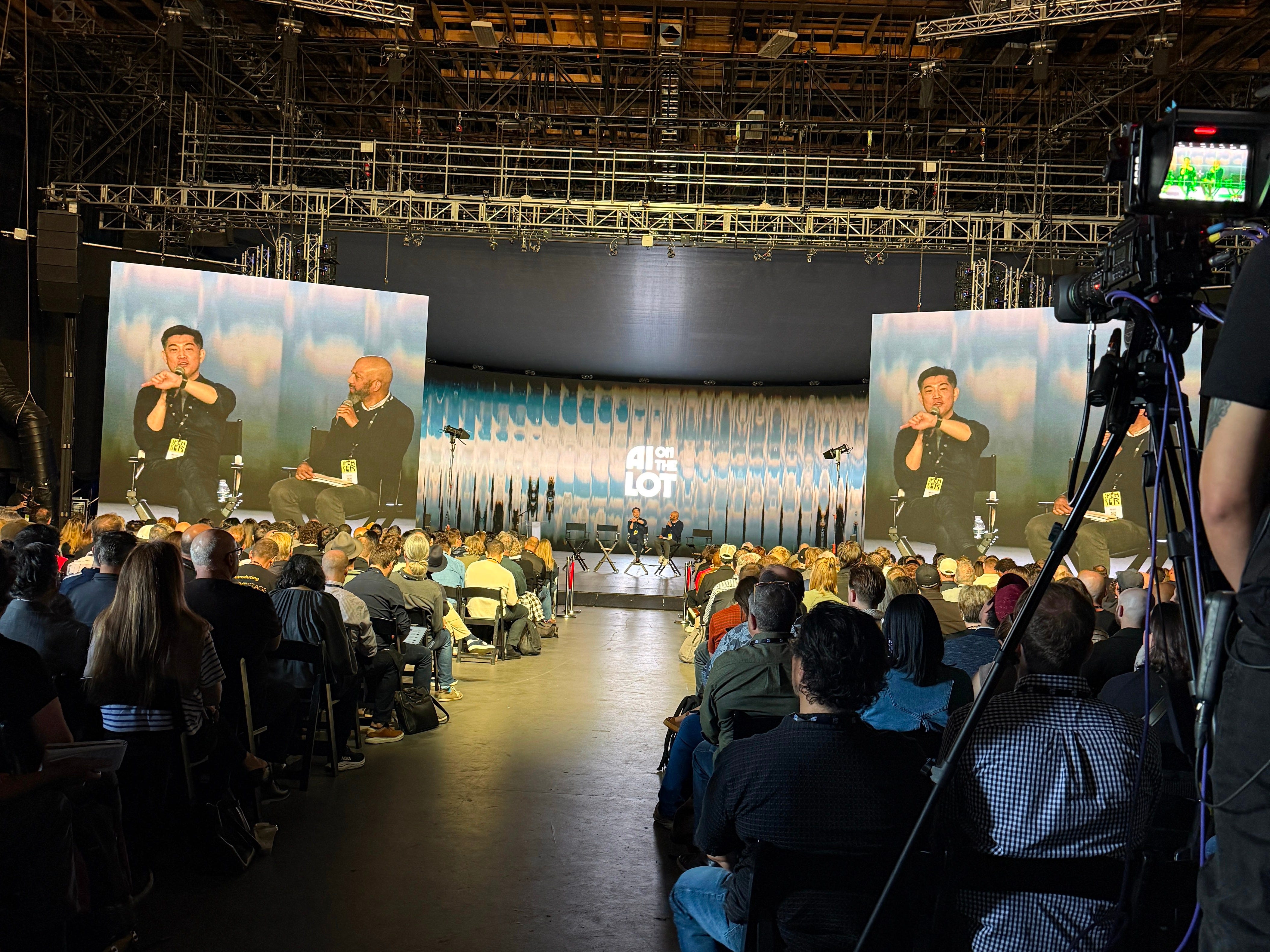
The day kicked off with Albert Cheng, who oversees AI strategy at Amazon MGM Studios, and Jay Tucker, Executive Director of UCLA Anderson’s Center for Management of Enterprise in Media, Entertainment and Sports, where he has spent more than 20 years bringing c-suite executives and industry leaders together to explore the future of entertainment. He’s a familiar and trusted voice at these kinds of convenings — exactly the right person to be asking the hard questions.
The conversation centered on Project Nara, Amazon MGM’s internal AI production initiative, and what it actually looks like to build AI infrastructure inside a major studio that is also a major IP owner. That dual identity, Cheng made clear, shapes everything.
“We are an IP owner and a tech company, so we understand all these aspects of it.”
On the question of copyright, something a lot of AI conversations conveniently sidestep, Cheng was clear and concise. For content to be copyrightable and thus monetizable, human authorship has to be provable at every step. NARA was built to track provenance for exactly that reason.
“If it’s a high-level prompt that says I want a kid who goes to space and then you let AI make the whole movie — that is not copyrightable. No one would buy it. No one needs to pay for it.”
He also pushed back hard on the narrative that AI replaces human crews. Every production they've done has had 100-plus people working on it. And while I appreciate the notion that it doesn't replace humans, it certainly reduces the need for certain positions.
“Every production we’ve done, we have industry people. We have VFX professionals. We have annotators. They’re just working differently.”
What piqued my interest was his argument that AI-assisted production could actually be the thing that brings work back to LA. Not by making fewer, bigger shows but by making smaller ones with more turnover. More jobs throughout the year.
“I’d rather make 10 shows in one sound stage than one.”
And for anyone still debating whether to engage with the tools at all, he had a simple answer:
“You can’t actually have a strong opinion about AI if you haven’t tried it. There’s no excuse for having a position if you haven’t tried it.”
Getting the Greenlight on Your Indie
Next, I power walked to the Culver Theater to catch this chat between actor-writer-director O.T. Fagbenle, actor/writer Reza Safai, and legendary Hollywood executive Rob Friedman.
Fagbenle is fascinating as he’s living both sides of the AI conversation. He’s currently starring in The Old Story: Moses at Wonder Studios, an AI-hybrid production, while simultaneously developing his own AI-assisted indie film.
His take on responsible use was refreshingly honest:
“I am yet to watch a full AI movie that I’m moved by. I can watch something where I’m like, wow, look at the effects. But emotionally moved? It’s so rare.”
For him, the responsible move is using AI to expand scope, not replace performance. Giving indie filmmakers access to spaceships, animals, scale — the things that were previously out of reach.
He encouraged filmmakers to keep experimenting and predicts that eventually, creatives will have to choose when to take the easy path by asking Claude to solve a challenge, and when to take the hard road, which uses your human brain.
Then Rob Friedman put the whole moment in context. This is the studio head behind billion-dollar franchises and Oscar winners including The Twilight Saga, John Wick, The Hunger Games, La La Land, and The Hurt Locker. When he talks about what makes this business work, you listen.
Rob has seen every wave of disruption our industry has faced. Cable, streaming, digital cinema, VFX. The technology always changes the process. What doesn’t change is what you’re making it for.
His read on AI’s role? It’s a tool. Full stop.
“It always comes down to filmmaker driven. It’s a tool to benefit the process. Story is something that comes out of the human creative mind. I don’t think AI is going to do that.”
And on the data-versus-gut question, whether AI changes how the next generation greenlights projects:
“You would have never made La La Land if you had run the numbers. Data does not drive the creative process at all.”
I pour a lot of time and heart into every post here. If AOP has brought value to you, please consider becoming a paid subscriber!
Brands as Commissioners of Culture
This one was the highlight of the day.
The question isn’t whether brands belong in premium storytelling anymore. It’s how to do it at scale. Justin Wilkes, President of Imagine Entertainment, the company behind work for Nike, Ford, Coca-Cola, and Apple, built alongside Ron Howard and Brian Grazer, sat down with Wes Walker, founder of Obsidian, to talk about exactly that.
Their meet cute story is pretty epic as well.
Two years ago, Wes directed the first AI commercial for Under Armour which aired during the Super Bowl. People went bananas. The outrage was real. Many called him a sellout. The DGA had a whole committee looking at it. Ron Howard, who sits on that committee, watched it frame by frame trying to understand how it was actually made.
Justin’s version of events: “We were like, who is the mastermind behind this diabolical scheme to tear down the filmmaking industry?”
So they tracked Wes down. Brought him in. And what started as an investigation turned into a series of real conversations about how Wes was using AI as a filmmaker. Not as a shortcut, but as a tool alongside cinematography, actors, and lighting. Using the full craft.
From there, Imagine decided to lean in. Justin was clear they wanted to understand best practices and worst practices both, so they could form an educated opinion as storytellers.
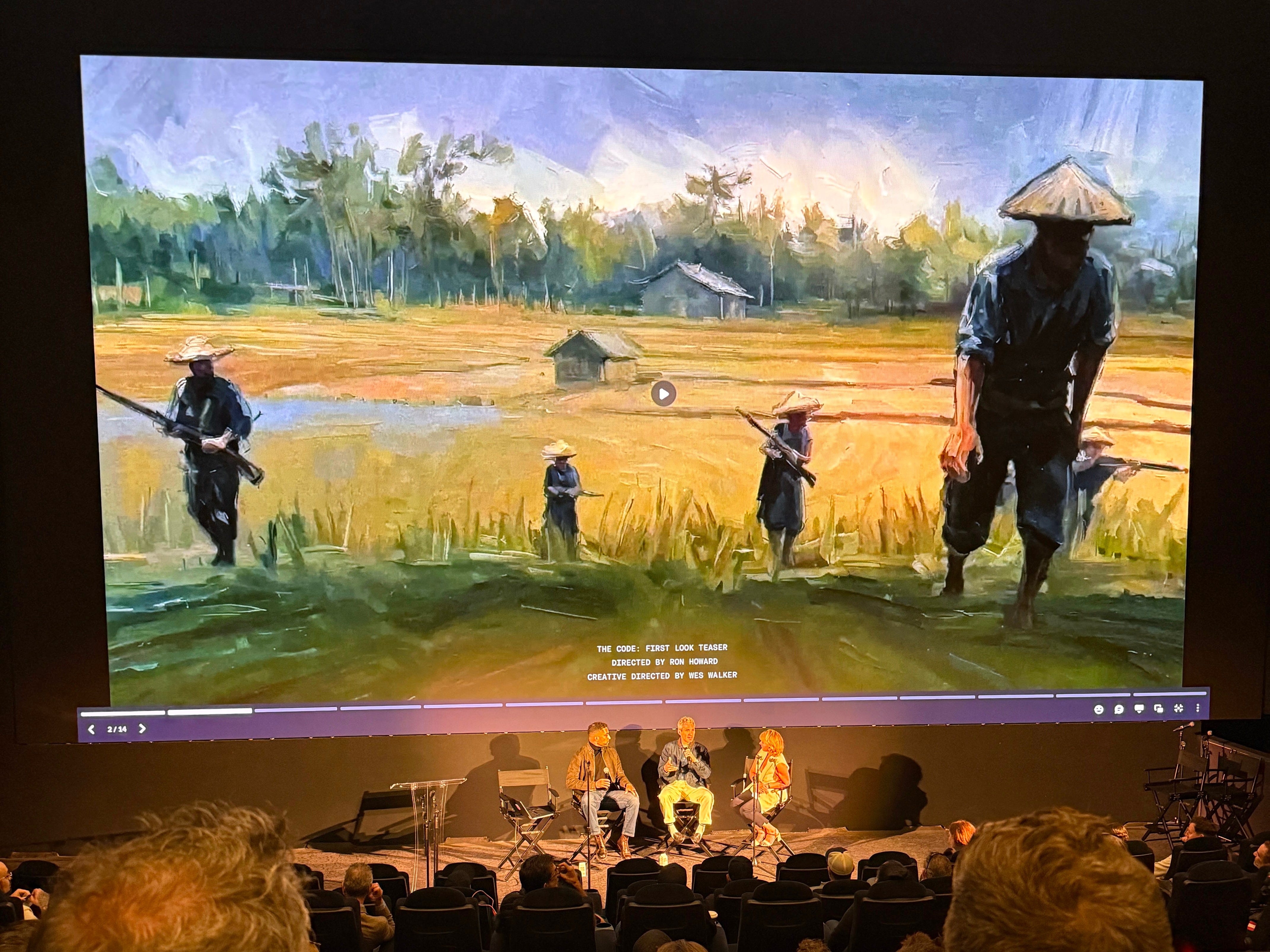
But the moment that tied the whole conversation together came when Ron Howard pulled Wes aside after all the DGA controversy. Ron showed him a newspaper clipping, a piece vilifying George Lucas for using digital projection when Star Wars came out in the 70s.
The message was clear: we’ve been here before.
Wes’s background is worth knowing and he should absolutely be on everyone’s radar.
A Stanford grad who started his career in tech, Wes worked at Tesla on the Model 3 before making a full pivot into filmmaking. He came up shooting car commercials, literally strapping himself to Teslas to get the shots he needed, eventually leading Elon to approve the purchase of a Russian arm — a gyro-stabilized camera crane mounted to a vehicle, used to capture those impossibly smooth high-speed shots you see in car commercials and action films. The full rig runs anywhere from $200,000 to $550,000...Because that's how ballers ball.
He's a cinematographer and director who fell in love with craft first, built serious technical chops along the way, and found AI later.
That combination — Stanford engineer, Tesla insider, working filmmaker — is exactly why his approach to these tools feels different. He’s building from inside the craft.
He started paying attention back when Runway could only hold an image for half a second. Now he’s stitching 15-second clips into minute-long sequences using six or seven tools inside a node-based workflow builder called Weave, combining Nano Banana Pro, Seedance, Cling, and others into custom pipelines.
But his frustration with where the space is right now was sharp:
“The world is lost in aesthetics. It’s just cool. It looks flashy. They pay attention for 10 seconds. What’s a 30-second ad? It’s quite disposable.”
What he and Justin are both pushing toward is brands commissioning actual stories. Five-minute films. Ten-minute short films. Work that makes people feel something.
As Justin said,
“Technology doesn’t drive the storytelling. The storytelling drives the storytelling. It’s not about, oh my God, we use this tool versus that tool. It’s this is how we’re going to make dinosaurs seem real. It was claymation and now it’s CGI. That’s a better way to do it. Let’s do that.”
Inside the AI Film Studios
The final session was a lightning round with six AI-forward studios presenting their business model, workflow, and house style. The range was wide: viral content, Hollywood VFX, and even the controversial “gray-box” production techniques used on Doug Liman’s latest film.
They included:
Pouya Shahbazian — Founder & CEO, Staircase Studios AI (producer of the Divergent franchise)
PJ Accetturo — Founder & CEO, Genre.ai (300M+ views across AI ad campaigns for Popeyes, Google, Qatar Airways)
KJ Kim (Kwang Jib Kim) — CEO, Studio Meta-K (South Korean AI content studio specializing in dramas, films, and virtual artists)
Ryan Kavanaugh — Co-founder, Acme AI & FX (producer behind Doug Liman’s Bitcoin: Killing Satoshi, the AI-assisted thriller that cut a $300M budget down to $70M)
Rupert Cresswell — Chief Creative Officer, Elevado, a creative studio built at the intersection of AI, VFX, and production, founded in 2025.
Tejas Shah — Co-founder, Gennie (generative AI studio focused on documentary and non-fiction storytelling)
I caught three of the five. The one that piqued my interest most was Elevado.
Founded just last year in 2025, Elevado doesn’t feel like a tech startup that wandered into filmmaking. It feels like seasoned creatives who chose to build something new.
Part production company, part innovation lab, they sit at the intersection of AI, VFX, and production. Their tagline, “powered by AI, elevated by artists.”
Their demo for Summer Walker showed what the hybrid approach actually looks like. Technology in service of an artist’s world, not overwriting it. It was a good note to end the day on. A young studio already doing the work, not just talking about it.
The Ron Howard Moment
Walking out of AI on the Lot today, I kept coming back to the Ron Howard moment. A newspaper clipping of George Lucas from 1977 harboring the same fear, the same resistance, the same question underneath it all: is this going to kill what we love about this?
It didn’t then. And I don’t think it will now, not if the people in that room have anything to say about it. What I saw today was an industry in process. Asking hard questions, learning, experimenting, and attempting to, protect what matters while reaching for what’s next.
So here’s what I’ll leave you with: if you haven’t tried the tools yet, what are you waiting for? Not because AI is the future but because your point of view on it matters. And you can’t have one from the sidelines.
What would you make if the only limit was your imagination?
Keep creating, keep hustling. And as always, thanks for doing this life thing with me!


I pour a lot of time and heart into every post I publish here. If AOP has brought you value, please consider becoming a paid subscriber. Thank you!
Comments
Nothing yet. Say the first thing.
Sign in to join the conversation.