
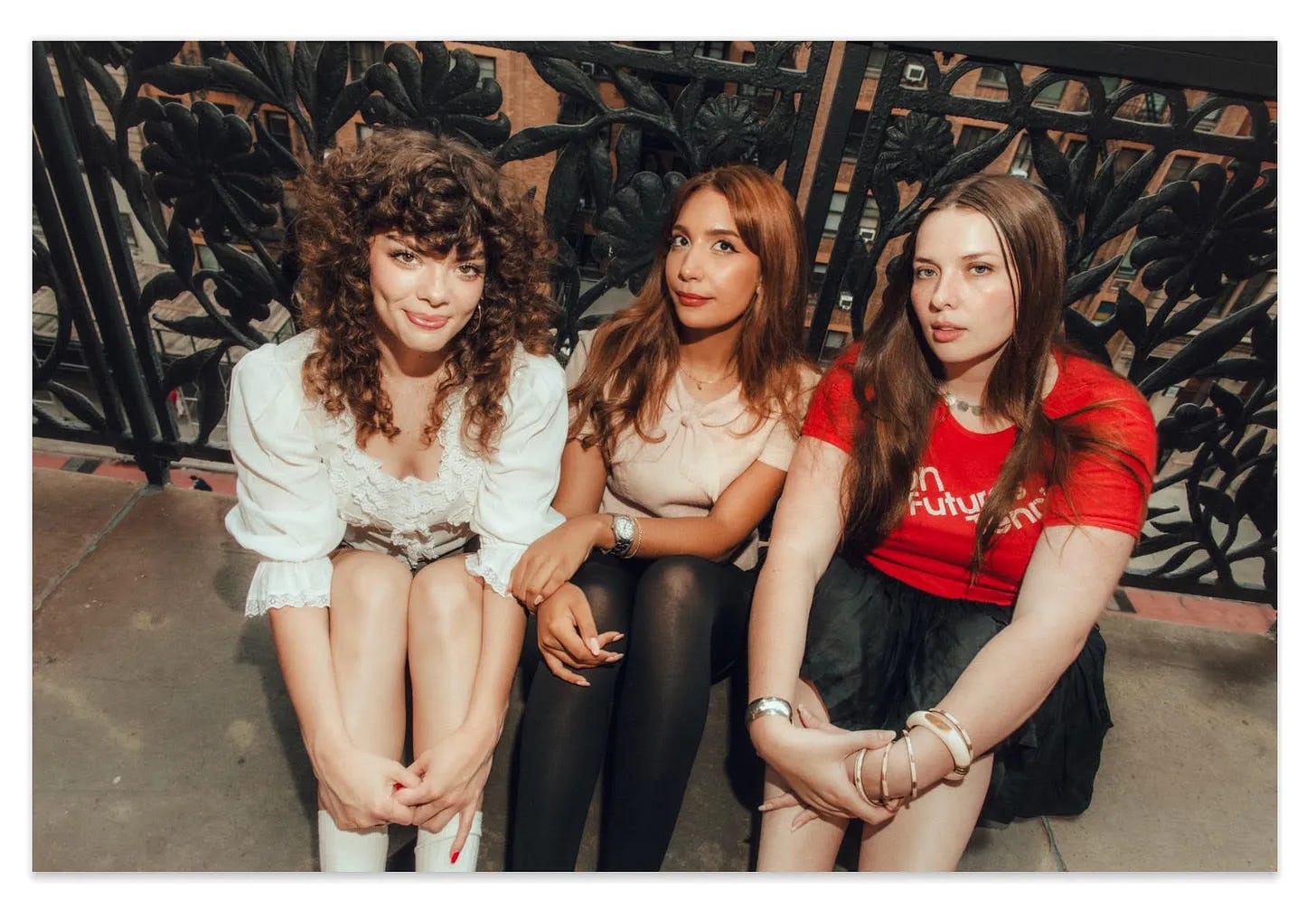
To call Alexi Alario, Biz Sherbert and Sam Cummins your favourite fashion critics’ favourite fashion critics might be accurate, but it would also be underselling them. Across over 100 episodes of their enormously influential podcast Nymphet Alumni they have developed a mode of cultural criticism pulled taut with rigourous research that glints off the razor edge of the zeitgeist, playfully weaving between off-the-cuff vibe-divining and scrupulously referenced critique. Their nimble grasp of style and aesthetics can keep pace with the velocity of our current media environment, yet is meticulous enough to revel in the finer detail of a well wrought take.
Crucial to their irresistible formula is an incisive understanding of the fact that world building has steadily taken over as the dominant form of cultural production of our time. An episode might take a single theme, period or neologism as its prompt - see ‘The Mormon Culture Report’, ‘Austin Powers Vibes and The Great Groovival’ and ‘Blokette’ - before spinning it out into its own critical topology, allowing the listener to then superimpose this onto their own cultural landscapes. Though famed for consistently beating the trend forecasters at their own game, it’s their generosity of knowledge and the joy with which Alario, Sherbert and Cummins pick out the most engaging narratives from culture that set them apart as some of the most important contemporary voices in fashion criticism.
This omnivorous approach to culture and bookish attention to detail is no more clearly communicated than in their carefully curated selection of guests, which range from fashion historian Dr. Valerie Steele and new school critic Rian Phin to contemporary fashion icon Mel Ottenberg and clout demon The Dare. What is perhaps most impressive, though, is Alario, Sherbert and Cummins’s seemingly innate ability to adapt to constant change. The media ecosystem from which the podcast emerged four years ago is very different to the one its hosts find themselves in today. As such, their methodologies and areas of focus have shifted accordingly. Catching up with them over Zoom at the beginning of the year and it’s clear that vibe literacy and social media agility are no longer enough for the fashion critic of 2025.
We spoke to them about craving rigour, the conflicting dreams of fashion and technology people, and why online dress up games provide such formative experiences for budding Nymphet Alumni.
Where does fashion live in 2025?
Sam Cummins:
In person! Because of the work that we do on the podcast we have to stay in touch with the way that people are engaging with fashion in day to day life. At the beginning of last year I realised it was becoming increasingly difficult to gauge that through my phone. While it is a game of balancing digital trends with real life trends, it’s much more grounded in the physical world.
Biz Sherbert:
I definitely think fashion lives everywhere. There’s always going to be behaviour around getting dressed for images, but fashion still exists beyond that. Every image you see of a person has some sort of fashion component and I’m really obsessed with how seeing images of fashion online informs how we see fashion and people in person, how it fuels feelings of resentment, or judgment, or jealousy and how we can move past that. If we’re constantly seeing each other this way, what is that doing to our collective consciousness? Maybe you haven’t actually seen that many people wearing an outfit, but if you’ve seen it a lot online, how is that changing your perception of seeing the outfit in person?
What about fashion criticism?
Biz Sherbert:
A lot of the people who have stood out in the video driven landscape, like our friend Rian Phin, are also writers. People like that will continue to try to build different platforms independently, but right now, audiences are mostly looking for respected voices from traditional media or Substack.
Sam Cummins:
We’re in a platform crisis right now. Twitter feels like a mess ever since Elon obtained it. TikTok was under threat of being banned. It’s not that those were the centers of intellectual conversation for most people, but they definitely pushed them to think critically about some things and were a pipeline for them to become interested in long form criticism, whether it be about fashion, art or music. I think the rise in popularity of Substack does point to the fact that people are really interested in coming into contact with long form writing. Also, magazines have been really good lately! Even just reading a New York Times article feels more fulfilling and interesting than it has in the past few years.
Alexi Alario:
I also really love Reddit, I feel like it’s where mostly stable people go to have real conversations. Of course people fight, but I think it’s the most rational, peaceful place on the internet that still seems capable of producing solutions, rather than problems. I would love to be part of a really good fashion community there.
Biz Sherbert:
There’s this Subreddit called Decadeology which is constantly talking about the things we talk about on the podcast. It’s really fab because it is just normal people who are really interested in the sociological and anthropological aspects of pop culture.
Alexi Alario:
It feels like a place where the balance between people who produce and consume is really even. The comment sections are always better than the actual content being discussed. People have fruitful conversations that are a little bit cringe, but you also see really good information come from really surprising places. I was trying to find something out about the LA wildfires the other day and one of the best threads I could find was on the Pokémon Go Subreddit because they were organising this big meet up and were really freaking out about where to stay and what was going to be affected.
Which are the emerging digital frontiers for fashion you are finding the most interesting?
Sam Cummins:
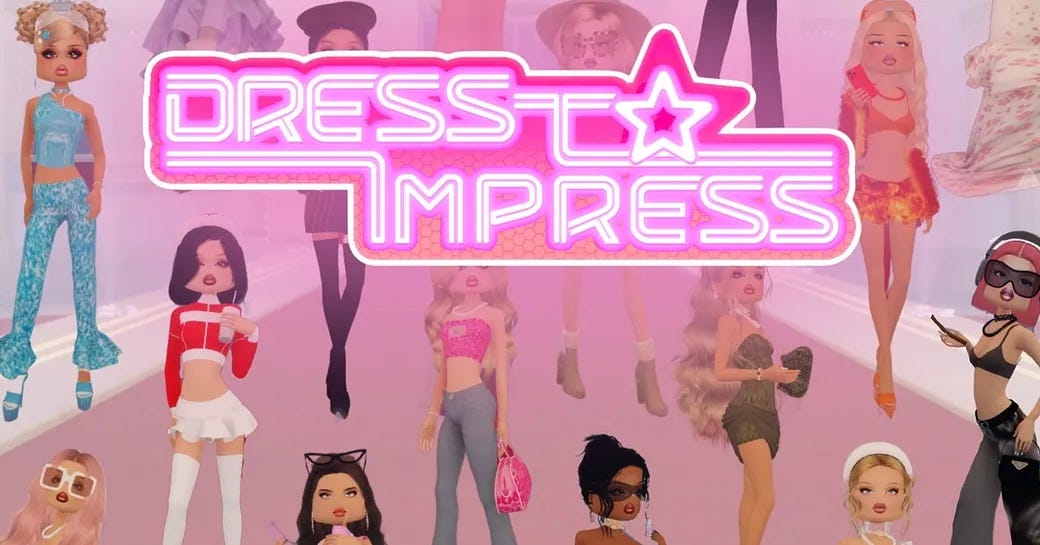
We did an episode on Dress To Impress in Roblox, which is definitely one of the most interesting new media platforms to explore. It has a lot of impact on the fashion of Gen Alpha and the younger generations. The key is that it’s user generated, that’s what drives most, if not all, platforms of the modern day. It’s a really brilliant format for something to have cultural impact. It can be frightening, because you realise that there are children on there creating these very disturbing games, but it is still able to forefront a really traditional form of digital fashion in the dress up game, which is probably most people’s first introduction to adult fashion.
Biz Sherbert:
We’re in a very different place now than when digital fashion was first making mainstream headlines right after COVID. Now that the economy is a lot worse, it’s easier to see it through the depressing lens of people being too broke or disenfranchised to have an awesome outfit, so they’re literally wearing their digital threads. In terms of digital fashion and media, recently I’ve actually just been enjoying using different file management tools to organise references I’m finding, either on online archives or in person and uploading them myself. People are moving away from surface level image aggregation sites like Pinterest and realising they want to take their references a little bit deeper. That’s been a practice that I’ve personally found significant, merging the digital world with what’s inspiring me in fashion to make it actually useful to my work.
Alexi Alario:
I think things have to be useful or they have to be insanely fun. There’s a lot of hype around skins in video games, which is obviously a huge source of income in the digital world, but I really don’t see much of an overlap with that and the actual fashion world. Of course you can wear Balenciaga in Fortnite, but the skins always have a certain look. I don’t know if it’s just because of the military fantasy nature of a lot of video games, but it would be good if a game that managed to break free from that genre and give you fun outfit options.
Sam Cummins:
It’s hard to get any type of digital fashion to appeal to adults in an impactful way. Dressing up an avatar feels like a really impactful experience as a child, but children famously don’t have any money, so they can’t really make the digital fashion industry profitable. Adults don’t have the time to really become invested in some sort of Metaverse situation where they would build a closet online. The hype came from a time where we were overestimating how much time people would spend online. We’re spending a lot less time online than we were during the pandemic and the time that we do spend online is often for work.
Biz Sherbert:
The dream of digital fashion was being conjured and sold by art and technology people and they’re selling a different dream than fashion people. Fashion people are really sensorial, driven by their whims and bodily impulses, by sight and texture and seeing people in person. It doesn’t appeal to the people that are actually stakeholders in fashion, even if it appeals to people elsewhere.
How would you make a truly great fashion game?
Sam Cummins:
Something I've learned playing Dress To Impress is that a sense of humour is really important. It overlaps with this gay, gag city thing, where women and gay guys love to participate in discourse about fashion. It allows for inside jokes to bubble up through various cultural references. Fashion has a really lovely sense of humour right now, which it maybe hasn’t in other generations. There is really rich potential there.
Alexi Alario:
Dress up games are extremely powerful. There’s this dress up game called Love Nikki I have known fashion people to get really, really addicted to, because it's also a social dress up game where you acquire stuff, put outfits together and vote. A truly great fashion game should be hyperbolically fashion-core, with Karl Lagerfeld-esque intense personalities to deal with, rather than having it be super sleek and cyber.
Biz Sherbert:
Something people like about Dress To Impress is its representation of contemporary clothing that already exists. People are really put off by this hyper polished, chewed bubble gum texture that most digital fashion has. Even just having a different rendering process would be really powerful, this super slick vision of the future isn’t appealing to people.
Do you think images that look less slick offer a more accessible way of engaging with digital media?
Sam Cummins:
It invites improvisation. A lot of glitches in Dress To Impress are reformatted into hacks that become a draw for people. They improvise through them, the holes in the game make people feel like it’s that much more user generated.
Alexi Alario:
Would you rather play a game that looks beautiful and play it alone, or play a game that’s kind of busted, but play it online with a ton of people? With Dress To Impress, you can choose to render it at a lower quality so you can move faster and do things more easily. You basically can’t play it on an iPad at full resolution without it exploding. I don’t think young people like it because it looks shitty, they’re just willing to trade that off being able to play with lots of their friends.
Sam Cummins:
It’s also a community building exercise. This exchange of hidden knowledge by finding exploits and glitches really appeals to this base impulse to spread secrets with each other. There are layers of participation: it’s a user generated game, that has a bunch of participatory lore built by the community, you get to play it with your friends and the glitches help you. The more participation is involved in it, the more it feels improvised, the more it appeals to people.
Biz Sherbert:
I think the dominant mode of our time is the idea of unveiling or discovering the truth. This conspiracy mindset is something that goes through many parts of our culture, in many generations.
What are your thoughts on the use of CGI and AI generated visuals within fashion?
Alexi Alario:
When DALL-E launched it wouldn’t let you make pictures of real people for valid fears of deep fakes, but there was this one week period where there was an AI image generation tool that would let you do it. All of these gay people on Twitter were using it to make pictures of these really absurd pop culture situations that were really funny, like Nicki Minaj winning a Grammy with Billie Eilish crying in the background. Images like that bring joy to people, but if you sit on it for too long and start actually thinking about the implications of AI and fake images, it starts to get a bit dark. Fashion entities know that the second they post something AI generated, their comments are going to be a total war zone.
Sam Cummins:
People feel swindled whenever they are shown an AI image. There was the controversial Sketchers ad in the issue of Vogue edited by Marc Jacobs. People felt personally wronged, like someone was tricking them. It has to be somehow explicitly embedded within an image that it is AI-generated, otherwise people feel like their intelligence has been brought into question. I think that’s where a lot of the controversies come from. If the quality is bad, people will like it more, if the AI is too realistic, they will feel very offended. If it’s absurdist and has a sense of humour, they might really enjoy it!
Biz Sherbert:
There is a bit of backlash right now with audiences who are disconnected from fashion, but still consuming fashion imagery and advertising. We’re coming out of an era where the real was the most important thing, whether it was showing stretch marks or having different body types represented in models. Now, it’s jarring for people to be faced with fashion’s perhaps most definitive sin, which is being extremely artificial and fake, in such a direct way.
We’re starting to see a shift in film and TV production towards the use of AI as standard, something we’re fascinated to see start unfolding in the fashion space.
Alexi Alario:
Being super resistant to it isn’t going to play out super well. I think it really is inevitable and unavoidable in a lot of fields. I think the general sentiment is going to end up being, if you do use it, let it be so good and so undetectable that we won't know. Brands can’t be too braggy and try to shove it down our throats. No one really wants to hear about how you designed a bag with AI.
Sam Cummins:
Fashion is one of those industries that’s incredibly dependent on real life. A lot of its art, in terms of concept and visuals, is used for advertising, but what they’re selling you, the product itself, is so dependent on the real world that I think those two poles really butt heads. The movie industry is completely dependent on fantasy and technology, it wouldn’t exist without that. Fashion existed far before any of those things were invented. It’s very difficult to try to merge two things that feel like opposites without there being some tension.
Biz Sherbert:
It depends what your goal is. My friend Éamonn Freel uses a lot of AI and CGI for fashion campaigns and editorials, but I don’t think his goal is to sell you an idea of beauty, whereas with mainstream advertising, selling a beautiful person and the product that they’re wearing is the goal. That’s where there will be a divide. Right now, people see CGI and AI as something that is more acceptable within the parameters of artistic output, not pure advertising.
Alexi Alario:
I also think the fashion images that are the most powerful are increasingly more candid, user-generated content, as opposed to big fashion photo shoot productions with CGI. Part of the magic of the fashion industry is this idea of reality, you want to imagine some poor intern running down the street with a bunch of dresses. Without that, I don’t think people will really care.
Biz Sherbert:
We interviewed Dr Valerie Steele on the podcast about her book on Gothic fashion and there’s a chapter in it about fashion and death, how the nature of fashion is that it’s constantly dying. There is something quintessential about a style that represents the now, but will be out of fashion soon. The fact that AI can be constantly modulated to represent changing desires is antithetical to fashion in a way, even though that is its essence. It’s like fashion’s perfect little monster, but I don’t think that’s actually what people want. They want something to be dead and gone.
Is trend forecasting still even possible?
Biz Sherbert:
What I learned from having millions of people watch my TikTok videos discussing fashion and trends in short form was that it can be a force for willing something into the culture, even without meaning to. I made this video about wired headphones in 2021 that got really big and was reported on by The Wall Street Journal and Vogue. It was this time when people were really wanting these trend forecasts to be meaningful and come true, so they kind of willed them into existence. I think we’re definitely moving past that as being the new thing in fashion. I think we'll look back at this time as the Wild West of new forms of fashion media. You can see these constant points of tension around predictions and what people are wearing in real life. It’s causing a lot of sadness and anxiety for people, who are now looking for more grounded perspectives, new voices of reason to cut through all of that.
Alexi Alario:
It was our thing for a while to be good at reading vibes. We were always talking about vibes and how they were the currency of our time, but just seeing how vibes have spiralled into darkness and negativity has been freaking us out. We’ve been wanting more intellectual fitness and literacy out of people. The data driven side of it is also not really pleasing to fashion people. We’re tired of the charts and the rise and fall, people just want to know why and what the precedents are, rather than just the fact that it’s happening. The people that are going to rise above will be researchers and historians, rather than data analysts.
Sam Cummins:
Bite-sized media is something that has really exhausted people. Like Alexi said, we’re really tired of vibes, we’re craving facts and information. Even though digital literacy has risen, we live in a time where media is so clogged that it feels impossible to parse. It feels like the internet is basically useless now for a lot of different reasons. Reading the footnotes of a book that you’re interested in feels a lot more relevant than a Google search of something because things are so clogged up. The Luddites are rising again!
Interview by Henry Bruce Jones and Róisín McVeigh.
No posts
Comments
Nothing yet. Say the first thing.
Sign in to join the conversation.