
Niall Campbell (also known as Phokojwe ‘the Jackal’) is a sangoma, a traditional doctor nyanga (medicine man), a doctor of traditional ceremonies as well as institutions as well as a Ngaka ya diKoma, a doctor of rites. He is a world-renowned specialist in men’s rites of passage.
Niall (pronounced Neil) has over 25 years of apprenticeship in ancestral and nature spirits, divination and medicinal herbalism with African teachers. He facilitates men’s rites of passage, initiations, entering adulthood and manhood and is widely regarded as one of the foremost holders of traditional ways.
He is the subject of numerous international documentaries on shamanic healers and consults, lectures and works all over the world.
What is a Free Range Human?
People who live inside ordinary life, but haven’t lost contact with its beauty or traded their aliveness for it. They are wholeheartedly human, astonished and at large. Finding them, and finding out how they got that way, is what this series is about.
Niall qualifies. I spoke with him in March 2026 and we talked about being with discomfort, participation, challenge, the will and why ‘going no-contact’ is a disaster.
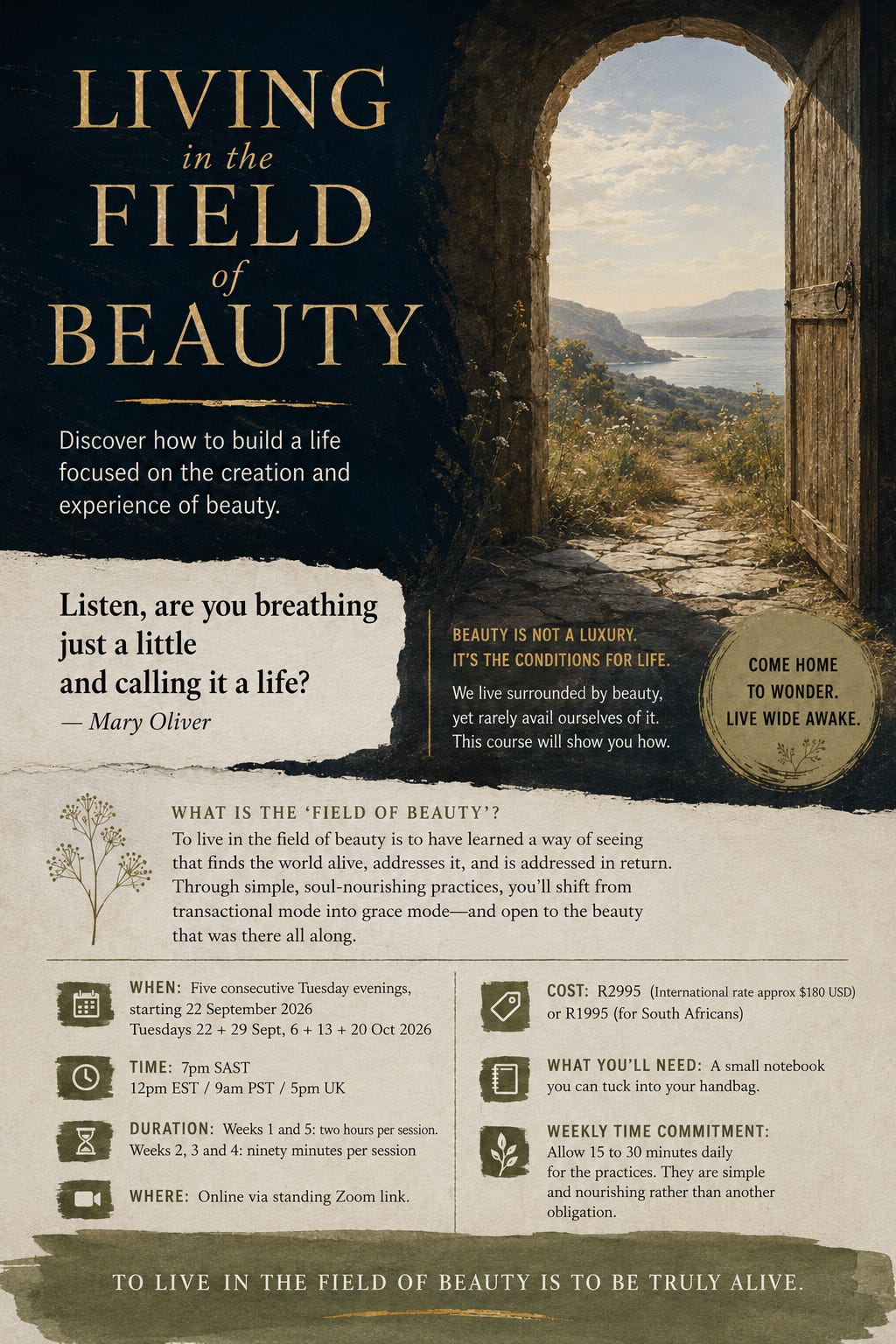
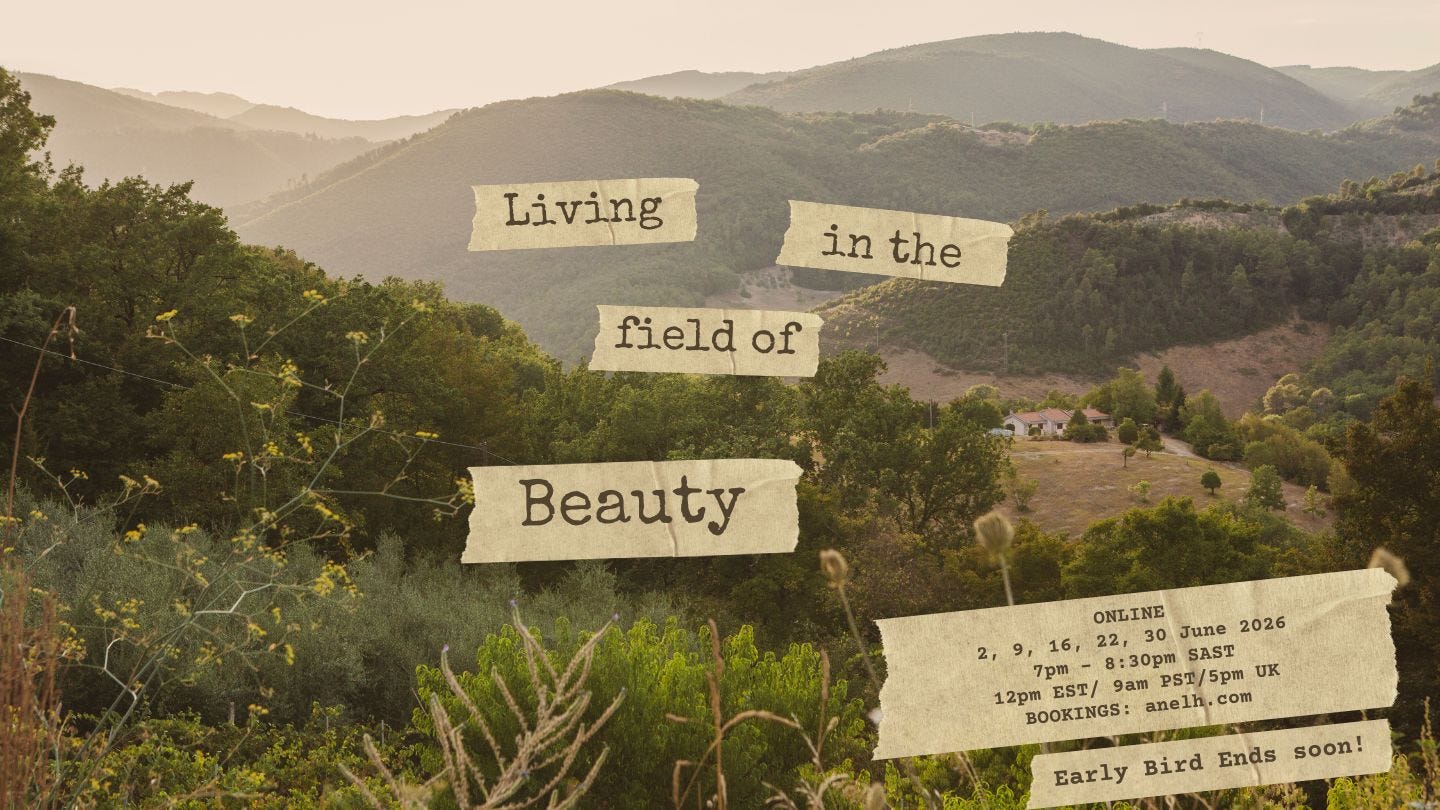
This conversation is part of a series I'm making in preparation for Living in the Field of Beauty, a five-week course starting in June. Next week I'll publish Part 2 which will be an essay reflecting on this conversation. If you'd like to support this work and get early access to future conversations, you can support me on Patreon.
Video Chapters
00:00 Exploring Identity and Spiritual Calling
01:41 The Concept of Free Range Humans
04:42 Barriers to Being Wholeheartedly Human
07:38 The Journey to Authenticity
10:21 Understanding Values and Trust
14:33 Discomfort and Convenience in Modern Life
17:21 Discipline and Willpower for Free Range Living
29:26 The Nature of Discipline
34:36 Participation in Life
39:32 The Challenge of Family Dynamics
42:31 Embracing Discomfort for Growth
48:42 Reconnecting with Nature
56:17 The Currency of Attention
59:28 Defining Love
Prefer to Read?
*This transcript has been edited for length.* Full transcript is available on the post page.
Anél Hamersma (0:00) Where do you live? Who are you?
Niall Campbell (0:04) That’s always an interesting question. I think we’re all trying to find out who exactly we are. I’ll start with what I do know, and maybe in this interview a little of what I don’t know will also emerge.
I’m from Botswana. I was born there and have lived most of my life there, and since recently I split my time between Botswana and Cape Town — I live in Botswana in the best of its weather and in Cape Town in the best of Cape Town’s weather.
I am what people in Southern Africa call a person of the spirit, or a person of air. When I was very young — little, in fact — I started having the symptoms of what people call a calling. Though in the indigenous languages here, we call it an errand. We are sent rather than called. It’s a calling of the ancestors, and it became stronger and stronger and eventually needed to be attended to. Fortunately my parents are very open-minded and very indigenously orientated, so I found myself training with an old man who lived close by, to become a traditional healer.
That has been the mark of my life ever since. A traditional healer is not simply somebody who fixes bodily ailments — it’s a combination of doctor, psychologist, priest, medium, and community elder. I still practice. When I was about fourteen, I used to sit at the feet of my teacher and watch him diagnose people through divination, and then treat them through baths or steamings or all kinds of other things. And right the way up to now, I tend to work with groups of people, in the wilderness. My spirituality is very much more in the wilderness than it has ever been. That’s a little nutshell of who I am — though, as I said, we’re still finding out.
Anél Hamersma (3:10) Niall, you are one of my two primary inspirations for Free Range Human. If the definition of a free-range human is somebody who lives within modern life but hasn’t lost contact with its beauty or traded their aliveness for it — wholeheartedly human, astonished and at large — in your opinion, what are some of the things that prevent people from being that?
Niall Campbell (3:31) Great question. I think me and you had a discussion outside of this about Maslow’s hierarchy of needs, and I’m very much a believer in that. To be a free-range human — there’s a great privilege to it. I don’t think it comes easily, and there are many people who don’t have access to what it takes.
When taking care of the day-to-day necessities of life is very difficult, becoming a free-range human is not accessible. The first criteria is that the basics of life must come with enough ease that they don’t take up the whole of one’s time and energy. And then secondly, there’s a certain level of mental health security that is needed — not being completely defined by one’s traumas, not locked up in one’s past.
Once those two are ticked, the cage door is open. But there’s always that thing of the poor chimp who was given an open door and decided to stay inside. And I think that’s one of the very big movements that needs to take place: when you get what I’d call gumption — chutzpah — to step out of that cage and go and become. How defined are we by the expectations of those around us? Can we break through enough of that to ask: what do I want in life? Not what drives you from behind — but what draws you forward. That, for me, is the beginning of free range.
Anél Hamersma (8:22) What strikes me is that you embody this so vividly. You are not interested in other people’s expectations of you. You are interested in being Niall — wholeheartedly. And there’s a certain fundamental courage required to show up in the world that way. How does one nurture that kind of courage?
Niall Campbell (9:37) It’s been a work. I wasn’t born a free-range human, though I was born into a family of pretty free-range people, so I had good groundwork. But a number of years ago — probably about fifteen years ago — I had this realisation that there was a thing I called radically myself, and it became my goal ever since. What it needed from me was to go out into places where other people are talking about this thing, finding useful experiences that put you face to face with the question: what am I, aside from all the expectations?
Know thyself. I think that’s fundamentally one of the biggest things — not to be afraid to go into any corner of yourself, to thrash it out. And my dad had good advice when I was younger: don’t compare yourself to others, compare yourself to your values.
I sit daily with values. In the beginning you make a list — I believe in this, I don’t believe in that. And you keep at it until you know your values really well. Then in any situation, you come back to that rather than comparing yourself to the person next to you. It’s become a habit for me. Every time I encounter a situation, I make a value judgment. And that compass tells you where you are in the world — what you can attend to, and what you can let go.
Anél Hamersma (14:58) Something is coming up for me around trust — trusting yourself. What does trust mean to you?
Niall Campbell (15:22) I have a different definition of trust to most people. My definition is that I can’t say I trust you. All I can say is that I trust my own willingness to be with how I will feel — whatever it is that you choose to do or say or omit. My sense of trust comes from taking responsibility for my own feelings. If I’m in a situation and I go, I trust myself — what I mean is, I’m willing to go in. I may get grievously hurt. But I’m willing to be with that.
Otherwise, I’m trying to manage other people. And I’ll tell you, Anél — you know me quite well — I’m very good at managing other people. One of my big lessons in life is learning to do that less. We manage people and situations in the place where we should actually just be managing our own feelings — the feelings of hurt, pain, rejection, abandonment, all the shadow feelings we try to push away and choreograph our future to avoid.
Anél Hamersma (17:17) Most of us would love to avoid all of the above. So tell me about discomfort — about learning to be comfortable in discomfort. What does that look like?
Niall Campbell (17:35) Let me tell you about the way of convenience. Some years ago, I took a walk to a favourite mountain of mine in Botswana. You park about a kilometre away because beyond that there’s a very tangled thorn bush — sickle bush, relentless and thorny. To get to the mountain you need to look at it first, set your direction, and keep as straight as you can. Which means crawling under branches, parting the bush, breaking through. It’s very difficult.
But what the tendency is — you get to a blocked patch, look left, see a little opening, take it. And then left again, and left again. And you find yourself back where you started. You’ve gone in a circle, because you always took the convenient way rather than the straight way.
I noticed a friend doing this on a trip and had a revelation: this is what life is about. We choose the convenient way the whole time. And the promise is amazing — but the cost is life itself. We have absolutely no discipline. We have absolutely no will. We are eroding those things, horrendously.
I look at this and I see three addictions: we are addicted to a sense of security, addicted to entertainment, and addicted to comfort. Go into one of those big malls — you will not know what day of the week it is, what month, what year. It’s an environment of complete, even comfort. And it erodes our participation in life entirely.
Anél Hamersma (21:35) So how do I build discipline and will in myself? What do I do?
Niall Campbell (22:28) One of the first steps is to leave the bubble. I go back to Botswana, where I’m a member of a tribe, and I visit with people who live very traditional lives — no internet, a cash and barter economy, lives dictated by the cycles of nature. When it rains, they have providence. When there’s a drought, they suffer. Watching what they do for discipline — that teaches you something.
For me, I do handcraft. I work with my hands. I carve wood with a knife, I beat iron with fire. There are a million machines that could make it easier, but I want the skill that comes from ten thousand hours. Convenience erodes ten thousand hours. We don’t become wise in anything.
And then give yourself a direction. What are you going after? What are you willing to do to get there? That gives tremendous will. Martin Shaw says you can’t have wildness without discipline — and I completely agree. To live completely wild, there need to be parameters. Everything in nature has laws. We humans are determined to break every single one of them and make our own.
Anél Hamersma (34:42) This word you keep coming back to: participation. And before we started, you mentioned that there are different communities in which we can participate as human beings. What are those?
Niall Campbell (35:27) We belong to communities — you don’t need to look for community, you need to see it, because we already belong. We belong to family, to social and neighbourhood groups, to people with shared interests or callings. Me and you belong to a community with its roots in something spiritual we have in common — and that community extends, in this country, to hundreds of thousands of people.
But communities are fractal. There’s the community of human beings alive now — about eight billion. And then the community of those who came before us: the ancestors, in all their permutations. And then those who will come from us: our children, their children, their children’s children. And then the community of those who are not human — far greater in number than we are.
How do we participate in each of them? I work very much with the community of the ancestors. But at the same time, I am probably already an ancestor, if we take time out of the mix. Some of the things I do now will affect those who come in the future. And if I’m going to be a good ancestor — what am I putting in place now?
Anél Hamersma (38:03) Both you and I are animists. But if someone listening doesn’t have a sense that the world around them is alive, or trying to have a relationship with them — what would you say to that person?
Niall Campbell (39:38) I would say your Prozac is probably the only thing you’ve got left.
We’ve come to a point in modern Western culture where many of us believe we are outside of nature — and many believe it without even knowing they believe it. We’ve othered ourselves so completely from nature that we are literally aliens. There’s a reason little green men have come so strongly into our mythology: they are an archetype of us, in our state of disconnection.
I take people into the bush who believe that nature is out to get them — that every creature wants to sting them, bite them, tear them to pieces. And the invitation is: what happens when you step back in? I’ve seen great transformation from the simplest thing. Don’t give them any more challenge than sitting by a campfire with their shoes off, in a nice tent. Make it glamping if you have to. But if that’s the first time it’s ever happened, it has a profound effect.
The currency of life is attention. Everything in nature wants to be seen. If you give it the right amount of attention, it’s happy. And that is participating. A lot of the mystics today say nature misses us as a species — and when we come back, it celebrates.
Anél Hamersma (53:22) Martin Shaw said something similar: the world wants to be admired by us, and when we don’t admire it, there’s a damage — to the world and to us. You said the currency of life is attention. Why?
Niall Campbell (54:04) You have a really nice haircut. And I’m wearing these gold-rimmed glasses and I very much like them. In the beginning of the interview, you said something about how I looked — you gave me some attention. When I complimented your hair, I gave you some. And that is food. It’s nourishment.
Babies learn two things very early: to scream, or to smile. Whichever one gets the attention is the one they tend to go with. We will do anything for it. I’ve listened to street people being interviewed, and they said the hardest thing — not the hunger, not the lack of shelter, not the exposure — was that people would not look at them. They got no attention. That was the killer.
And it’s not only what humans need. Everything wants it. So when you give it liberally, you’re participating. But we tend to go into life in an extractive way. There’s a very African term: stealing with your eyes. You’re taking rather than giving. Whereas if you look at someone who is marvellously dressed and you say, wow, look at you — you’ve given something. You didn’t steal. Attention is free. And it’s where we can be most generous.
Anél Hamersma (56:14) But something has been perverted. We now have Instagram and this whole attention economy — everyone screaming look at me, and nobody actually paying attention to the world around them. Something has gone wrong somewhere.
Niall Campbell (57:01) Attention is addictive, like any good thing. I know a man — a big Facebook personality — who is wonderful in his videos, warm and generous. But when we sit together, he’s usually doing his videos. You don’t get anything from him in person. It’s always: did you see this post? I got this many likes. He was in a deficit for a long time, and now he’s on a binge.
We call people needy — but needy just means that person’s way of getting attention is boring or irritating to the rest of us. We’re all doing something for it. Some of us have very fun ways of getting it, and others have ways we then cruelly label needy. Which is rather sad.
Anél Hamersma (59:51) So if I want to participate in my environment a bit more — I’m going to sit by a campfire, take off my shoes, not kill all the spiders. What else do you recommend?
Niall Campbell (1:00:04) Cold showers. Only cold showers. And do things longhand — I call it the handmade brand. Nothing written or edited by AI, done the old-fashioned way. Your journal and your notes happen by hand, not on a keyboard. And cultivate a willingness, when you’re in adversity, to be a complete and absolute participant in it — knowing your mountain is straight ahead and you’re going to have to crawl through this bush to get there. But enjoy every moment of crawling through the bush, because you’re not at the mountain yet. That’s what I would offer, to be a free-range human.
Anél Hamersma (1:01:07) I have one last question. What is your personal definition of love?
Niall Campbell (1:01:22) The Greeks said it right, having different words for it — we put so many different shapes of things into one basket and call it love. But for me, one of the things love is, is a certain sharing of joy.
Joy is not the same as excitement, or bliss, or happiness — it’s a very particular thing. But there’s a certain joy that sits between people. I look at my wife, who I love very much, and I ask: what is this love thing? It’s not completely lust. It’s not co-dependence. It’s that there’s a certain joy that sits between us. I want her to experience that joy, and I think she wants me to experience it. And that joy sits between us. For me, that’s love. And that’s in the relating between all things.
Anél Hamersma (1:02:34) That’s so beautiful. Thank you Niall, so much.
Niall Campbell (1:02:47) Thank you. It’s been really nice to sit in this context with you.
More Free Range Human
Watch my conversation with Peter van Straten.
Watch my conversation with Maja Marx.
Sign up for Living in the Field of Beauty, starting in June, here.
Join me on Patreon.
More about Free Range Human.
Comments
Nothing yet. Say the first thing.
Sign in to join the conversation.