
In 1972, George Carlin performed one of the most famous comedy routines in American history: Seven Words You Can Never Say on Television.
The routine wasn’t really about profanity.
It was about authority.
Who gets to decide which words are acceptable? Why are certain collections of sounds considered dangerous while others pass unnoticed? Why is one word obscene while its synonym is perfectly respectable?
Carlin was arguing with television executives, advertisers, and the FCC. He knew who the censor was.
Half a century later, we’ve built a much stranger version of Carlin’s world.
The list of forbidden words is longer, less consistent, and constantly changing.
And nobody can tell you exactly what it is.
Because the thing enforcing it often isn’t a person.
That sounds like science fiction until you spend five minutes online.
You’ll encounter a strange new dialect of English.
As platforms increasingly moderate language through automated filters, internet users have developed an entire shadow vocabulary built on semantic substitution: people are unalived instead of killed, self-delete instead of suicide, SA instead of sexual assault, grape instead of rape, seggs instead of sex, corn instead of porn, PDF file or map (controversially and often to evade moderation) for pedophile, spicy accountant for sex worker. The list goes on.
Andy Might is a reader-supported publication. To receive new posts and support my work, consider becoming a free or paid subscriber.
Then there is what I can only describe as orthographic camouflage.
The word doesn’t change.
Its appearance does.
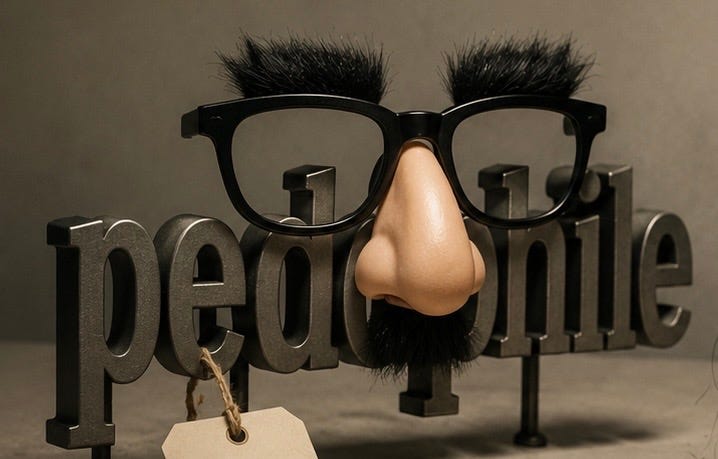
pedophile
p3dophile
p.edophile
p̶e̶d̶ophile
p€d0ph!le
Letters are struck through.
Vowels become numbers.
Periods bloom where they have no grammatical business being.
Punctuation appears in the middle of words like someone is trying to satisfy a password generator that insists on one uppercase letter, one number, and one symbol.
Humans read straight through it.
The software, people hope, won’t.
Whether these workarounds actually fool moderation systems as often as people believe is almost beside the point. Once enough creators became convinced that certain words might reduce their reach or trigger automated moderation, language began adapting to that belief. Like all good folklore, the practice spread because it seemed to work often enough.
The remarkable thing isn’t that people found workarounds.
Human beings have always found workarounds.
Whenever someone is listening who shouldn’t be, language gets creative.
Political dissidents have long relied on metaphor. Gay men in Britain developed Polari when homosexuality was criminalized. Enslaved communities embedded hidden meanings in songs. Teenagers have always invented slang their parents couldn’t decode.
Every system of surveillance eventually produces its own dialect.
The novelty isn’t the code.
It’s the listener.
For most of history, communication looked something like this:
Speaker → Listener
Now it increasingly looks like this:
Speaker → Algorithm → Listener
The algorithm isn’t your audience.
It’s the bouncer outside the club deciding whether your audience gets to see you.
That’s an extraordinary change.
Writers have always imagined readers. Novelists imagine readers. Journalists imagine readers. Love letters imagine readers.
Now millions of people also imagine… whatever lives inside a recommendation engine.
Somewhere between me and you sits a statistical system that has never laughed at a joke, never cried during a movie, never been persuaded by a brilliant argument, and yet apparently has very strong opinions about certain combinations of letters.
Nobody knows exactly what those opinions are.
That’s part of the anxiety.
The rules are partly published, partly inferred, constantly changing, and surrounded by rumor. One creator swears a particular word destroyed their reach. Another insists it makes no difference. A third heard about someone whose account disappeared after mentioning a certain topic. The internet has always excelled at producing urban legends. Algorithms simply gave us a new monster to tell stories about.
So people adapt.
Not because they understand the machine.
Because they don’t.
Andy Might is a reader-supported publication. To receive new posts and support my work, consider becoming a free or paid subscriber.
Linguist Steven Pinker coined the phrase the euphemism treadmill to describe what happens when polite replacement words gradually become just as emotionally charged as the originals. New euphemisms inherit the same baggage as the words they replace, and eventually require replacements of their own.
“Unalive” looks like another stop on that treadmill.
I don’t think it is.
The older euphemisms evolved because humans were negotiating with other humans. We softened language because we didn’t want to sound cruel, vulgar, or insensitive.
This time we’re softening language because an invisible gatekeeper might misunderstand us.
That’s different.
At some point, the euphemisms stopped being audible and became visible.
We aren’t merely inventing new words.
We’re changing the written form of old ones.
For thousands of years, orthography has generally moved toward greater standardization. Alphabets replaced pictographs. Dictionaries regularized spelling. Printing presses reduced variation. We generally think of writing as becoming more uniform, more stable, more legible.
Now, quietly, that trend has begun reversing itself.
Not because humans suddenly need help reading.
Because machines do.
We’ve spent decades teaching computers to understand human language.
Somewhere along the way, humans quietly started teaching themselves to speak computer.
The evolutionary metaphor turns out to be surprisingly useful here.
Algorithms don’t invent words any more than predators invent camouflage.
They change which traits survive.
If unalive appears safer than kill, then unalive spreads. If striking through a word appears to help it slip past automated filters, that visual mutation spreads too.
Language isn’t simply changing.
It’s adapting to a new environment.
For generations, linguists explained language through migration, conquest, prestige, class, education, and technology. Those forces are still with us.
But they’ve acquired a peculiar new companion.
Machine learning.
For perhaps the first time in history, one of the environments shaping everyday English isn’t another culture.
It’s software.
George Carlin wanted to know who decided which words you couldn’t say on television.
Half a century later, that’s still the question.
The difference is that we often can’t point to the censor anymore.
We can only infer its existence from the shape of the language it leaves behind.
That’s why words like unalive, PDF, and p̶e̶d̶ophile matter.
They aren’t the story.
They’re the footprints.
Tiny impressions left behind by an invisible force acting on English.
For most of history, you could study a language and learn about the people who spoke it.
Someday, linguists may study ours and discover something stranger.
They may conclude that, sometime in the early twenty-first century, English acquired a new audience.
One that never laughed at jokes, never cried at stories, never fell in love with a poem.
But quietly changed the language anyway.
Thanks for reading Andy Might! This post is public so feel free to share it.
Comments
Nothing yet. Say the first thing.
Sign in to join the conversation.