
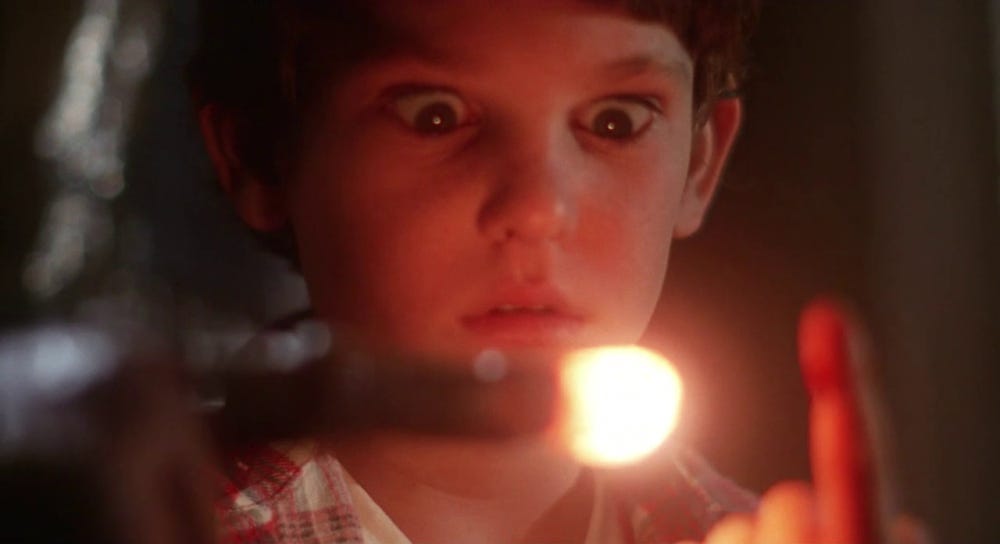
E.T. is usually remembered as a sentimental fable about childhood. It is also a refugee narrative structured as revisionist science fiction. Its central conflict is not between humanity and the alien. It is between two forms of illumination: the state’s spotlight and the immigrant’s glow.
In the classic alien-invasion films of the 1950s, extraterrestrials arrive as threats. Panic spreads. The government mobilizes. Force restores order. The beam of institutional knowledge, military and scientific, reveals the danger and neutralizes it. As genre scholarship has long observed, this structure aligns extraterrestrial otherness with Cold War anxiety and casts the state as rational defender.
E.T. quietly inverts this template.
The alien does not conquer. He wanders. He botanizes. He is abandoned. His arrival is accidental, not hostile. He is stranded without language, without infrastructure, without documentation. He is not an invader. He is displaced.
The panic that follows is bureaucratic rather than civic. The apparatus arrives with trucks, containment protocols, and faceless authority. The suburban home becomes a site of federal intrusion. The narrative’s energy does not build toward annihilating a threat; it builds toward shielding a vulnerable body from institutional capture.
The government appears first as light.
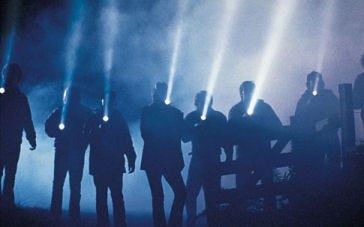
Flashlights slice through the forest. Anonymous men are framed in silhouette, backlit and dehumanized. Later, surgical lamps flood the house as plastic sheeting seals domestic space into a laboratory. Straight lines and sealed seams transform a living room into a quarantine corridor.
This illumination is not neutral. It isolates and exposes. It renders bodies as specimens.
The spotlight presumes that knowledge is extracted through exposure. To see is to dominate. To illuminate is to control. In classical science fiction, that logic stabilizes the world . In E.T., it destabilizes it. The beam feels predatory, not protective.
Contemporary audiences, living amid highly visible immigration raids, detention centers, and border spectacles, recognize the aesthetic. Floodlights. Tactical gear. The staging of enforcement as theater. Illumination as authority.
Against the spotlight stands the glow.

E.T.’s fingertip glows when he heals. His chest glows when he feels. But the glow is more than warmth. It is signal. The alien repeatedly attempts to “phone home.” His light becomes directional, intentional. It is a beacon.
If the spotlight scans for threat, the beacon searches for kin.
Beacons are not designed to interrogate. They are designed to guide. They assume relation rather than suspicion. The glow does not expose others; it emanates from within. Knowledge arises through touch and reciprocity. When Elliott and E.T. share sensation, illumination marks connection rather than control.
The distinction is reinforced in the design of the ship.
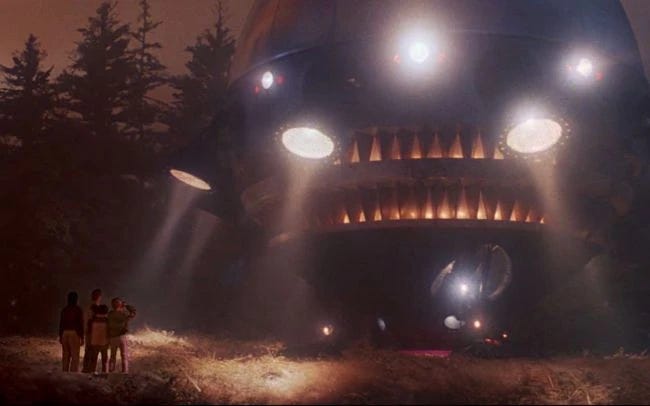
Unlike the hard-edged geometries of Cold War spacecraft, E.T.’s vessel has no sharp angles. It rises from the forest like something grown rather than engineered. Its surface appears curved, almost liquid. The silhouette recalls not a battleship but a lamp. A vessel for holding light.
A genie’s lamp contains latent magic activated through care rather than force. E.T.’s ship follows that design logic. It suggests shelter for radiance, not deployment of weaponry. In a genre that often fetishized metallic symmetry and militarized machinery, Spielberg’s production design offers an organic counter-image.
Form encodes ideology.
The apparatus that hunts E.T. is built of edges: plastic corridors, rigid grids, harsh lights. The ship that rescues him is built of curves. One architecture contains and extracts. The other gathers and returns.
The film’s political charge intensifies through its child protagonist. Mick Broderick has argued that a counter-tradition within Cold War cinema positions children not as passive casualties of nuclear anxiety but as active agents disrupting the military-industrial complex. In these narratives, youth intervene where adults have normalized secrecy, escalation, and abstract security.
E.T. belongs to that lineage.
Elliott does not merely befriend an alien. He obstructs a system. He hides an undocumented body. He lies to authorities. He refuses containment. Broderick describes such films as foregrounding active resistance rather than resignation. Elliott’s tenderness is not naïveté. It is defection.
In earlier invasion narratives, the child often symbolized the future inheritor of state power. Here, the child aligns with the refugee. He protects rather than reports. He shelters rather than exposes.
The suburban home, already fractured by divorce, becomes sanctuary. Trust migrates from the federal to the familial. The house operates as counter-infrastructure. It hides the vulnerable body from the beam.
This dynamic resonates powerfully in a political climate shaped by aggressive immigration enforcement. Migrants are framed as invaders. The apparatus mobilizes accordingly. The spotlight scans for bodies to detain.
E.T. quietly asks whether the invader narrative is misapplied. What if the “alien” is displaced rather than hostile? What if the true invasion is procedural power entering domestic space?
The film’s most iconic image clarifies the stakes. As searchlights sweep the ground, the children rise on their bicycles into the sky. The spotlight moves horizontally, scanning and containing. The beacon pulls vertically, guiding home.
No superweapon is deployed. No enemy is annihilated. The victory is not elimination but escape.
The refugee does not assimilate into American life. He departs. The state is neither redeemed nor reformed. It is outmaneuvered. The glow survives, but only by leaving.
The final image reads less as triumph than as moral choice. The children refuse conscription into a logic of suspicion. They choose hospitality over enforcement.
Disguised as family entertainment, E.T. stages a contest between two ways of seeing. The spotlight assumes threat and demands exposure. The glow assumes relation and invites recognition. One architecture is built of edges and extraction. The other of curves and return.
In the early 1980s, this was a revisionist gesture within Cold War science fiction. Today, amid border crises and inhumane treatment of migrants, it feels newly urgent. The film does not offer policy solutions. It offers a diagnostic image.
The question is not simply whether aliens are friendly. It is whether we will organize our world around beams or beacons.
That choice remains illuminated.
Thanks for reading Andy Might! This post is public so feel free to share it.
Comments
Nothing yet. Say the first thing.
Sign in to join the conversation.