
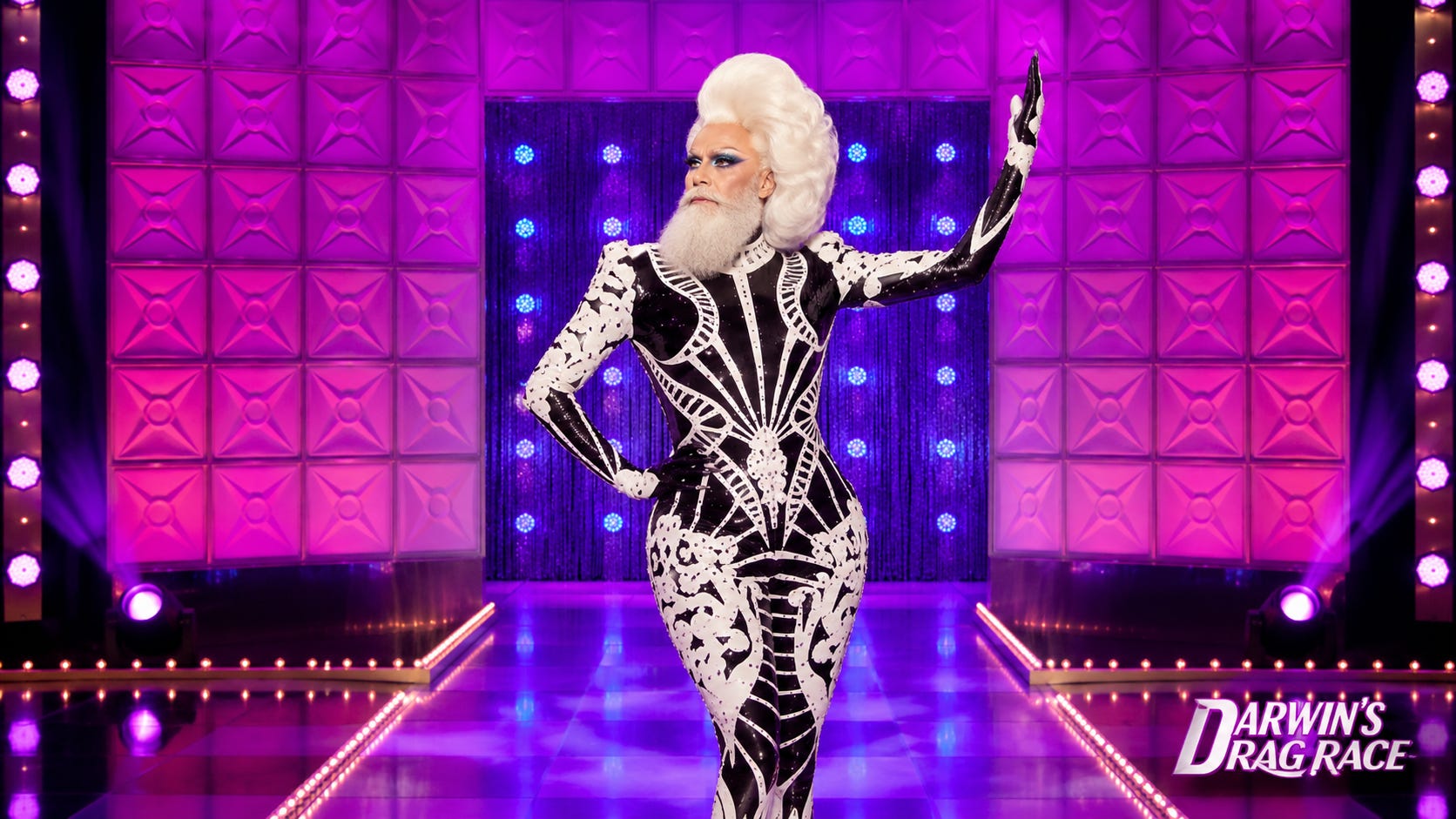
Imagine RuPaul’s Drag Race has been running for 3.8 billion years.
Every species is a contestant.
Every geological era is a new season.
Every environmental change is a new maxi challenge.
There are no producers. No judges. No script. Just one rule: if you don’t survive this week’s challenge, you don’t come back next episode.
If you’ve never quite understood evolution, I think it’s because we’ve been explaining it with biology instead of reality television.
Evolution isn’t a ladder.
It isn’t progress.
It isn’t nature’s attempt to build increasingly sophisticated organisms until, with suspicious convenience, it finally arrives at us.
It’s a competition where the category keeps changing.
One week the runway theme is Warm Shallow Seas.
Then Walking on Land Realness.
Then Ice Age Eleganza.
Then Post-Asteroid Apocaloptic Couture.
The contestants don’t get worse.
The challenge changes.
That’s natural selection.
The first thing most people ask about evolution is the wrong question.
“What’s the most evolved animal?”
That’s like asking who’s objectively the greatest Drag Race queen of all time.
Better at what?
Comedy?
Fashion?
Lip syncs?
Branding?
Every challenge rewards something different.
Nature does too.
A cheetah is extraordinary until the category becomes Open Ocean Extravaganza.
A whale dominates that challenge but crashes spectacularly during Desert Week.
A cactus slays Drought Couture and bombs Arctic Eleganza.
There is no universally best contestant because there is no universal challenge.
Charles Darwin understood this long before sequins entered the chat.
When he described natural selection in On the Origin of Species, he wasn’t arguing that evolution marches steadily toward perfection. He proposed something far stranger. Individuals vary. Some of those variations happen to work a little better in a particular environment. Those individuals tend to leave more offspring. Repeat this process over millions of generations and populations gradually change.
Notice what’s missing.
No finish line.
No crown.
No final winner.
RuPaul judges queens on Charisma, Uniqueness, Nerve, and Talent. Evolution has its own acronym. It isn’t nearly as glamorous: Variation, Selection, Inheritance, and Time. V.S.I.T. doesn’t fit on a T-shirt, but it has produced everything from trilobites to tigers. Charisma might help a peacock attract a mate. Uniqueness might open up a new ecological niche. Nerve might reward the first fish to venture into shallow water. Talent might make a hummingbird a master of hovering or a cheetah terrifyingly fast. But like Drag Race, every adaptation is spectacular until the environment changes the category.
Which brings us to the contestants.
The early fan favorite was Trilobita Turner.
She absolutely owned the Cambrian episode. Incredible versatility. Fantastic exoskeleton. Compound eyes before anybody else thought they were cool. Merch was everywhere.
Then the competition changed.
She’s gone.
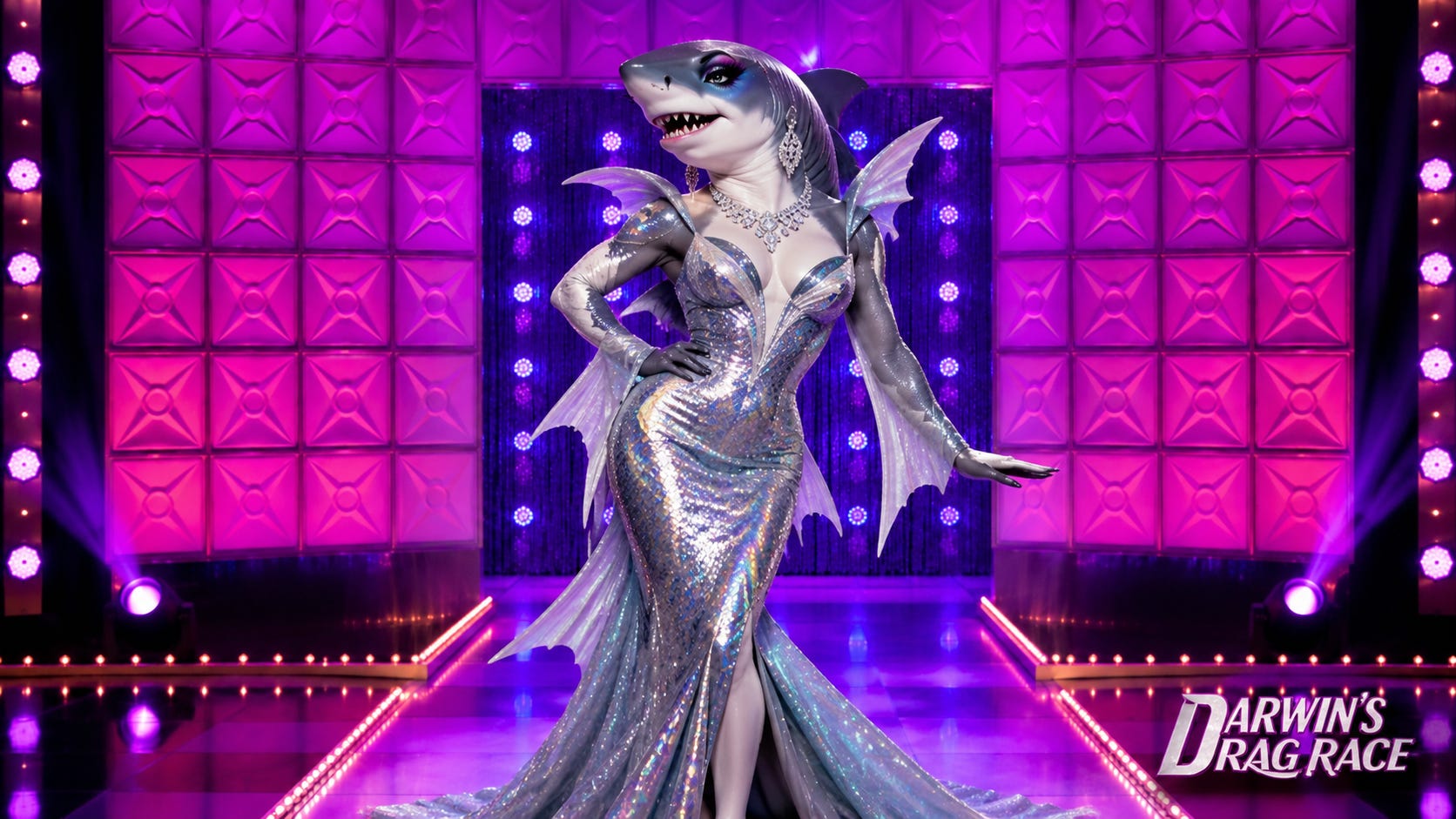
Sharkira, meanwhile, has become the definition of consistency.
Every episode the judges complain that she’s showing the same silhouette.
Every episode she ignores them.
Sharks have been around for more than 400 million years, surviving multiple mass extinctions with a body plan that simply…works.
The fandom keeps begging for reinvention.
Evolution keeps declaring her safe.
Then there’s Miss Crustacea the horseshoe crab.
Critics call her outdated.
The judges wish she’d take bigger risks.
She has ignored every note for roughly 450 million years.
Somewhere Michelle Visage is losing her mind.
And then there’s Roaché.
Nobody understands why she’s still here.
She doesn’t dominate challenges.
She rarely gets confessionals.
She isn’t flashy.
She’s just…still competing.
Reality television has taught us to admire challenge winners.
Evolution has a soft spot for queens who quietly survive.
In fact, one of the strangest things about Drag Race is that winning every challenge isn’t necessarily the safest strategy.
Every few seasons there’s a contestant who dominates the first half of the competition. Challenge win after challenge win. Huge edit. Endless confidence. Everyone assumes the crown is inevitable.
Then something changes.
A makeover challenge.
A design challenge.
One bad lip sync.
Suddenly the front-runner is gone.
Nature tells that story constantly.
For more than 160 million years, one queen seemed absolutely unstoppable.
Tyra Rex.
She towered over the competition.
Multiple challenge wins.
The biggest edit of the season.
Every confessional sounded like she’d already written her acceptance speech.
“I’m not saying I’ve already won,” she tells the camera. “I’m just saying…look around.”
Meanwhile, tucked into the back of the workroom, barely getting any screen time at all, sits another contestant.
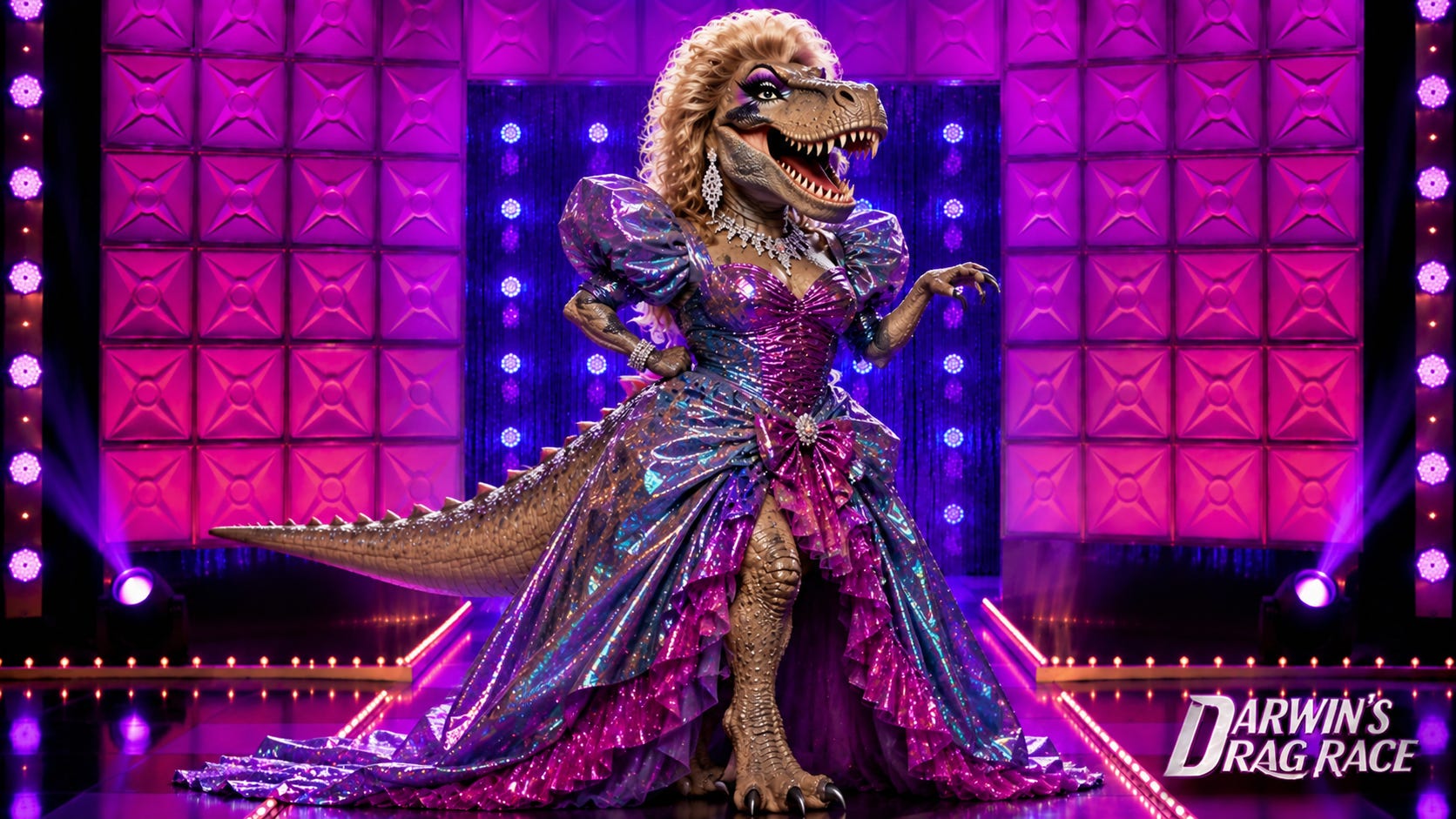
Squeaky Fromage.
Tiny.
Forgettable.
Always safe.
Always underestimated.
The audience barely remembers that this little titmouse is still in the competition.
If this were ordinary television, she’d be filler.
But evolution has never cared about television logic.
Because every season eventually arrives at the same moment.
RuPaul walks into the workroom.
Smiles.
And says the six words every contestant fears.
“Ladies…the category has changed.”
If you’ve watched enough Drag Race, you eventually realize that challenge wins are an unreliable predictor of who actually makes the finale.
That turns out to be one of Darwin’s most radical insights. We instinctively imagine evolution as a staircase, with primitive organisms occupying the bottom and increasingly advanced creatures climbing toward the top. Schoolbook illustrations don’t help. They often depict a procession from fish to amphibian to reptile to mammal to human, as though life were patiently waiting for us to arrive. Darwin shattered that image. Evolution is a branching tree, with every living species occupying the tip of its own branch. Sharks are not failed mammals. Crocodiles are not unfinished birds. Humans are not the goal toward which bacteria have been striving for billions of years. Every species alive today has survived the same amount of evolutionary time. We’ve all been in the competition just as long.
That’s why “survival of the fittest” remains one of the most misunderstood phrases in science. Herbert Spencer coined it after reading Darwin, and although Darwin later adopted the expression, most people hear “fittest” and imagine Olympic champions. Bigger. Faster. Stronger. Evolution means something almost embarrassingly ordinary. The fittest organism is simply the one that fits its current environment well enough to leave more descendants. A parasite can be exquisitely fit. So can a mushroom, an oak tree, a jellyfish, or a moss growing unnoticed on the side of a rock. Fitness isn’t a trophy. It’s a relationship.
If Drag Race teaches anything, it’s that the category matters more than the contestant. A queen who demolishes the Snatch Game may panic when asked to design a gown out of hardware-store supplies. The best dancer in the room may freeze during an acting challenge. Nobody concludes they’ve suddenly become untalented. They were brilliant yesterday because yesterday rewarded different skills. Evolution works exactly this way. Feathers are astonishing if the challenge involves insulation, display, or eventually flight. They’re considerably less useful underwater. Thick fur is a winning look during an Ice Age but becomes a liability in tropical heat. Gills are masterpieces in rivers and oceans. Lungs dominate on land. Every adaptation answers a particular question, and the moment the question changes, so does the leaderboard.
Which brings us back to Tyra Rex.
For more than 160 million years, she looked untouchable. Massive challenge wins. Incredible confessionals. A silhouette so iconic that countless other contestants rearranged their own strategies around her. If you had tuned into Earth’s Mesozoic season halfway through, you would have assumed production had already decided the winner. Meanwhile Squeaky Fromage kept slipping through another elimination. Small. Nocturnal. Barely visible in the edit. She spent most of the season hiding under the scenery while dinosaurs filled every frame.
Looking back, the editors were practically screaming at us.
We just didn’t know the next episode was Meteor Week.
Thanks for reading Andy Might! This post is public so feel free to share it.
Comments
Nothing yet. Say the first thing.
Sign in to join the conversation.