In this January 2022 pod, an Israeli journalist brings empathy to an intractable issue.
(The full Dish returns on September 4. In the meantime, we are re-airing a handful of the most downloaded episodes from the early years of the Dishcast.)
The Middle East has become one of the most contested topics here at the Dish. So on our summer break, we thought we’d run some classics, popular with Dishheads and ageing well. So here’s the great and humane Yossi Klein Halevi from 2022, a pod that elicited some wonderful listener comments as well, included below.
Yossi is an American-born Israeli journalist, and his latest book is Letters to My Palestinian Neighbor. After our pod with Peter Beinart in July 2021, many of you recommended Yossi to balance out the discussion on Israel. I was grateful for the suggestion and truly enjoyed our January 2022 talk — alternately honest and difficult. How can one admire Israel while also being candid about its flaws? How deeply utopian was Zionism in the first place?
Go here for a polished transcript. We also have two clips on YouTube — on the “bizarre, tragic” history of Zionism, and on the intractable nature of the Israeli settlements. Here’s how one listener responded:
Thank you for inviting Yossi Klein Halevi as an interlocutor. He is a deeply humane and nuanced thinker and writer, and his views on the difficult conflict are informed not by slogans but by experience. I hope you will bring a sagacious counterpart from the Arab side, who can acknowledge the existence of two conflicting true stories. This is the key that can unlock the difficult decisions necessary for a compromise.
I want to question one of the conclusions that you seem to have reached regarding the conflict. You talk about the corrosive nature of the settlement enterprise, which Yossi seems to be agreeing with. He is saying that if there is an honest peace offer to divide land, the Israelis will be willing to accept the compromise and risk the civil war. For you, however, settlements mean the end of the Zionist project.
This is where you lost me. I understand the very strong opposition to settlements. I understand that they are an obstacle to an agreement, one among many. But why do they mean that Zionism is doomed? Would you say the same if Israel hadn’t built beyond the 1949 armistice line?
Do you think that building settlements is a singularly bad policy that will undo Zionism, or that they expose the incurable lethal poison in the heart of Israel? If it’s the former, then every bad policy can be corrected. As Yossi explained, Israel evacuated its population when required for peace (and those who prefer to stay in settlements may chose to become citizens of the Palestinian state when it is created). So, bad as they are, settlements do not spell the end of Zionism.
However, settlements do serve as a convenient euphemism for the opposition to Zionism and Israel per se. It is not Israel’s 1967 borders, but Israel’s 1948 existence. If Israelis believed that stopping settlements means peace, they would have stopped. But if they are told that not matter what they do their country has to stop being, why would they listen?
As Yossi said, many Israelis are ready to trade ’67 for ’48. What is your position?
I favor a settlement based on the 1967 borders. And I think the settlements are deliberately designed to prevent that. But what they will create is either more atrocities, as Palestinians are expelled from those areas in due course; or endless conflict with no security for the Jewish state.
Another listener wrote, “Yossi Klein Halevi and Peter Beinart are an excellent point/counterpoint (as much as I vehemently disagree with Beinart)”:
Thank you for this discourse about Israel, and I’m sending you warmest regards from Beit Shemesh, approximately 10 km as the crow flies from the “green line.” I’m an American — and an oleh, a recent immigrant to Israel. Let me just say I immigrated here in 2018 with one set of ideas and find myself in possession of a totally different set after nearly four years living this complicated Jewish dream.
Soon after moving to Israel — and not only seeing my beloved Homeland from the inside, but also the Old Country (the USA) from the outside — I began to feel an intellectual tumult that disturbed me greatly. So much rhetoric. So much ideology. Not enough journalism. Not enough thought.
So I started a list in my Evernote called “Voices of Sanity/Voices of Reason.” You were the first person on my list, and Yossi is also on the list; his Letters to My Palestinian Neighboris one of the most important books of my life. I read it straight through during one Shabbat in Mitzpe Yericho — one of those dreaded “settlements.”
One of the biggest shifts I’ve realized since becoming an Israeli citizen: in Israel, group identity is radically important. I guess it creates a sense of security in being right all the time. The trade-off is that everyone else is more than wrong; they are heretics. This includes family and friends.
This is the opposite of Judaism. Instead of creating the energy that brings the world together — which is our mandate as Jews — it splinters everything into the smallest possible splinters. I came to Israel more inclined to the particularist in “orthodox” Judaism. Now nearly four years later, I’m far more interested in the universalist in Torah.
For a refresher on the pod with Peter that spurred Yossi’s appearance, here’s a chunk of that conversation on the state of Zionism:
Below are some emails on that pod that are also relevant to the Yossi pod. This first listener felt that I’m “deeply wrong about Israel/Zionism”:
I think most Westerners have a delusional view: that a two-state solution was ever acceptable to enough Arabs/Palestinians to have been possible. Many Westerners also have the equally delusional view that a binational state is viable (a view you don’t share, I was glad to hear). Unfortunately, for most Arabs/Palestinians, the dream isn’t about getting East Jerusalem, the West Bank, Gaza and a bit more, while leaving the rest to the Jews. They want Tel Aviv, Haifa and everything else — with no Jews.
Every war over Israel has been fought by the Arabs in service of a one-state Judenrein solution, beginning in 1948, when they were offered and rejected a contiguous state in nearly half of Mandatory Palestine, from Sinai to Jordan to Lebanon — the river to the sea. The option for a two-state solution was on the table for more than half a century afterward, if the Palestinians had been willing to take it. Half-hearted participation by the Palestinian Authority in peace talks (which they were dragged to), with Hamas and Hezbollah jeering from the sidelines, isn’t remotely good enough.
Whether or not you think the state of Israel should ever have been created (that discussion was the most disappointing part of your episode with Beinart), there are now nearly seven million Jews in their historic homeland (of thousands of years), out of a little over nine million inhabitants. Some three-quarters of those Jews were born there. Just under half of the Jews in Israel are Mizrahi/Sephardi, whose family members were largely expelled from Arab countries. They know exactly how the Arabs feel about the Jews, so they aren’t signing up for a binational state, now or ever.
Moreover, the Arabs (the notion of a distinct Palestinian identity wasn’t a significant part of mainstream discourse until the 1960s and ‘70s) don’t actually want a single binational state. Agreeing to a peace on the basis of two states would get their leaders assassinated, because Palestinians continue to hope, against all evidence, that one day they’ll get all of it.
Arabs living in Israel proper have far better lives and prospects than their brethren in neighboring states: they can vote, an Arab party is in the government, and Israel is the best place in the Middle East to be gay, among other things. Polls show that a majority of Israeli Arabs would prefer living in Israel to a Palestinian state. It would be ideal if the Arabs in the West Bank and Gaza gave up their unrealistic expectation of driving the Jews into the sea and stopped promoting terrorism. Then, security restrictions could be relaxed and their lives could improve a lot.
But I fear things are too far gone. The Second Intifada, and then Hamas’ unwavering commitment to ending the state of Israel, don’t inspire confidence.
The best solution, to be honest, would be for Jordan — more than 20% of whose residents are Palestinians — to take over the Arab areas of the West Bank, and for Egypt to absorb the pestilential flyspeck half the size of Singapore that is Gaza. But Jordan and Egypt wouldn’t touch those areas with a ten-foot pole because they’re ruled by warlords, gangsters and criminals. They’re Northern Ireland during the height of the Troubles, but a thousand times worse.
I do agree with you and Beinart that the status quo could persist for a long time. I think if the PA collapses, as Beinart suggests, it’s not going to turn the West Bank into Gaza, because there’s too much economic interdependence between the West Bank and Israel. If it did, though, all that would happen is that Israel would annex the areas with significant Jewish settlements, cut the Jews in the outposts loose and create a hard border, leaving the West Bank population to figure things out for themselves and get bombed if they fire rockets.
I get it that Bibi’s an asshole and he behaved unacceptably toward Obama, your fave. But Bibi is finished and may go to jail. Time to move on — for you and the Palestinians. Maybe think more about Xinjiang (which I was glad to hear you discuss with Beinart), where a million Muslims actually are in camps, being sterilized and reeducated. They don’t have the option of giving up terrorism and eliminationist pipe dreams for peace.
“Pestilential flyspeck”? It’s that kind of rhetoric that turns me off, however sane the rest of the analysis. There’s no indication in my listener’s email that he understands why people thrown out of their own land and homes might harbor legitimate resentment, even rage.
Another pro-Israel listener:
Your discussion glossed over important points that, if discussed, would demonstrate the conflict is more two-sided than you and Beinart made it appear to be. For example, you stated that it’s apparent Israel has never supported a two-state solution, and it was all a lie. But you seem to have forgotten the Oslo Accords, where it was the PLO, not Israel, who ultimately walked away. In addition, Israel made the decision to evacuate its own citizens from Gaza in 2005, handing the Palestinians their own territory.
What has happened since then? While Beinart mentions the UN says that Gaza is uninhabitable, he or you fail to mention that a terrorist group is running the place. In fact, in your discussion about Israel, terrorism is not mentioned once. How can Israel agree to a two-state solution when one of the parties declares death to Israelis in its constitution?
When it comes to the Israeli-Palestinian conflict, the regime in the Palestinian territories is not held accountable. No doubt about it: the occupation creates considerable hardship on the Palestinian people. I just don’t know how the regime, particularly in Gaza, can be negotiated with.
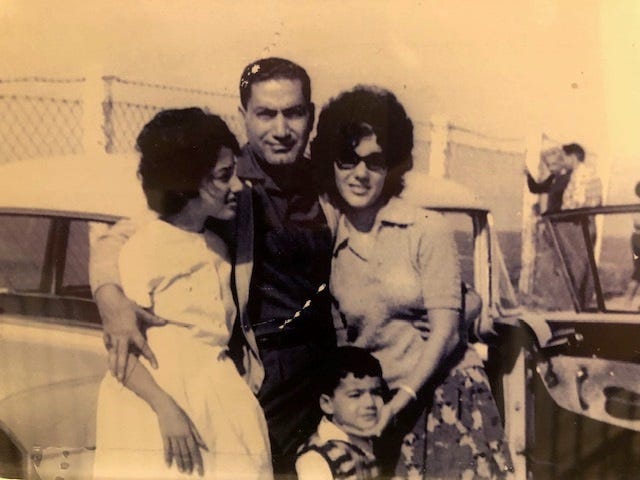
By the way, here is a picture of my grandfather, with my mom, aunt and uncle, on the boardwalk in Tel Aviv in 1962:
My grandparents fled Iraq in 1941 after a horrible pogrom called the Farhud. It bothers me to no end when people call Jews “white colonizers.” My grandfather was far from white! Iraqi Jews trace their history to their exile from the Kingdom of Judea in 6th Century BCE. My grandmother would say she was a “Babylonian,” to signify her direct ancestral tie to the land of Judea.
My grandparents and the generations of persecuted Jews before/around them is why Zionism exists and why it endures. I will be a passionate Zionist until my last breath. It’s the only place I know for sure where Jews will be tolerated. Peter Beinart will only realize this when it’s too late. A world that that is indifferent to the fall of the Jewish state is not a safe world for Jews anywhere.
Yossi talked a lot about the Jews who immigrated from elsewhere in the Middle East, and it’s an overlooked point at times.
From a listener critical of Israel:
Thank you for having on Peter Beinart. I have followed you for years and assumed you were either a Zionist supporter or just didn’t want to touch the Issue. So I am pleasantly surprised.
During the past eight years [2013-2021], I have been to the West Bank four times working on behalf of a Christian ministry in Bethlehem. The birthplace of Jesus Christ, Bethlehem is now surrounded by prison walls and guard towers on three sides. This cultural capital of Palestine, with its rich history, art, music and food, is being surrounded by settlements, so it cannot grow. The situation is horrific.
Another critic of Israel writing in 2021:
Zionism, as an ideology, has stopped progressing. It’s like Communism in the 1980s — all energy has seeped out. It has been replaced by very nasty ethno-nationalism and an optimistic economism (Israel the Start-up Nation). The underpinning ideology has boiled down to a large collection of cliched slogans, like the ones your Israeli readers wrote down. I can already fill in the Zionist trope bingo card. Nothing new has been added in the last 15 to 20 years, except an inflated sense of victimhood.
This next listener, though, pointed to a Palestinian sense of the same forever-victim mentality:
I believe this is a point that will resonate with you: the settlement project feeds into the “settler colonialism” mantra that is a key component of intersectional doctrine sweeping through much of America. As they say, “From Ferguson to Palestine!”
In this context, my admittedly counter-intuitive argument that Palestinians will not let the Israelis leave the West Bank, just as they have successfully blocked Israel from divorcing itself from Gaza, cannot be processed by the progressive cerebral operating system (“does not compute,” as the robot would say). For this reason, the settlements and occupation are an even greater conundrum for Israel than ever before, requiring the most sober, de-politicized and mature decision-making by the new Israeli leaders.
But so long as the international community indulges the Palestinian penchant for utilizing their own self-generated suffering as their most powerful weapon, I see no good solution for Israel. There’s no Iron Dome for what, from our perspective, is this profound dysfunction.
Here’s one more listener, on the settlements:
First of all, I’m DELIGHTED that you’re planning to invite on Yossi Klein Halevi; I was going to suggest you have him before seeing four other dissenters beat me to it. In addition to sharing his views on Israel, Zionism, and the Palestinians almost entirely, I also happen to know him personally and he is an absolutely wonderful guy — one of those people whose very presence calms you.
Anyhow, you said in your response to a reader that “the settlement policy is now and always has been the core obstacle to any deal” (emphasis mine). As a liberal Zionist, I have two problems.
The first is the one you’d probably guess: While I grant that the settlements have certainly been an obstacle, I disagree that they’ve been the obstacle. They have serious competition — for instance, the dream that lives among an all-too-large contingent of Palestinians to displace Israel utterly. Call it “Greater Palestine,” if you will — and of course “displace” is a euphemism. I’d love to hear why you believe the settlements are somehow more “core” than that, a dream that is explicitly stated in Hamas’s charter.
Second (and this is a major reason I’m so glad you’re planning to invite Yossi on), is what the settlements symbolize for the Jewish people — that is, what the lands of the West Bank (the heartland of Biblical Judea and Israel, as I’m sure you know) mean for the Jewish soul. And here I’m cognizant of speaking more to your religious side. To renounce our claim to those lands is painful — necessary and right, no doubt, but painful too. And that is never acknowledged even rhetorically, let along with true compassion.
No question that Yossi’s humanity and learning and empathy are impossible to ignore. Just listen to the episode — or read the transcript here.



Comments
Nothing yet. Say the first thing.
Sign in to join the conversation.