
It’s the weekend after the local elections, which means that it’s time to write my traditional debrief piece trying to summarise the results and seeing how my previews from before the election fared.
This is the second set of local elections under the Starmer government, and in many respects the results resemble last year’s set with a collapse in support for the two traditional main parties and with a clear win for Reform UK. What’s different this time is that this year’s polls were in the urban, Labour-facing parts of England rather than the rural, Conservative-facing part as last year, and the councillors up were mostly elected in the good Labour year of 2022 rather than the good Conservative year of 2021. This year, Labour had the most to lose. And lose they did: with a few straggling results to come in, the BBC (who have attempted to make allowance for boundary changes) have Labour’s councillor tally down by 1,496 with Reform UK’s numbers up by almost the same amount.
The BBC’s projected national share for this set of English local elections gave 26% to Reform UK, 18% to the Green Party, 17% each to the Conservatives and Labour, and 16% to the Liberal Democrats. Compared to 2022 Labour are down by 18 percentage points, the Conservatives are down by 13 percentage points and the Lib Dems are down by 3 percentage points. No PNS share for Reform UK or the Greens was published in 2022, but the actual votes cast that year (which are not representative of the whole country) gave 9.5% to the Greens and 0.1% to Reform UK, which had run very few candidates.
In many councils, that Reform UK lead entitled them to the largest-party bonus which England’s first-past-the-post system often (but not always) delivers. Reform UK gained overall control of fourteen new councils, and would have won many more had they not been held back by their complete lack of success in 2023 and 2024; the thirds electoral system which most English boroughs outside London use meant that a Reform UK majority was not possible in those areas this year. That might well change next year, though. The thirds system saved Labour’s bacon in several districts, enabling them to hold on to 28 councils at least for the time being. There are now 15 Liberal Democrat-majority councils and 5 Green-majority councils, marking the first time that the Greens have broken through on a major scale in England’s urban areas. The Conservatives held nine of the 15 councils they were defending, the Rahmanite Aspire party now have an overall majority in Tower Hamlets, and there has been a significant increase in hung councils where cross-party deals will need to be struck to get things done.
But possibly the biggest blow for Labour will be being pushed into third place in Wales for the first time in over a century, as Plaid Cymru became the largest party in Senedd Cymru. Labour also went backwards for the sixth Scottish Parliament election in a row and finished in a tie for second place with Reform UK; the Scottish National Party lost seats but clearly remain in first place, and the Parliament in Holyrood will continue to have a pro-independence majority.
One welcome theme is that this year’s English local elections saw a significant increase in turnout, much of which was driven by Reform UK getting customary non-voters out to the polls. This continues trends which have been seen in recent local by-elections.
We’ll now look at what those general trends mean for particular areas - because all politics is local, and nowhere in England is demographically or politically average.
North East
I started this year’s Preview in Hartlepool, the one council in the North East which counted its votes overnight. Here Labour needed to hold four of the six seats they were defending to preserve their council majority - and they lost the lot, with Reform UK sweeping the board in all 12 of Hartlepool’s wards. The new Hartlepool council has Labour and Reform UK tied on 15 seats each, with six independents holding the balance of power: the Pool’s independent councillors have typically been anti-Labour, so I would expect Reform UK to take over the leadership here.
In fact, Reform UK now hold overall majorities in all four of the ex-County Durham councils which polled today. Reform UK gained Sunderland (58/75) and Gateshead (38/66) directly from Labour, who fell into third place behind the Lib Dems on both councils, while in South Tyneside a controversial Labour minority administration held onto only one of the 27 seats it was defending: South Tyneside council now has 41 Reform UK councillors against 10 Greens (unusually, this was a council where the Greens went backwards), 2 independents and 1 Labour. Labour lost 12 seats in North Tyneside (10 to Reform UK and 2 to the Greens) but held on to their council majority, although Labour holding the North Tyneside mayoralty last year meant this was less important.
Newcastle upon Tyne, meanwhile, looks radically different to what came before. This is now a very balanced council with 25 Liberal Democrats (who continue to dominate across the north of the city), 24 Greens (who ate Labour’s lunch in the inner-city wards), 24 Reform UK (who ate Labour’s lunch in the outer eastern and western suburbs), 3 independent and just 2 Labour councillors. A grand coalition between the Lib Dems and Greens looks like the only route to reaching the 40 votes needed for an overall majority.
North West
Moving into the Lancashire districts up for election, Labour continue to be shut out of Pendle where the entire Labour group quit the party and went independent over Gaza in 2024. The independent group made a net gain this year to finish on 13 seats while their Lib Dem coalition partners now have 7; the opposition is now split between 8 Conservatives and 5 Reform UK councillors.
Reform UK are now the largest party in Burrnley after nearly sweeping the board outside the three Muslim wards, which voted for independent candidates: the only other councillor to resist the turquoise tide was the town’s former Lib Dem MP Gordon Birtwistle, who is now well into his 80s but was still re-elected for another term in Coal Clough with Deerplay ward. There are now 12 Reform UK councillors, 10 independents, 10 Labour, 6 Lib Dems, 4 Conservatives and 3 Greens. The previous independent-Lib Dem-Green coalition does not have the votes to continue.
Labour have lost control of neighbouring Hyndburn after Reform UK won eight of the eleven seats up for election: the composition here is now 17 Labour, 8 Reform UK, 8 Conservatives, 1 independent and 1 Green. Blackburn with Darwen saw a similar story, with Labour caught in a pincer movement between independents in the Muslim wards and Reform UK elsewhere to lose 11 of the 13 seats they were defending: the new council has 20 Labour, 17 independents, 9 Reform UK and 5 Conservatives. Coalition-building in these districts could be difficult.
We saw a third Lancashire Labour loss in the city of Preston, where seats sprayed all over the place to leave Labour on 22 seats against 14 Lib Dems, 5 Reform UK, 3 Conservatives (who lost all the seats they were defending), 2 Greens and 2 independents. The Labour majority in Chorley was not at stake in this election, but Reform UK won half of the seats up for election to cut the Labour majority to 29/42. In already-hung West Lancashire the Labour minority administration has surely been defeated after losing every seat it was defending, to the benefit of Reform UK in Skelmersdale and the localist party Our West Lancashire in the Ormskirk area: the new council has 13 seats each for Labour and the OWLs, 12 Conservatives and 7 Reform UK. Maybe we’re about to have an OWL-led council?
The only metropolitan borough with an all-out election that stayed with Labour was Sefton, although the party’s majority was cut to 36 out of 66 seats: there are now 17 Lib Dem councillors, 5 Maghull localists, 5 Reform UK and 3 Greens, with the Conservatives being wiped out. Whether Reform UK will admit their councillor for Bootle West ward, who was outed by the Liverpool Echo during the campaign for holocaust denial, remains to be seen at the time of writing. It was a different story in St Helens, where Reform UK built on some by-election gains in the last term to gain overall control from Labour with 34 seats against 6 independents, 3 Lib Dems, just 2 Labour councillors and 1 Conservative; these totals don’t include the two seats in St Helens Town Centre ward, where the poll has been postponed after a Reform UK candidate died. There was similar Reform UK dominance in the Halton results, but the thirds electoral system saved Labour there: despite holding only two of the 17 seats they were defending, Labour continue to control Halton council with 32 seats against 16 Reform UK, 3 Lib Dems and 3 independents. One-third of the council was up in Knowsley, which now has right-wing councillors for the first time in many years after Reform UK gained four wards, but Labour did enough to preserve their majority for now with 24 out of 45 seats.
In Greater Manchester the Liberal Democrats got the gains they needed for overall control of Stockport, where the council now has 33 Lib Dems against 14 Labour, 9 independents (including the Edgeley Community Association and the Heald Green Ratepayers), 4 Greens, 2 Reform UK councillors and one Conservative. This was the worst electoral cycle for Labour in Greater Manchester for many a long year, but the thirds electoral system meant that the only Labour-majority council to fall was Tameside where Reform UK won 18 of the 19 wards up for election: the one that got away was a Labour hold in St Peter’s ward in Ashton-under-Lyne, leaving Tameside council at 25 Labour, 19 Reform UK, 8 ex-Labour independents and 5 Conservatives. As a contributor to Radio 4’s overnight show accurately pointed out, on those figures Angela Rayner would lose her seat in Ashton-under-Lyne.
Reform UK also won 13 seats in Oldham, where some serious coalition-building will have to be done to reach the 31 seats required for an overall majority. Labour remain the largest party but only have 18 seats, Reform UK have 16, the BBC summary lumps the Muslim independents and the localist councillors for Failsworth, Royton and Shaw into a single group of 16, the Liberal Democrats have 6 and the Conservatives 4. There is also work to be done on that front in Bolton, where Reform UK won 9 wards and the minority Labour administration has slipped further away from a majority: Labour now have 20 seats, the Conservatives are on 11, Reform UK have 10 (including Derek Bullock, who was previously disowned by the Conservatives midway through the 2023 election campaign for racism), the Lib Dems have 5, the Greens (who gained three of Bolton’s Muslim wards) have 4, Horwich and Blackrod First have 4, Farnworth and Kearsley First (who had their lunch eaten by Reform UK) have fallen back to three seats, and there are three independents - one Muslim and two defectors from Horwich and Blackrod First. My guess is that the Labour minority administration continues, but they will need the Lib Dems on board and getting Lib Dem support has proven difficult for Bolton Labour in the past. One of the Labour casualties in Bolton was the council leader, who lost to Reform UK in Tonge with the Haulgh ward.
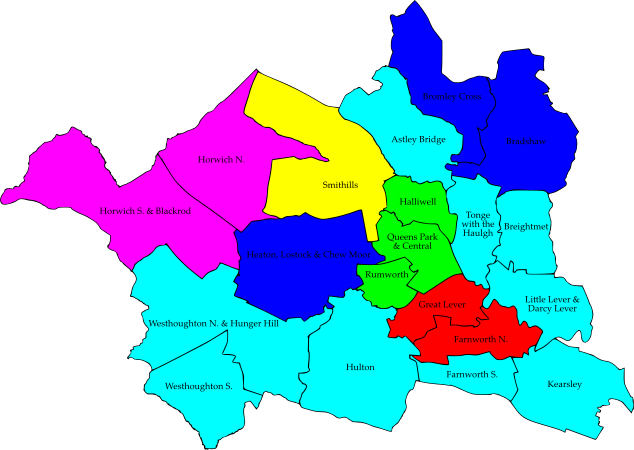
Labour’s best performance in Greater Manchester came in Bury where the party lost only one seat nett to remain in control on 30 out of 51 councillors: the opposition is now split 7 for Radcliffe First, 6 for Reform UK, 3 Conservatives, 2 councillors for Conservative splinter group Together for Bury, 1 independent, and 1 Workers Party councillor who gained Redvales ward from Labour. There is one vacant seat in Moorside ward, where the poll was called off after the Reform UK candidate died and which Labour will be defending at the rerun in June. I had speculated that Radcliffe First might be most at risk from Reform UK here, but in the end it was the Bury Conservatives who came off worst: they lost all three wards they were defending, with Pilkington Park and Bury West going to Reform UK and - in possibly the most surprising individual result of this cycle - North Manor ward going to Labour after the Tories and RUK split the ward’s large right-wing vote between them. This result might well be a fluke, but it wins the coveted title of Result Which Made My Jaw Drop - because I was listening to the live web feed from the Bury count, and that’s what happened when I heard this declaration.
I identified five Greater Manchester councils where the Labour lead was impregnable or nearly so, but that will not be the case next time. The Labour majority in Rochdale is down to two seats after Reform UK gained 13 wards at this election; there were another 13 Reform UK gains in Salford; and Trafford Labour went backwards for the first time in some years, although seats there sprayed all over the place: for example, the seat in Hale ward vacated by the Gorton and Denton by-election winner Hannah Spencer was gained by the Conservatives. In Manchester, Spencer has blazed the trail for a majority of the city’s wards to vote for the Green Party, marking the first time in decades that Manchester Labour - who have traditionally run a tight ship here - have failed to carry the city: Manchester council now has 63 Labour councillors, 21 Greens, 7 seats for Reform UK (who performed particularly well in the city’s northern wards), 4 Lib Dems and 1 Workers Party councillor. But the booby prize for worst Labour performance of this cycle is won by Wigan, where the party were defending 22 of the 25 seats up for election and lost every single one: Atherton North was successfully held by the Independent Network, and Reform UK won everything else. Wigan now stands at 42 Labour councillors, 25 Reform UK, 8 independents and 0 Conservatives.
Yorkshire
On the wrong side of the Pennines, five of the seven metropolitan boroughs up for election had all-out polls on new ward boundaries. Three of them now have Reform UK majorities, with the party’s most emphatic performance coming in Wakefield where they won 58 seats out of a possible 63: the opposition consists of two Lib Dems and one councillor each from the Conservatives, the Greens and Labour. In Calderdale a sizeable Conservative group was completely wiped out, and Reform UK won 34 seats to 8 Labour, 7 Greens, 2 independents, 2 Lib Dems and one Workers Party councillor. Those councils will be going back to the thirds system next year, but Barnsley will not: Reform UK’s 42 seats out of 63 gives them four years of control against an opposition of 11 Labour councillors, 8 Lib Dems and 2 independents. All three of those councils had Labour majorities going into this election.
Bradford was the last council in the north to finish counting, and we will be back here shortly because even now the result is not yet settled. This will complicate the coalition-building which needs to be done after no-one got near the 46 seats necessary for overall control: Reform UK are now the largest party with 29 seats, the Conservatives have 18 after making net gains, Labour have fallen from an overall majority to third place with 17 councillors (mostly from inner-city wards), the Green Party and the Bradford Independent Group have 9, other independents have 4, and the Liberal Democrats currently have one seat and will be looking to defend three more when the postponed poll in Idle and Thackley ward takes place in June. On the face of it Reform UK and the Conservatives together have a small majority, but this might be eroded very quickly: one of the Reform UK councillors for Clayton and Fairweather Green ward was busted for racism during the campaign and at the time of writing it’s not clear whether he will accept his seat. Anyway, it’s decision time for the Conservative group. Do they go into coalition, or do they put Reform UK in with a minority administration and watch them struggle?
We have similar arithmetic in Kirklees, where an all-out election completely wiped the Labour group out but has not resolved the council’s hung status. Reform UK have 29 councillors, there are 14 independents (of whom 3 are localists in Holme Valley North and the rest represent Muslim wards in Dewsbury and Batley), 12 Greens, 9 Conservatives and 5 Lib Dems. Again Reform UK and the Conservatives can muster a council majority between them - but will they be prepared to go into coalition?
The one West Yorkshire council which will likely continue to have Labour leadership is Leeds, although the party did lose 12 seats this year and their overall majority. The new tally has 48 Labour councillors against 14 Conservatives, 11 Greens, 10 Reform UK, 4 Morley Borough Independents, 3 Garforth and Swillington Independents and 3 SDP councillors.
In the home of snooker most of the reds went down this year, as Sheffield Labour held just 3 of the 13 seats they were defending. We now have a very hung Sheffield council with 25 Labour councillors, 22 Lib Dems (they also went strongly backwards), 20 Greens, 13 Reform UK and 4 independents. The Greens and Reform UK will have more influence in the city’s committee system going forward.
Finally, the Liberal Democrats have lost control of Hull council after Reform UK won a majority of the 19 seats up for election, but the Lib Dems held up relatively well against the turquoise tide and they remain the largest party. Hull now has 26 Lib Dem councillors against 16 Labour, 10 Reform UK and 5 independents.
Also from Hull we should also report that Anita Harrison, who was the outgoing Labour councillor for North Carr ward, died on Friday a few hours after she had lost her seat to Reform UK. This technically counts as a death in service, because Harrison - in common with all councillors who were up for re-election this year - was not due to leave office until the Monday after the election. She will be included in next year’s In memoriam section.
East Midlands
Just two East Midlands councils held elections this year. Reform UK are now the largest party on North East Lincolnshire council after winning 14 of the 15 seats up for election: the one that got away was East Marsh ward in Grimsby, which the Lib Dems successfully defended. Most of these gains came at the expense of the Conservatives who have consequently fallen to third place, and it’s unlikely that their minority administration will continue. North East Lincolnshire now has 14 Reform UK councillors, 11 Labour, 10 Conservatives, 4 independents and 3 Lib Dems.
Meanwhile Labour successfully held on to Lincoln with a reduced majority: as suggested by this column, the four Lincoln wards won by Reform UK were mostly gained from the Conservatives who drew a blank this year. Labour now have 17 seats against 7 Lib Dems, 4 Reform UK, 2 Conservatives, 2 independents and a Green.
Reform UK had a clean sweep in the East Midlands region’s local by-elections, successfully defending Hackleton and Roade ward in West Northamptonshire and gaining both seats in the double by-election to Staveley North ward in Chesterfield. One of those gains in Staveley North was from Labour, the other from the Lib Dems.
West Midlands
Over in the West Midlands, the final insult of a catastrophic term for the outgoing Birmingham city council is that the city was the last place to finish counting this year: multiple recounts for the two seats in Glebe Farm and Tile Cross, the ward represented by the outgoing Labour council leader John Cotton, were not finally settled until Monday, with Reform UK and the Workers Party splitting the two seats after four recounts. As I noted in the Preview, the anti-incumbent mood was real and anti-Labour votes could and did go anywhere leaving the new Birmingham council as a fractured mess. Reform UK have emerged as the largest party with just 23 seats, the Greens have 19, Labour are on 17, the Conservatives 16, independents 13, the Lib Dems 12 and the Workers Party 1. The only two-party coalition which can reach the 51 seats required for a majority is the surely-implausible Reform UK plus Green, so some serious multi-party deals are going to need doing here. Either that or we leave the city's governance to the Peaky Blinders.
Reform UK performed better in the Black Country boroughs, gaining overall control of both Walsall (40 seats out of 60, with the Conservatives second on 10) and Sandwell (41 seats out of 72, with Labour second on 28). Reform UK also won 12 out of 21 seats up for election in Wolverhampton, but the thirds electoral system means that the Labour majority there is safe for now. The turquoise tide was actually strongest in Dudley where Reform UK won 22 seats out of a possible 25, leaving the council more hung than it already was: the Conservative minority ruling group is now down to 27 seats against 23 for Reform UK, 15 Labour, 4 Lib Dems and 3 ex-Labour councillors who are now in the Black Country Party. Do the Dudley Conservatives plough on as a minority or invite Reform UK into a grand coalition?
There are now no metropolitan boroughs under Conservative control after an all-out election in Solihull returned a hung council. The Tories remain the largest party here with 24 seats, while Reform UK have 17, the Lib Dems 6 and the Green Party 4. Solihull is a contender for the worst Green result of this cycle: they lost seven seats here as Reform UK ate into the strong previous Green vote in the always-unlikely setting of the Chelmsley Wood towerblocks.
Another all-out election in Coventry saw Labour lose control of the city. They remain the largest party with 24 seats, against 20 for Reform UK, 6 Conservatives and 4 Greens. With 28 seats needed for a majority, some form of Labour-Green agreement looks likely here to run the council for the next year.
In Warwickshire, Reform UK have emerged as the largest party in Nuneaton and Bedworth after winning 15 of the 19 seats up for election. Labour are now on 11, the Conservatives (who lost all 8 seats they were defending) have fallen to 9, and the Greens have 3. The Labour minority administration here has surely been defeated. Surprisingly the Liberal Democrats were the biggest winners in the Rugby council election, and they have drawn level with the minority Labour administration with the two parties holding 12 seats each on the new council; presumably remaining in opposition will be 15 Conservative and 3 new Reform UK councillors. The Lib Dems also successfully defended the Stratford-on-Avon council by-election in Bishop’s Itchington, Fenny Compton and Napton ward.
The only action this year in Worcestershire was an election for one-third of Redditch council, in which Reform UK won eight out of nine seats to remove the Labour majority. Labour remain the largest party on 13 seats, Reform UK have 8, the Conservatives have 4, and the balance of power is held by two independent councillors.
Reform UK ran rampant through Staffordshire this year, gaining overall control of Newcastle-under-Lyme council directly from the Conservatives with 27 seats out of 44 and emerging as the largest party in Cannock Chase after sweeping all 13 seats up for election. Labour - who previously had a majority on Cannock Chase council - now have 10 seats, the Conservatives 8, the Greens 3 and independents 1. We will have to wait until next month’s postponed poll in Wilnecote ward to see if Reform UK can also get their entire slate elected in Tamworth, where Labour have also lost control: here Labour remain the largest party with 14 seats, Reform UK have 10, the Conservatives 3, the Greens 1, independents 1 and there is one vacant seat.
South West
As predicted not much changed in Cheltenham, where the Lib Dems lost one seat to Reform UK but still have a massive council majority. The Lib Dems also easily defended the Gloucestershire county council by-election in the Cheltenham division of St Mark’s and St Peter’s.
There was much of interest in the other South West councils up for election. Labour lost control of Swindon after losing seats to both Reform UK and (interestingly) the Conservatives; the Tories are now the largest party here with 23 seats, Labour have 19, Reform UK have 14 and the Lib Dems continue to make up the numbers with one seat. Swindon is not going back to the thirds system, so these numbers should remain more or less stable until 2030.
In Exeter we see some of the vagaries of England’s first-past-the-post system at work. Last year Labour topped the poll across the city in the Devon county council elections and won 0 seats out of 9; this year the Labour vote fell even further but they held on to 4 seats out of 14, although that wasn’t enough to preserve the Labour majority. The new Exeter council has 18 Labour councillors, 10 Greens, 5 Lib Dems, 3 Reform UK, 2 independents and 1 Conservative. The Lib Dem seats include what appears to be a fluke win in St Loyes ward where they had never previously challenged and where the Reform UK and Conservative votes were almost perfectly split: the Lib Dem winner polled 817 votes to 812 for Reform UK and 808 for the Conservatives. It was numerically impossible for Labour to lose control of Plymouth this year, which was probably just as well for them as Reform UK won 14 out of 19 seats: the new Plymouth council has 31 Labour councillors against 16 Reform UK, 4 independents, 3 Greens and 3 Conservatives.
Over in Dorset, Reform UK took overall control of the new Bournemouth and Poole town councils, while the Lib Dems won a majority on the new Broadstone town council. All of these are parish-level authorities and so they don’t show up in the stats. In Somerset, the Lib Dems successfully defended a council by-election in Mendip Hills ward.
Eastern
Peterborough is used to chaos in local elections and that was we got again this time. The Conservatives won the most seats here this year, although it remains to be seen if they will admit the new councillor for Dogsthorpe ward who was suspended from the party partway through the campaign for antisemitic social media. Subject to that, there are now 13 Conservatives, 11 Labour, 9 independents, 8 Lib Dems, 8 councillors for the localist group Peterborough First, 6 Greens and 5 Reform UK. With nobody anywhere near the 27 seats needed for an overall majority, some horsetrading will be necessary.
Huntingdonshire remains under no overall control, but the Liberal Democrats are now the largest party with 20 seats: the Conservatives have 15, Reform UK join the council with 10, independents have 4, the Greens 2 and Labour 1. The Lib Dems had previously been leading a coalition of all the anti-Conservative groups, which still just about has the 27 seats needed for a majority. No such calculations are necessary in South Cambridgeshire, where the Lib Dems increased their already large majority over the Conservatives to 43-2. Meanwhile in Cambridge Labour lost six seats to the Green Party and control of the council: Cambridge city council is now 17 Labour, 12 Greens, 11 Lib Dems and 1 Conservative.
Norfolk county council would probably have gone Reform UK if it had polled last year as scheduled, but since then the Great Yarmouth MP Rupert Lowe has split with the party and launched his own localist party, Great Yarmouth First. They ended up winning the Great Yarmouth council by-election in Caister South ward and all nine county council seats in Great Yarmouth, which cost Reform UK the 45 seats needed for an overall majority: the new Norfolk county council has 40 Reform UK councillors against 13 Lib Dems, 12 Greens, 9 Great Yarmouth First, just 8 Conservatives, 1 Labour and 1 independent councillor. Amazingly, the sole Labour win was a gain of Hethersett division in South Norfolk district where the party came through the middle of an almost perfect right-wing vote split (Lab 1158 RUK 1155 C 1133). Labour drew a complete blank in the city of Norwich, not just at county level but also on the city council where the Greens won 11 out of 14 wards: this gives the Green Party overall control of Norwich on 21 seats, against 12 Labour, 3 Lib Dems, 2 Reform UK and an independent.
Reform UK made no such mistake in Suffolk, gaining overall control of the county council from the Conservatives with 41 seats against 13 Greens, 9 Conservatives, 3 Labour, 2 independents and 2 Lib Dems. The three Labour seats were all in Ipswich, where in the borough elections Reform UK won a majority of wards but Labour’s majority was impregnable thanks to the thirds system: Ipswich now has 29 Labour councillors against 10 Reform UK, 5 Conservatives, 3 Lib Dems and a Green. The Green Party won the West Suffolk council by-election in the Abbeygate ward of Bury St Edmunds, gaining the seat from the Conservatives.
Essex county council was the biggest English local government body up this year in terms of population, and as the county includes the parliamentary seats of both Kemi Badenoch and Nigel Farage a lot of pride was at stake. In the end it was Farage’s party which defeated Badenoch’s, as Reform UK easily took control of the council with 53 seats to 13 for the Conservatives, 5 Liberal Democrats, 2 independents and 1 seat each for the Greens, Labour, the People’s Independent Party in Castle Point and the Residents for Uttlesford. There is one vacant seat in Chelmsford Springfield division, where the poll was postponed to June after the outgoing Lib Dem county councillor died during the election campaign.
This turquoise wave was matched in many, but by no means all, of Essex’ second-tier districts. One major exception was Harlow, where the ruling Conservative group must be doing something right: the Harlow Conservatives won all 11 wards, gaining five seats from Labour, to increase their majority on the council to 22 out of 33. (Labour have 10 seats, Reform UK one.) In Colchester seats went all over the place as usual, but the ruling Labour/Lib Dem coalition has lost its majority: the Conservatives remain the largest party on 18 seats, Labour and the Lib Dems have 12 each, Reform UK have five seats, the Greens three and independents one.
But in other Essex districts it was Reform UK all the way. The party won seven out of fourteen seats in Brentwood, where the Lib Dems had hopes of winning outright control; instead, the present Lib Dem-Labour coalition may now be forced out of office if the Conservatives and Reform UK can work together. The new Brentwood council has 16 Lib Dems, 12 Conservatives, 8 Reform UK councillors, 2 Labour and 1 independent. In Epping Forest Reform UK won 11 out of 18 seats and they are now in joint second place behind the Conservative minority administration: there are now 19 Conservatives, 12 seats each for Reform UK and the Loughton Residents’ Association, 6 Lib Dems, 4 independents and 1 Labour. Basildon council is now evenly split with 12 Conservatives, 12 Labour, 11 Reform UK councillors and 7 independents and localists (many of whom come from the Reform UK genepool). And in Rochford Reform UK won 13 out of 15 seats from a standing start to become the largest party on a fractured council: independents have 10, the Conservatives have 7, the Lib Dems 5 and the Rochford District Residents 4. It looks like Andrew’s Previews will be in Rochford district quite soon, as newly-elected Reform UK county and district councillor Stuart Prior has immediately resigned both of his seats after being chucked out of the party for racism. Elsewhere in Essex, the Conservatives gained a Chelmsford council by-election from the Liberal Democrats (who finished third behind Reform UK) in the rural Broomfield and the Walthams ward.
Outside the Essex county council area, Reform UK won the most seats in the Southend-on-Sea election. Labour remain the largest party here, but the Labour (17), independent (5) and Lib Dem (3) coalition no longer commands a majority against 11 Reform UK, 11 Conservative and 4 Green councillors. No such calculations are necessary in bankrupt Thurrock, where Reform UK won a massive majority with 45 of the 49 seats up for election: the 4 seats that got away are split evenly between the Conservatives and Labour.
Moving over the border into Hertfordshire, Broxbourne delivered its usual efficient count and swiftly re-elected its Conservative council: the Tories held seven out of 10 seats and also gained a county council by-election in the district’s Flamstead End and Turnford division from Reform UK. Reform UK also failed to make much headway in Welwyn Hatfield district, which remains hung; Labour remain the largest party but fall to 16 seats, ahead of their Lib Dem coalition partners on 15, the Conservatives on 12, Reform UK on 3 and 2 independent councillors. Further up the A1 Labour did enough in Stevenage to preserve their majority, but Reform UK won 9 out of 14 wards and have moved into second place on the council (22 Labour, 10 Reform UK, 6 Lib Dems and 1 Conservative).
The Lib Dem-run councils in western Hertfordshire up for election this year (St Albans, Three Rivers and Watford) were among the few areas of England where Reform UK drew a blank, although the Lib Dems are now further away from control in Three Rivers district where the Conservatives confirmed a by-election gain in Abbots Langley and Bedmond ward and also took Penn and Mill End ward. The Tories also gained the deprived South Oxhey ward from Labour to leave Three Rivers council at 18 Lib Dems, 14 Conservatives, 3 Greens, 2 independents and 2 Labour. The Watford mayoral election was an easy win for the Lib Dem incumbent Peter Taylor, who polled 53% of the vote against 18% for Reform UK’s Mark Dixon and 11% for the Greens’ Jake Mitchell.
In the Hertfordshire districts which were not due to hold elections this year, the Conservatives successfully defended two by-elections: in the Little Hadham and the Pelhams ward of East Hertfordshire, and in Hertsmere council’s Bentley Heath and the Royds ward.
South East
The New City of Milton Keynes has reverted to its usual state of No Overall Control after a brief period of Labour majority since 2024. In an all-out election the Lib Dems narrowly became the largest party with 20 seats, Labour are now in second place on 19, the Conservatives have 12 and Reform UK are on 9. We can probably expect a resurrection of the previous Lib-Lab coalition here.
The three Oxfordshire districts which polled all remain hung. The Liberal Democrats consolidated their position as the largest party in Cherwell district, and their coalition with the Greens now holds a majority of the seats: 21 Lib Dems and 4 Greens face 8 Conservatives, 8 Labour, 6 Reform UK and an independent. The traffic-light coalition in West Oxfordshire lost ground, mostly to the Conservatives, but looks set to continue: there are 20 Lib Dems, 8 Labour and 4 Green councillors against 16 Conservatives and 1 Reform UK. In Oxford Labour repeated their 2024 result of 10 out of 24 wards, with the Greens picking up five seats: the new Oxford council has a Labour minority administration of 20 against 13 Greens, 9 Lib Dems and 6 independents of various stripes.
The Greens also made the running in Reading, where the Labour majority was cut to 29 out of 48 seats. In nearby Wokingham the Lib Dems improved their position to 29 out of 54 seats, with very little change from the previous council. Both of these were Reform UK shutouts.
In Hampshire the Conservatives lost their majority on the county council but remain in first place: the new council has 27 Conservatives, 26 Lib Dems, 20 Reform UK and one seat each for the Greens, Labour (who lost their seat in Aldershot North to Reform UK by one vote), an independent, the Whitehill and Bordon Community Party and the Community Campaign (Hart). The Tories will need to do a deal with Reform UK to keep control - but will it be a coalition or Reform UK support for a Conservative minority administration?
Rushmoor council remains under no overall control after Reform UK gained six seats, mostly from the Conservatives who hadn’t yet collapsed here when these seats were last fought in 2022: the new council has 17 Labour seats, 10 Conservatives, 6 Reform UK, 3 Lib Dems and 3 independents. Expect the Labour minority administration here to continue. In next-door Hart the ending of the electoral pact between the Lib Dem and the Community Campaign had no effect, and their coalition has increased its majority after the Lib Dems gained Hook ward from the Conservatives. In Basingstoke and Deane seats sprayed all over the place with little nett effect, but the ruling coalition of the Basingstoke and Deane Independents (12), the Lib Dems (11), independent councillors (3), the Greens (2) and the All In Party (2) has slightly increased its majority over the Conservatives (12), Labour (10) and Reform UK (2).
Further south in Hampshire, the Lib Dems increased their majority on Winchester council thanks to a Conservative wipeout, while there was no net change in Eastleigh. The Conservative majority in Fareham did prove to be Reform UK-proof, as RUK won only one seat here. The traffic-light coalition running Havant should have the votes to continue thanks to the mayoral casting vote, after a Reform UK surge (they won 9 out of 12 wards) mainly came at the expense of the Conservatives: Labour (7), the Greens (6) and the Lib Dems (5) have 18 out of 36 seats, with the opposition split 10 Reform UK, 5 Conservatives and 3 independents.
In Portsmouth seats flew in all directions, but mostly to the benefit of the Lib Dems who now have overall control of what is normally a hung city. Portsmouth council now has 22 Lib Dems against 12 Reform UK, 4 Labour (who lost all the seats they were defending), 3 Conservatives and an independent. There was less good news for the Lib Dems on the far side of Portsmouth Harbour, as they lost every seat they were defending in Gosport and their minority administration has surely been defeated. Gosport council now has 11 Conservatives, 10 Reform UK, 6 Lib Dems and 1 independent. In Southampton Labour lost 10 seats, mostly to Reform UK, and control of the council: there are now 24 Southampton Labour councillors against 8 Reform UK, 7 Lib Dems, 6 Greens and 6 Conservatives (who lost all the seats they were defending). Across the Solent, Reform UK made big gains from the Conservatives on the Isle of Wight but ended up one seat short of a majority: Wight now has 19 Reform UK seats, 11 for independents and localists, 4 Lib Dems, just 2 Conservatives, 2 Greens and 1 Labour.
The Conservative loss of West Sussex completes their rout in the county councils since 2021. They lost 37 of the 48 seats they were defending, leaving the Lib Dems and Reform UK in a tie for first place on 23 seats each; the Conservatives retained 11, and there are now 7 Greens, 5 Labour and 1 Selsey localist councillor. With 36 seats needed for an overall majority, Reform UK plus the Conservatives are on 34 and the traffic-light parties have 35; all eyes will be on the Selsey localist to see which bloc they are inclined to support.
On the Sussex coast the Labour majority in Worthing is now gone as their vote collapsed in favour of the Green Party, which won 6 out of 13 wards; while the Conservatives drew a blank as their vote collapsed in favour of Reform UK. Labour now have 15 Worthing councillors against 8 Greens, 6 Conservatives, 5 Reform UK, 2 independents and a Lib Dem. Surprisingly the Labour majority in neighbouring Adur council was maintained, with Labour successfully holding the five seats they were defending to remain on 17 out of 29 seats; Reform UK have now moved into second place. The joint election count for Adur and Worthing saw a bizarre incident in which the returning officer had to advise everybody to stay in the building, due to a swarm of thousands of bees outside the main entrance.
The situation in Crawley continues to get worse for the Conservatives, who lost every seat they were defending to Reform UK: Crawley council now has a Labour majority of 21 against 11 Reform UK and just 4 Conservative councillors. The West Sussex Conservatives did have the slight consolation of gaining a Horsham council by-election in Itchingfield, Slinfold and Warnham ward from the Lib Dems, albeit by just 16 votes; the Lib Dems successfully defended a Mid Sussex council by-election in Hurstpierpoint ward.
The Conservative majority on East Sussex county council had disappeared in 2023 thanks to by-election losses, and the postponed 2026 election saw the party almost wiped out. As in West Sussex we have a very close split between the left and right blocs here: on the right are 22 Reform UK and 3 Conservative councillors, on the left are 13 Lib Dem and 11 Green councillors, with the balance of power held by long-serving independent councillor Stephen Shing of Willingdon and South Downs division. Shing was in the Lib Dems many years ago, but this might not be a reliable indicator of which way he would be prepared to jump now.
The only East Sussex district holding elections this this year was Hastings, where the Green Party capitalised on a major split in the local Labour party to take overall control. There are now 19 Green councillors against 6 Reform UK, 4 Labour, 2 Conservatives and an independent. By-elections elsewhere in the county saw Reform UK gain Rother council’s Rye and Winchelsea ward from Labour in a close four-way split, while the Lib Dems easily held on two Lewes council seats in Newhaven South ward.
In Kent only one-third of Tunbridge Wells council was up for election, and the Lib Dems increased their majority there to 25 out of 39 seats; the opposition is now 7 Conservatives, 4 independents and 3 Labour. As in 2025, Reform UK failed to win anything here.
Finally we come to the brave new world of local government with the inaugural elections to the new East Surrey and West Surrey councils. Both of these will have Liberal Democrat majorities when they take up their powers in April next year. In East Surrey the Lib Dems won 40 seats to 10 for the Conservatives, 8 Greens, 5 Reform UK, 4 independents and just five seats for Residents’ Associations: the Liberal Democrats have finally broken the 90-year stranglehold on local government of the Residents Associations of Epsom and Ewell, who won just one seat. The larger West Surrey council has 56 Lib Dem councillors against 20 Conservatives, 9 Reform UK, 4 Residents and 1 independent. The final insult for the Surrey Conservatives was that they lost a by-election to the outgoing county council in Warlingham to Reform UK; in other by-elections to the old régime the Lib Dems held on to Onslow ward in Guildford while the Green Party retained Earlswood and Whitebushes ward in Reigate and Banstead district. A slow handclap to Reigate and Banstead council, who completed their count of that by-election on Friday evening but didn’t publish the full result until Saturday afternoon.
London
We now come to the 32 London Boroughs, which saw significant change this year as Labour fell down from their high water-mark. For the first time, the Greens made a significant breakthrough in Inner London; the Lib Dems consolidated their south-west strongholds; the Conservative vote generally held up better than elsewhere in England; and Labour councillors fell across the board.
Reform UK generally didn’t make much of an impact in London, with the exception of Havering borough which would probably rather not be classed as part of London at all. In Havering the Conservative vote went over to Reform UK en masse and the Tories were wiped out: the new council has an overall majority of 39 Reform UK councillors against 14 Residents and 2 Labour. Reform UK also ended the 18-year redwash in Barking and Dagenham, but they finished in a rather distant second place with 9 seats; Labour easily retained their overall majority on 38, while the Greens also broke through to win four seats.
A number of east London boroughs saw close fights between Labour and independent councillors. In Redbridge Labour had the better of it and they easily held their council majority with 43 seats; independents won 9, the Conservatives stayed on 5, the Greens won 5 and Reform UK 1. Newham was a score draw as the Newham Independent and Green Party campaigns mostly cancelled each other out. Newham council went into No Overall Control with 26 Labour, 24 Newham Independent and 16 Green councillors, and this was reflected in the all-important Newham mayoral election: Labour’s Forhad Hussain won with just 30% of the vote versus 24% for the Newham Independents, 23% for the Greens and 9% for Reform UK. In Tower Hamlets the convicted electoral fraudster Lutfur Rahman consolidated his grip on power, being re-elected to the mayoralty with 39% of the vote while the Labour and Green candidates scored 21% each; the Aspire party of Rahmanite councillors now has an overall majority with 33 of Tower Hamlets’ 45 seats.
The Green Party now have control of two boroughs north of the river. They include Waltham Forest, where Polanski’s party came from nowhere to win the 31 seats required for overall control: Labour fell back to 15 and the Conservatives made a net gain to finish on 14. Zoë Garbett became the first-ever Green elected mayor when she gained the Hackney mayoralty from Labour by a 47-36 margin, and the Greens also won an overall majority on Hackney council to go with it: 42 Green seats against 9 Labour and 6 Conservatives. The Green council tally includes Mayor Garbett who was also re-elected to a seat in Dalston ward; that council seat has been vacated and a by-election will follow in due course. The Greens also made progress in Islington, gaining 16 seats from Labour, but this merely cut the Labour lead on that council from 48-3 to 32-19.
We might have to wait a little while for confirmation of how Haringey will be ruled going forward. Haringey is now a hung council, with the Greens finishing one seat short of an overall majority on 28 seats; Labour retained 21, and the 8 Lib Dem councillors hold the balance of power. A complicating factor here is that one Green councillor was reportedly elected while ineligible due to a previous criminal conviction: if this is correct, then there will have to be a by-election in short order and the police might also want to get involved. There is at least one previous case of an election candidate who stood while ineligible due to a criminal record being sent to prison for electoral fraud as a result.
Two outer London boroughs saw similarly close hung results. In Enfield the Conservatives are now the largest party, but they finished one seat short of an overall majority on 31 seats and might be shut out if a deal can be done between Labour (27) and the Greens (5). In Barnet not one but two parties finished one seat short of an overall majority as the Conservatives and Labour tied on 31 seats each: a single Green Party councillor holds the balance of power there. Both Enfield and Barnet saw Labour majorities toppled; there were also swings to the Conservatives in Harrow and Hillingdon where Tory administrations were re-elected with increased majorities. Labour lost 20 seats in Hounslow, where the Conservatives and Reform UK both made gains, but did just enough to keep control.
Elsewhere in outer West London, Labour impressively retained control of Ealing council (46 out of 70 seats). Brent council has fallen into no overall control, with Labour losing 23 seats and finishing 3 short of a majority on 26; the Conservatives and Lib Dems are disputing second place on 11 seats each, with the Greens on 9.
The Prime Minister was spared the embarrassment of losing his own borough of Camden, but it was a close call: Camden Labour now have 30 seats against 11 Greens, 10 Lib Dems, 3 Conservatives and an independent. One of the Green councillors is reportedly ineligible due to working for the council as a schoolteacher, so a by-election in Regent’s Park ward might follow in short order. Neighbouring Westminster saw the only Conservative council gain of this cycle, with the Tories capitalising on local disquiet over the pedestrianisation of Oxford Street to gain 9 seats and a 32-22 lead over Labour. The Westminster council Labour group still includes noted psephologist David Boothroyd, who was re-elected for a seventh term of office in Westbourne ward and might have more time for psephology again now that he no longer has to make the council’s books add up as Westminster’s finance cabinet member. As usual, Kensington and Chelsea was a boring Conservative hold with very little change in its election results; there was also very little change in Hammersmith and Fulham where the Labour administration was easily re-elected.
South of the river, Wandsworth is in the unaccustomed position of No Overall Control. Labour have lost their council majority and fallen to 28 seats; the Conservatives have 29 seats and half of the council; and the remaining seat is held by Malcolm Grimston, the independent councillor for West Hill ward. The casting vote of the mayor - who is currently Labour councillor Jeremy Ambache - could be crucial going forward.
In south-west London, the Lib Dems might be disappointed by failing to make headway in Merton - where Labour slightly increased their majority to 32 out of 57 - but their results in other boroughs were impressive. The Liberal Democrats won all 54 council seats in Richmond upon Thames, consolidated their position in the party leader’s borough of Kingston upon Thames, and came close to sweeping the board in Sutton where the opposition Conservative group was completely wiped out. Sutton council now stands at 51 Lib Dem councillors against 2 for Reform UK, an independent and a Labour councillor.
It was as you were in Croydon, where Labour had high hopes of defeating the Conservative mayor Jason Perry against the national swing but they again fell just short. Mayor Perry was re-elected for a second term with a majority of just over 1,000 votes, polling just 31% at the top of a fragmented field: Labour had 30%, the Greens 17% and Reform UK 12%. There was also little change on Croydon council, where both of the top two lost ground: Labour remain the largest party on 30 seats, the Conservatives’ 28 is enough to ensure safe passage of the mayoral budget which requires a two-thirds majority to veto, and there is a larger crossbench of 8 Greens, 2 Lib Dems and 2 Reform UK councillors.
In Kentish Outer London the Conservatives had no trouble being re-elected in Bromley, and they impressively retained control of Bexley council where a Reform UK charge mostly failed to ignite. Bexley council now has 29 Conservatives against 9 Labour and 7 Reform UK councillors. Labour retained control of Greenwich, where the Greens have moved into the opposition spot.
In Lewisham the Labour vote melted down and the Green candidate Liam Shrivastava won the mayoralty, defeating Labour’s Amanda de Ryk by a 40-35 margin. This translated into a 40-14 Green lead over Labour in the Lewisham council poll. As in Hackney, Mayor Shrivastava was also elected as a councillor: that seat has been vacated and a by-election in Crofton Park ward will follow soon.
That leaves two inner London boroughs for us to discuss, and both of those saw Labour majorities disappear. In Southwark Labour are down to 29 seats, the Greens came from nowhere to take 22 seats, and the 12-strong Lib Dem group has a decision to make as to which of those parties should be put into power. There is similar arithmetic in Lambeth, but here the Greens have become the largest party: scores in Lambeth are 29 Green councillors, 26 Labour and 8 Lib Dems.
Wales
The 2026 Senedd Cymru election saw a historic defeat for Welsh Labour after over a century in power, with the First Minister Eluned Morgan losing her seat. Plaid Cymru emerged as the largest party with 35% of the nationwide vote and 43 seats, six short of an overall majority; they have indicated that they will form a minority government. Reform UK are in second place with 34 seats, Labour fell to just 9, the Conservatives have 7, the Green Party 2 (one in each of the Cardiff constituencies) and the Lib Dems 1 (in Brycheiniog Tawe Nedd). The most dominant performance in any constituency was in Gwynedd Maldwyn, where Plaid Cymru won four seats and the other two went to Reform UK; six of the sixteen constituencies returned MSs from four different parties.
The last Senedd passed legislation removing an exemption from the double-hatting rules, which had previously allowed Welsh local councillors who are elected as MSs to keep their council seats if they were within the last 53 weeks of their term: no longer is that the case. There appear to be 19 new MSs who are also local councillors (ten elected for Plaid Cymru, eight for Reform UK and one for Labour), so we can expect a deluge of Welsh local by-elections in the next few months.
Two further Welsh local by-elections were held on the undercard of the Senedd election, with the Conservatives retaining a Newport council seat in Rogerstone North ward and the Liberal Democrats successfully defending a Powys council seat in Llandrindod South ward.
Scotland
We finish this long debrief north of the border where it’s as you were in terms of who will be running the Scottish government, but where the SNP have slipped a bit. The Scottish National Party won 58 seats (57 constituencies and one regional seat in the Highlands and Islands), which is a net loss of 6 and takes them further away from an overall majority. This was balanced by a gain of six seats for the Scottish Green Party: the Greens now have 15 seats, and they won constituency seats for the first time in Edinburgh Central and Glasgow Southside (which had previously been the seat of Nicola Sturgeon, who retired at this election). Second place is now being disputed between Labour and Reform UK, who finished on 17 seats each; Labour gained two constituencies (Edinburgh Southern and Na h-Eileanan an Iar) but their fall in the regional vote meant a seat loss overall, while Reform UK’s representation came entirely from the PR top-up system. The Conservatives lost more than half of their delegation, including their constituency seat in Eastwood which the SNP gained, and they finished on 12 seats (4 constituencies and 8 from the list). The Liberal Democrats advanced to 10 seats, with constituency gains in Edinburgh Northern, Strathkelvin and Bearsden, and the Highlands seats based on Caithness/Sutherland and Skye making up for a loss to the SNP in the Shetland Islands constituency.
The overall nationalist majority at Holyrood is unchanged, with 73 seats for pro-independence parties (the SNP and the Scottish Greens) and 56 for unionist parties. It should be noted that this does not reflect the votes cast. In the regional ballot the SNP polled 27.2% across Scotland and the Greens 14.0% for a total of 41.2%, while the vote for the unionist parties was 16.7% for Reform UK, 16.0% for Labour, 11.8% for the Conservatives and 9.4% for the Liberal Democrats for a total of 53.8%. The pro-independence lead in seats is entirely due to the SNP’s dominance in the constituency ballot, which gave them an overhang of 17 seats - a much bigger mismatch than in 2021, when the SNP polled 40.3% of the regional vote and their overhang was only 4 seats.
The 53-week rule may have been abolished in Wales but it still applies in Scotland, so MSPs who are also local councillors can keep their seats until the 2027 Scottish council elections. However, two Scottish National Party MPs were elected to Holyrood and they will now have to resign their Westminster seats, so Westminster by-elections will follow in the Aberdeen South constituency and in the Arbroath and Broughty Ferry constituency in the near future. The work of this column never truly stops.
The by-elections arising from this year’s local and devolved elections will take a few weeks to work their way to the top of the queue. In the meantime Andrew’s Previews will return on 21st May (earlier for paying subscribers, and thank you for your generous support) with polls in Lancashire, Worcestershire and Dorset. Stay tuned.
If you enjoyed these previews, there are many more like them - going back to 2016 - in the Andrew’s Previews books, which are available to buy now (link). You can also support future previews by becoming a paid subscriber to this blog - which will also you get you early access to the Previews.
Andrew Teale
Comments
Nothing yet. Say the first thing.
Sign in to join the conversation.