
This series bridges the gap between evidence and action by curating key studies that disaster, climate and resilience decision-makers should consider when designing policies and programs. Do you have a study that you would like to see featured? Contact me.
Reference: Wood, Nathan, Alice Pennaz, and Jeanne Jones. "Earthquake-hazard exposure of residents with potential access and functional needs in the United States." International Journal of Disaster Risk Reduction 134 (2026): 106002.
Earthquake early warning (EEW) systems like ShakeAlert are designed for the general population: the phone buzzes, they read an alert, and duck for cover. But what if you can’t hear the alert, read it or understand it? Can’t physically get under a table? The research on EEW has largely treated these questions as a topic for future study. And yet the evidence from past earthquakes and other disasters shows elevated death and injury rates among people with disabilities.
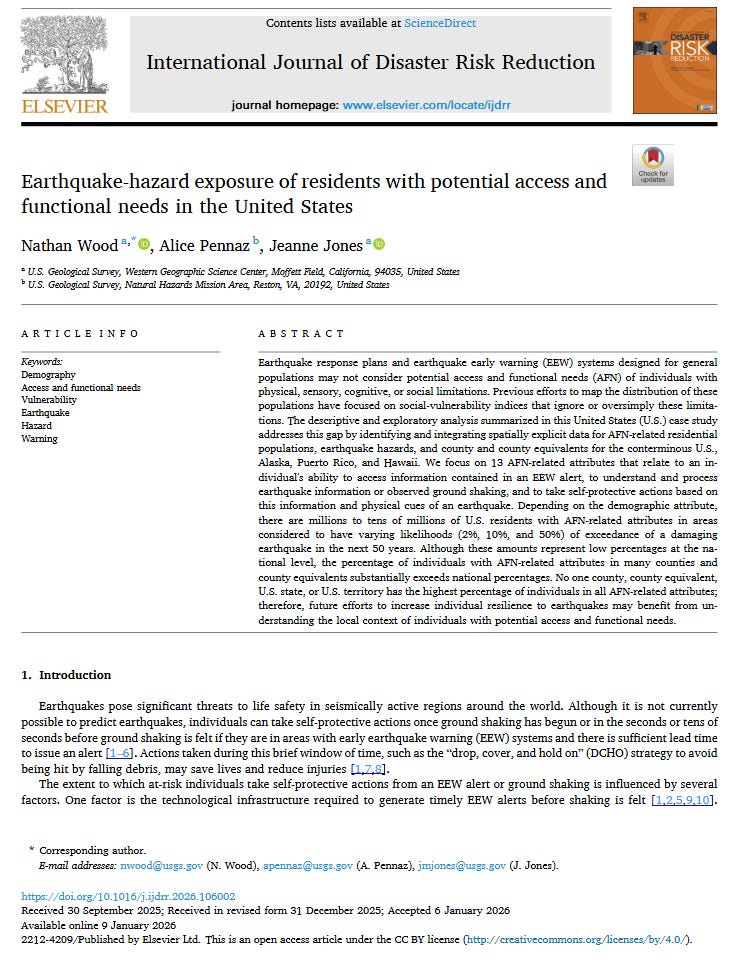
This study from Nathan Wood, Alice Pennaz and Jeanne Jones at the U.S. Geological Survey takes a straightforward approach to mapping and measuring where populations with access and functional needs (AFN) actually live relative to earthquake hazard zones, using county-level data that covers the entire U.S. Their framing draws on the CMIST framework (Communication, Maintaining Health, Independence, Support and Safety, and Transportation) that was originally developed by Kailes and Enders to move emergency management beyond generic labels like “disability” and “special needs” toward a functional understanding of what people actually need to prepare, survive and recover.
The value and innovation here, I believe, is in the approach the authors take to selecting nationally-available demographic variables that describe access and functional in a hazard context and mapping them onto real-world actions. Rather than collapsing disability, age, language, and technology access into a single vulnerability score, the authors identify 13 distinct variables and map each one separately. Crucially, they organize these variables by the specific functional challenge they create:
Accessing information: Can a person receive a warning? The variables here include hearing difficulty, vision difficulty, households without a telephone, and households without a computer.
Processing information: Can a person understand what the warning means or recognize that ground shaking is dangerous? These variables includes cognitive difficulty and limited English proficiency.
Acting on information (mobility): Can a person physically protect themselves? This covers ambulatory difficulty, dependence on durable medical equipment (e.g. ventilators, dialysis machines, electric wheelchairs), and mothers with newborns.
Acting on information (caregiver reliance): Does a person need someone else to help them prepare or respond? This includes children under 18, adults 65+, people with self-care difficulty, and institutionalized populations (e.g. nursing homes and correctional facilities).
Organizing data this way is helpful because each AFN variable implies a different intervention point or pathway. A community with high rates of hearing difficulty needs visual or haptic alert systems, while another with large institutionalized populations may require facility-level emergency plans. A composite index that blends these factors into one metric obscures exactly the information an emergency manager or decision maker needs to act.
The authors then overlaid these county-level data with USGS National Seismic Hazard Model maps showing areas with different probabilities of a damaging earthquake in the next 50 years. This methodology seems perfectly transportable to other hazard types, though the definitions (and associated variables) for access and functional needs would likely change.
The authors analysis shows that 252.5 million people live in areas with at least a 2% chance of a damaging earthquake in the next 50 years, or 75% of the U.S. population. Within those areas, there are millions of residents with AFN-related attributes: tens of millions of children, older adults, and people with limited English proficiency; several million with hearing, vision, cognitive, ambulatory, or self-care difficulties; and about 1.4 million people who are dependent on durable medical equipment.
At the national level, AFN populations represent relatively small shares of the overall population - typically less than 10%. But locally there is significant variation, in the population and their geographic distribution. For example, less than 1% of the U.S. population is currently incarcerated, but in some counties in Mississippi and Arkansas people in correctional facilities and nursing homes make up a third of all residents. In parts of Puerto Rico fewer than 40% of households have access to computers. And so on. The varied makeup of county populations according to AFN attributes means that cookie-cutter approaches to disaster preparedness (and specifically EEW) at the national or even state level will likely leave critical gaps in our system, which perhaps helps explain why those populations are so chronically underserved during and after disasters.
A few other findings worth noting:
The counties with the highest concentrations of populations with AFN attributes are almost entirely small and rural places, which are often overlooked in national and state-level planning.
Some AFN attributes cluster or intersect in ways that compound risk. For instance, the authors find that county-level shares of people with cognitive difficulties correlate strongly (0.8) with ambulatory and self-care difficulties.
Limited English proficiency is the one attribute that increases linearly with earthquake risk, reflecting the fact that there is a heavy concentration of Spanish-speaking populations in seismically active areas in California and Puerto Rico.
As a long-time critic of the proliferation of disaster and climate risk indices, I very much appreciate this study and approach. While many indices are broadly useful for comparing geographic regions, I find them less helpful for directing our actual policies and actions. What should an emergency manager who knows that one county is more socially vulnerable than another do with that information? The authors’ approach of tying nationally representative variables to specific functional barriers during earthquakes is refreshing, and in some ways a throwback to earlier eras of research from greats like Quarantelli and Lindell.
That being said, the analysis of county-level data is a strength and limitation. Counties are large and heterogeneous…similar to how indices can obscure individual-level variables, county-level analyses can mask enormous variation at the neighborhood or household level. The authors acknowledge this and note the common shortcoming that margins of era for census-tract level data prevents finer-grain analyses. And yet, many practical decisions about how to address potential vulnerabilities that arise from access and functional needs happen at a more local level.
One area I’d love to see extended: the paper focuses exclusively on residential populations and doesn’t account for non-residential groups. In some areas, non-residential populations - like tourists or workers - substantially outnumber residents, and it is important that we consider how AFN attributes might challenge conventional approaches to emergency response in those places. A parallel analysis of workplace and institutional populations with AFN attributes would be a valuable addition to this work.
Enjoyed this post? Please consider ‘liking’ it by clicking the heart icon below. It brings new readers to Place + Resilience. And be sure to subscribe!
Comments
Nothing yet. Say the first thing.
Sign in to join the conversation.