I have said it before and I will say it again. Sexy Beast is the last good British gangster film.
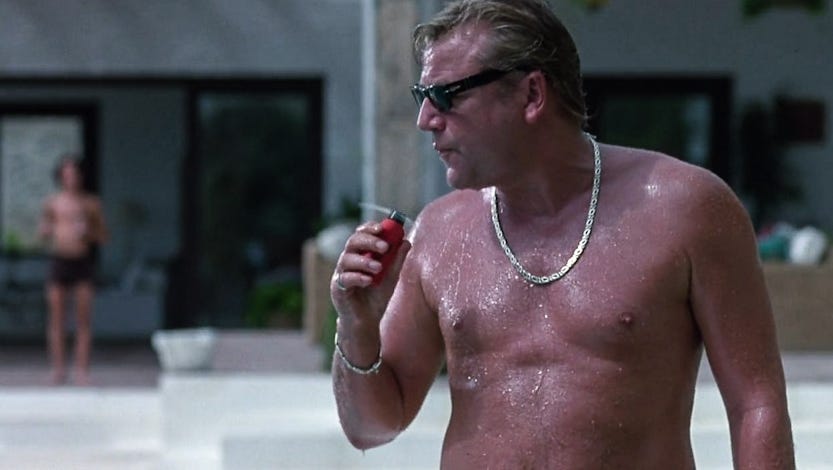
You most likely know the story. Gary ‘Gal’ Dove (Ray Winstone) is a retired safecracker now living the good life with his illegal proceeds in a Spanish villa with his ex-porn star wife, Deedee (Amanda Redman). Gal wants to do nothing more than sit in the sun with Deedee, and fellow London underworld refugees, Aitch (Cavan Kendall) and Aitch’s wife, Jackie (Julianne White). That is until their peaceful life is thrown into utter chaos by the arrival of Gal’s foul mouthed, psychotic former underworld associate, Don Logan ( Ben Kingsley), a gangster, who has come on behalf London crime lord Teddy Bass (Ian McShane), to recruit Gal to help pull a heist Bass is planning.
Gal wants no part in the job, setting the scene for an escalating series of confrontations between he and Logan, who simply will not take no for an answer. Logan's attempts to bully Gal to take part in the job start humourlessly enough but ratchet up until he threatens to violence, at which point Deedee shoots him, unleashing a wave of pent up anger on the part of her, Aitch and Jackie, in which all three beat him to death.
Director Jonathan Glazer doesn’t give all this away in a linear fashion, however. Before we find out Logan has been killed, we see Gal in grey, rain sodden London, apparently brow beaten into taking part in the robbery, which involves breaking into a bank vault from an adjoining men’s bath house. Gal goes through the motions, but is clearly an unenthusiastic player. He is also aware of being under suspicion from Bass for Logan's mysterious disappearance.
Britain has produced some stunning gangster films (see below for my favourites). Sexy Beast deserves a place in this canon while at the same time wonderfully subverting it. The heist in Sexy Beast goes right and it is everything leading up to it that goes to shit. Rather than the usual story of the cunning, hungry working class man (and it is usually a man), climbing his way up the criminal ladder, Gal has long gone to seed and wants nothing to do with the proposed criminal job.
Interestingly, the underworld lives of the women are central. Deedee, who made her name starring in old blue movies produced by Maltese pornographers, and Jackie, who it is suggested got by as a consort to various gangsters including, at one time, Logan. Both women have come to Spain to get as far away from their previous underworld selves as possible and it is Logan’s act of bringing up their past which ultimately triggers their violent retribution against him.
At its best, the British gangster film has not only delivered thrills, it has also charted shifting social mores and class politics of Britain. Every single British gangster film since Sexy Beast - and this is a hill I am prepared to die on - has been a tired rehashing of the so-called heyday of the British gangster cinema (which, you could argue says something about where Britain is at the moment, but that’s a discussion for another time). I include in this category Gangster No 1 (2000), Layer Cake (2004), and Guy Ritchie’s Lock, Stock and Two Smoking Barrels (1998) and Snatch (2000), both of which are entertaining enough, but are largely pastiches, an homage to Britain's so-called lost underworld culture, even including actors from key gangster movies of the seventies, like Alan Ford. It takes more than violence, interspersed with a bit of old school criminal slang, a sunken lounge here and there, some shag pile and a few artfully placed Tretchikoff prints to make a good crime film.
As for the other great British gangster films I mention above, here are my 10 favourites.
They Made Me a Fugitive (1947)
One of a trio of early post-war British gangster films that caused a stir with censors, the others being No Orchids for Miss Blandish and Brighton Rock, both of which appeared in 1948. Fugitive stars Trevor Howard as Clem Morgan, a demobbed Royal Air Force pilot who reluctantly joins a criminal gang headed by a flash gangster with a very nasty streak, Narcy, but baulks when his discovers his new employer is into drug trafficking. What I love about this film, and the aspect that attracted the most critical condemnation when it first appeared, is its depiction of the poverty and desperation of post-war British life.
No Orchids For Miss Blandish (1948)
Based on the controversial James Hadley Chase book of the same name, this film makes my list simply because it is so bizarre. An American-style gangster film set in a fictitious large American city but actually made in the UK with a largely British cast (well known Carry On franchise star Sid James as a barman in a glitzy gangster own nightclub is just one of many familiar faces). If you want to know more I wrote about the film and the book it was based on last year for the US site CrimeReads.
Never Let Go (1960)
I suspect that John Guillermin's Never Let Go is one of the lesser known titles on my list. A put upon cosmetics salesman under economic pressure (Richard Todd) is forced to take drastic action when his car - essential to keeping his job - is stolen by a group of young toughs with links to a glitzy, vicious gangster (Peter Sellers at his venal best) and the police are, at best, inactive. A deceptively hard British noir, the ending in particular packs a real emotional punch.
The Criminal (1960)
Stanley Baker as a tough criminal under pressure from associates to reveal where he has hidden the proceeds of a racetrack robbery. Apparently modelled on real-life Soho villain Alfred Dimer, this was one of six films Baker did with blacklisted Hollywood director, Joseph Losey. The Criminal seamlessly combines the heist, prison and gangster film.
Robbery (1967)
Stanley Baker again in Peter Yates's fictional retelling of the Great Train Robbery. Baker plays Paul Clifton, recently out of jail and trying to corral his gangster backers and criminal colleagues into the heist of a lifetime, while dealing with the unwanted attention of the police and a failing marriage to the stunning Joanna Pettet. Not only a great gangster film but a superb heist film.
Get Carter (1971)
Pretty sure you know the drill on this one. Jack Carter, an enforcer for a criminal organisation run by two brothers, Gerald and Les Fletcher, leaves London and travels to the unnamed industrial working-class town in northern England where he grew up, to investigate the death of his estranged brother, Frank. Jack doesn’t believe the official version of his brother’s death and proceeds to tear the local syndicate apart to get the truth. The film’s narrative power derives principally from the collision between the grim working-class world of Jack’s youth and modern 1970s Britain.
Villain (1971)
Richard Burton as Vic Dakin, a gay, misanthropic, homicidal, Tory gangster whose time at the top of the London underworld heap is coming to an end. Oh, and did I say, how much he loves his old mum?
The Long Good Friday (1980)
A long time ago I had a lengthy argument on Twitter with crime writer Ray Banks about what was the best British gangster film. I was in the Get Carter corner, he was pushing for The Long Good Friday. Many years later I am happy to admit he was right. Stunning performances by Bob Hoskins as Harold Shand and Helen Mirren as his tough but caring partner and, without doubt, the best execution of the long running trope in British crime cinema of the working class gangster as wannabe ruling class right-wing entrepreneur. And also, what about that stunning final scene in the back of the taxi?
McVicar (1980)
The Who frontman Roger Daltry stars as John McVicar, a real life 1960s armed robber and at one time Scotland Yard’s ‘public enemy number one’. Supposedly based McVicar’s book, McVicar by Himself, the film is split into two halves. The first sees McVicar plotting his jail escape between prison riots and bouts of guard brutality. Once out, he kicks starts a troubled relationship with his wife and young son and hatches a plan to escape to Canada. But to do this he needs money and the only skills he has are criminal. Plenty of old school London villains and a great soundtrack courtesy of its star, Daltry.
The Krays (1990)
The Krays really deserve a gong of some sort for services to British crime fiction and film. I am not sure how many times they have been depicted on the screen, as either themselves or as the inspiration for someone else. Whatever the case this 1990 effort is my pick as the best Kray film. While Gary and Martin Kemp are good as Ronald and Reggie Kray respectively, The Krays belongs to Billie Whitelaw as their loving and ruthless mum, Violet Kray. There is also a great supporting cast, headed up by Steven Berkoff's wonderful turn as the Kray's gangster rival, George Cornell.


Comments
Nothing yet. Say the first thing.
Sign in to join the conversation.