
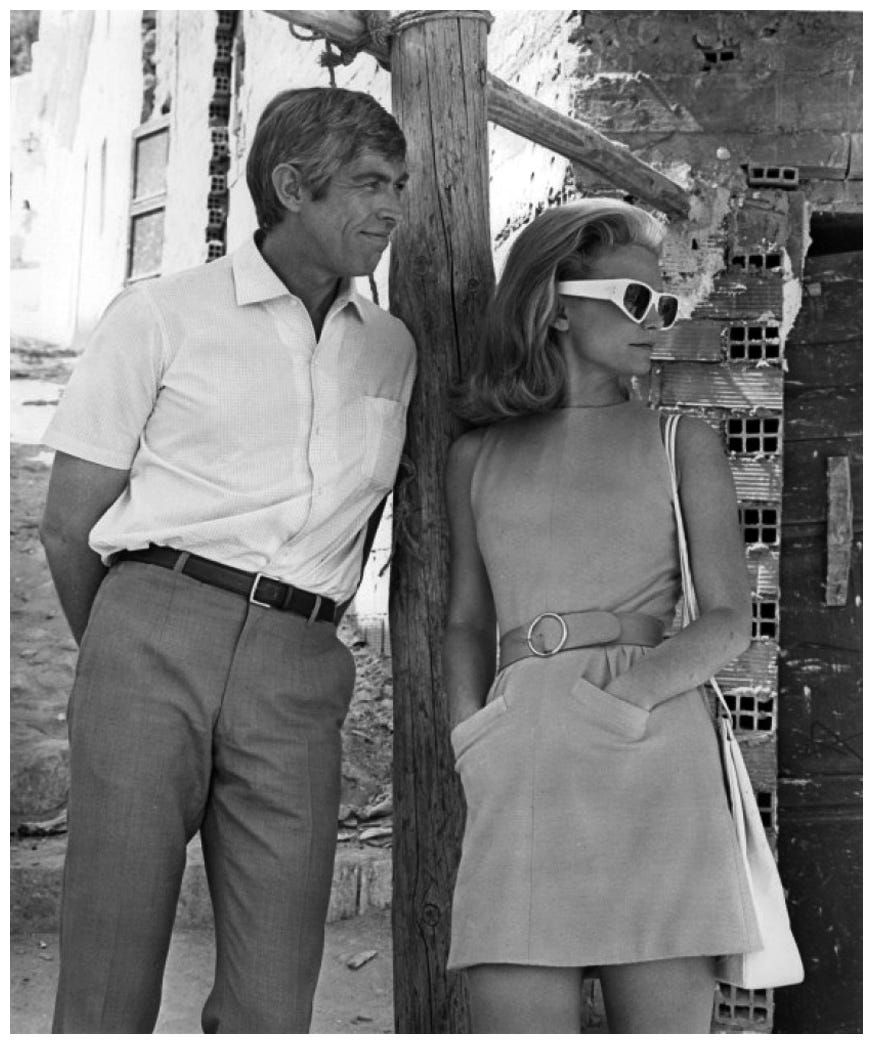
If he was still alive, James Coburn would’ve been 97 a few days ago. No one lives forever, of course, but I kind of wish Coburn had.
Regular readers will be familiar with my Lee Marvin obsession. But Marvin appeals to the id, the dark energy, in many men, myself included. Whereas Coburn was just pure positive energy. On the screen, anyway. Seriously, can you think of another mid-century American actor who had such a good mojo? Who made everything look so good and so easy? Who was always a joy to watch, even in his shit films (of which there were many)? Charisma to burn, especially when he flashed that giant grin of his.
Coburn had a long and varied career that stretched from 1957 to his last role in 2002. He got his start playing tough guys in westerns on TV and then on the large screen, including his break out role in The Magnificent Seven (1960). He starred in the 1963 classic, The Great Escape, then rode the mid-sixties spy film craze with Our Man Flint (1966) and In Like Flint (1967). He spent the seventies appearing in some great action, crime and Westerns: Pat Garrett & Billy the Kid (1973), the little known Harry in Your Pocket (also 1973, and which I wrote a little bit about here), Walter Hill’s wonderful boxing film, Hard Times (1975), and Cross of Iron (1977). The next three decades were not so great for him, with a few obvious exceptions, such as Affliction, the 1999 film that won him a best supporting actor Oscar.
Anyway, most of you will have not only a favourite Coburn film, but a favourite lesser known Coburn title. For me the latter is the 1969 film, Hard Contract.
In Hard Contract, Coburn plays John Cunningham, a cold, clinical CIA hit man. The film opens with him dispatching his latest target in a New York cinema (we have no idea who the victim is), then going to vote in city elections. He’s a Republican, much to the chagrin of the liberal minded call girl he spends the rest of the afternoon with (played by Karen Black). As befits Cunningham’s detached attitude to life, he is incapable of having normal relationships and only sleeps with prostitutes.
Cunningham meets his CIA handler, Williams (Burgess Meredith), a former leftwinger who is also a College professor, and is offered a “hard contract”, so called because it will involve Cunningham killing three people within a strict one-month time frame. Two of the targets are in Spain, one in Belgium. The identity of the second target in Spain won’t be divulged to him until he eliminates the first two. As is often the case in hitman films, Cunningham accepts the contract because the money is so good that he’ll be able to retire from the contract killing game for good.
While casing out his first target in a Spanish holiday town, Cunningham meets American socialite Sheila Metcalfe (Lee Remick). Sheila is at a loose end after her latest failed marriage and hanging with an entourage of louche Euro-trash types, including Adrianne (German actress Lilli Palmer), her companion Maurice (French actor, Claude Dauphin) and Alexi (Patrick Magee), a rich former Nazi infatuated with Sheila and who Sheila taunts about his past killing Jews in concentration camps.
After a shaky start, which includes Cunningham mistaking Sheila for a prostitute, a mix up Sheila plays along with at first, the two fall in love. As their relationship deepens, Cunningham finds he no longer has the stomach for the hitman business. He kills the first target in Spain and travels to Belgium (via a strange detour to Tangiers), where he throws the second target out an apartment window, but his heart just isn’t in it any longer.
Things become even more complicated when he discovers the third target, a man called Carlson (Sterling Hayden) was Cunningham in a former life before he grew tired of killing people for the American government and retired to the Spanish countryside. Despite threats by Williams that Cunningham and Sheila’s lives are in danger if the assassin does not complete the contract, Cunningham decides murder is obsolete. It’s not exactly Godspell, but in true late sixties counter cultural style, he and Sheila damn the possible consequences and run away together. The last scene shows them making love in a clearing in the woods.
Sigh.
Hard Contract was a box office flop, which Coburn blamed on the film’s writer and director, S Lee Pogostin. Pogostin was a well-known pen for hire, mainly for television, who’d never directed a feature film before and it is easy to see he was out of his depth. According to Coburn, the actors more of less took over the film and directed themselves. Coburn affects an air of detached suaveness and Hayden sleepwalks through his part. The highlight is Remick, an actor I’ve never much cared for, who is great as the free spirited, good natured peacenik-type, Sheila.
The script is disjointed and full of lengthy sequences in which the characters discuss capitalism, the morality of war and killing and different philosophical approaches to life. With the exception of a long discussion between Cunningham and Carlson in the middle of a wheat field in Spain, these don’t go anywhere or feel like they have much relation to the story.
But these flaws are more than made up for by the star wattage emanating from the duo of Coburn and Remick. There’s a lot of picturesque globetrotting between Spain, Europe and Tangiers. Cunningham gets caught in a violent political demonstration in Belgium and he and Sheila run away in the middle of gypsy wedding in Spain. Fans of late sixties interior design will also dig the extended scenes in various casinos, bars and hotel suites, where Sheila and her entourage spend their time.
If you can find it - no mean feat - watch it because it’ll make you feel good. And to quote Willem Dafoe’s character in Platoon (1986), sometimes, feeling good’s good enough.
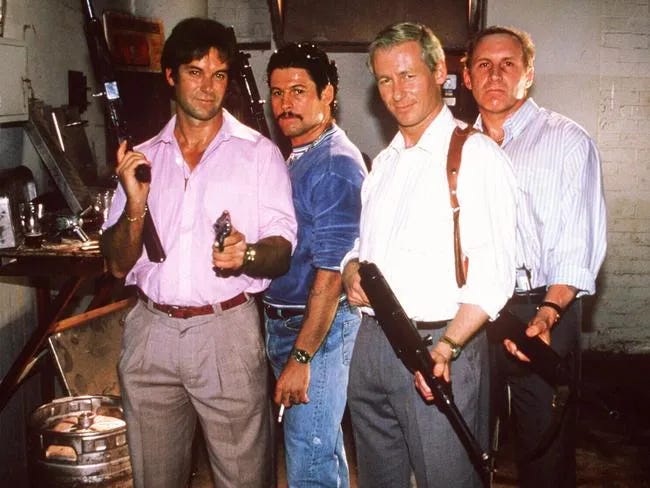
Another anniversary of sorts came across my radar this week. It is 30 years since the release of what is still the best Australian TV true crime drama show ever, the two-part series, Blue Murder.
I have written about this show before here, but the topic is worth reprising.
Blue Murder was the brainchild of Australian director, producer and scriptwriter, Michael Jenkins. Jenkins got his breakthrough with the three-part 1983 Australian Broadcasting Corporation series, Scales of Justice. It was incredibly controversial for its time because of the focus on New South Wales police corruption, something everyone knew about at the time but seldom talked about publicly.
Scales of Justice was just the warm up act, however.
Blue Murder premiered on the ABC in September 1995, but was delayed in New South Wales and the Australian Capital Territory until 2001 due to its potential influence on a legal case involving Arthur ‘Neddy’ Smith, brilliantly played by played by Tony Martin in the series. After Queensland’s Fitzgerald inquiry in the late 1980s, police corruption was a major topic of public debate and, just as the economy was being deregulated by the then Labor government, so too was organised crime.
Blue Murder is set in Sydney in the 1970s and early 1980s and has two interrelated plot strands. The first is the relationship between Smith and former police detective Roger ‘The Dodger’ Rogerson (Richard Roxburgh), following Rogerson’s decision to grant Smith the ‘green light’ to commit crime without fear of police reprisal. The second deals with undercover cop Michael Drury (Steve Bastoni), who refuses Rogerson’s bribe to not testify against Melbourne heroin dealer Alan Williams (Marcus Graham). In retribution, Rogerson helps Williams arrange for Christopher ‘Mr Rent-a-Kill’ Flannery (Gary Sweet) to kill Drury. Drury survives the hit but is seriously injured.
There are several aspects to Blue Murder that make it so interesting. While it does not exactly glamorise Rogerson and Smith, neither does it depict their relationship entirely unsympathetically. And while it forms part of a rich heritage of gritty local true crime oriented television that dates back to programs like Homicide, it also radically breaks with it.
Through his relationship with Rogerson, Smith becomes involved in Sydney’s burgeoning heroin trade, a task he approaches with the zeal of a self-made 1980s entrepreneur. Rogerson meanwhile embodies the malevolent inversion of the clean-cut, by-the-rules police officers of earlier Australian television shows. Indeed, he is a rare Australian example of the characters in the American tradition of hard-charging cops who are not afraid to cross the line to fight crime, and then become criminals themselves.
As Rogerson describes his job: ‘The only thing standing between your average punter and total anarchy is someone like me.’ Yet, despite this, he doesn’t put in long hours combing witness statements and interviewing suspects. ‘Real police work,’ he says in one of his voice overs, ‘the sort that puts hardened criminals behind bars, means forming relationships with people you wouldn’t piss on if they were on fire.’
In addition to organising a hit on Drury, Rogerson is shown destroying the career of a young policeman who refuses to release one of Rogerson’s informers, whom he has inadvertently arrested. There have also been unproven allegations he was involved, along with Smith, in the murder of sex worker Sallie-Anne Huckstepp (Loene Carmen in the show), after she goes on national television to talk about police corruption. Her murder remains unsolved and is unlikely to ever be as all the suspects are now dead.
I don’t want to be that person caught in a never ending spiral of lauding old culture as superior to new but watch Blue Murder (unlike Hard Contract, it is not heard to find) and marvel at how good they are compared to sensational tabloid garbage of recent local offerings, such as the Underbelly series.
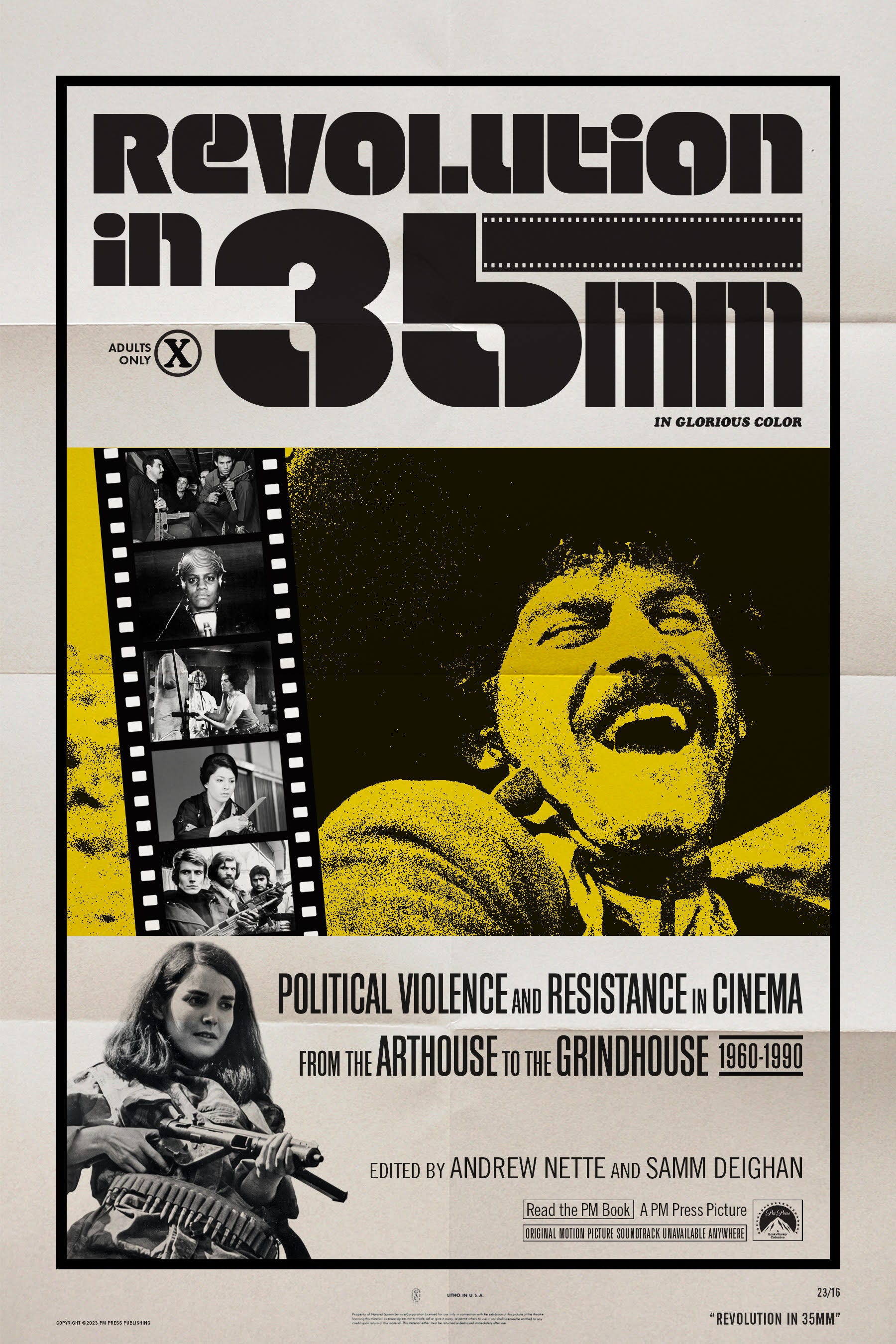
I am still doing bits and pieces for the PM Press book I co-edited with Samm Deighan, Revolution in 35mm: Political Violence and Resistance in Cinema from the Arthouse to the Grindhouse, 1960-1990.
The latest saw me interviewed for an episode of the Film Cult Podcast. Thanks to Robert Lalonda for having me on for a great conversation about the book and radical cinema, which you can listen to in full here.
In addition to being available online and in physical book shops, you can pick Revolution in 35mm up as a physical and ebook from the publisher at this link here.
Until next time.
No posts
Comments
Nothing yet. Say the first thing.
Sign in to join the conversation.