

“During a gold rush, sell shovels,” goes the saying.
The idea being that the factors of production, or enablement goods and services, is where true value is extracted, not in the excavated commodities or in the final goods themselves. Fortunes were made off of picks, shovels, wheelbarrows, and work pants (this is where jeans come from) in the 1840s, while most prospectors never struck gold and came up empty handed.
There may be a cornel of truth here for a select number of entrepreneurs. However, the base assumption underlying the popular phrase is not only false, it is also financially hazardous to the investing public.
That’s because input goods, like raw materials, components or services, must by definition always be less valuable than the output goods they spawn. Otherwise, there would be no economic incentive to produce at all!
Why would anyone waste blood, sweat, and tears only to wind up poorer?
Nobody would.
That’s why Tesla is more valuable as a company than the individual lithium miners who make EV’s lithium-ion batteries possible. That’s why Apple commands a 40X larger market cap than its main supplier, Foxconn Technology Co. That’s why gold was a better investment than buying shares in Levi Strauss & Co.
Again, by necessity input goods are always less valuable than output goods.
With this in mind, what’s the gold rush 2.0 of today?
Answer: Computing power.
We are living through the chips rush (trademark pending), and the world has an insatiable appetite for microprocessors. Nvidia just hit a $1.7 trillion market cap and is now more valuable than the entire Chinese stock market, as Bank of America chief investment strategist Michael Hartnett points out.
Yes, the chipmaker’s market cap is up almost 4X since the start of last year., with its stock price up 239% in 2023, and another 41% this year alone. Only four US public companies are worth more.
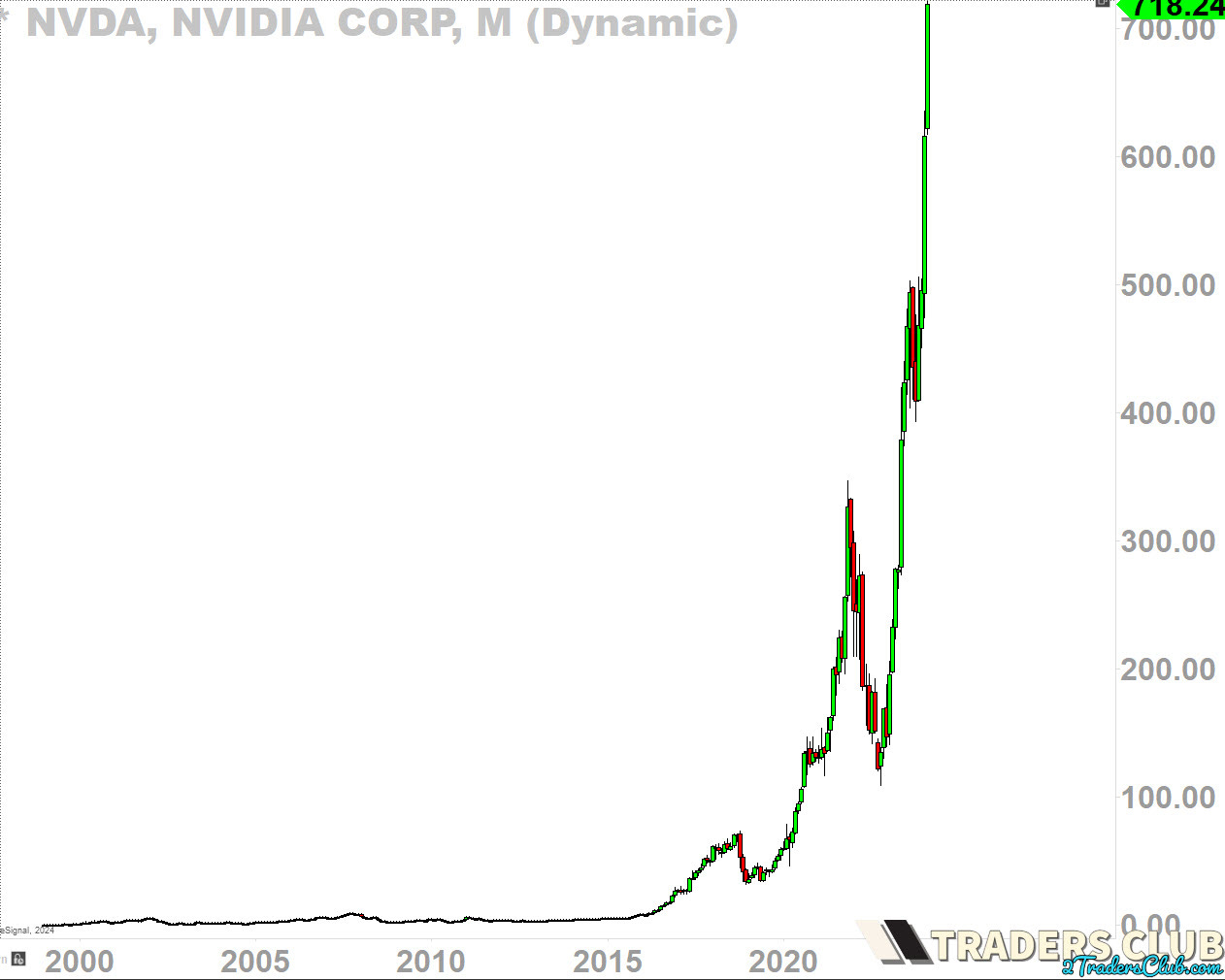
For all intents and purposes, chips are the modern equivalent of picks and shovels:
This is because chips are merely the individual neurons on the brain of the artificial intelligence we are all in the process of building. For context, our collective information on social media and the broader internet is the dataset for this brain, i.e. the electric signals these synapsis are firing.
This is because chips are just the building blocks for the wave of automation that’s coming - they will help deliver on the long hailed promise of The Internet of Things (IoT), i.e. the network of physical objects—“things”—that are embedded with sensors, software, and other technologies. This means self driving cars, autonomous delivery services, ghost factories & kitchens, etc.
This is because chips are automating central banks and enabling the financial reset we are currently undergoing. They will power this new encrypted global monetary standard and open up financial services to billions of previously unbanked people.
In other words, we are on the cusp of a productivity explosion as never before seen. Chipmakers like Nvidia are all upstream of the true value creation we have ahead of us. Because remember: Inputs < Outputs. This means that the picks and shovels crowd will miss the vast majority of the value creation. Meanwhile, the wealth generation will accrue to the applications built on top of this new digital economy.
Likewise, tomorrow’s middle class will have available to them a universe of new and cheap goods and services - an embarrassment of riches that will make today’s billionaires look positively impoverished.
I hear you, there's no way, right? This sounds like pure science fiction…
But just look around you.
You’re already living in a science fiction.
Today's average citizen is immensely more wealthy than were even kings of old.
Kings stood at the absolute pinnacle of power and wealth, in societies that were grotesquely impoverished by modern standards.
The seeming opulence and grandeur of their castles and palaces were overshadowed by the absolutely rancid living conditions that plagued these buildings.
Usually, only one room was heated, leaving the rest of the castle cold and damp. The heat was generated by a fireplace that caked the walls in soot and filth. The smoke and ash led to respiratory problems.
There also wasn't running water or indoor plumbing, which meant kings and their courtiers had to rely on chamber pots and other primitive methods of waste disposal - a foul smell pervaded many castles. The lack of sanitation led to the spread of infectious diseases such as cholera and typhoid fever.
Their diets were equally squalid and lacking in nutrition. Due to the expense of importing and preserving fresh food, most meals were comprised of heavily salted meats, grains, and root vegetables. These foods were often stored in dark, damp cellars or pantries, encouraging the growth of mold and bacteria. The drinking water was often contaminated with bacteria and parasites, causing dysentery.
Kings usually didn't live past their 50s.
Now let's compare and contrast this with modern times.
I'm typing these words from a pleasantly air-conditioned room overlooking the gorgeous Miami skyline through a floor-to-ceiling glass pane window.
The 24-hour supermarket, conveniently located at the base of the building, is just an elevator ride away. It carries 50,000 consumer items.
The device in my pocket can summon ride-sharing drivers and instantly access the sum total of human knowledge.
I understand this may be more of a Western experience, but the trend is clear. The number of people living in extreme poverty worldwide has been cut by over 70% since the 1990s.
If we don't commit civilizational suicide under blooming mushroom clouds or under the cold fluorescent lights of a bioweapons lab, is it crazy to think this trajectory will continue?
Not at all, already we can easily see how exponentially growing computational power, artificial intelligence, automation, and a new cryptographic monetary system will lead to unfathomable productivity gains.
There's just one catch.
While tech is driving marginal costs of production to zero, our anachronistic fiat system offsets these productivity gains through debasement, driving prices up.
Those wanting to participate in the prosperous economy of the future will have to update their money.
Wishing you all a Happy Super Bowl Sunday! 🏈
If you’ve enjoyed this Sunday edition of the Bitcoin Macro Newsletter, please help spread the word by sharing this post with friends and colleagues. We rely on your good word of mouth. Any pledges are greatly appreciated.
Thank you for reading Bitcoin Macro. This post is public so feel free to share it.
No posts
Comments
Nothing yet. Say the first thing.
Sign in to join the conversation.