
You’ve heard it a million times.
Start investing while you’re young, just dollar cost average into broad-based index funds, and you’ll be golden. After all, the stock market goes up and to the right forever. Let the wonders of compounding interest work for you, goes the chorus.
Yes, this has been the cookie cutter advice for decades now:
*If you start at the age of 25, only $200 in monthly contributions to the S&P 500 will turn into $1M by the time you retire (assuming 10% annual returns.)*
It’s that simple.
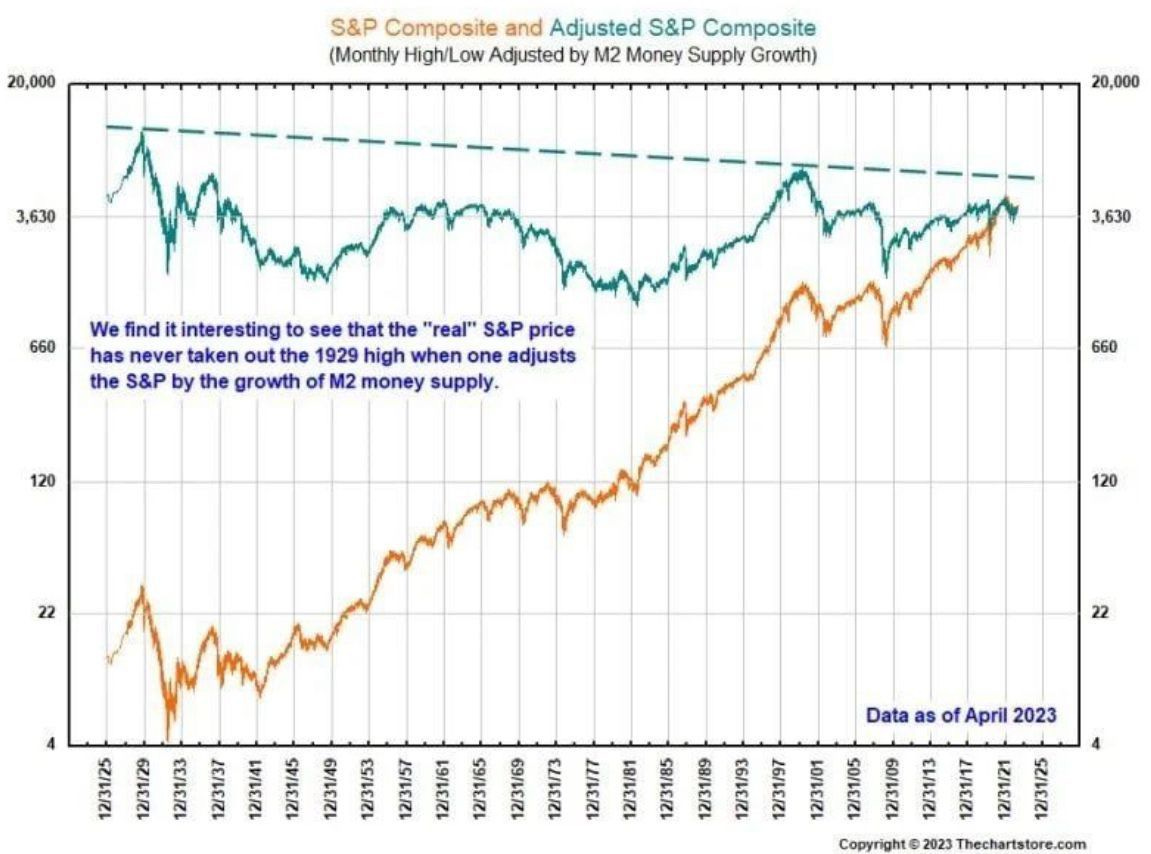
While this little math exercise may work in theory, the real numbers tell a very different story: When adjusting for monetary debasement, i.e. real inflation, the S&P 500 never recovered from the Great Depression of 1929:
That’s right - the idea that index funds just print money and that you can get rich off passive investing is arguably one of the greatest illusions of our time.
Hard to believe, but anyone can run these numbers at home.
Go to the St. Louis Fed website and download a CSV for M2 money supply.
Then use it to discount S&P 500 historic prices.
What do you get?
You get the green graph above, "Adjusted S&P Composite."
It shows how stocks haven't moved in a hundred years (corrected for M2).
Stock prices are simply offsetting currency debasement. They've only kept up with the money printer and staved off the worst effects of loss in purchasing power, nothing more. However, it’s important to note that the reality for investors is in reality significantly worse than this:
That’s because you can’t actually buy the S&P 500, which itself only exists in theory. To gain exposure, investors have to go out and buy real life funds that try to replicate the performance of this abstraction by buying and selling the underlying stocks that make up the S&P 500. This means investors are subject to operating fees (expense ratio), commission fees, and turnover fees (for perspective, the median turnover for an equity ETF is approximately 25%). Not to mention capital gains taxes that apply when investors try to realize their nominal gains.
In other words, attempting to track the S&P 500 typically makes investors poorer in real terms, although much less so than other alternative asset classes. Yes, keeping up with the money printer is incredibly difficult, almost impossible.
Now, does that mean people haven't gotten rich off stocks?
Of course, not.
If you bought Tesla you probably did pretty well. Same for Nvidia.
But not so much if you followed conventional wisdom and passive invested through broad-based index funds (most active funds did even worse.)
In fact, the S&P 500 collapsed in 1929 and never came back in real terms.
To be fair, equity holders don't just get price appreciation, they also get paid dividends. If you factor in those absolute returns, the S&P 500 did in fact on average outpace currency debasement by 3.79%.
That doesn't seem so bad, until you realize that's just an average.
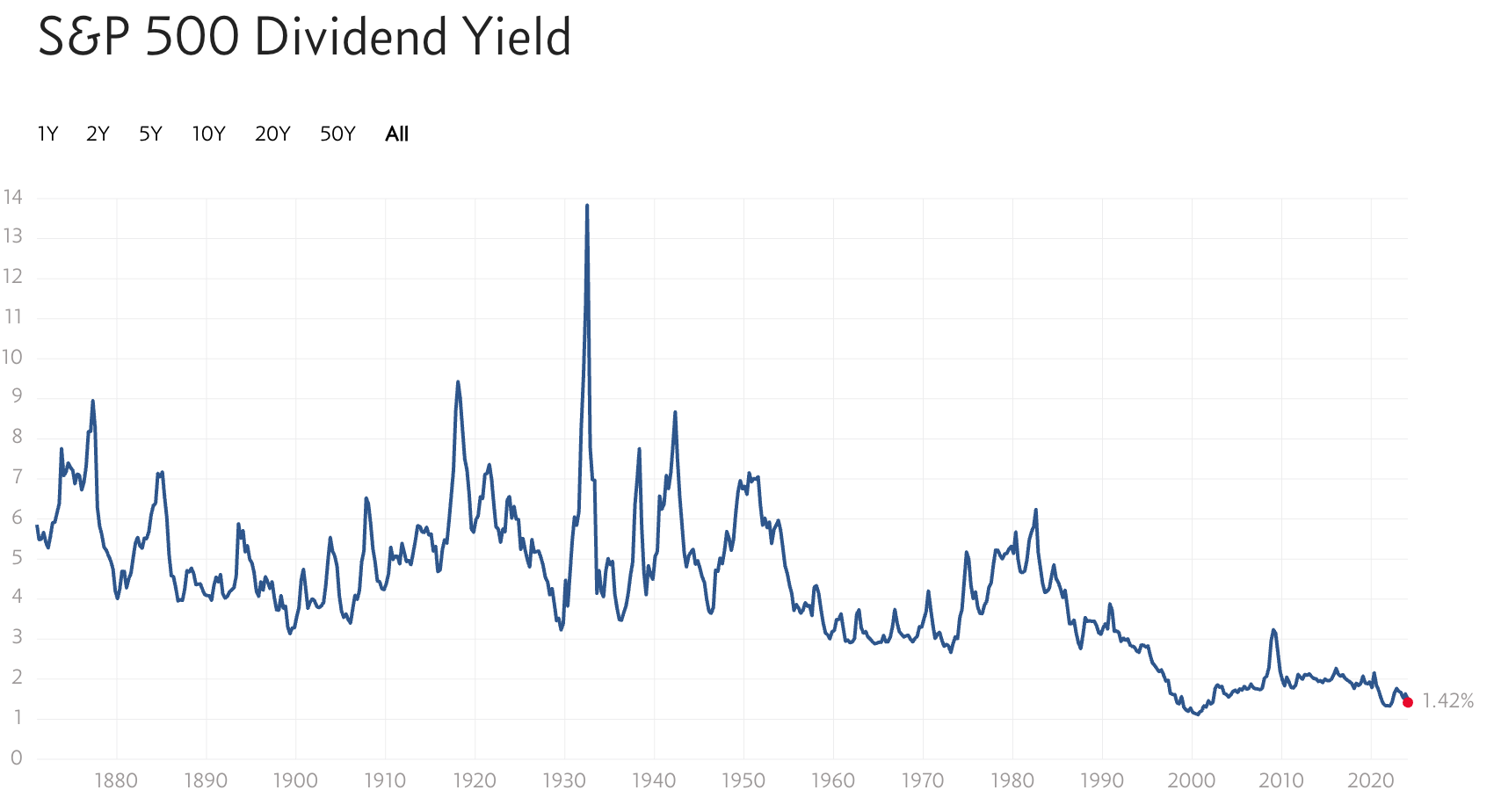
Turns out the S&P 500 dividend yield has been in steady decline, spiking as high as 13.84% in 1932 and shrinking to 1.42% today.
What does that mean?
It means stocks as a whole are barely keeping up with the money printer, where free cash flows and net income, which drive dividends, are becoming increasingly insignificant when compared to the price appreciation of the stock itself.
This becomes apparent when you consider that today's average 1.42% dividend yield implies investors wait ~50 years to recoup their investment. It's even worse with the Magnificent 7, i.e. the 7 largest tech stocks: The implied wait is 400 years (!) at their current annual 0.18% dividend yield.
Clearly, it's not about companies generating income (who would wait 400 years?), instead it's about the monetary premium of the stock itself.
As the currency gets debased, other financial instruments monetize.
Is this a uniquely American phenomenon?
Nope.
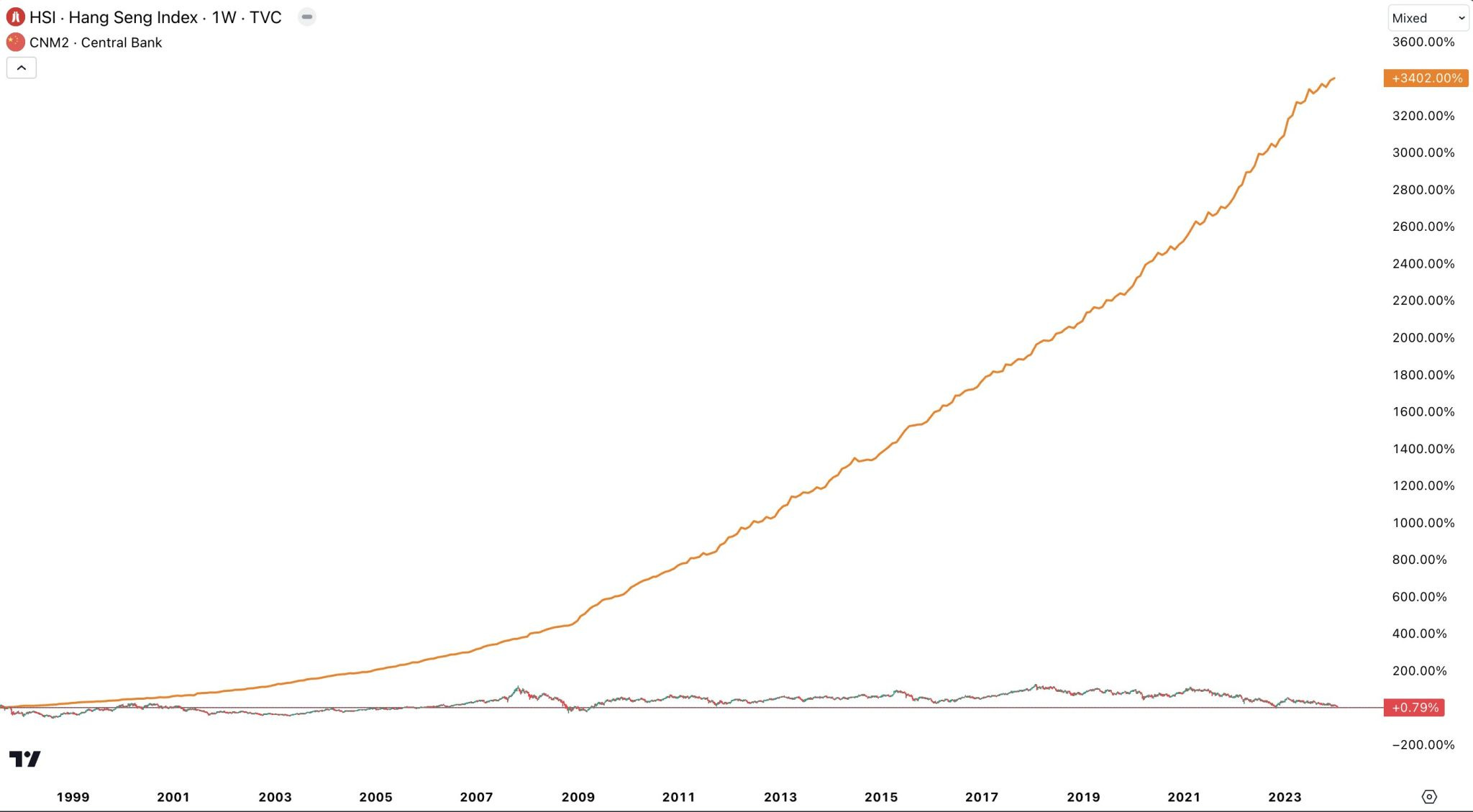
Contrary to popular belief, China’s stock market performance has been nothing short of devastating for investors, spinning its wheels for over two decades even in nominal terms. The Hang Seng Index (HSI) hasn't moved since 1997, despite the money supply increasing a staggering 35X.
In fact, foreigners that tried to participate in the Chinese growth miracle through broad-based index funds got burnt BAD. I say foreigners because the vast majority of Chinese household savings are in real estate and regular savings accounts - almost the exact inverse of the US where households have significant exposure to stocks through IRAs and 401(k)s.
How bad did they get burnt?
HSI hasn't moved since 1997, but that's just nominally. Over that same timeframe the money supply's been increased 35X, which means in real RMB terms China stocks are down 97%...
Looks like the asset price inflation / currency debasement Ponzi is universal :)
If you’ve enjoyed this weekend edition of the Bitcoin Macro Newsletter, please help spread the word by sharing this post with friends and colleagues. We rely on your good word of mouth. Any pledges are greatly appreciated.
Thank you for reading Bitcoin Macro. This post is public so feel free to share it.
No posts
Comments
Nothing yet. Say the first thing.
Sign in to join the conversation.