
Diana arrived at the castle around five o’clock in the afternoon and there, in the nursery, she was asked by Prince Charles if she would marry him. The setting for this life-changing moment was a bare, unremarkable room with worn green carpet and matching coloured walls adorned with ancient family photographs. Hardly the stuff of a fairy-tale romance. Not a rose nor a flickering candle in sight. Even the gruff Prince Philip had managed a proposal at Balmoral ‘beside some well-loved loch, the white clouds overhead and curlew crying’.
The Morton Files is a reader-supported publication. To receive new posts and support my work, consider becoming a free or paid subscriber.
Diana takes up the story: ‘I laughed. I remember thinking, “This is a joke,” and I said: “Yeah, OK,” and laughed. He was deadly serious. He said: “You do realise that one day you will be Queen.” And a voice said to me inside: “You won’t be Queen, but you’ll have a tough role.” So I thought “OK,” so I said: “Yes.” I said: “I love you so much, I love you so much.” He said: “Whatever love means.” He said it then.’ Then Prince Charles rang the Queen.
‘Whatever love means’ – three words that came to haunt him, especially as he repeated practically the same equivocal phrase during the engagement interview, before the world’s media, on 24 February 1981. Then, he said: ‘Whatever “in love” means.’ His ambivalence was unnerving for the princess-to-be.
Watching on unnoticed from an upper-floor window at Buckingham Palace, Her Majesty observed the couple as they paraded in front of the attendant media in the palace gardens. It was a moment of quiet triumph. After so many years of prevarication by her son, at last he had chosen a girl who had the pedigree, personality and popularity to support and nurture the future King. Finally, the kingdom seemed secure.
At this moment of triumph, though, shadowy forces were plotting to assassinate the Head of State. The success, as the Provisional IRA saw it, of Mountbatten’s murder eighteen months previously had encouraged them to aim higher. This time, it was the Queen who was in the cross hairs of their murderous campaign. As the palace planners started preparing for the wedding of the year, the IRA began organising their next deadly attack.
On 9 May, just over eleven weeks before the royal wedding, the Queen was due to open Sullom Voe oil and gas terminal on the Shetland Islands. One of Europe’s largest building projects, Sullom Voe’s construction had cost £1.2 billion and employed more than 6,000 workers between 1975 and 1981. Unfortunately, though, at least one of the site’s employees was a member of the Provisional IRA.
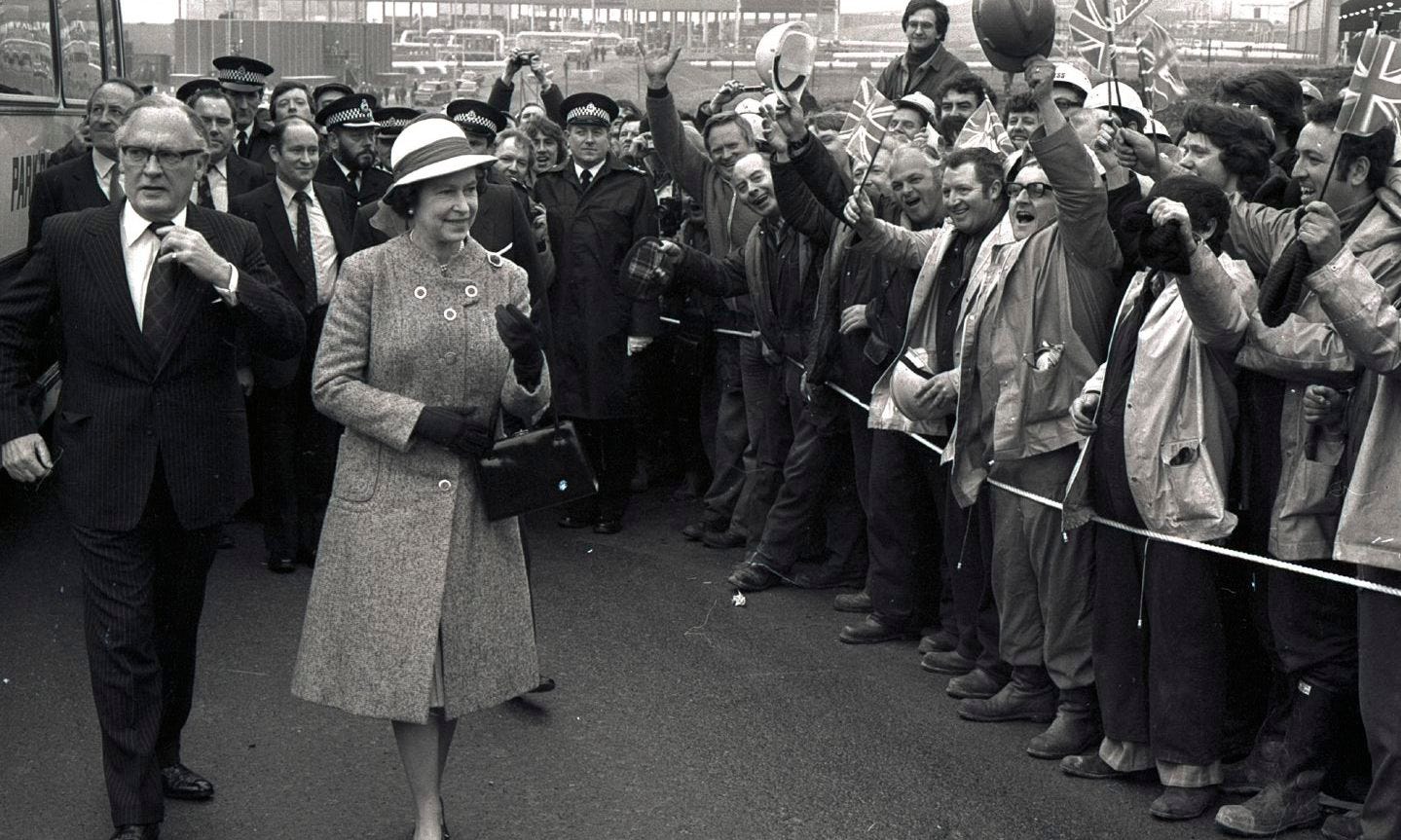
When the Queen was due to open the facility, over in Northern Ireland tensions were running high. The IRA hunger striker Bobby Sands had died at the Maze prison on 5 May, and consequently there was an upsurge in IRA activity alongside rioting in nationalist areas. Meanwhile, on the Shetland Islands, the IRA contact at Sullom Voe received a parcel sent over from Ireland that contained 7 pounds of gelignite and a twelve-day timer device. A second bomb was also due to arrive, but had been delayed in the post. The IRA operative, concerned that the other explosive had been intercepted by security services, hid the first bomb in a power station, set the timer and then fled back to his home nation.
Just after midday, as the Queen readied herself to give her speech and the band began to play the national anthems of both Norway and Great Britain, there was a sharp bang from the power station about 500 yards away, the noise mainly masked by the music. Fortunately, the bomb had only partially detonated, and BP, the site’s operator, was able to claim that the small explosion was just an electrical fault. If the postal service had been more efficient, and the second bomb had arrived when it was supposed to, then the Queen, Prince Philip, King Olav V of Norway and many others could have been the victims of one of the most heinous events in history.
Given the confusion surrounding the ‘non explosion’, the incident received little attention in the press, much to the fury of the IRA, who felt obliged to release two statements claiming responsibility. The second declared: ‘Had we managed to place Saturday’s bomb close enough to the British Queen, she would now be dead.’ Their claims were overshadowed by the attempted assassination of Pope John Paul II four days later, and the happier news that the Queen had become a grandmother for the second time following the birth of Zara Phillips, the daughter of Princess Anne and Captain Mark Phillips, on 15 May.
The Morton Files is a reader-supported publication. To receive new posts and support my work, consider becoming a free or paid subscriber.
Just a month later, the Queen faced another assault, this time with the world watching. As she rode along The Mall on her nineteen-year-old Canadian mare Burmese, during the annual Trooping the Colour parade, six shots rang out from the crowd. A gun had been fired by seventeen-year-old Marcus Sarjeant, who was quickly wrestled to the ground by at least one guardsman, a police officer and a St John’s Ambulance volunteer. Amidst a flurry of activity, the Queen, who had seen her assailant for a split second before he started shooting, was a study in calm. After many years of riding, she was able to soothe her startled mount, who was more alarmed by the horsemen of the Household Cavalry riding towards her than by the initial gunshots which, it later transpired, were blanks fired from a starting pistol.
Her Majesty, who was riding side-saddle, continued the ceremony without demur, smiling at the crowd and occasionally patting Burmese with her left hand. Lady Diana Spencer, who was attending her first Trooping as Charles’s fiancée, recalled that everyone around the Queen marvelled at her sangfroid. She seemed utterly unruffled by the experience, the Sovereign airily dismissing the danger she had just faced. Prince Charles later commented that his mother was ‘made of strong stuff’. It took a lot to unsettle her equilibrium.
There was, too, a sense of fatalism about her behaviour. Unlike other Heads of State, she always made it clear that she wanted security kept to a minimum. Her personal protection officer knew to maintain a discreet, unobtrusive presence. It was many years into her reign, for example, before she accepted the need for police outriders to stop traffic, as she didn’t want to inconvenience fellow road users. She was backed to the hilt by Prince Philip, who had little time for the cocoon of security. There was also a streak of obduracy in her make-up. She was the Queen and it had always been her choice as to whether or not she wore a hard hat while out riding. Well into her nineties, she insisted on a Hermès scarf as her only protection. Safety campaigners were worried, but as far as the Monarch was concerned she didn’t want to mess up her hair in case she had to be on public parade shortly after her morning ride.
Over the past 40 years, I’ve written bestselling books about Princess Diana, The Queen, Wallis Simpson, Meghan Markle and many others. You can find all of them to buy here.
The Morton Files is a reader-supported publication. To receive new posts and support my work, consider becoming a free or paid subscriber.
Comments
Nothing yet. Say the first thing.
Sign in to join the conversation.