
✨ In this post I’ll cover ✨
Why talking to users and having user insight are two different things
What current segmentation approaches miss — and why it matters for new products
What Human-Computer Interaction research tells us about finding the right user
A practical framework: how to screen before you waste interview time, and what to listen for once you’re in the room
Why every user segment is a design opportunity, not just a research classification
A few months ago, the founder of a gardening app contacted me after a product launch that wasn’t going as expected. They had a product. They had users. And they had done what felt like the right thing before deciding what to build next: twelve interviews with people recruited from their personal network and Reddit communities related to the problem. They showed participants the product, asked for feedback, and took notes. The responses were positive. Users asked for plant care reminders and seasonal planting guides, so the team built both.
Six months later, the reminders were barely used and the seasonal guides had single-digit engagement. The founder wanted help making sense of the data so I started looking at how the research had been conducted.
The conversations had been unstructured. Leading questions had shaped the responses without anyone realising it. Social desirability bias was present throughout (people tend to be encouraging when shown someone’s work). And the participants had been recruited at random (well, they had a brief segmentation involving demographics). The team had talked to users. They hadn’t necessarily talked to the right users, or in a way that would produce reliable insights.
This is something I see quite often when teams do discovery research, and I decided to write about it and explain how rigour can be added to research even before talking to users, specifically for teams that already have a product and are trying to figure out what to build next.
The problem isn’t that you don’t talk to users
Talking to users has become standard advice, and for good reason. But there’s a difference between having conversations and having insight, and that difference usually comes down to who you’re talking to and how you’re interpreting what they say. In this article, I want to focus on the first part which I think doesn’t get enough attention and is very important.
The founder I mentioned had put real effort in. Twelve interviews is more than most teams do at that stage. But effort doesn’t compensate for unclear selection criteria. Without knowing what type of user you need to speak to (and why!) you can end up with enthusiastic, well-intentioned feedback that points you in the wrong direction. Which is, in some ways, more costly than having no feedback at all.
How user segmentation usually works (and what’s missing)
Most teams that do user research segment in one of three ways.
Demographics: age, location, job title. Useful for targeting. Almost useless for product decisions. Knowing your user is “a marketing manager in her 30s” tells you nothing about whether she experiences your problem acutely enough to give you reliable signal.
Behaviour: what users do in the product. Session frequency, feature adoption, retention curves. More useful, and I’ll come back to it. But behavioural data tells you what people do, not why they do it or what their relationship to the problem actually is.
Jobs-to-be-Done: what job is the user hiring the product to do? This gets closer. JTBD acknowledges that users have functional and emotional needs, and it pushes teams to think beyond features. But JTBD captures what someone is trying to accomplish. It doesn’t capture whether their motivation for accomplishing it is identity-grounded, compulsive, obligatory, or something in between. And that difference, as we’ll see, changes everything about how you should interpret their feedback.
But there’s an angle that these frameworks miss, which is a very important human aspect that drives our behaviour towards technology (and other areas in our lives): motivational quality. And motivational quality is exactly what determines whether the person sitting across from you in an interview can give you signal worth building from.
What the scientific research actually tells us
Rooted in one of the most validated frameworks in psychology, Self-Determination Theory (SDT), the study I want to discuss is representative for rigour that changes research insights from surface level to AHA moments.
Bennett and Mekler, published in ACM Transactions on Computer-Human Interaction, identified five distinct motivational profiles in technology use across 497 participants. Using Self-Determination Theory and latent profile analysis, they found that the same product produces fundamentally different psychological experiences depending on who is using it and why, with significant differences in need satisfaction, affect, and perceived usability across profiles.
The finding that matters most for product teams: the differences between motivational profiles were larger than the differences between users who felt good versus bad about a product. In other words, two users who are equally satisfied with your product can give you completely different (and equally misleading) feedback, depending on why they use it in the first place.
The five motivation profiles
Note: these profiles shouldn’t be used as a fixed typology, they are reference points and ways for recognising the motivational quality of someone’s engagement.
🚀 High Quality profile
Uses the product with conscious, self-driven engagement. Connects it to personal goals, identity, and values. Describes themselves “as a [role]” before evaluating a feature. High need satisfaction, high affect.
From the study: participants in this profile prefaced their descriptions with identity statements ( “as a DJ”, “as a woman and as a mom”) and connected their engagement to personal growth, professional identity, or meaningful goals.
Use their feedback for: product vision, feature prioritisation, understanding what the product needs to mean — not just do.
⚖️ Medium profile
Uses the product regularly, rates it positively, but feels no deep personal connection. “It’s fine, I use it.” Moderate engagement, reliable usability scores.
From the study: “they don’t mean anything really, i just like them.” Their satisfaction is real but not grounded in personal meaning.
Use their feedback for: usability iteration and polish. Not for direction or vision.
🌳 External profile
Uses the product because they have to. Team uses it, switching costs are high, social pressure keeps them there. Their negativity is relationship feedback, not product feedback.
From the study: “I have to continue using it cause everyone else does.”
This group is not lost, they represent a design opportunity. The research calls this “design for internalisation”: what would need to change for this user to genuinely choose you, rather than stay out of obligation?
Use their feedback for: reducing friction, onboarding improvement. Separately, ask: what would move them toward genuine choice?
🎭 Amotivated-Intrinsic profile
The most important profile to recognise — and the hardest to distinguish from the High Quality profile. High engagement, enthusiastic in interviews, knows the product deeply. But their engagement is compulsive and low-intentionality.
From the research: 63% of users in this profile described compulsion and empty habits. 61% said the technology was bad for them. Yet their usability scores were nearly as high as the High Quality profile.
The paper named this “hedonic amotivation”: immediate but shallow pleasure coexisting with weak self-determination. Their feature requests will ask for more stimulation, more novelty, more of whatever feeds the loop.
Use their feedback for: design ethics signals. Not for product direction or feature prioritisation.
👻 Amotivated profile
Flat, disengaged, struggles to articulate why they use the product. Low self-attribution. From the paper: “it means nothing except a technology I have to stop using.”
Their data introduces noise at the generative research stage.
Note it, don’t weight it here. This profile is most useful for churn research.
Before the interview: use behaviour to pre-screen
Don’t start with “who wants to talk to me about this problem.” Start with: what does this person’s behavioural data already suggest about their motivational profile? If you have analytics, the motivational quality of your users is partially visible before you recruit anyone.
Look for high session depth, cross-feature usage, active exploration (high-quality), regular sessions, narrow feature usage, no exploration (medium), high frequency, short sessions, same features repeatedly (amotivated-intrinsic), sessions triggered only by notifications or team activity (external), declining sessions, support complaints, disengagement (amotivated). These are just examples, but be creative and act like an investigator 🕵️.
During the interview: listen for motivational quality
One question that tends to open up the motivational dimension of a conversation early:
“What would be different about your life, not your experience of the product, but your actual life, if this problem was perfectly solved?”
This will not definitively classify the person you are talking to. It surfaces whether their stake in the problem is genuine or surface-level. Treat the answer as a starting point, not a verdict.
A High Quality profile answers with life consequences: work outcomes, relationships, goals they could pursue. The answer lands outside the product.
A Medium profile gives a competent answer that stays close to the functional dimensions. A better version of what already exists.
An Amotivated-Intrinsic profile’s answer circles back to the activity itself. “I’d just enjoy it more.” Never lands on a life consequence.
An External profile says some version of: “I wouldn’t have to use it anymore.”
An Amotivated profile struggles to answer at all.
Throughout the conversation, listen for these language signals:
High-Quality: “As a [role]...” before describing the product → Anchor your synthesis here. Their need statements are translatable to the mainstream.
Medium: “I just like it”, pleasant but no deeper meaning → Usability feedback is reliable. Vision feedback is not.
External: “I have to”, “everyone else uses it”, “I don’t really have a choice” → Useful for friction and onboarding. Not for feature direction.
Amotivated-Intrinsic: “I can’t stop”, “it’s a bad habit”, love-hate descriptions → Design ethics signal. Their requests optimise stimulation, not sustainable value.
Amotivated: Flat, circular, can’t explain why they use it → input more useful for churn or evaluative research
The bigger question
It would be easy to read this as: find the High Quality profile user, ignore everyone else. But you shouldn’t do that and that’s not what this research meant.
The research study I discussed ends with something they call design for internalisation, the idea that products can actively move users toward more autonomous, identity-grounded engagement over time.
For the External profile, the question is: what would need to change in the product for this user to start choosing you rather than staying out of obligation? That is a retention strategy and a product strategy question simultaneously. For the Amotivated-Intrinsic profile, the question is harder: if a significant proportion of your engaged users describe your product as bad for them, what does that tell you about the kind of engagement you’re optimising for?
These are not research questions. They are product leadership questions. And they only become visible when you know which users you’re looking at.
The gardening app founder’s real problem wasn’t that they talked to the wrong users. It was that they had no framework for knowing who they were talking to — and no way to fully understand what different people told them differently.
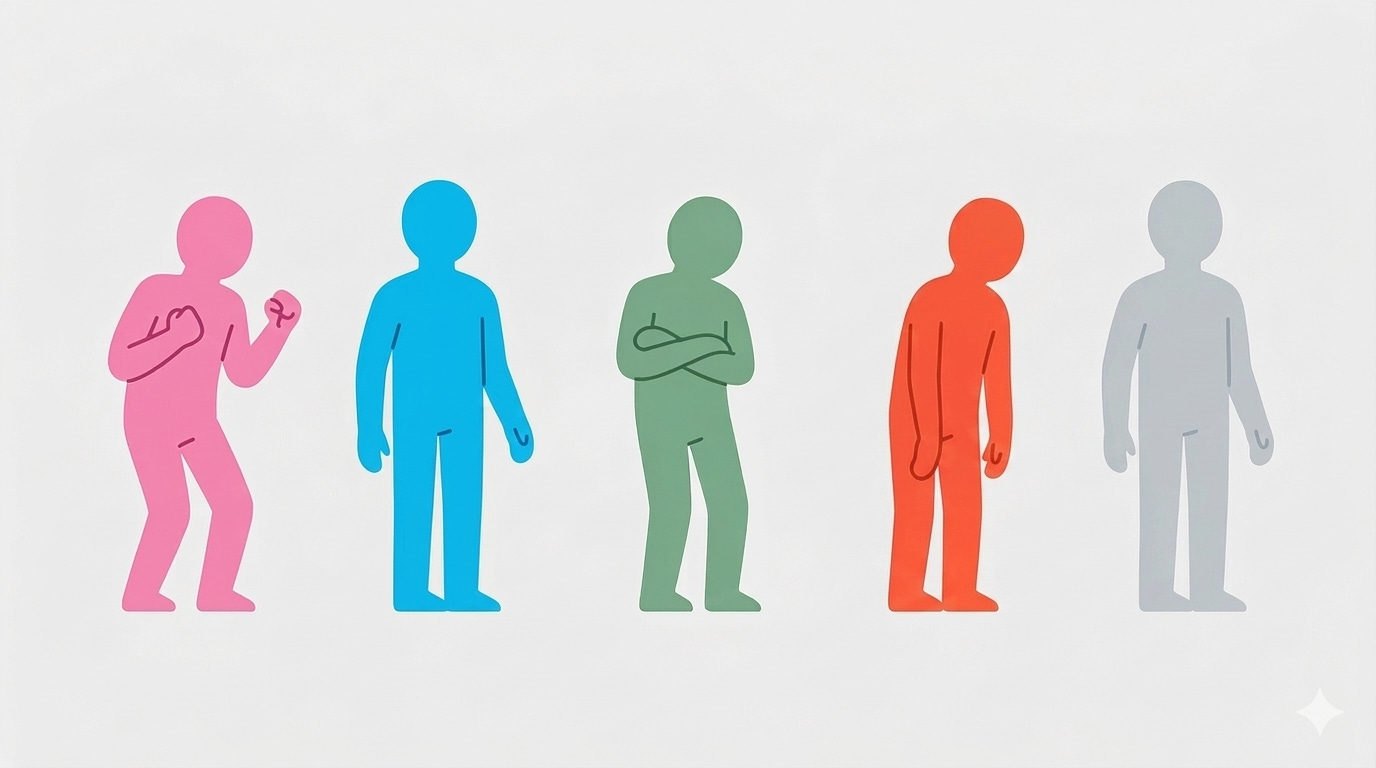
User research doesn’t require talking to more people. It requires knowing which five you actually need — and what to do with what each of them tells you.
🚀 Hi! I’m Andreea, an academic HCI researcher (gesture recognition and virtual reality interfaces) turned UX researcher that helps product teams build products users actually love. I conducted hundreds of research studies for tech companies seeking clarity and I started this newsletter to share real examples and stories from my experience, so teams can do better research and build better products.
If you found this article helpful, I would be super grateful if you shared it with others.
I also love great discussions and debates, so I’m excited to hear your thoughts in the comments.
When I’m not doing research or writing, I like to go on hikes, read a good novel and play pretend with my dinosaur-obsessed toddler boy. If you’d like to support my work (and energy for writing, haha), feel free to buy me a coffee!
Either way, thanks for reading and supporting my work ❤️
Comments
Nothing yet. Say the first thing.
Sign in to join the conversation.