
I know I’m not screaming into a void when I tell you that 2026 has been a nightmare for a lot of those in the creative community.
Revenues are ridiculously low because the economy is struggling and artificial intelligence has glutted the market to the point that discoverability seems to be nothing more than a pipe dream.
Many of us hold down full time employment that has become more demanding and stressful as well, and we have very little energy left to pursue the things that bring us joy.
This can be especially true for authors like myself who are questioning whether our blood, sweat and tears are worth it.
I am going to keep putting words on paper, but I am also going to take the time to decompress.
I am so grateful for this community of readers and authors who support each other through all the laughter and tears.
Tropes: opposites attract; workplace romance; forced proximity; road trip
Blurb: Gert Wainwright is tired of writing penny dreadfuls, and wants to write true crime. Before she can do that, she has to persuade her publisher, Seamus O’Donnell, whom she’s never met and who thinks she’s a man. She travels to London from Cumbria to persuade him in person, and neither is what the other expected. They form an uneasy alliance and when her “true crime” informant feeds her confidential information that jeopardizes her safety, her publisher is the only one that can help her land a notorious crime lord behind bars before he gets to her. They take off together in a race against time on a dangerous adventure via train that pushes them closer together and forces them to confront their deepest fears, their desires, and their growing feelings for each other.
Spice Level: Slow burn with three or more open door explicit scenes.

This is a snippet from my research into what rail travel really looked like for Gert & Seamus’s story.
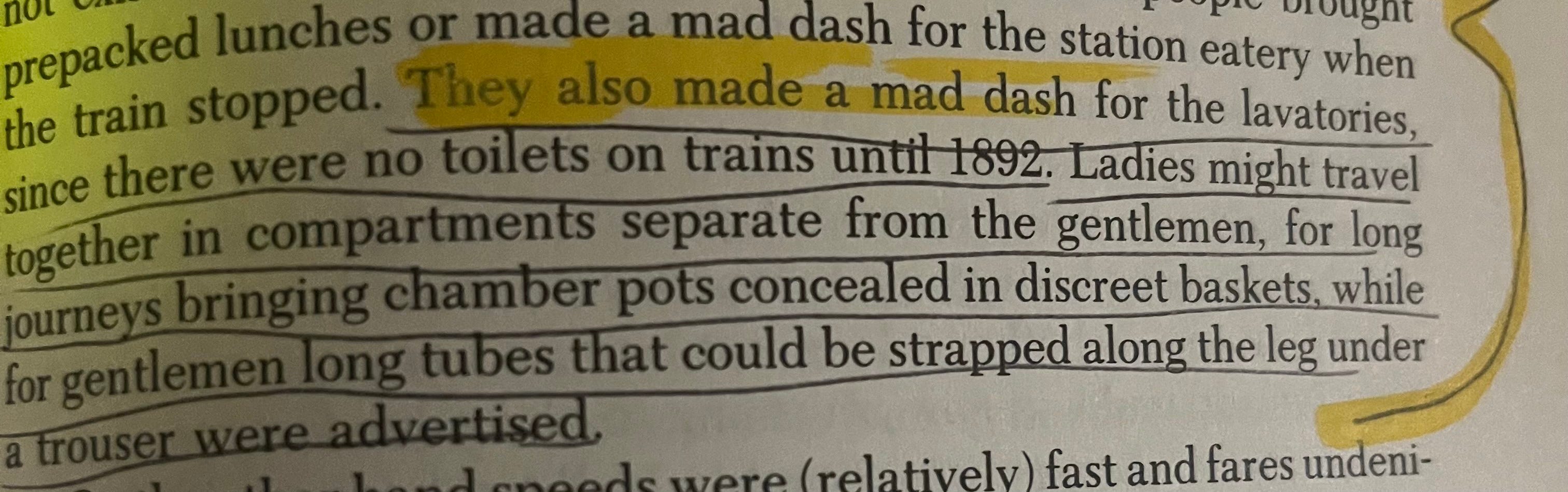
I can very vividly imagine one of the Wainwright sisters transporting her chamber pot in a wicker basket!
If you’d like to be on the ARC Team, the sign-up sheet is here. ARCs will arrive via Bookfunnel to your email on the evening of October 10, 2026. The review deadline is December 27, 2026 (60 days after publication), but if you review prior to publication day on October 27, 2026, you’ll receive signed prints in the mail as well as a 25% discount code to order a signed mass market paperback copy from my website.
The letter was on a scrap of parchment, the handwriting so faded it was barely legible. She'd heard nothing in months, and her hands trembled as she unfolded it.
Her heart stuck in her throat when she saw the date. It was dated 10th September, 1862, more than three months ago. As she began reading, Lilly set a hand to her stomach to soothe the kicking babe her husband might never meet.
My Dearest Tiger Lilly,
I have something to confess. When I kissed you farewell on the edge of the hayfield and set off for war, I had no intention of joining the 30th Sharp Shooters. I always intended to join the 1st United States Sharpshooters and fight to preserve the Union.
I lied to spare you, and I know you understand why.
If my defection was common knowledge, you'd be ostracized at the very least, and tarred and feathered if someone in the village is feeling vengeful.
It still terrifies me to contemplate your fate at the hands of some of those we've called friends and neighbors.
We retreated from the battlefield at Bull Run, our escape nearly cut off by the Confederate Army and are en route to rendezvous with the remainder of our brigade.
The nub of my pencil is nearly gone, and I promise to write more when I have the opportunity.
I carry you in my heart.
Your loving husband,
John
I love what we in the English literature field call the long eighteenth century, as both a reader and a scholar. This label ostensibly covers the years from 1688 (viva la Glorious Revolution!) to 1815, the year of Waterloo, the final defeat of Napoleon, and the end of decades of war for Great Britain.
The Georgian period, as it’s called, usually covers 1714 to 1830, from the ascension of George I to the death of George IV (nobody cares about poor King William, who ruled from 1830-1837). The Georgian period runs up against the Regency, which lasts from 1811 to 1810 from the Regent himself but expands to around 1800 to 1830 as an era.
Why do we care about dates and periods? Mostly as a way to think about the character of an age and the tastes and habits that define it.
I think of the Regency as a relatively buttoned-up period, all those rules about etiquette and chaperonage and how many times you can dance with a gentleman at a ball. (Morning calls are *strictly* 15 minutes.) In contrast, the Georgians were rude, loud, exuberant, and excessively noisy–my kind of people. They emerged from a civil war with very strong ideas about representative government (for some). They didn’t like one royal family so invited another to come rule them, and then they had bloody fights when the old family wanted a shot at the throne. (The Duke of Cumberland, called Butcher by some and Sweet William by others, depending on which side of the Jacobite cause you supported, plays a role in my novel, though not in person, since he’s dead by this time.)
So, the Georgians get to have the Industrial Revolution, the print revolution, and a huge population increase as London becomes the largest city in Western Europe. They witness the British Empire begin, get a great whacking from those American rebels, regroup, and grow even stronger. They invented (or enjoyed) coffee shops, tea rooms, circulating libraries, gossip columns, serialized novels, and fashion magazines. What’s not to love?
The feature of Georgian life that I want to highlight, which was gathering real steam in the 1770s and going strong in 1792, when my novel LADY DARING is set, is the debating society. The debating society emerges from the confluence of coffee shops, pubs, and taverns providing congenial public spaces for vibrant discourse (at least for men) while the rise of print culture widely circulates news and other literature, which yields plenty of topics to loudly discourse about. As a growing leisure class (thanks to the aforementioned Industrial Revolution) creates growing opportunities for entertainment, the debating society emerges as a recreational activity, right up there with lectures, exhibits of art and other curiosities, panoramas, and the circus.
Most debate societies worked like this. Someone would organize a group and give it a name. The leaders would decide on a topic for a debate and advertise this topic in the newspapers. (In London at this time, there were anywhere between half a dozen to a dozen newspapers circulating. I mentioned the growing print culture, right?) Most debates were open to male and female audiences. You paid a small fee, maybe a few shillings, and then you got a front-row seat to that perenially entertaining blood sport, the political debate. (Or cultural debate. Or debate over social convention. Topics varied.)
What was most interesting was that debating societies weren’t limited to the male, white, Anglican, propertied upper class. Women could and did have their own debating societies. (The Minerva Society, which I invented for my novel, is one such.) Working men and tradesmen could attend debates, participate in debates, or have debating societies of their own. These debates could get really interesting, because remember, the Great Reform Bill didn’t pass until 1832. Working men and tradesmen couldn’t vote. Women couldn’t vote. Most people couldn’t vote. But most everybody had opinions, and the debating society was where you could air them.
I set LADY DARING in 1792, when the French Revolution is getting dicey, and the British government, led by Prime Minister William Pitt (the Younger) is watching events across the Channel very closely. They are also watching events on their islands very closely. The loss of the lucrative American colonies still smarts. Nobody wants another civil war. In the summer of 1792, when my novel takes place, the Bastille has been stormed (remember that from history class? July 14, 1789, French royal prison) but the monarchs, Louis XVI and the lovely but widely hated Marie Antoinette, have not yet been dethroned.
Thomas Paine published his fire-breathing Rights of Man in 1791. Oh, the debates that little tract inspired! The fiercely radical Olympe de Gouges (an inspiration to my heroine, Henrietta Wardley-Hines) published a Declaration of the Rights of Women in fall of 1791 as well. Mary Wollstonecraft’s A Vindication of Women, just as fierce and radical, was published in early 1792, and Henrietta has it mostly memorized. This will get her into a great deal of trouble.
So, the freedoms that the individual person should be allowed to exercise, and the limits of government control, are fueling lively debates that Prime Minister Pitt is keeping a careful eye on. Especially after there was a rather tepid attempt to burn down the Houses of Parliament in the spring. (A Guy Fawkes plot this was not; apparently the incendiary was a pair of burning breeches stuffed into a closet. So my research says.)
One debating society that came under close scrutiny from the government was the London Corresponding Society. What was unique about this group was the composition–mostly artisans, tradesmen, and shopkeepers–and their radical democratic ideals. One of their favorite topics was universal suffrage (which meant, to them, men would get to vote. Women, not so much.) Their vocal leader in 1792 was Thomas Hardy, shoemaker (no relation to the smoldery actor Thomas Hardy or the author of Tess of the d’Urbervilles.)
I knew the novel was going to require a situation where Henrietta gets herself into trouble with legal authorities, and Lord Darien Bales, the irredeemable rake that London Society calls Lord Daring, would put himself to the trouble of rescuing her. A debating society offered the perfect opportunity since Pitt was on the lookout for hotbeds of treasonous discussion. For extra fun, I threw in some historical characters whom I admire: Olaudah Equiano, the Black abolitionist and activist; William Godwin, the philosopher who marries Mary Wollstonecraft (and fathers of Mary Wollstonecraft Shelley), and MP William Wilberforce, who was indefatiguably introducing bills in Parliament to abolish the slave trade, until one finally succeeded in passing in 1830.
Don’t worry, there’s plenty of romance in LADY DARING (though this a banter-heavy, kisses-only book). But I wanted to create a reformer heroine who is alive to the causes of the time, yet still shaped by the ideas she would have been exposed to. Henrietta’s feminist sensibilities don’t look like modern feminist sensibilities, but I wanted to position her within the rich tradition of foremothers and others who have been fighting the good fight for equality for centuries, since they built the ground we stand on.
Comments
Nothing yet. Say the first thing.
Sign in to join the conversation.