
Lately, I’ve been talking a lot1 about how generative AI will impact the publishing industry. My message is, I think, a bit obvious: AI threatens to erode the triangle of trust between author, reader, and publisher.
But as I’ve talked to more and more booksellers, I started to wonder—how is the technology affecting the folks actually getting titles into readers’ hands?
I sent an open-ended ask to some of the story-mongers in my rolodex, and their responses, below, were eye-opening. I hope that publishers realize they’re threatening these crucial relationships by cramming LLMs into the center, and I hope readers and authors recognize that generative AI adoption is screwing with booksellers’ jobs, too.
And of course, I hope that reading the below replies makes you want to bolt into their shops, shake their hands, and buy a bunch of books.
We’ve recently experienced an uptick in AI-generated children’s books. With one listing the AI program as the illustrator, which felt downright insulting. We know those big-headed bug-eyed kids are what our soon to be overlords think small humans should look like. So no, dude, Ayza Pro is not a real person and you cannot fool us.
While we understand some folks see AI as a chance to finally publish the book they have always wanted to, we also know no one wants a children’s section filled with books with AI-generated art. And, if someone uses a program to generate the art it feels logical to question the authenticity of the writing as well.
You of all people know this conversation is about the integrity of the craft. AI is not the same as copywork, yet it is being sold as similar to this type of old-school self-training. But it’s not, because the core of AI is built upon pilfered intellectual property filtered through a machine and passed off as someone else’s. I don’t think enough people understand this, or perhaps they do not care because content creation is lucrative. And, this seems to be the crux of it: an Author writes a story hoping to connect with the reader, a content creator produces a product for consumption.
AI is a shortcut, a means to an end. If you use AI to produce your book you are a content creator. Not an Author.
What does this mean for us as booksellers? The answer is simple: we do not exist without very real Authors writing books. This is a symbiotic relationship which goes from your desk to our shelves to the hands of readers. So, in this brave new world of self-publishing and trad-publishing we had to decide how to approach the growth of AI in this business. And really, we are booksellers first. We want to sell books written by authors who do not take shortcuts. We sell stories. Not content. Which means no AI-generated books for us. Even if they try to convince us it is the way of the future.
—Erin Ruggeri, manager of The BookMark Shoppe in Brooklyn, NY
My main worry about how publishing uses AI right now is that (besides all the many reasons you have already pointed out in your work) it isn’t good at the jobs people are giving it. A certain publisher uses AI to manage their comps in Edelweiss and it is a TERRIBLE user experience for buyers and events managers. I have to manually add in comps on almost every title. My buying is less informed and less precise because of it. I suspect AI usage with other publishers too....just based on some subtle things I’m seeing. It’s just deeply frustrating, I imagine even more so for the authors and editors who work there.
I would speak more openly, but I am in the weird position of not being the owner of my bookstore, so I don’t set our AI policies. The store owners are opposed to AI use for creative or generative purposes, but like a lot of people trying to save money (understandably, at least in their case) they are curious about how “assistive” AI can save them time/money in other areas, like spreadsheets, etc. I have to tread carefully and not speak on behalf of the store or make any particular “all AI is bad” statements when I’m representing the store. Even though that’s what I believe, and I think they are wrong, but wrong in a way that I find morally understandable and not necessarily condemnable.
—Anonymous
First up, I’m trying to avoid using anything genAI wherever possible but I’m not anti-technology. I use spell-check, I use voice-to-text transcription, I appreciate a computer program that can help me streamline ordering by making sure that my out-of-stock books are automatically put into buckets for the best reordering discounts/shipping/etc. All of these things conceptually and practically pre-date this current wave of “AI” and I’ve never really had a problem with them... until they all started to break because they are increasingly no longer programs but instead unnecessarily-genAI-tarnished derangements masquerading as programs.
But I actually think there’s a bigger issue at hand, or rather that the genAI push is a symptom moreso than a root cause.
I saw a bookstagrammer, after the SHY GIRL thing, saying that they didn’t care if the book was AI-written or assisted or not: they had a good time reading it and will continue to recommend it because they enjoyed it. I think this is both the worst-case scenario and, at present, the most likely: that because standards have slipped and we’re all suffering from various levels of brain rot brought on by the internet and the modern condition, people are just going to accept an inferior product.
To put another way, what I’m seeing is not just a decline but a collapse in comprehension. I think every fear about AI ruining publishing is valid, but I worry that even if we manage to firewall it, the wider damage to human cognition means it won’t much matter.
I’m seeing people who ought to know better sharing with me that they’re using Claude “just to help me write my text messages” or Gemini as “a great thesaurus”—people who are big readers! Some of my store’s best customers! They’re asking ChatGPT for book recommendations and then telling me about it, with the same hushed shameful tones as they do when they tell me they “had to” buy a book on Amazon because they couldn’t find it and needed it the next day.
It is, not to put too fine a point on it, totally fucking terrifying, because I think it’s tremendously short-sighted, in ways that echo how art and specifically the work of making art has been systemically devalued in this country (and arguably across the world) over the last several decades. I want it now, I want another, I want the answer (whatever that might mean) without having done any work to discover it for myself and thus not actually learning a thing in the process.
I broke one of my rules of online engagement a few weeks ago and got into it on Bluesky with a Women’s-Prize-winning author in the wake of the Olga Tokarczuk thing. This author has been one of these “we should embrace the tool” people and had seemingly no good rebuttal to most arguments I was throwing her way—that the data sets are built on stolen content and should thus be considered fruit of a poisoned tree, that the impact on the natural world should outweigh any ‘positives’ from using the platforms, etc.
Similarly, I’ve been shocked to see the likes of Anthony Horowitz coming out and admitting he’s using AI when he writes—and I don’t have any patience for the “I only use it for research” people because we all know how slippery these slopes are! First it’s research, then it’s a thesaurus, then it’s an editor, then it’s....
If I could get away with it, I wouldn’t stock a single book by any author who has admitted to using any kind of genAI tools. I’m getting there—I haven’t reordered any Horowitz since that article dropped, I’ve totally cut my orders for that unnamed WP winner’s new book, and I cut my order way back on the new Tokarczuk (even though it’s an older book just now translated etc etc)—and I recognize the difficulties in making that kind of decision and certainly don’t want to see another wave of witch-hunts breaking out... but I also think it’s the kind of ambitious stance the industry will need to take. It’s the same thing as asking Democrats to set up proper truth & reconciliation overhauls: there must be consequences for this wanton disregard for anything beyond one’s own needs/existence.
Maybe I’ll be left behind by this. Maybe the genie truly is out of the bottle—and hey look maybe we’re going to weather this period of capitalistic overreach only to see it ultimately become a useful tool, one that does automate some of the tedium of our working days in order to free up our time to be more creative. If this brings about the UBI revolution, maybe folks will find that in their free time they’re more interested in human-generated art—more interested in the strange corners of their minds, more interested in community and nature and boredom and so forth.
But I’m not holding out hope for that. Instead, I’ll be up on the barricades, unapologetically and frankly mercilessly shaming the people who are using it, whether they’re in this industry or not. None of this has to be this way, everything is a choice, and I wish more people realized the choice that they were making when they chose to give up their cognition in these ways.
—Drew Broussard, bookstore manager at Rough Draft Bar & Books in Kingston, NY
I haven’t had any significant encounters with AI via bookselling so far thankfully. My biggest concerns would be if publishers were using AI or allowing it but it seems to be the opposite. If I had to add “AI watchdog” to my list of things to do when buying books I think I’d die. We also generally don’t stock self published books (we make exceptions all the time for people we know, but we never take random books over the transom). That could be helping to keep us insulated from it.
I have seen AI creep into the different software systems we use to run the store but I just ignore them. Square, for example, has this stupid feature where you can use AI to generate a description for a book, which seems to me to be way more complicated than if it simply pulled the existing description from metadata, but what do I know, I’m not a tech genius I guess. I just never click that button. Edelweiss has a feature where it can guess which shelving code a new book might need based on where we’ve shelved other books like it, but that seems to me to just be software, not an artificial intelligence. I also don’t use that one; I tried a couple of times but I had to change half of its guesses.
Of course, I have a thousand concerns about human-written-books being used for AI, but that’s a whole other issue you’re already dealing with!
—Jesse Post, co-owner of Postmark Books in Rosendale, NY
I don’t know if you’ve heard of this whole Moleskine Lord of the Rings planner/notebook debacle: https://cjleo.com/blog/moleskine-ai-lord-of-the-rings-collection-can-only-mock/
When these LOTR planners were sold to our store (back in January), there was no language anywhere in the markup (I went back and double checked) that indicated they were “imagined by Moleskine, generated by AI.” And if we had known, we probably wouldn’t have bought those planners. But we didn’t know, so we did buy them, because we always stock Moleskine’s limited edition planners.
The planners came in right around the time everything online was blowing up about Moleskine using AI imagery for this Lord of the Rings series, but we made that buying decision months before without the knowledge that was now very public. We’ve paid for them. They’re sitting in our store waiting for planner season to go on display. And because planners are purchased as non-returnable items, we have to sell them if we want to recoup our initial investment. So we risk looking like we endorse generative AI for creative purposes (like covers, art, writing) or we just lose that money, which isn’t exactly feasible for a small shop.
The likelihood of some customers (who either don’t know or don’t care about the AI thing) still purchasing these planners is fairly high, so we will probably just...sell them. Because capitalism. But we also run the risk of some random person taking a picture of the planners in our store, posting it online, and saying “X Bookstore supports Gen AI” which is its own kind of risk, and doesn’t acknowledge that we didn’t know when we purchased the stock and are now stuck with a product we feel squicky about.
We haven’t made a decision yet. Either way, Moleskine already got their money. So what stops them from doing this again?
—anonymous
In regards to AI, I’ve noticed customers have relied on AI searches to choose books as recommendations. However, AI doesn’t have the quality that booksellers in independent booksellers have with our patrons. We set certain books aside for our loyal customers as we come to know their interests over time.
Sometimes, we try to research more on what is being talked about in the book world when it comes to trends, but AI pushes books that usually don’t align with our curation and tends to hog informational platforms.
At our store, we like to highlight authors and illustrators, especially local ones. Real humans. The AI slop won’t be in our stores because we think the authors and customers deserve better than their subpar writings and covers. I love that people are reading, but publishers shouldn’t insult people’s intelligence with anything generated by AI.
—Keshia Horne, manager of the Barbara’s Bookstore inside Macy’s in Chicago, IL
I don’t work in either store day to day, so take this with a grain of salt. But despite our store being in the heart of AI country I’ve not once thought about how AI impacts our business as an independent bookstore. I think the two are completely orthogonal.
I think people come to us for the exact opposite of what they get from AI, from social media, from always-on, wired, polarized, algorithm’d worlds and everything that has done to us. When I’m in our stores I feel like I’m in a parallel universe where those things do not exist. That’s why people like them.
A lot of the growth in reading print books — in my view— is a direct reaction against that. My two Gen Alpha kids hate AI and everything it stands for. There’s a lot of that that very loudly expresses itself in our communities. And even people who work in AI— Anthropic is around the corner from our San Francisco store— come in and buy classics and history books and other print books. They want things that are not AI as well for part of their lives.
Anecdotally, I know a ton of people who use AI for way too many things and think AI can write and all that nonsense. But those people don’t tend to come in our store a lot, I guess.
I’ve never heard someone say they won’t buy a book after a certain date because it might contain AI.2 That’s foolish and the most overly progressive thing I’ve ever heard— let’s kill a whole industry to save it. GREAT JOB! I hope that’s not widespread because it’s so hard to get published and be successful and the last thing emergent authors need. I have to trust most book buyers are smarter than that.
We don’t use AI in any way shape or form to run our store. We don’t think it’s good at things and on principle we don’t like to feed it anymore than it has already stolen from us as writers.
James Daunt’s comments3 are irrelevant to real bookselling IMHO. They are that of a private equity banker whose job is to take a company public soon and nothing more. He’s not a bookseller. Barnes and Noble is a private equity owned entity about to go public. As such, its job is to extract as much capital as possible from the business and give nothing back. They’ve done an excellent job with PR pretending otherwise. Nothing he says has anything to do with what real booksellers are seeing or doing in their everyday lives and jobs.
We aren’t bankers taking a massive private equity conglomerate public. We aren’t a huge real estate corporation who moves into markets, looks at what independent stores are having a hard time, and then puts pressure on them, until they are so weak we can offer to buy them for pennies on the dollar.
If individuals really want to make sure they are keeping AI out of bookstores, maybe they should stop pretending Barnes & Noble is some last bastion against Amazon to be romanticized and see it for what it is: A predatory private equity institution that drives Indies out of business while pretending to be their friendly bigger cousin. That would help everyone a lot more than not buying books written after a certain year.
—Sarah Lacy, co-owner of The Best Bookstore in Palm Springs and The Best Bookstore in Union Square
As an independent bookseller, I pride myself on only accepting authors who have done the work. And that’s what it is, isn’t it? Hard work. From manuscript inception to editing to marketing, only humans can recognize true mastery of writing as an art form. We have some independent writers who apply to have their work on our shelves, admitting to using AI, and then wonder why we won’t carry their copies. And here’s what I tell them: art is a form of expression, emphasizing deep emotional connection, and if artificial manufacturing cannot feel, then we as readers cannot feel alongside it. Writers, true writers, know that weaving words is a labor of love. If the love isn’t there, then what’s the point of reading it?
When AI was first introduced publicly, I didn’t recognize the harm of using it in a non-writing setting because I was uninformed. I didn’t make the full switch until I conducted thorough research. Now, I fully grasp what data centers are doing to our planet, to our creativity, to our intellectual ownership, and I firmly stand against it.
—Brii Forte Miller, manager of The Book Lounge in St. Petersburg, FL
As the main buyer for our store, AI has made curating incredibly difficult. Having to go through every publishing house, sales rep, and the dozens of different sites for online self-service ordering, the labor of placing weekly orders is already high. Now, the rise of AI in creative spaces presents an additional difficulty. Upholding our promise to share human-made art is deeply important to us, and beginning to question our trust in publishing houses feels unfair.
Since indie bookstores are already trying to do so much to maintain a presence in our communities, ensuring there is no AI-use in books is not an appropriate use of anyone’s time. The plagiarized slop being pushed is boring, unoriginal, and quite frankly, embarrassing. There is no place for AI in this industry. Adding that extra stress to our lives, authors’ lives, or even the readers’ lives is unfair.
I do not believe independent bookstores will suffer long-term; however, I do believe we will see a stronger push towards self-publishing from the humans willing to put in the work and garner that trust with booksellers and readers.
—Kat Holsonback, senior bookseller/assistant manager of The Book Lounge in St. Petersburg, FL
I don’t use generative AI in any capacity. Aside from any conversation about its helpfulness or the way it is destroying creativity, its impact on our environment makes it a non-starter for me. Really the only way it has affected me in store is that I have to clarify with authors, mostly indie/hybrid published, that no AI was used in the making of their books.
—Devin Abraham, manager of Once Upon a Crime in Minneapolis, MN
I saw you restacked my note about that new publisher Qomix….
Today while buying for the bookstore I came across a new-to-me publisher, Qomix classics. All of the books are graphic novels of classic public domain books like Frankenstein, The Fall of the House of Usher, The Great Gatsby, etc.
I didn’t clock why at first, but something bothered me about them. Then I realized I wasn’t seeing an artist/illustrator listed. I checked every piece of information presented to me in the catalog. No illustrator/artist listed. I zoomed in on the art and noticed a few small AI tells, but they were not immediately apparent at a glance of the thumbnail image. Then I googled the company, and they openly admit that they are using AI for these books. But they didn’t disclose it anywhere in the catalog presented to me.
My job is already complex enough. This fucking sucks.
I immediately emailed my long list of other buyers I know to warn them about it. I am actually thinking of contacting the comic book artists that have clearly been the “inspiration” fed into the machine to let them know about the similarities. Maybe they will be able to mount some sort of defense. There’s a version of Oedipus that looks eerily similar to the style used by Rachel Smythe in her Lore Olympus series, just with different colors.
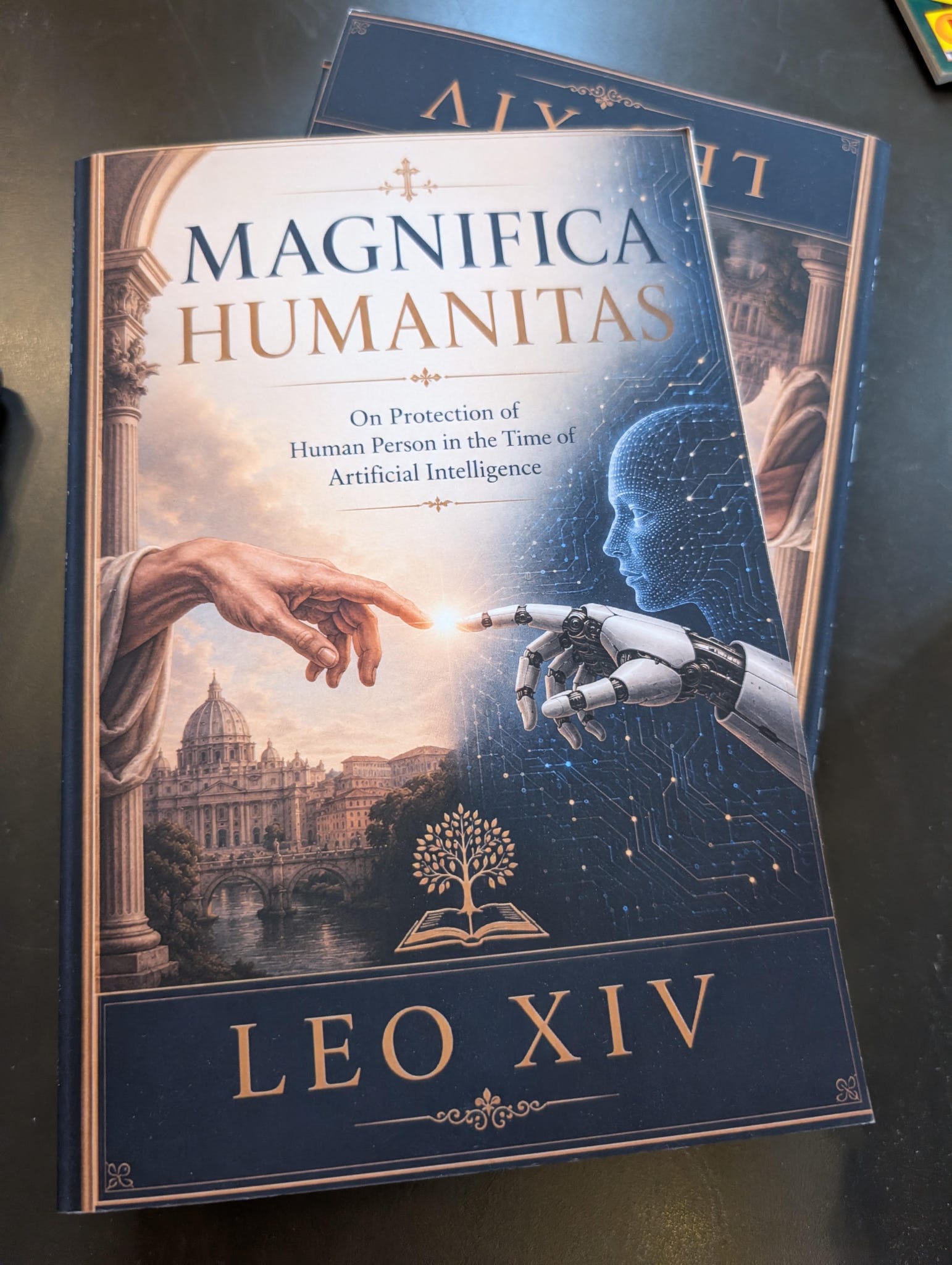
And just in case you thought I couldn’t POSSIBLY have any more dispiriting news, the new encyclical on AI by the Pope?
It’s in the public domain, so anyone can print it. And One of my coworkers didn't notice and ordered this “independently published” one from Ingram that has an obvious AI cover. Count God’s fingers.
Just came in today.
I want to hit my head against the wall.
—Fisher, frontlist buyer for Carmichael’s in Louisville, KY
I mentioned in my bookseller outreach that I’d seen several comments on my op-eds saying something along these lines: “I’m only buying books published before 2022 so that I can feel confident no generative AI was used in the creation.” Face-palm.
The CEO of Barnes & Noble said: “Yes, I have actually no problem selling any book, as long as it doesn’t masquerade or pretend to be something that it isn’t… So as long as an AI-written book says it’s an AI-written book and doesn’t pretend to be something else and isn’t ripping off somebody else, as long as that’s clearly stated and the customer wants to buy it, then we will stock them.”
Comments
Nothing yet. Say the first thing.
Sign in to join the conversation.