
That’s right, it’s a guest post! Because I don’t actually know everything, I’m excited to share from-the-trenches pieces by authors and publishing professionals. This reflective one is from MJ Soni, whose debut mystery, The Masala Chai Mystery Club, is out now. Enjoy!
Let me start this post with a disclaimer: There is a fundamental difference between being a doctor and being a mystery author.
As a doctor you may, usually accidentally, end up doing more harm than good to another person. And that matters—a lot. As a murder mystery author, you set out from the very beginning to do harm to a fictional character, and it doesn’t matter, since none of it is real.
That said, following are five things being an ophthalmic surgeon taught me about becoming an author.
Every patient has a story to tell. Sometimes the story is clear, and at other times it’s complicated and difficult to unravel. It can take persistence and patience to get to the core of it.
Many years ago, my father-in-law had a minor stroke that left him with vertigo. A week later, he deteriorated rapidly into a coma. His neurologist was confused because his MRI showed new hemorrhages on both sides of his brain. They went over his history many times, performed multiple tests, and the doctor was still generally flummoxed.
A few days after my father-in-law’s admission, the neurologist was at his bedside, probably asking himself, “What if I’m missing something?” when my mother-in-law came in. She answered as many of the doctor’s questions as she could, many of them for a second or third time. “I really don’t know what happened,” she finally said. She was frustrated herself. “He was feeling better until he tried to get out of bed and hit his head against the side table.”
And that was the key piece of information that had been missed earlier in a less pointed inquiry about whether he had hurt himself. The injury was so minor that my mother-in-law hadn’t even thought of it as an injury. Except my father-in-law was on blood thinners, which—to a doctor—explained the hemorrhages.
In my debut, The Masala Chai Mystery Club, the protagonist Neeti Shah was the only character clear to me at first. I knew she was a librarian, and she wore a saree like my mother. But everything else was a blur.
I went on many long walks to interrogate my imagination and my experiences until I remembered an incident regarding a goat and a homeowners association. And the inspiration behind my plot emerged from asking myself, “What if the homeowners association’s president is murdered?”
Anne Lamott, author of Bird by Bird, one of the best books on the craft of writing, says, “Very few writers really know what they’re doing until they’ve done it… They do not type a few stiff warm-up sentences and then find themselves bounding along like huskies across the snow.”
Asking a gazillion “what if” questions is my way to move forward.
My job as a doctor was to help my patients get better, and it was truly a rewarding job to be an ophthalmologist. One of my fondest memories is of an older man who presented with dense cataracts in both eyes.
He and his family were uneducated and lived in a distant rural area. They’d assumed his blindness was part of the normal aging process. One day, a family friend suggested they take him to an ophthalmologist.
After a five-hour journey by bus, he arrived at our clinic and became my patient. I expedited his surgery and operated on the first of his cataracts. To this day, I remember the huge grin on his face when I removed the eye patch the next day.
As an author, my job is to write the best story I can, and to keep rewriting it until I can’t make it any better. I spent many hours contemplating and eventually writing my debut. It took work to create the characters, their backgrounds, the world they inhabit, and the murderer’s motive and opportunity. This is my job now, no less than being a doctor used to be my job, so there’s no slacking. Although the best part is I’m my own boss.
As John Grisham says, “Writing’s still the most difficult job I’ve ever had—but it’s worth it.”
There is a lot of heartbreak that goes into practicing medicine. Alongside the times we get to bring relief or cure a disease, there live the times we cannot cure. Sometimes all you can do is hope to make somebody pain-free or at least a bit more comfortable.
I once had a seventeen-year-old patient present with bilateral viral retinitis, a condition that has a poor prognosis. In spite of incredible effort, I couldn’t prevent this young person from going blind, and I will never stop thinking about them. But honoring that experience led me to try again the next time and the next time and the next time.
I’ve been writing for almost fifteen years and have four completed manuscripts, dozens of short stories, and have had at least sixty rejections by agents. They live in various folders on my computer. Sometimes a story is hard to pin down, it may not make sense, or you can’t find a home for it. These are not failures. They showed me what wasn’t working.
I finally set these aside and wrote what I wanted to write—a lighthearted murder mystery that let my brain have fun. Lo and behold, I found a home for it. My takeaway is not to be wedded to one story, or even one genre. Let go of your darlings, while still honoring what they’ve taught you. Try something else, even if it means starting all over again.
As a doctor, you have to have enough humility to admit when you need the skills and knowledge of other doctors for the good of your patient.
I once worked at a very underfunded hospital only for Black patients in apartheid South Africa. My patient required a surgical intervention no one in our department had experience with. The administration had no intention of paying to have the patient flown to a different center to have the surgery.
I managed to convince the head of our department to help find money so the surgeon from the other center could fly over to perform the surgery at our hospital. We raised the funds, the patient benefited, and our surgeons learned a new procedure.
As an author, you must be humble enough to really take in feedback from beta readers, agents, and editors. And usually, you have to go out and find those people who will tell you difficult truths about your own story.
I rewrote my debut five times, mainly to remove multiple point-of-view characters because I’d started with six and ended up with two. It was painful and frustrating. But after reading the final manuscript, I realized each change had made it better. When submitting your work, you have to let go of your ego and really listen.
In the medical world, when a patient has a satisfactory outcome, you may never hear from them again because they don’t need you anymore. Some patients also leave unhappy and give you a bad review.
It’s the same with readers. Some will love your work, and others will hate it. Some readers may leave a one-star review or add your book to the new Did Not Finish (DNF) list in Goodreads. But after you’ve finished that book, and all the people you’ve asked for help have weighed in, you have to step back and let it be.
My mentor, the amazing suspense author Kellye Garrett, echoes the wisdom most experienced authors have about the feedback that comes after a book has been published: “Don’t read your reviews. Once in a while, get someone to read the four- and five-star reviews to you. But don’t read your reviews yourself.”
Being a doctor and an author are both rewarding in their own ways. I feel very privileged to have been an ophthalmologist. I’ve helped to restore people’s vision, both as a surgeon and as a pharmaceutical physician. In the latter role, I worked on the very first drug for a blinding condition called age-related macular degeneration, and it was among the most rewarding aspects of my life.
Now, as a debut author, I can hold my first book baby in my hands, knowing it will be out in the world and bringing joy to readers. That is its own amazing reward.
MJ Soni will send a signed copy of The Masala Chai Mystery Club to one lucky subscriber. (US only; enter by 11:59pm ET on Friday, July 31.)
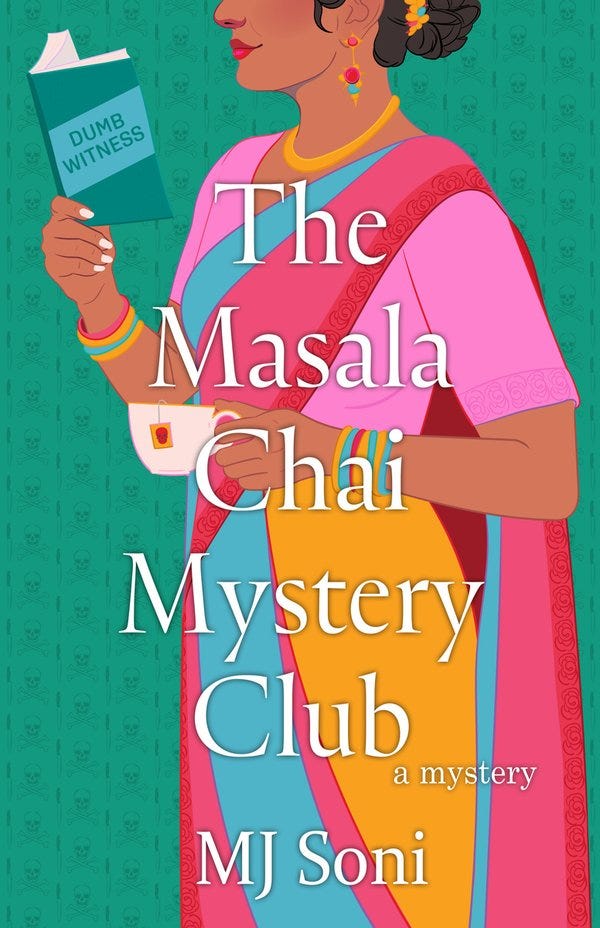
Suspects abound when a much-despised neighbor is killed, perfect for fans of Only Murders in the Building and Richard Osman’s The Thursday Murder Club.
Retired librarian Neeti Shah was hoping for a restful life with her chai-loving friends, but when the body of a neighbor, a childhood friend of Neeti's, turns up dead and the killer’s MO is similar to that of Neeti's most recent book club read, things start to get out of control.
When Neeti hears a commotion at a neighbor’s house, she finds Rohit’s body sprawled across the bottom of the staircase with Agatha Christie’s Dumb Witness nearby. Blackmailing his neighbors, threatening them with lawsuits, and calling them by nasty nicknames were only some of the hateful things that made him so disliked. But were they angry enough to kill?
Neeti is indebted to her old friend, and she's determined to find his killer. But she can't do it alone, so she enlists her mystery-loving friends, the Masala Chai Mystery Club, to get to the bottom of the murder.
But Neeti and her club members need to be careful. As more bodies turn up and more suspects start to appear, they’ll need to find the killer before they end up in hot water!
To enter, comment #chai below.
Comments
Nothing yet. Say the first thing.
Sign in to join the conversation.