
Somewhere in the middle of his TrustCon talk this year, my former Facebook colleague Samidh Chakrabarti started describing bowling bumpers and how they not only keep the ball from going in the gutter, but also guide it toward the pins.
Samidh was using it as a metaphor for how we think about AI in trust and safety. A guardrail stops the ball. A guiderail keeps it moving toward the pins. We spend most of our energy specifying what a system must never do, and far less figuring out how to nudge it toward what we want it to do.
Samidh ran the civic integrity team at Facebook. What I learned from him then, and what I’d forgotten how much I missed, is how he reframes problems.
Here’s an example from our time at the company. We were trying to get a product through, and policy and product were stuck on a disagreement. On the policy side, we treated escalation as failure. Escalating meant we couldn’t sort it out ourselves, that we were bugging our bosses with something we should have handled. Product had the opposite instinct: escalate fast, escalate early, no shame in it. Samidh walked me through why. When two teams have been handed goals that conflict, they are not going to resolve it between themselves, no matter how reasonable everyone in the room is. Somebody above both of you has to set the priority. The faster that happens, the faster everyone moves on. Facebook executive Andrew Bosworth (aka: Boz) wrote a version of this called Escalate Early and Often that’s worth your time.
That’s a guiderail. It didn’t tell me what to avoid. It moved me toward the outcome.
Which brings me to what Samidh and Dave Willner have built at Zentropi. They talked about Reflexes, an open-source safety harness for AI agents. You write the rules your agent has to follow in plain English. It checks every action in real time, and when the agent crosses a line, it gets handed the policy text back so it can fix its own next step. It’s a bumper rather than a wall.
A lot of trust and safety has been built as walls. Much of the work that actually changed behavior looked more like bumpers.
Here are a few other things I took away from this year’s TrustCon - the annual meeting of trust and safety professionals working across tech, civil society, academia, and government.
Alice Hunsberger wrote about this in Everything in Moderation, and it was the hallway conversation everywhere. Trust and safety teams are using AI to do their own jobs now. Some people are at the basics: how to write a good prompt, how to set up a project in Claude or ChatGPT. Others are building agents.
That range surprises people. These folks work in tech, so there’s an assumption they showed up fluent. They didn’t. It’s a skill, and a lot of them are learning it just like we are.
For years, anything we wanted to build in trust and safety meant getting engineering time. That meant a queue, a fight over prioritization, and often a no. With vibe coding, the queue gets shorter. I’m working with a client right now, walking through step by step how we build a basic internal AI tool for their team. Nothing fancy. The kind of thing they’d never have gotten built before.
I had a handful of people come up to me at TrustCon asking about training. It’s still very new. But it’s real, and I’d like to see where it goes.
I came home from TrustCon last year unsure whether I should keep going. As a consultant and a newsletter writer, I’m working at 30,000 feet. Most sessions are built for people doing the day-to-day work, which is correct, and which also meant I sat in rooms that weren’t for me.
The sessions were still largely there this year. But there were more senior people in the hallways and more people who could connect me across more companies than I remember in past years. I don’t have numbers on this. It was just the vibe I was getting.
We’ve heard a great deal about the decimation of the trust and safety industry, and the layoffs are real. Alice made the fair point that the only people in that room are people whose employers could pay to send them. Both of those things can be true at once. I have never come home from a TrustCon this tired, and all of it was conversation. Potential clients, academics doing work I wanted to hear about. Go read the Oversight Board’s paper on whether LLMs are stifling political speech. I talked the ear off the people who worked on it.
On Tuesday’s Pivot, Kara Swisher mentioned she’s being contacted by more companies that want to talk about what they’re doing on safety. Her theory is that with Democrats likely to take back the House, companies see hearings coming and want to start setting the stage.
That’s partly true. But the thing I say constantly, and will keep saying: this work never stopped. Teams kept doing it through it all. What changed was how much companies were willing to say about it out loud. Watch whether that shifts as we get closer to the midterms, and then again depending on who wins them.
Consultants, vendors, newsletter writers, podcast hosts, think tanks. The Center for Democracy and Technology ran a workshop on political influencers, building on some excellent work they’re doing on the topic. A lot of the people in that room used to be inside companies. The industry didn’t disappear. It scattered, and that scattering is producing work the companies couldn’t have produced from within.
Kate published an AI crisis flowchart yesterday, drawn instead of the Lawfare piece she sat down to write. It’s XKCD-style by her own description, and it maps what happens when something goes wrong with AI: what the government does, what companies say publicly about wanting regulation, and what any of that means internally.
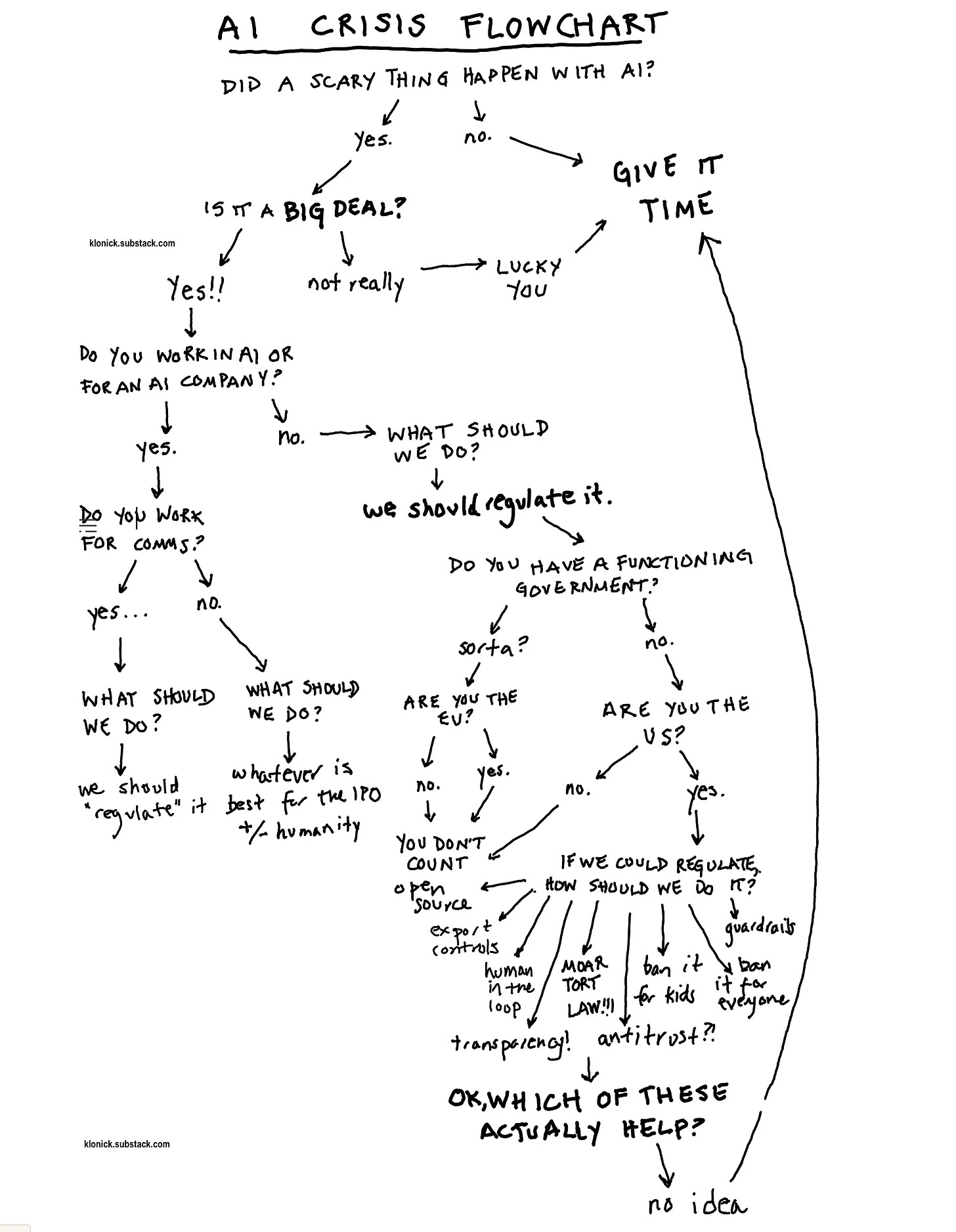
It’s the clearest picture I’ve seen of the current state of play, and it lands on the same problem. The EU is regulating, and what that mostly produces is reports. I’ve watched trust and safety teams lose real working hours to compliance paperwork instead of the work the paperwork exists to protect. That’s an unintended consequence we should be naming. The US approach is scattered across enough different attempts that it’s an open question whether any of it is functional.
Most of what’s on that chart is a guardrail. The question I brought home from TrustCon is how much of what we’re building actually moves anybody toward the pins.
We’re living through a moment where AI, politics, media, and technology are all crashing into each other at once. Anchor Change is where I connect the dots, share what I’m noticing, and help people panic responsibly about what comes next. Subscribe for grounded analysis and strategic insight from someone who’s been inside the rooms where these decisions get made.
No posts
Comments
Nothing yet. Say the first thing.
Sign in to join the conversation.