
I want to show these to my foreign friends. I want them to feel something about the thing that is perfectly normal for me, familiar, comforting — but probably unusual and a little unhinged for them.
I experienced this with my younger Russian friends as well. Gen Z are as amused by Soviet animated movies as people from abroad.
I was born in an interesting year: 1984. Like the book title.
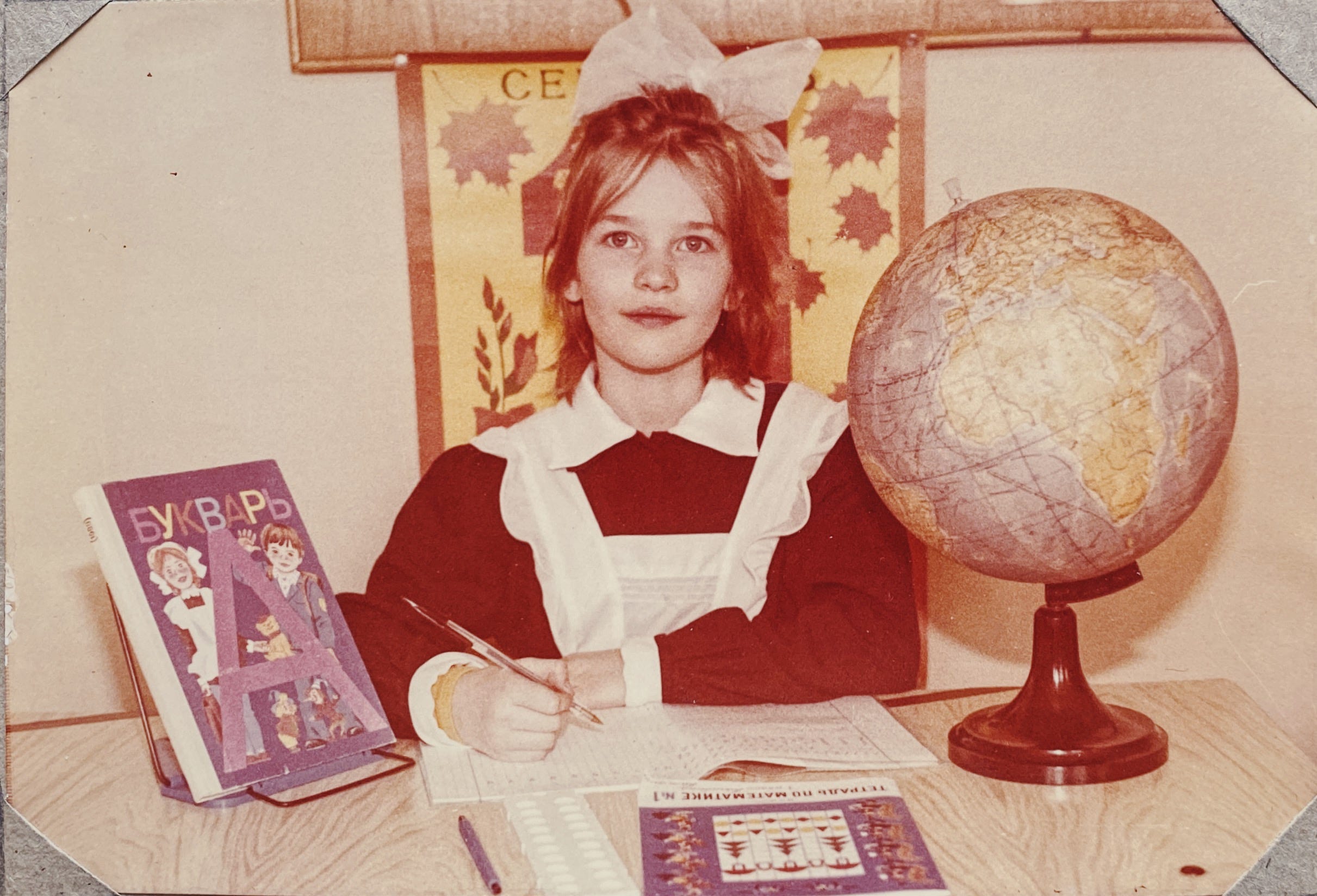
The USSR fell apart just when I was starting school. I wore a Soviet uniform in primary school: a brown dress, a white apron for festive days, a black apron for everyday use. White collar and cuffs, sewn on Sunday evening, ripped on Friday, to be washed separately.
For three years of primary school, I had to write with a fountain pen, as if we were still in the past. My strict teacher, Lyudmila Anatolyevna, was sure that the novelty of a ballpen would destroy our handwriting. My hands were always stained with ink.
I dreamed of using the ball pen, and even if not, at least a fun-colored ink, purple or green. But only blue was allowed at school.
Before starting school, I’d read all the books my local library had about brave, community-oriented pioneers who help older people and never lie. I wanted to be a pioneer, too. I hoped to become one.
I cried when I found out there would be no more pioneers going forward because there was no USSR anymore.
As I started school, a new culture was rising for me to get fluent in. I exchanged Little Mermaid album stickers and won glow-in-the-dark temporary tattoos. I stopped going to the library because it didn’t have any new books; the bookstore, on the other hand, offered many newly translated items. I learned about the Hardy Boys and twins from Sweet Valley High. I tried to learn the dance from the “Baby Hit Me One More Time” music video, wondering why someone would ask their “baby” to hit her again. Was she even safe?
I tried to write down the lyrics to the Titanic song when it came up on the radio. I did my best, ending up with “Lafkan tachas mmm tain lestnitsa mmm nnn time, ene valet mmm nnn and gone” instead of “Love can touch us one time / And last for a lifetime / And never let go till we’re gone”. This quickly replaced any good deeds of the young pioneers in my head.
Although some bitterness about the loss stayed. The new stuff was exciting, but it wasn’t bringing people together. It didn’t feel like what I did as a person meant anything. I mostly yearned to buy something, and sometimes I succeeded. Then the focus would change to something else I could buy in the future. The books I bought in the bookstore were gathering dust in my room. It felt good to own a thing, but it was a dead end somehow.
I suggest we take a look at the culture that existed before that, on the crossroads of censorship, creativity, idealism, and fun.
First, here are three warm-up TikToks that showcase what you’ll see in the post from ‘outside the egg’ perspective, using the term from my previous post. You can see what other people think before diving in further.
Then I’ll present the full examples, most of which have English subs (and others have no dialogue). I’ll wrap up with a video about Soviet Animation in English (by a Canadian YouTuber) that provides a general timeline and an overview of the evolving visual culture.
Ready? We’re going in!
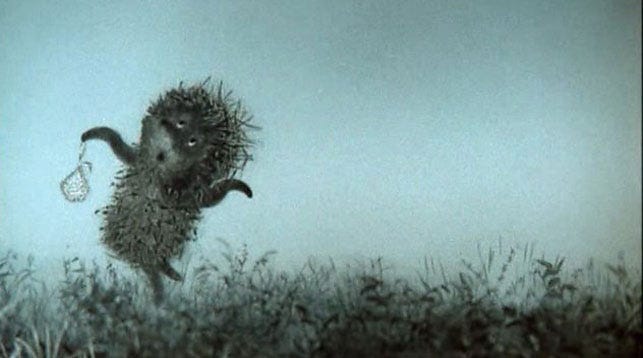
It is about friendship (Hedgehog has a best friend, Little Bear). It is about the meaning of life. It is about getting lost, letting go, and being found. It is about wandering in the dark.
The famous animation director Yuri Norstein (Hayao Miyazaki was inspired by him) and talented art director Francheska Yarbusova (they are a couple) created something special out of nothing. Without access to much technology, they crafted the screens that produced the fog effect. A very thin piece of paper was placed on top of the scene and slowly lifted toward the camera, frame by frame, until everything behind it became blurry and white.
The next two animations are from Armenfilm, a strong producer of high-quality cartoons, famous for shape-shifting, smooth on-screen transitions, and songs that stay with you for years.
I can spontaneously start singing the first song, unable to stop. It’s simply too powerful 🧜🏻♀️
Moving on from Armenfilm, this one is my favorite, too. Without any dialogue, only music and “the contact” between a shape-shifting alien and a human.
Director Vladimir Tarasov was dazed by the theme of universal communication. He considered animation “the universal language of all mankind”.
Cheburashka is the original Soviet Labubu.
He is a refugee who arrived in the USSR illegally in the box of oranges, and he is lonely. He is looking for friends and something to fill his life. He looks at the pioneers who have a community for well-behaved children and wants to be part of it (I can identify with that).
But first of all, he befriends Gena, a crocodile who works at the zoo as a crocodile from 9 to 5. Gena bravely puts an ad out and finds his chosen family. It’s actually quite queer of everyone, if you think about it.
This animated movie brought too many memes in my early life. I can speak using only quotes from it.
The boy is called “Uncle Fedor” at home because he is too grown-up for his age. It is probably a coping mechanism: his mother has a non-diagnosed anxiety disorder, and his father is quiet and distant.
The boy runs away in hopes of finding a chosen family that cares for him. He befriends a narcissistic cat who embroiders for fun, likes to maintain order at home, and dreams about being a farmer. They run to the countryside to squat in an empty house. There, they adopt a (hipster) stray dog with low self-esteem who loves Converse shoes and a good vintage photo camera. Their enemy is a mailman who is too bureaucratic because he doesn’t have a bicycle.
This was the life I was promised as a child ✊🏻
A Soviet Tom & Jerry.
The hare is polite, classy, and successful. The wolf is working-class, no manners, smoking, aspiring to be someone like hare, but lacks the systemic access or resources. Out of revenge, he wants to capture the hare, but it never happens.
At the end of every episode, the wolf howls, “Well, just you waaaaaait!” (Nu pogodiiiii), promising he’ll be back.
The full playlist (20 episodes)
Winnie is a poet and a philosopher, lost in his thoughts. Piglet is loyal, tiny, and anxious. The rabbit is annoying and likes rules too much. The owl always sneezes. Eeyore is depressed.
When I grew up and found “the original,” yellow, Winnie, I didn’t like it because it was not as deep as I expected 🥲 (see this post for the details of why the soviet Winnie was different)
Together with Tove Jansson, Astrid Lindgren was my favorite children's book writer. I wasn’t too much into Pippi Longstocking (I related more to Tommy and Annika without superhero abilities), but I loved Kalle Blomkvist, the book of Seacrow Island, the protagonists from Mio, My Mio — and, of course, Karlsson. The mean, passive-aggressive, and lovable gaslighter “who is better than the dog.”
Gianni Rodari was as popular in the USSR as any Soviet author. His approach was ideologically correct (Cipollino is a socialist tale, with the working class rising against the oppressor) and really heartwarming.
My favorite Gianni’s story was “La Freccia Azzurra“ though, “The Traveling of the Blue Arrow” in Russian (but I didn’t find it on YouTube). Later, I discovered his non-fiction book “The Grammar of Fantasy“ on storytelling and loved it.
Here is the most popular story:
Based on the books of my favorite writer Kir Bulychev, it is a rare case of a girl who is brave, has adventures, and is living her life to the max. Usually, the protagonist was a boy, and I had to identify with him.
Alisa Selezneva was a role model, breaking social gendered stereotypes and living her life to the full. With a father who is a space professor, she is flying here and there, solving mysteries, traveling in time, meeting aliens, and beating boys at everything.
additional link if this one doesn’t work, or subs are funny: back-up
This is a kind of subversive story. Vovka (a diminutive of Vladimir) travels to a “faraway kingdom,” the usual location of any Russian fairy tale, to learn that even in fairy tales, you need to actually do things.
Being lazy, he wishes to avoid action, but, this being a cautionary tale, he learns that creating things actually makes him proud of himself (and that libraries have useful manuals). It is a bit didactic/moralistic at times, but really enjoyable and funny. Many quotes became memes.
I didn’t find a version with the subs, but the sounds here are more of an addition, not the main course.
The plot is simple: once the sun sets, the anthill (home of the ant) will be closed for the night. The ant is already late and needs to hurry.
As with Ant Journey, one doesn’t need subs to understand the plot. There is no plot. Everything morphs into something else; the background song just names the objects on the screen.
The short timeline of creative and technical developments in Soviet animation (many titles that I’d shared above are mentioned).
See also: History of Russian Animation on Wikipedia.
P.S. I know that all the links are slowly expiring online.
If you are scrolling this post from the future and notice anything not working, please drop a comment. I’ll recheck and see if I can find a similar video that works.
Thank you for being here 🫶🏻
I am happy to hear your thoughts — in a comment or email.
No posts
Comments
Nothing yet. Say the first thing.
Sign in to join the conversation.