
Last summer, I finally got to the open-air cinema I had wanted to visit so much in the years before.
The movies they announced always looked interesting. Old ones, I’ve never heard about most of them. Documentaries, my favorite genre. It felt like a mystery box I didn’t yet have the key to. One reason was that it was supposed to be entirely in German, and I needed to reach a certain level of understanding first.
Do you know the feeling when you don’t have all the information yet, but something inside is fairly sure it’s something cut out just for you? I usually trust this call.
Here, you get your weekly updates on my anchoring process.
Freiluftkinos
The open-air I was postponing to visit was in Lichtenberg, far away from my Schöneberg home base. I’m rarely in that area. Also, Berlin has many Freiluftkinos, cinema screening spots without a roof, no need to travel that far, specifically. Even the biggest one in Volkspark Friedrichshain is far enough away to skip it, especially if the film starts at 9 pm, my bedtime. The horrors.
(I really enjoyed the screenings at Mobile Kino usually, though; earlier start time and great choice of contemporary movies, usually with EN subs.)
Other Freiluftkinos, in case you were wondering where to go once the season hits:
Berliner Berg Brauerei (Kungerkiez)
ARTE Sommerkino Kulturforum (Tiergarten, next to Philharmonie)
Freiluftkino Insel (Atelier Gardens, southern edge of Tempelhofer Feld)
Freiluftkino Rehberge Wedding (in Volkspark Rehberge)
Bethanien (Mariannenplatz)
Kranzler Eck (Ku’damm)
Kino Central (Hackescher Markt)
…please add in the comments.
Last year, I had my eyes only on the Stasi Museum Campus Kino, the one in Lichtenberg, having never visited it.
In 2025 alone, during only 4 weeks, 10 700 guests attended, including me (twice). Some films attracted as many as 1 000 viewers at a time. It all happens in the yard in front of the museum, around sunset. I remember the staff bringing out more and more foldable chairs from storage as people kept arriving for Die Unbeugsamen 2 and Die Architekten.
Some practical tips on Stasi open-airs:
All the information on the website (and movies themselves) is unfortunately in German. This is why I needed a good command of the language to start attending.
The screenings are free, but the spots are limited and served as you come. If it starts at 7 pm, I would not arrive later than 6 to secure good seats by throwing my jacket on them (learning from past mistakes).
Open-air movies are shown late in the evening, on the border between the day and the night. The reason is — the big screen looks better in the darkness. It is getting colder, might be windy and chilly, as the night falls.
They have some food options and drinks, a free toilet, but you also could bring a thermos of tea, a blanket, a scarf, and a sturdy jacket to be as cozy as possible.

GDR knowledge
Sitting on the folding chairs at the Stasi Museum Campus Kino for the first time, my friend J and I loved the documentary we were watching. It consisted of many interviews with women from the GDR — strong, sometimes tired, and always with a great sense of humor (Berliners were, as usual, especially snappy).
On the screen, the portrait on the room's wall appeared. A middle-aged man with hipster glasses looked familiar. “Is this Honneker?” I whispered to my friend J, pretty sure I was right, proud of my knowledge. “Who?” whispered she back. She is a bit younger than me and grew up in West Germany.
Then, Christa Wolf appeared on the screen. “Christa Wolf!” I said. “Who?” J repeated. I started retelling the story of the unfair cancellation. I was thinking how weird it was to tell this story in front of the Stasi Museum, the place that impacted Christa’s fate as a writer so much. But the movie went on, more people appeared on screen, and so I dropped the subject.
On the way home, I was thinking. Is it the case that GDR history (and the shared loss of the bright future) is better known and more deeply felt by other Post-Ost people who grew up in the Eastern Bloc than by Western Germans? The vast divide between Ossis and Wessis astonishes me, despite them speaking the same language.
A friend told me she finished reading the classic book The Short End of the Sonnenallee, about a childhood in the GDR, and mentioned it to several people, all of them German. Those who grew up in Eastern Germany knew what she was talking about. Those who grew up in the West didn’t.
I read about Sonnenallee as soon as the book was translated into Russian at the beginning of the 2000s. After emigrating, I attended the 25th-anniversary screening of the movie in Babylon, with the director on stage. For me, it’s a classic in the same way “Wir Kinder vom Bahnhof Zoo” is. But apparently not for everyone.
Two queer movies were produced before the Wall came down. Western It Is Not the Homosexual Who Is Perverse, But the Society in Which He Lives (1971) is well-known, maybe because of the famous director Rosa von Praunheim or the stronger community in the West. Eastern Coming Out (1989) is rarely mentioned, perhaps because it was screened at Kino International on a very fortunate day: 9 November 1989, the night the Berlin Wall fell. The attention slipped instantly.
There are always logical reasons. But there is also the bigger picture, where some things are more present and visible than others.
Riding the U-Bahn home from the Stasi open-air event, I was confused. For me, GDR was the past of the country I’ve immigrated to. But for some locals, it didn’t hold the same weight, more of a forgotten aberration in the past.
Jenny Erpenbeck, who grew up in East Germany and got a Booker Prize in 2024, was born in 1967; therefore, she was in her late twenties when the Berlin Wall fell.
I was born later, in the 1980s, and in another country. Still, feelings of loss, displacement, loneliness, failure, and grief are similar.
In her book Not a Novel: A Memoir in Pieces, Jenny shares her experience of DDR's collapse, which I fully identify with:
There was suddenly a lot of talk of freedom, but I couldn’t make much of this word freedom, which floated freely in all sorts of sentences.
Freedom to travel? (But will we be able to afford it?)
Or freedom of opinion? (What if no one cares about my opinion?)
Freedom to shop? (But what happens when we’re finished shopping?)
Freedom wasn’t given freely, it came at a price, and the price was my entire life up to that point. The price was that everything that had been called the present until then was now called the past. Our everyday lives weren’t everyday lives anymore, they were an adventure that we had survived, our customs were suddenly an attraction. In the course of just a few weeks, what had been self-evident ceased to be self-evident.
A door that opens only once a century had opened, but now the century was also gone forever. From that moment on, my childhood belonged in a museum.
Similar emotional understanding and sad cultural nuances I recently found in Lea Ypi’s first book, Free: Coming of Age at the End of History. She is writing about her childhood in Albania, the last Stalinist outpost in Europe.
I thought a lot after reading this passage:
In the past, one would have been arrested for wanting to leave.
Now that nobody was stopping us from emigrating, we were no longer welcome on the other side. The only thing that had changed was the colour of the police uniforms.
We risked being arrested not in the name of our own government but in the name of other states, those same governments who used to urge us to break free. The West had spent decades criticizing the East for its closed borders, funding campaigns to demand freedom of movement, condemning the immorality of states committed to restricting the right to exit.
Our exiles used to be received as heroes. Now they were treated like criminals.
Perhaps freedom of movement had never really mattered. It was easy to defend it when someone else was doing the dirty work of imprisonment. But what value does the right to exit have if there is no right to enter? Were borders and walls reprehensible only when they served to keep people in, as opposed to keeping them out?
The border guards, the patrol boats, the detention and repression of immigrants that were pioneered in southern Europe for the first time in those years would become standard practice over the coming decades.
The West, initially unprepared for the arrival of thousands of people wanting a different future, would soon perfect a system for excluding the most vulnerable and attracting the more skilled, all the while defending borders to “protect our way of life.” And yet, those who sought to emigrate did so because they were attracted to that way of life. Far from posing a threat to the system, they were its most ardent supporters.
The bad and the truth
My friend C asked me whether I honestly thought the Eastern Bloc was entirely bad. I do share a lot of thoughts and memories on what was wrong and inhumane there; Stalin's terror is the first that comes to mind. I’ve recently been to Bucharest and heard again how the communists brought so much destruction and damage to the country and people.
Side note: it is interesting to compare this view of “communists” with a positive approach to socialism that I encountered in Berlin in the leftist circles. There are many memes like this one:
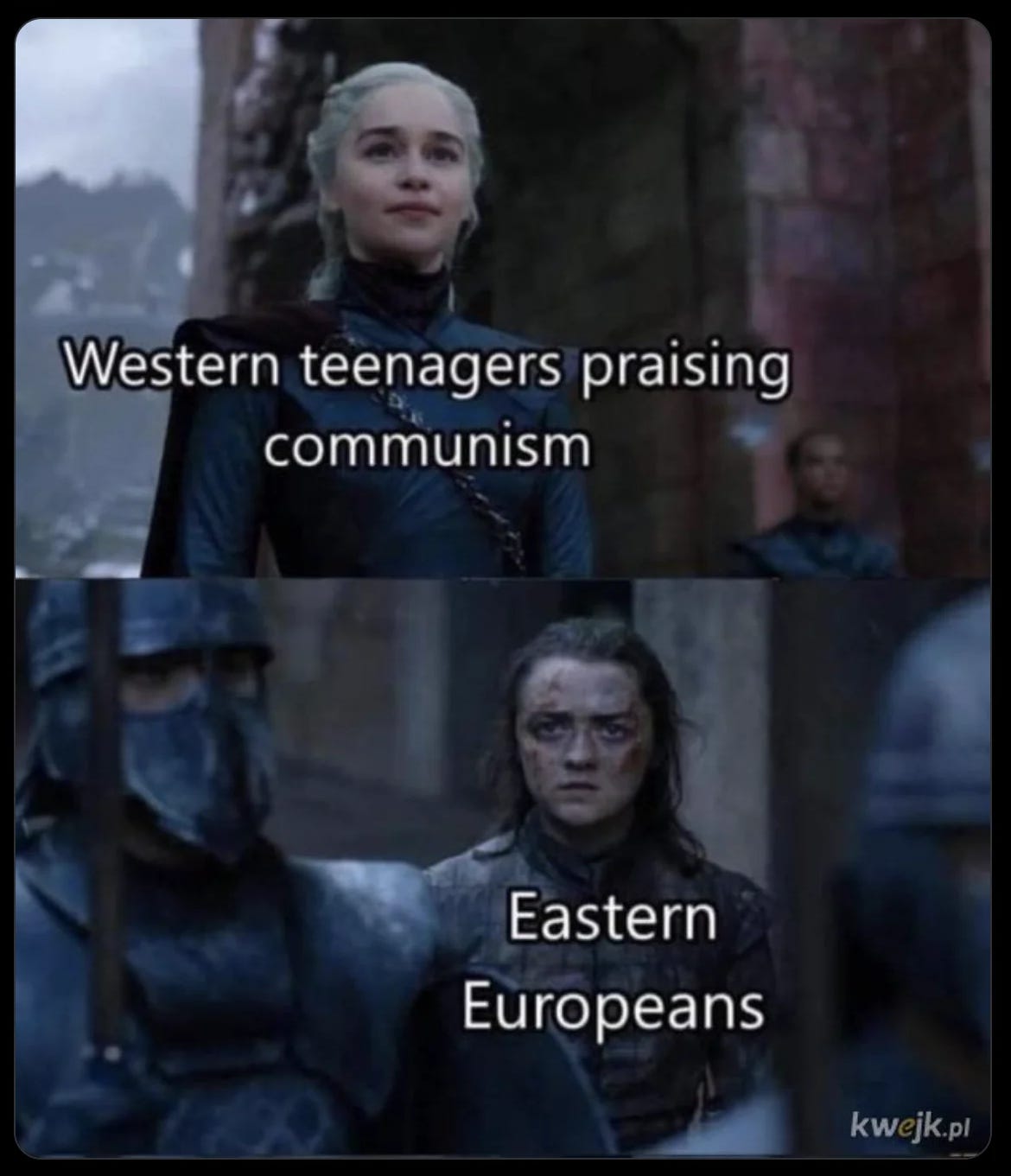
I answered C that, despite all my critiques, when we paint the Eastern Bloc fully black, we also erase all the good that was in the system for the people, and what was in the people for the people.
One easy example is a huge literacy project, the libraries, and access to (censored but many) books. Some infrastructure was useful, and not all the countries had the same. I’m planning to write about it later.
Capitalism is bad in so many ways, too, but we are here, living under it. We have a good time sometimes. There are many moments of joy in suboptimal locations and situations.
If we only paint the Eastern Bloc black, we erase all the love, togetherness, and small freedoms people carved out. As a person who was born in the USSR, grew up during perestroika, and emigrated from Russia several years ago, I know that personal life continues even if the political system looks horrible from the outside.
Useful features often exist in systems that seem to be full of bugs. I’ve heard multiple times (and read in Christa Wolf’s book They Divided the Sky) how people leaving the Eastern Bloc for the West aimed to find freedom but found only consumption.
But the strangest thing to me is the difference between how the GDR looked from my home country, the USSR, and how people in West Germany see it and speak about it. I’ve read and watched a lot of German content, current and archival, over the last couple of years to be able to compare.
Looking from the West, the GDR was grey, boring, poor, unfree, and sad. The word I hear the most is “dictatorship.” People in the West do not value the movies or books from there much because they were all too niche, too propagandistic, and not very relevant now. The products were poorly made because the USSR received reparations after the war in the form of factory machinery and resources. There wasn’t a lot left.
Still, looking from the East, the GDR was dreamy. Everyone wanted to visit it at least once in their life. Military personnel and their families hoped to be sent to serve there. People who got lucky tickets and lived for some time “in Germany” brought back many everyday objects that are still in use today, forty years later. German quality was praised.
And that applies not only to GDR but to all the other Eastern Bloc countries. They had the best stuff. In the USSR, everyone wanted a GDR leather jacket or a pair of jeans, some Romanian wooden furniture, a Czech crystal vase, or a Polish leather bag.
Other Eastern Bloc countries looked like heaven compared to the USSR. Even better: a theoretically reachable heaven. Maybe you could take a summer trip to Jurmala or marry someone with the right connections to get a pair of jeans.
To give you a practical example, ribs, or music on the bones, was a thing in the USSR. Because of the shortage of everything in the (badly) planned economy, people needed to be creative in sourcing the (banned) musical records.
Medical X-rays, purchased or picked out of the trash from hospitals and clinics, were used for that purpose. The X-rays were cut into 7-inch discs and the bones went into the motion, producing music.
(see 2015 book X-Ray Audio: The Strange Story of Soviet Music on the Bone by Stephen Coates or his TED talk)
The GDR is not my past. It’s the past that my past was jealous of.
And at the same time, when I see old recordings from the GDR era, they look like a deepfake, AI-translated into German, filmed originally in the USSR. I recognize the music, the slogans, the emotions, the ideology of companionship, the double speak, the limitations of freedom, the lack, the fears, the realities, and the dreams.
The dreams.
Thank you for reading 🫶🏻
I am happy to hear your thoughts — in a comment or email.
Comments
Nothing yet. Say the first thing.
Sign in to join the conversation.