
Every great analyst started with one simple question: “What does this data really mean?”
In the blockchain space, data never stops moving; wallets, swaps, liquidity, trades. But the difference between noise and insight often comes down to the analyst’s ability to ask the right questions and translate raw on-chain activity into meaning.
The truth? Data alone doesn’t tell the story. You do. And learning the language of SQL is the first step in turning blockchain’s endless flow of transactions into opportunities, insights, and solutions the industry needs.
The SQL query below retrieves the number of daily active users and passive users on the Ethereum blockchain for the year 2023.
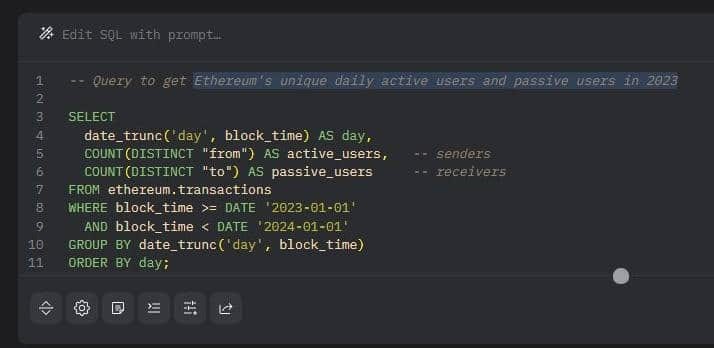
Query Breakdown
- SELECT date_trunc('day', block_time) AS day: This line truncates the block_time to the nearest day, effectively grouping all transactions that occurred on the same day. The result is aliased as day.
- COUNT(DISTINCT "from") As active_users: This counts the number of unique addresses that sent a transaction. These are labeled as active users and represent the senders.
- COUNT(DISTINCT "to") As passive_users: This counts the number of unique addresses that received a transaction. These are labeled as passive users and represent the receivers.
- FROM ethereum.transactions: The data is sourced from a table named ethereum.transactions, which contains information about all transactions on the Ethereum network.
- WHERE block_time >= DATE '2023-01-01' AND block_time < DATE '2024-01-01': This filters the data to include only transactions that occurred within the year 2023, from January 1, 2023, up to, but not including, January 1, 2024.
- GROUP BY date_trunc('day', block_time): This groups the results by day, allowing the counts of active_users and passive_users to be calculated for each individual day.
- ORDER BY day: This sorts the final output in chronological order based on the day.
Our learners don’t just study SQL, they create real dashboards that solve real problems.
Here’s an image of one of our recent Cohort 5 mentees Dashboard;
Read more: $GRASS Token Analysis
This isn’t just practice dashboard, it’s proof that learning SQL and on-chain analysis opens doors to building things that matter and tell a story.
It’s your turn to take the leap.

Become a Blockchain Data Analyst
Learn Onchain Analysis using SQL and Dune in our hands-on, guided training program.
Deadline: 30th Sept, 2025
Start Date: 1st Oct, 2025
Read details and Secure Your Spot here:
https://analyticsages.io/beginner-blockchain-analytics-sql/
This is your chance to learn the skills that power dashboards, insights, and data-driven decision-making in Web3. Don’t miss it.
No posts
Comments
Nothing yet. Say the first thing.
Sign in to join the conversation.