
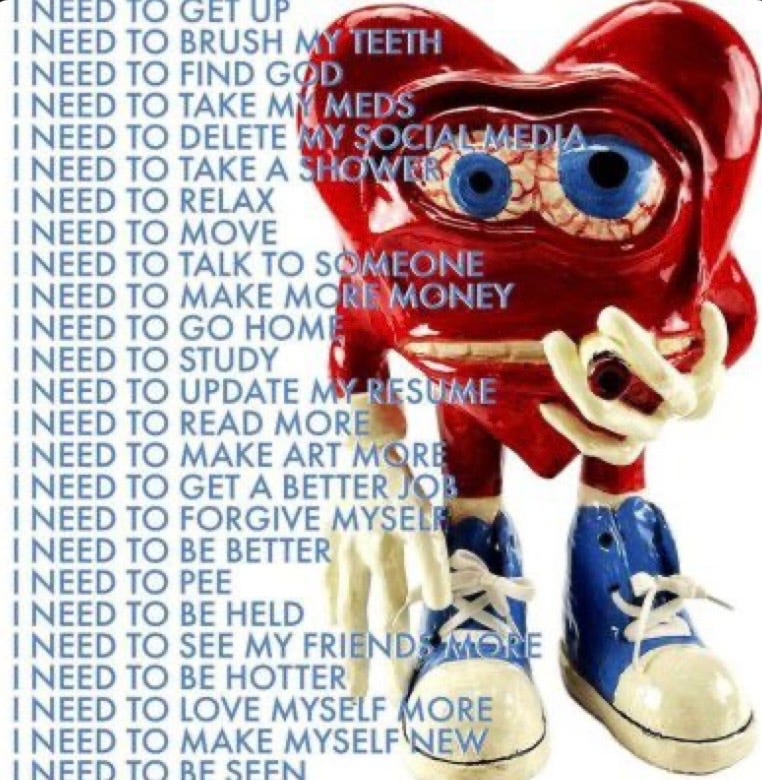
I became aware of the disillusionment surrounding New Year’s resolutions before I was really conscious enough to make my own. By the time I entered high school, it seemed as though the general public’s sentiment surrounding New Year’s resolutions was that they were surface-level throw-away goals that would be forgotten almost as quickly as they were adopted. Ever the skeptic as a teenager questioning a Catholic upbringing and the reasoning behind every practice we engage with, I discarded New Year’s resolutions as another product of consumerism—another push to fit into a set standard for an ideal life and passively manifest a life you’ll never have. As I grow and learn to combat my skepticism (because questioning everything and believing in nothing is not only exhausting but incredibly depressing), I’m finding the value in consciously creating goals for ourselves that are based not on what is expected of us, but on what we truly want or need when we take a hard look at our surroundings and our circumstances. We’re a society shifting away from the old ways of the world, so much so that it’s a political talking point, an argument over how much change should be allowed into our culture. As we attempt to reshape behavior and expectations from the past, I think, rather than discarding the idea of having goals for ourselves in a new year completely, we can instead take a different look at the way we set those goals in the first place.
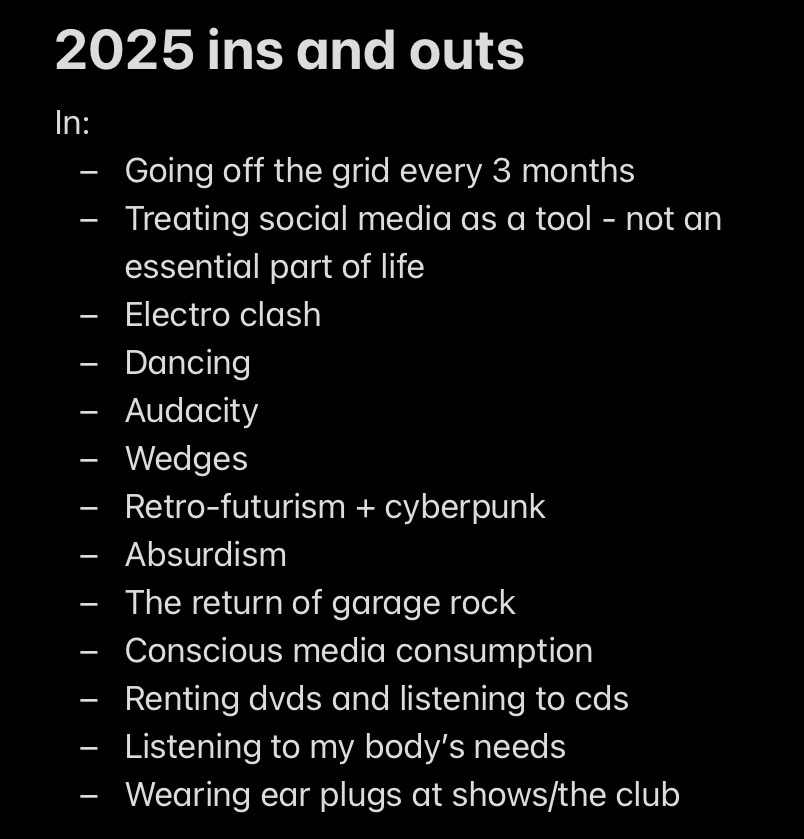
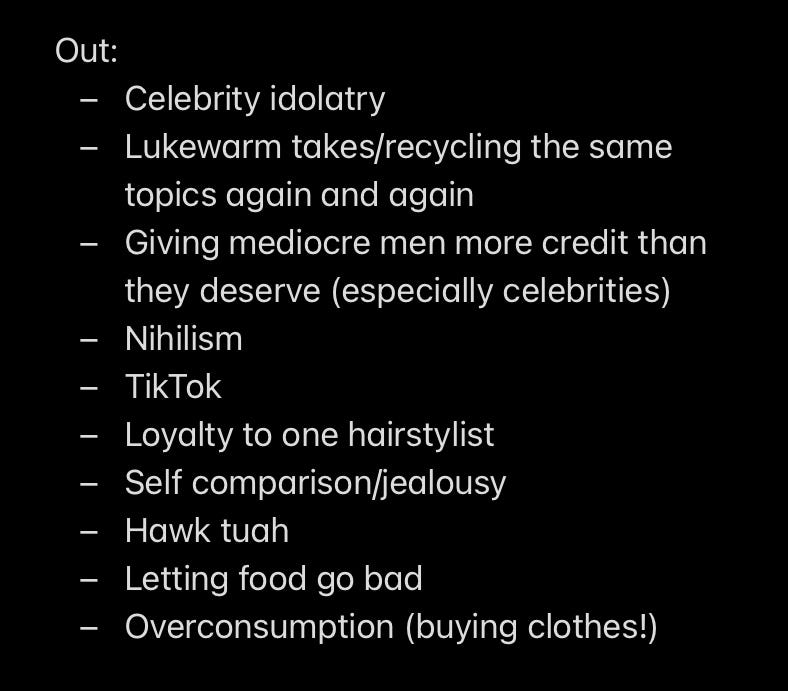
Enter the “in and outs” list. I believe these lists have been utilized in different forms in magazines for a few decades, but were popularized for New Year’s resolutions through social media, in some cases to discuss actual goals and sometimes to discuss internet/fashion/culture trends. I personally think these are really fun. I think rather than having an abstract goal or two like “get in shape” or “be more outgoing,” making a detailed list of what you want to leave in the past and introduce in the future invites the ability to create more measurable expectations for yourself. You can stick more closely to some things, while faltering in others, and still end the year feeling relatively accomplished. Some goals might still seem unrealistic in a sense, as this article points out that putting “overworking” in your “outs” section isn’t realistic due to the state of the economy. Most Americans understand that working less isn’t an option, but maybe someone that’s intending not to overwork will put more effort into doing what they can to care for themselves after a long work week; maybe they won’t pick up extra unneeded shifts when their body is telling them not to. It’s all in our head; it’s all in our intention.
Here’s the thing- the concept of choosing a specific date to become a better person is all silly and arbitrary anyway. New Year’s resolutions date back thousands of years to a Babylonian celebration that is believed to have taken place in March. In America, we celebrate our New Year on January 1 based on the Gregorian Calendar, but Chinese New Year is on January 29, and Nepali New Year is celebrated the second week of April. Rosh Hashanah, Jewish New Year, is celebrated in September/October. Spring Equinox on March 20 is also considered a date to celebrate new beginnings. Humanity experiences new beginnings all the time. We have so many opportunities to watch the sun rise over the mountain, to find inspiration to be a better version of ourselves, to attempt to shed the negative and meditate on what is most important.
And get this—first we will, and then we won’t. The negative will seep in anyway. But our use of symbol and ritual gives us the opportunity to make our hope tangible and actionable, to take a look around and remember the pieces of our reality that are not out of our control. It’s expected for us to falter in those goals, for life to get in the way, for powers out of our hands to twist our lives, for our own ego or greed or laziness or consumption to cloud our view of what’s most important, but I see value in having specific moments where we try to see more clearly. Yes, we are at times selfish and stupid, but practices with the intention for better speak on the human desire to pursue better, for ourselves and others, and as we approach a year that bodes uncertainty and pain, I think it is useful to celebrate the possibility that comes with new beginnings, shift our perspective and step away from our anxiety of the future for just a moment.
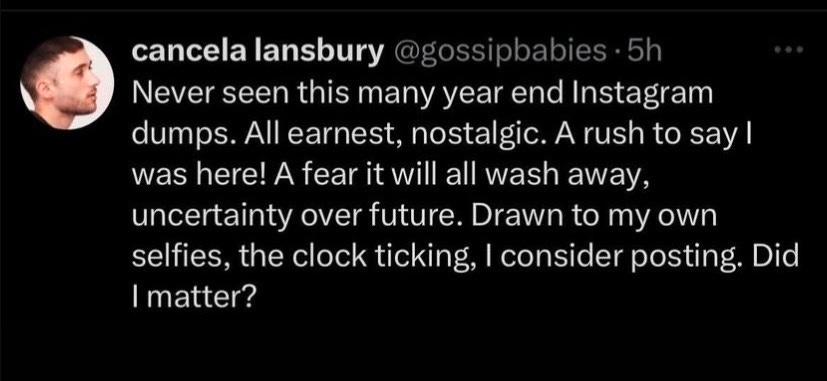
Criticism of nostalgia is often similar to that of hope: that it keeps you from the real, the present, the actual needs in the moment. And I agree! We can’t drown in the past or the future if we desire change. However, I think hope and nostalgia are coping tools that sometimes we need. It’s necessary to find comfort in looking back at what we’ve had and anticipating what we could have in order to keep going, to keep fighting, to keep pushing. Taking a moment to focus on the potential positives of a year that’s anticipated to be rife with pain for many and looking back at the beautiful moments we experienced the year before, a year that was also rife with pain for many, gives us the comfort and strength to demand better and push through the terrible moments we’re guaranteed to experience in the future. I understand how lucky we are to be able to have hope in the first place, and it’s understandable why, in the current state of the world, someone would choose not to linger on something as miniscule as a New Year’s celebration. There is no argument. But if you feel the need to indulge in your hope or nostalgia for a moment just to feel good amidst the bad, I don’t believe there is any harm in that. As long as we remember that the present is what’s most important, always.
As I’ve mentioned before, 2024 was a big year for me. It was one of those years where the rug of control is swept completely out from under you, and you’re reminded how much of your reality is out of your hands. 2019 and 2020 were also that kind of year for me. And my New Year’s Eve followed suit. I thought I’d celebrate the end of my big year and the start of 2025 the way I spent the year itself, surrounded by friends and music. Instead, I was diagnosed with a bacterial infection I picked up while traveling for the holidays, and spent all of New Year’s Eve nauseous with stomach cramps as a side effect of my antibiotics. I was in and out of sleep most of the day, and when midnight rolled around, I drowsily kissed my partner before passing out on our couch. Not the most glamourous way to start my year.
That’s where the silliness of this all comes in. We choose days to represent new starts, but sometimes we’re thrown a curveball, like illness. It’s just a day, and it can mean the start of a new life, or it can just be another day. I was disappointed not to start my year on a high note and worried that it meant the rest of the year would follow. However, I realize that my New Year’s Eve served as a moment of clarity for what’s most important. My partner gave up his plans and opted to stay inside all night watching How I Met Your Mother while he listened to me groan and writhe with pain in our living room. Our friend stopped by with ginger ale (labelled “champagne”), snacks and crafts for us, so we wouldn’t be bored inside all night. The next morning, we picked up the keys to our new apartment. Sometimes hope comes from recognizing what’s already with us. I still have goals for 2025, my 25th year of living, and I’m also really terrified of what’s to come this year. But this time, my New Year served as a reminder to take a step back, to realize what I have, and to soak it in for as long as I can.
Comments
Nothing yet. Say the first thing.
Sign in to join the conversation.