
I turned 26 two weeks ago. 10 years ago, I sat on my bed under the white fluorescent ceiling light I begged my dad to install in my room so I could have better lighting for Instagram photos I never posted. I hunched over my mom’s laptop, pretending to work vigorously at algebra 2 homework I had already finished (or planned to finish before class) and listened to Marina and the Diamond’s Family Jewels through earbuds while scrolling through apartment listings in L.A., NYC, San Francisco, and Seattle. I kept a list of my favorites on a private doc.
Are you satisfied with an average life?
Marina has been asking me this for over 15 years now. Do you remember exactly when your dreams were flattened into goals, when ambition overshadowed wonder? When did having what you once worked for lose its sheen as you move forward towards the next shiny ambition? I have an apartment in the downtown of a busy city, a cat, a partner, cute clothes, friends, food, family, art to show and to be proud of. But as an over-achiever since kindergarten, the typical pressure to reach certain levels of achievement by a certain age weighs heavily on my knotted shoulders as I enter the second half of my 20’s. I feel behind; I am sick of feeling financially nervous; I regret decisions I’ve made for my career; I wonder if I’m in the right place; I want more.
High achiever, can’t you see? Baby, nothing comes for free.
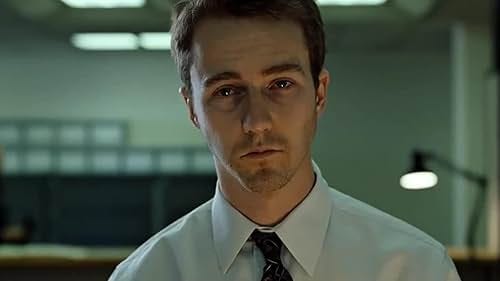
I have never been satisfied with being settled, maybe because as a kid I bounced from new town to new town, or maybe because of a deeper reason I haven’t pinpointed. I’ll spare you the unnecessary self-reflection. With my baseline of contentment revolving around always anticipating the next move, the next job, the next event, and nonstop focused energy toward being more productive, my hedonic treadmill is constantly uphill. I am literally Sisyphus, and my boulder is ambition, which parallels with greed. It’s addictively easy to fall down a checkered spiral of not having cute enough clothes, not living in a big enough city, not having enough money or enough followers or enough art to show off. Is this what Gen X felt in the late 90’s when they condemned a settled life through Fight Club and Office Space? Hey, at least they had retirement plans and insurance—most adult Gen Z’s like myself are still fighting the battle for resources to survive. However, the chunking of life into a series of actions and milestones to pass, measuring life by goal after goal after goal, is a relentless universality across generations that have been forced to find value in wanting and working toward what you don’t have. Is life just about wanting, until one day you’re too old and tired to want anymore?
They say I’m a control freak, driven by greed to succeed, nobody can stop me.
I’ve been struggling with the idea of turning 26. I know, I know, groans from anyone over the age of 30 can be heard from miles away. But, come on. It’s no secret how society and the pedophilic men that manipulate it feel about older women. I know I am in no way close to being considered “old,” but this is the first year where I’m beginning to feel that internal shift, where my youth feels less like excitement and more like expectation. I don’t necessarily feel what some would call my biological clock ticking (not at all actually) but I do feel a need to justify, and to quantify, what I’m doing with my life, and how I’ll be even better tomorrow. Who do I feel the need to prove myself to? Myself? My family? The invisible audience I’ve been conditioned to believe is watching me? Probably all of the above. There’s no denying the ongoing cultural temperature on female aging: women in their late twenties (start in your teens to REALLY get a leg up!) should start using retinol, considering baby botox, tracking their steps and their cycles, and thinking about the future of their eggs. If my value physically diminishes as I age, my only option is to optimize my success to prove my worth and autonomy.
Do I need to lie to make my way in life?
I know it’s all a lie. It’s misogyny; it’s the Rat Race; it’s American hyper-individuality; it’s social media; etc. etc. etc. Comparison is the killer of all joy and no two paths will look the same. Inspirational wisdom can be true and still not comforting. In an image-focused culture where identity is currency, we struggle to keep our heads above the murky water full of every other person that wants attention and validation. The more locked in you are on an identity, and the more you can package, enumerate, and market this identity to an audience, the better. Track your daily habits to optimize a more productive you. Having a boyfriend is fine, but it’s lowkey embarrassing for your personal brand. The older you get, the (hopefully) more complex and nuanced your understanding of yourself and the world is, which in turn makes your identity difficult to pigeon hole. This especially goes for women, who, through media, are often categorized into palatable stereotypes that make the breadth of their experience limited and more easily digestible. In the 80’s, it was the cheerleader versus the goth girl. Today, it’s clean girl versus e-girl. Oh wait, no, that was almost 5 years ago. Now we’re just being replaced by AI women. Great.
Once you cross the line, will you be satisfied?
Are we all doomed to not only compare ourselves to echo-chambers within echo-chambers of niche celebrity, but also to completely fake people now? Feelings of inadequacy, woe-is-me-ism, and self-absorption (which all go hand-in-hand), are so easy to fall into in a world obsessed with people obsessed with themselves. Like relentless ambition, self-obsession and self-comparison limit the minutiae of our existence and isolate us from complexity outside and within. We’re ambition-maxxing: we measure ourselves and our time through what has been done and who has seen it, but it’s not as easy as working harder and harder to eventually be just as cool as the micro-celeb on Instagram that lives in Brooklyn and writes for DAZED, or replacing your meal with a vape hit enough times to look like the pilates princesses on TikTok.
My formal decree: obsessive self-optimization is OUT. You’ll never be satisfied, because you’re so hyper-conscious of mastering yourself that you’re not doing the actual living that comes with mastering yourself. Don’t get it twisted: by “you,” I mean me. I’m still talking about myself here, of course. Besides, the Trump administration used “deportation-maxxing” to advertise ICE, further aligning the maxxing movement and the looksmaxxers that established it with fascist ideology and eugenics—do you really want to align your behavior with that foolishness?
In French philosopher Simone Weil’s essay “Attention and Will,” Weil says this on the desire to seek more:
It is only effort without desire (not attached to an object) which infallibly contains a reward. To draw back before the object we are pursuing. Only an indirect method is effective. We do nothing if we have not first drawn back. By pulling at the bunch, we make all the grapes fall to the ground.
My personal interpretation of this applies to what I’m coining as a of remedy to the ambition problem: identity indifference. Placing intense dependence on desire to the level of obsession only focus your energy on the act of desiring, not on any actual result. Through drawing back, refraining from foaming at the mouth for what we want, and living with general ambition not crucially attached to a specific object (and not only attached to ourselves), we can work more peacefully toward the life we are meant to live. Ever heard the saying, “You get what you want when you least expect it?” It sucks, but it’s true. Look away from the object you’ve been staring at for hours, and you’ll eventually find it at your doorstep. Or you’ll find something even better.
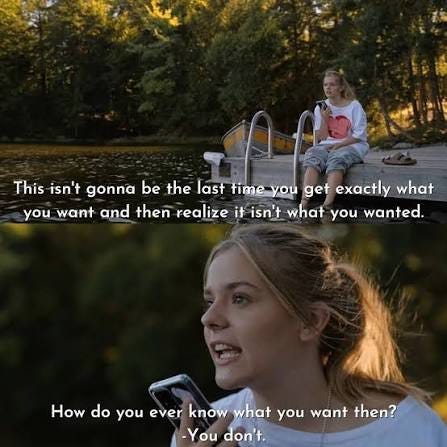
I recently watched My Old Ass, a film where a teenage girl on the cusp of moving for college meets her 39 year old self (Aubrey Plaza) while on a mushroom trip. In the movie, the older self tells her teen self the age-old sentiment: “The only thing you can’t get back is time. It goes by so fast.” This got me thinking: why does everything move so fast in adulthood? It’s not as if time moves any differently after you turn 18. There are multiple theories by psychological researchers on this, but one theory is that of the Oddball Effect: when something out of the ordinary happens among typical, standard events, the duration of that moment seems more exaggerated. When you’re a child, adolescent, or young adult experiencing the world for the first time, novel moments stand out, and in turn feel slower, as you experience them. Everything around you is so new that you take in more of the world, and your passion for it is still raw. Adulthood speeds up as the world and our experiences within it become more familiar. Our days become limited to checklists and arbitrary methods of demonstrating achievement, as we are no longer taking in the wonder of experiencing for the first time. Youthful eagerness turns into rigid requirement.
Again, from Simone Weil’s “Attention and Will”:
In our sense perceptions, if we are not sure of what we see we change our position while looking, and what is real becomes evident. In the inner life, time takes the place of space. With time we are altered, and, if as we change we keep our gaze directed towards the same thing, in the end illusions are scattered and the real becomes visible. This is on condition that the attention be a looking and not an attachment.
“This is on the condition that the attention be a looking, and not an attachment.” We attach pressure and reputation on experiences that are supposed to be lived, limiting our ability to see our own reality. Learning to look at something with the curiosity of a child, or the excitement of a teenager on the brink of moving away, we can find a kind of freeing indifference that opens us to more possibility, rather than minimizing our experiences by measuring them based on attachments we ourselves have established.
6 years ago, the pandemic hit while I was in the worst depression of my life, living 4 hours away from my family in a small mountain town. I had a full-ride scholarship to the school I was attending, but I wasn’t sure at that point how I’d convince myself to live long enough to graduate, so when COVID lockdown began, I transferred schools and moved back in with my parents. I worked multiple jobs while doing Zoom school, but I still graduated on time. I dedicated more time to falling in love with my partner, who lived in my hometown still, and the best friends I had once left behind that I eventually moved in with.
I promised myself after that, that I would always do whatever is necessary to move my life in the direction I wanted to, even if it’s terrifying. The whole “do one thing every day that scares you” shtick, but on a more cosmic scale. Kind of ironic, considering the scary thing I did would be considered backtracking, returning home. I still firmly believe in this philosophy, but I fear I’ve compensated too far—I’ve been so anxious to prove to myself that I could take in every drop of the world that I became too eager for the next drop, forgetting that this pact I made with myself came from regaining my joy and identity through returning to what was once familiar.
I fear this is leaning toward bootstraps-inspirational self-help audiobook (How to Get Your Life Together: Stop and Smell the Roses (and get off your phone!)), so I’ll get to my final point. I was inspired to write this post, and to follow my thought of identity indifference, thanks to this Anaïs Nin quote from her diary:
I am now twenty-six and have done nothing. No book, no stage career, a lot of unsatisfied desires, and a realization that I am but half of what I hope to be. But I am terribly, profoundly happy, and terribly, profoundly unhappy—I am alive, thank God!
Isn’t this what it is to be excited about living? Being simultaneously terribly, profoundly happy, and terribly, profoundly unhappy? Feeling both at once, not knowing when the scales will tip? When did my dreams flatten into ambition? When excitement became overshadowed by expectation. When the boundless prospects of a future straightened into a timeline. When I began to fear unhappiness so incessantly that I tried calculate it away, forgetting that unhappiness can be a tool for learning.
We are in a restless world, in a restless time, convincing each other and ourselves that our restlessness should be mended by productivity and distraction. I want to keep living with the unknowing excitement of moving to a brand new city without any plans. The excitement of going on a road trip as a kid. The excitement of falling in love with someone new. Even when something isn’t new, when it’s a part of a routine, when life is settled, I can choose to look at it with curiosity, to be indifferent and unattached to any set rule about how my life is supposed to go. It’s finding interest in the 99% boring parts of life that lead to the 1% interesting parts. The interesting parts are usually too high stakes and anxiety-inducing for me to fully soak in, anyway.
Simone Weil, one more time:
We should be indifferent to good and evil but, when we are indifferent, that is to say when we project the light of our attention equally on both, the good gains the day […] A divine inspiration operates infallibly, irresistibly, if we do not turn away our attention, if we do not refuse it. There is not a choice to be made in its favour, it is enough not to refuse to recognize that it exists.
What do we focus our attention on? Does focusing on what we haven’t done, what we wish we had, actually bring motivation? How can we work genuinely with what we have and allow space for genuine inspiration, outside of our own ego and desires, to shine through? Is the answer to this winding piece to just to go touch grass? Yes, but I mean that more literally than figuratively (grass is lovely and can be grounding because it’s, well, the ground).
I find that the people who inspire me the most are the ones that play life with a level of detachment from the rules I myself end up falling for. My friend who yells “No, YOU’RE beautiful!” at the man catcalling us on the street. My youngest brother, who doesn’t speak, but spends all day humming different tones, listening to the way they echo in different settings. My partner, who convinced me to adopt a 3 month old kitten just a week before we moved across the country with minimal plans or belongings. I’m endeavoring to live my next year with their level of curiosity, with an understanding that my perspective is my own to bend, living within happiness and unhappiness and being grateful that I am alive—thank God!
Comments
Nothing yet. Say the first thing.
Sign in to join the conversation.