
Hi. Welcome back to “the second taste,” my not-so-monthly recap of everything swimming around in my head to quench my sort-of-maybe-voyeurstic thirst for vulnerability.
It’s been a while. The last time we spoke, I was reading The Passion According to G.H. by Clarice Lispector. For those that not familiar with this niche Brazilian banger: The Passion (I’m shortening it for typing reasons, not to be mistaken with the Of the Christ variation) is the philosophical internal monologue of a sculptor that enters her maid’s bedroom for the first time, crushes a roach, and faces an existential crisis as a result. In the latter half of the book, G.H. begins to uncover compartmentalized memories from a time she spent with a past lover, interspersed with her discoveries about human nature. A specific reflection on pg. 82 has stuck with me since finishing the book:
Every word of ours — in the time we called empty — each word was as light and empty as a butterfly … In those intervals we were thinking of ourselves as resting from one being the other. Really it was the great pleasure of not being the other: since that way each of us had two. Everything was going to end, when what we called the interval of love ended; and because it was going to end, it weighed tremulous beneath the very weight of its ending already in itself.
I was subtly thinking a lot about liminal spaces, and liminality in general, before reading this. I thought of 2025 as a kind of mental liminal space in my life; I spent the year working on projects that were either already established or weren’t yet ready to show the world while working the same job I’d had for several years with no upcoming signs of change or mobility. Everything was stable and happy overall, but I felt as though I was teetering in between a before and an after, waiting for something to happen. The foundation to becoming a new person, whoever the hell that is, was there, but I hadn’t yet been pushed to the other side.
I’ve been fascinated with liminal spaces before I even knew what they were, consistently finding an eerie comfort in long car rides, quiet parking lots and empty public bathrooms. While liminal spaces are typically considered areas of transition (hallways, waiting rooms, etc.) I interpret their significance as halfway points between lived reality and something else. The “something else” can be up for interpretation, with some liminal spaces literally portrayed as halfway points between our world and others, as with The Backrooms or The Upside Down in Stranger Things (before it was bad). They can also be quiet, non-engaging places that harbor unease paired with strange familiarity, leading to revelations about what lies at the edges of our reality. In The Passion, G.H. enters her maid’s room, a dusty space outside of her controlled existence, and it serves as a portal into discovery.
Psychologically and anthropologically, liminality is defined by moments of being caught in the middle and the disorienting feeling of occupying two spaces. As G.H. says, “Everything was going to end … and because it was going to end, it weighed tremulous beneath the very weight of its ending already in itself.” I think that is why liminality can be so anxiety-inducing — the low rumbling in your ribcage, the uneasy understanding that the monotony of the liminality will not last. You wonder how long you will be living in the shadow of two.
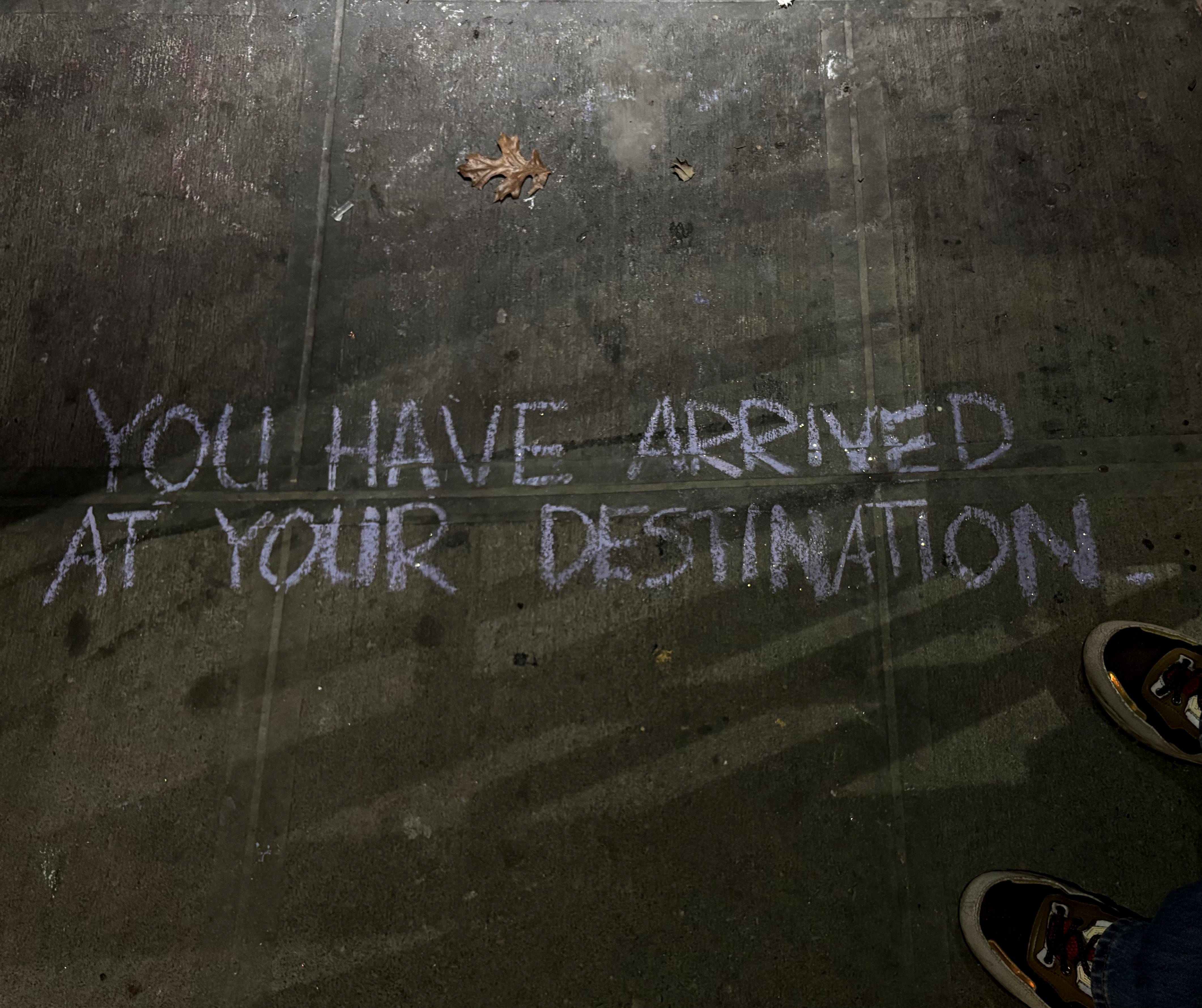
In March, my partner and I were let go from our jobs within an exact week of each other. We had both been working the same roles for 3-4 years, both growing restless within them, but using them as enough financial security to make it by while waiting for our next steps. The night I lost my job, I wrote this in my journal:
I lost my job today. I’ve decided that it feels romantic, in a sense. When the panic of survival settles, all that is left is openness. It is an empty field, suddenly, a removal so abrupt that I am forced into being conscious of the existence right in front of me— I am facing the randomness of future and present head-on. It’s an ancient, humming battle, the human body vs. possibility and circumstance, again and again and again. Perpetuated by systems surrounding us, no doubt. The lack of stability is nothing to romanticize, but I have no choice but to face this challenge. I can only hope that I can look it in the eye and create something out of it.
I’ve never known liminality, empty time, as deep as unemployment. The tightrope walk between two realities grows longer, and the ending of the interval is nowhere to be seen. Everyone told me to enjoy it as long as I could. Who knew the next time I’d have this much empty space around me?
To quell my anxieties over not having a financial source, I had to try to embrace the lightness that comes from having less responsibilities, but this can be disorienting. It’s easy to connote being “in between phases” as being too transient, not responsible enough, or “low-achieving” — narratives that force a lingering weight of guilt over not being able to control certain aspects of life and not already achieving specific levels of success. And just because I know those narratives are bullshit and I’m just a person doing my best with my circumstances, conditioning to over-achieve and prove yourself at every point of your growth can make a stumble feel like an it’s-all-over kind of fall. It’s been a practice at reshaping how I measure success, against measurements that I’ve adopted from the culture around me and the people that never wanted to see me fail. It’s been heartbreaking to break up with standards of success passed on to me by people that love me, but I’m learning that I won’t actually learn anything from change if my guilt restricts me from experiencing it with flexibility and grace.
So, I had to more deeply resonate with what G.H. in The Passion refers to as “the great pleasure of not being the other: since that way each of us had two.” In this unguided time, Angel and I found comfort in conversations fantasizing about the possibilities awaiting us and long-awaited projects we could finally work on with the free time, trusting that rather than sitting in between a present and a future self, we were in a rare time of personifying so many selves, with identity and time living in all of the opportunities that will trickle in and around and away from us.
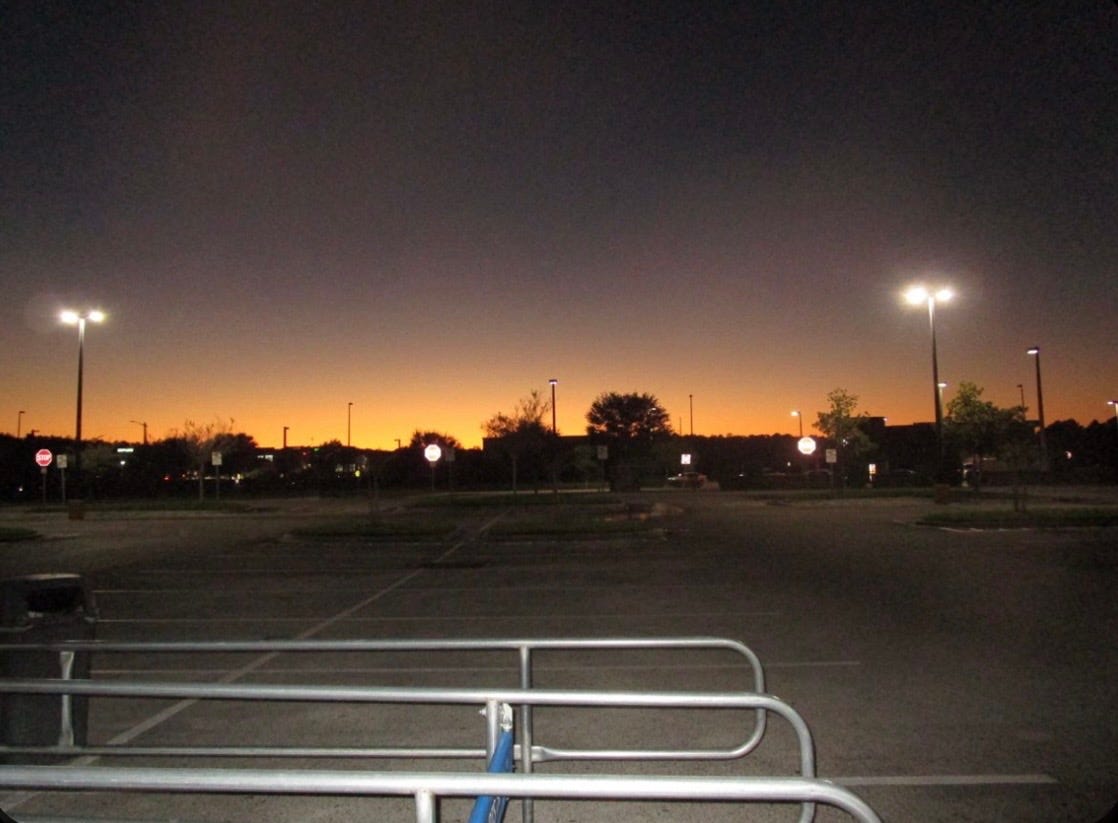
In the moments I wasn’t panic-applying for jobs, I found myself fantasizing a lot about mostly-empty parking lots in Tucson and the dinner table of the first apartment where my parents and I lived Germany. I still can’t pinpoint why, in a moment where I’m crushed by the weight of in between, I find comfort in these monotonous spaces. Maybe it’s the quiet that comes from a place being completely ordinary. Maybe existing in liminal spaces, both physically and existentially, is necessary in embracing our own monotony on the path to achieving moments that are unordinary. In another journal entry after I lost my job, I wrote:
I keep envisioning a diner. At night, I think. With warm lighting and dark wood. I also keep thinking about a grocery store, also at night, also with warm light. I wonder why I am being drawn to the orange light of my childhood dining room. As I take another step, potentially bigger than the steps before, there is romance in staying small, quiet, under dim the lights where I created and dreamt of neon-lit cities and fluorescent photo shoots. I return to the warmth, both suffocating and comfortable.
WHAT I’VE DONE
Shortly after we lost our jobs, we released the fourth edition of the magazine I edit, Disposable Parts. This edition is our best one yet, in my opinion. We received submissions from around the world, organized multiple photo shoots where I could try my hand at creative direction (which I still don’t entirely understand, but it’s fun!), and we had a sick release party at a Basecamp, a venue under an art gallery in Downtown Seattle. I also built our website with my own two hands and lots of YouTube tutorials. It’s continuously flourishing into something more than I ever expected it to be, and I’m going to keep following it as far as I can.
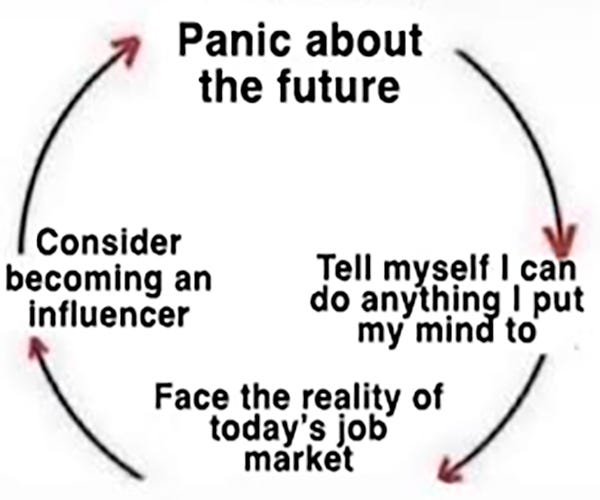
After the magazine release and website were finished, my unemployment free time gave me a lot of space to:
Think about my career goals
Research my career goals
Realize they’re competitive and freak out
Realize I will need to keep working my ass off and eventually move to New York if I ever want to achieve my career goals
Freak out a little more
Remind myself that I use my anxiety and imagination to Get Shit Done, and I can make anything happen!
Apply for writing and publishing fellowships
Wonder if, in the current state of the world, having career goals in journalism, editing, and publishing is straight up juvenile and ignorant at this point
Freak out a little more
Consider becoming an influencer
WHAT I’VE READ
My friends and I started a book club in December, which has become a flexible way for me to do a lot more reading than the measly half a book a month rate I was at before. It's the perfect setup, and I don’t have to face choice paralysis over what book to read next, because we’ve got a pretty solid queue lined up with everyone’s recommendations.
Rapid reviews of books we’ve read so far:
Stepford Wives by Ira Levin - while not revolutionary, important for starting conversations about second-wave feminism and woman/mother/wifehood
This is How You Lose the Time War by Amal El-Mohtar and Max Gladstone - cool concept that gets overshadowed by the flowery over-poeticness of the language, lost the ability to hold my attention by over-detailing everything
Boy Parts by Eliza Clark - as my friend put it perfectly: American Psycho, but Patrick Bateman is a beautiful female artist. I would never, ever read it again, but I couldn’t put it down.
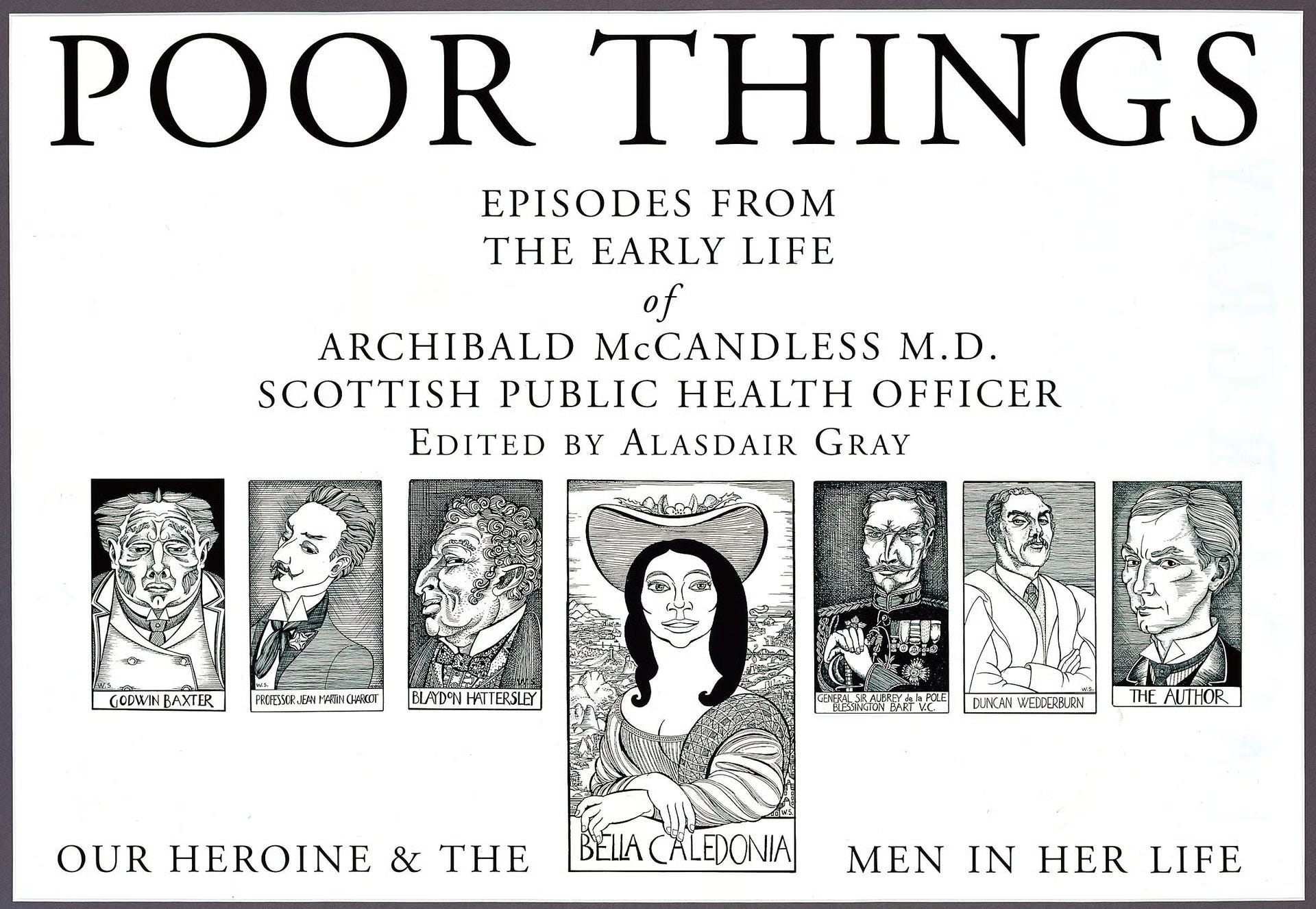
I’ve also been reading Poor Things by Alasdair Gray as a part of an unexpectedly long-going project I’ve undertaken of analyzing different iterations of the Frankenstein story. The novel is deeply self-aware without being insecure or deprecating, and the way Gray uses framing devices, letters, indexes, parenthetical, and anatomical illustrations adds an overall wacky, unworthy scientist vibe to the narrator of Archibald McCandless that I love (he was re-named Max McCandless in the movie adaptation, I assume for alliteration). I won’t say much more to save most of my analysis for the bigger project, but after rewatching the Poor Things adaptation by Yorgos Lanthimos while reading the book, I firmly stand by my opinion that the book is better, for some really glaring reasons. The movie’s style and costuming are still to die for, though.
WHAT I’VE LISTENED TO
“Caught in the Middle” by Paramore nonstop. Topical. I’m also still on the long, arduous journey of swapping my music from Spotify to Apple Music. It’s a lot less fun at this point, a lot more of a chore I’m just trying to get over with. Alas, we prevail.
Since music streaming-wise has been a bore lately, I’ve been throwing the FM radio on a little red cassette player in my kitchen. While radio ads are in my ultimate top 20 of things I HATE, I have missed the ease of trusting someone else (a human person, not Spotify AI) to curate my music, even if it is dad hair metal. Sometimes the music gods (underpaid radio DJ’s somewhere in my vicinity) can be prophetic with their playlists. On a morning when I was particularly emboldened by my opportunity for rebirth within unemployment, the KEXP radio hosts played “A Change is Gonna Come” by Sam Cooke, followed by the ever-inspiring “Heroes” by David Bowie, causing me even greater motivation while I ate my scrambled eggs and toast. This might be my own apophenia finding inspiration in random coincidence, but hey, what better vessel is there to random discovery than music?
WHAT I’VE WATCHED
I’ve watched a lot since we last spoke, but the most prominent in my memory have been Pen15, My Mad Fat Diary, and Project Hail Mary. While one of these things is not like the other, I realized (right now, while writing this) that there’s a strange thread of liminality between these pieces of media as well. For the first two, our characters are experiencing the liminality of adolescence, the awkward teetering between childhood and adulthood. There’s a lot more to divulge in with the characters of Pen15 and My Mad Fat Diary, like Maya in Pen15 also navigating the disorienting inbetween-ness of being both American and Japanese, and Rae from My Mad Fat Diary discovering the boundaries between the reality in her head, the reality in front of her, and how she must live in between them. In Project Hail Mary, Ryan Gosling’s character faces perhaps the scariest liminal space of all — literal. space. Meanwhile, all of Earth waits with its breath held before potential detrimental collapse. For the sake of space and spoilers I’ll refrain from diving more into these stories, but I thought it necessary to point out the connection here, especially because I really enjoyed all of these pieces of media. Perhaps a character is even more enjoyable when they are faced with being caught in the middle, and embracing it is sometimes their only option.
Talk soon, xoxo!
Thanks for reading analog fog! Share this post so we can all embrace our strange versions of liminality together.
Comments
Nothing yet. Say the first thing.
Sign in to join the conversation.