
20 de agosto 2026
Hola y welcome back to CubaCurious.
Thanks for being here.
It’s great to be back after a two-post break to catch up on Cuba news with you.
Choosing just three stories proved as hard as ever. In recent days:
Cuba suffered its sixth nation wide power outage.
Average Cubans, dissidents, activists, journalists, and political prisoners reported new acts of persecution and violations of their basic human rights.
Protests led by Cuban women and children grew in quantity, frequency, and intensity.
U.S. court records implicated Raul Castro’s grandson in human-trafficking, a boat-theft ring, and close involvement with Yucatan-based mafiosi, according to a New York Times article.
The U.S. expanded targeted sanctions against Cuban entities and individuals responsible for repression in Cuba and fostering subversive activities in the U.S., Convicted Cuban spy Fernando González was among those sanctioned.
I skipped those and chose the following tres scoops. I think they do a good job of showing the variety of ways that totalitarianism destroys individual freedom and civic power.
Uno—What shortages? The regime’s splurge for Fidel’s 100th b-day shows there’s plenty of electricity when it comes to propaganda.
Dos—Why did the Dominican Republic order 9 Cuban diplomats to leave the country? Alleged espionage or proven infiltration by Cuban agents at the 2026 Juegos?
Tres: Ministry of justice officials don’t like the Grand Commander Cuba’s Freemasons elected. Its message to the brotherhood? Try again, but elect the guy we tell you to elect.
Sorry I went long. There was just too much to share.
If hope you enjoy the post and that you click the heart, comment, share, subscribe, or restack to help others find CubaCurious.
Gracias—y hasta la semana que viene,
Ana
Sources: CiberCuba.com
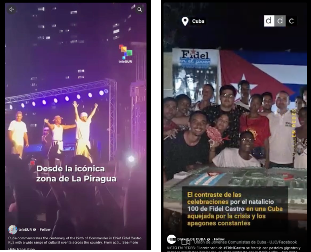
It boggles the mind. Just one week after the sixth total collapse of the national energy grid, amid the worst social and economic crisis in post-revolutionary history, the regime splurged on a four-day celebration of Fidel Castro’s 100th birthday (August 13th). The government-sponsored festivities—concerts, parties, conferences, panels, cake-cuttings—even a 100-piñata party—drew harsh criticism from average Cubans and activists in recent days. Many Cubans shared their outrage over the waste of precious resources—including hosting international brigades in luxury hotels—on social media and to the independent press.
“Those are the people who beat us with rods, the ones that put the yoke on us,” a man commented on a CiberCuba Facebook post showing images of the events.
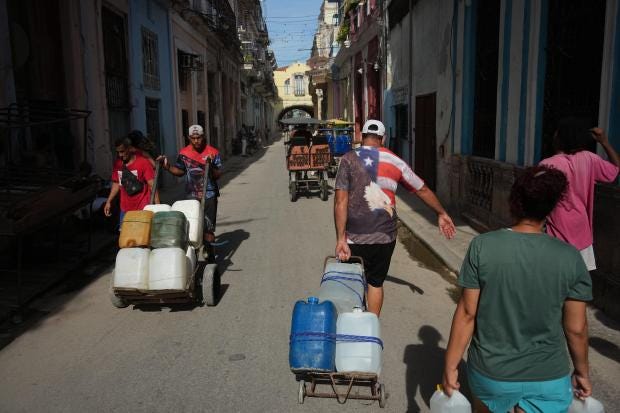
I understood why he felt separate from the partiers. They were well dressed, and most looked healthy, hydrated, rested. Nothing like the images I see every day of weary Cubans waiting for water trucks, banging pots in protest, digging in dumpsters, or walking like zombies under a blazing sun.
ón Espinosa)Residents of la Piragua, a barrio near Havana’s Revolutionary Plaza, were on their 30th hour without electricity when a large concert began near their homes. They responded with a loud cazerolazo (pot-banging protest) and blasted their own loud music, thanks to a few homes with generators.
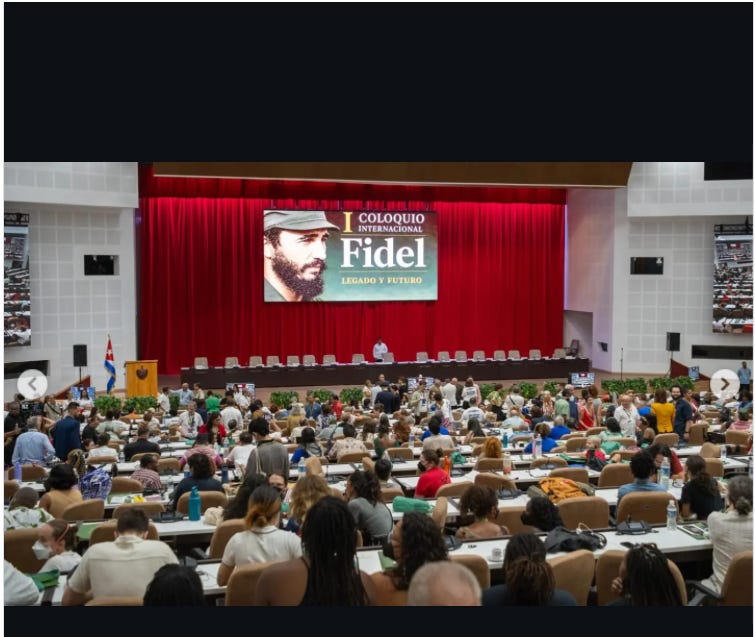
More than 1,500 delegates, including 1000 guests from 63 countries, gathered in the Palace of Conferences in Havana to honor Castro in the First Annual International Colloquium “Fidel: Legacy and Future.”
Cuban leader Miguel Díaz-Canel told the delegates that the “Historic Leader of the Cuban revolution” is still “the best compass we have to navigate through the storm the Cuban people face,” and that “Fidel belongs not just to Cuba, but to all who fight for “a better world.”
Díaz-Canel warned delegates that remembering and admiring Castro isn’t enough. Castro’s ideas continue to guide the country, he said, and should be used for the economic transformation needed to preserve the Cuban political system.
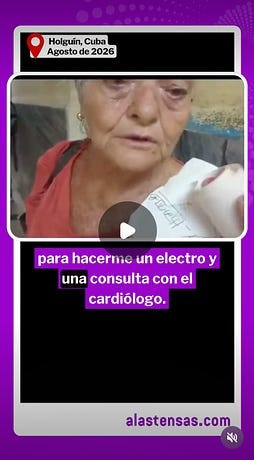
When I read that a 42-page program describing the festivities was distributed to guests at the venues, I thought of a Facebook reel I’d seen earlier in the day. An exhausted Cubana said she was told to bring paper to Lenin Hospital in Holguin for the EKG she needed. Off camera, a woman interrupts, “We have to buy everything, hypodermic needles . . . everything.”
Cuban leaders continue to blame the shortages on America’s campaign to “asphyxiate the Cuban economy and vanquish the Cuban people and the revolution,” as foreign minister Bruno Rodrigues wrote on X.
Yet, somehow, there’s enough paper, electricity, air conditioning, gasoline, food, ice water, soft drinks, and the scarcest resource of all in Cuba—joy—for the government to host a four-day celebration in honor of Cuba’s “Maximum Leader.”
Source: DiarioDeCuba.com
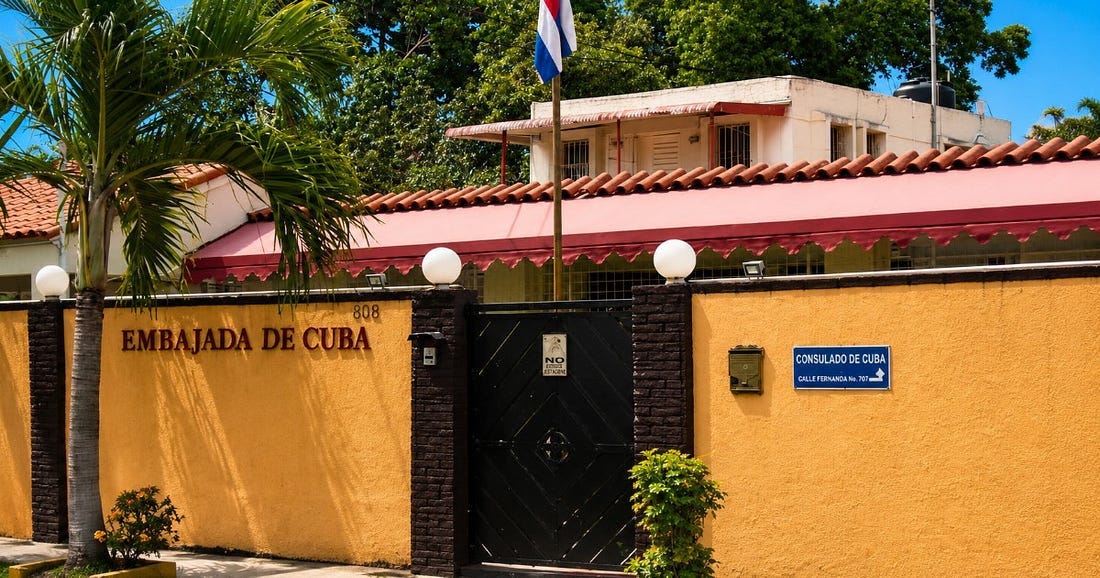
The Dominican Republic (DR) last Thursday ordered nine Cuban diplomats and their family members to leave the country within seven days. The announcement offered no explanations and led to much speculation. But an investigation published this Tuesday by Dominican newspaper Diario Libre points to Cuban agents’ infiltration at recent sporting events, allegedly to prevent Cuban athletes from defecting, as one cause.
According to Libre’s report, Cuban political agents wearing other team’s uniforms infiltrated at least two sporting facilities to pursue Cuban athletes attempting to defect. Dominican military security closed the doors of one facility after suspicions arose about athletes’ identities. Dominican security identified the disguised Cuban agents and expelled them from the facility. A similar incident occurred at a separate facility later that same day.
Another Dominican daily, El Día, disagreed with Libre’s analysis. High-ranking Dominican sources with direct knowledge of the incident told the newspaper that the cause for the order was the diplomats’ work for Cuban state security while in the DR. The government determined that activity “incompatible with the proper functions of a diplomatic mission.”
One of the five Cuban athletes who defected during the Juegos countered El Día’s views, telling 14ymedio that Dominican officials had warned him Cuban agents were looking for him and urged him to stay off social media to avoid being found. “They [Cuban agents] wanted to kidnap us in a country where they don’t have the right to do that,” the athlete said.
Defections by Cuban athletes at international sporting events have been occurring for decades despite close surveillance by their handlers and trainers, including the retention of their passports during the competitions.
On his X account, Bruno Rodríguez, Cuba’s foreign minister rejected the DR’s order, “in the most forceful terms,” and accused it of subjugating itself to the Trump administration’s pressure campaign for political change in Havana. He celebrated the “meticulous work” of the expelled diplomats. “They followed the Geneva Conventions for diplomatic relations and scrupulously followed the principles of #RevolutionaryDiplomacy, as do all of our officials in any international situation and in opposition to imperialist pressures.”
The diplomats were received as heroes upon their return to Cuba.
TRES
Ministry of Justice rejects Freemason’s choice of leader.
Sources: DiariodeCuba.com, TranslatingCuba/14ymedio.
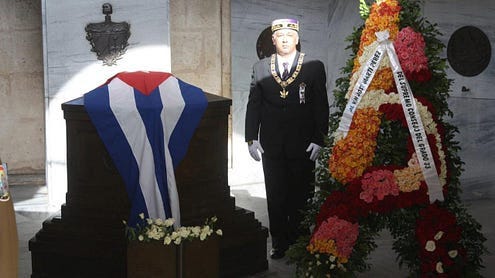
Freemasons in and outside of Cuba are standing by the Cuban fraternity’s election of José Ramón Viñas Alonso as Grand Commander, despite the regime’s continued attempts to oust him. State officials delivered a summons at the fraternity leader’s home, ordering him to present himself at the Ministry of Justice and turn over his post to Lázaro Faustino Cuesta Valdés, the ministry’s choice for the position. (Cuesta was ousted by the brothers earlier this year.)
Dozens of freemasons stood in support of their leader at their headquarters as a ministry official demanded they elect a new grand commander and that they “follow the laws of the country.” She said the state “would not recognize” Viñas as their new leader.
Viñas, the leader elected by the brotherhood, has been a target of repression since he objected to the Cuban president’s call to “combat” protestors during the countrywide protests of 11 and 12 July 2021.
The Grand Lodge of Cuba is a rare example of a nongovernmental group that survived the total ban on unapproved private associations imposed by the 1959 revolution. The fraternity has had to subjugate itself to government pressure ever since, including detentions, surveillance, harassment, fines, and interrogations of members and leaders. Some brothers have been charged with “disobedience” for objecting to the regime’s repression and interference.
Freedom of association is protected in Article 20 of the Universal Declaration of Human Rights (UDHR), adopted by the UN General Assembly on 10 December 1948 in Paris, France. Cuba was one of the forty-eight states that voted for the resolution, which was adopted without objection by any member state. Cuban scholars and its chief delegate, to the UN, Guy Perez Cisneros y Bonnel, helped draft and lobby for Resolution 217, a two-year multinational project led by Eleanor Roosevelt.
The world celebrates the adoption of the UDHR on 10 December each year. And each year Cuban dissidents, independent journalists, and activists report being detained, followed, harassed, or held under house arrest. Well, they report those human rights violations throughout the year, but they’ve learned to expect abuse as December 10th approaches. [Consider ending it here – the next paragraphs don’t really apply to the Freemasons]
Ironically, Cuba is an elected member of the UN’s Human Rights Council, the main UN body responsible “for strengthening the promotion and protection of human rights around the globe.” Cuba frequently uses its position to denounce U.S. sanctions and assert the right of each state to interpret human rights independently. It argues that criticism of human rights conditions interferes with countries’ sovereignty and self-determination.
But Cuba seems to have forgotten sovereignty and self-determination when they applies to Ukraine.
Ukraine has presented evidence at the U.N. showing how Cuba enabled Russian recruitment of thousands of Cuban mercenaries. Cuba has denied the accusations, asserted its opposition to mercenarism, and said it had uncovered human trafficking rings that had tricked its citizens into joining Russian forces.
How is it possible that a government that monitors citizens’ movements, embeds agents in schools, workplaces, and hospitals, and knows who is “liking” what on Facebook was unaware that an international human trafficking ring was operating across the island and sending thousands of Cubans to fight for Russia in Ukraine?
Okay. Not the best recording, but it is of the great nCuban composer Ernesto Lecuona playing his Malagueña live, in 1930.
Hope you enjoy.
No posts
Comments
Nothing yet. Say the first thing.
Sign in to join the conversation.