
1About 10 days ago, after spending 10 blissful days in Sardinia, we landed back home to a week of rainy weather. C went straight back to work (science apparently never sleeps) and I was left with three children who needed indoor entertainment. Since the prospect of watching Garfield on Netflix 8 hours a day was likely to erode my sanity, I made a carefully curated plan of museum visits.
The first two museums were, at least from my perspective, a roaring success. We started at the Kunsthal Charlottenborg where a series of interviews with some of the exhibiting artists played in a small screening room. It was interesting to hear their thoughts on their work and then see their actual artistic output. We even caught a glimpse of one of them in one of the halls and CA was a bit star-struck.
Two days later we spent a whole morning at the Hirschsprung Collection admiring Danish painters from the turn of the twentieth century and a special exhibition on the Swedish artist Hanna Hirsch Pauli. After feasting on high-quality art we headed to a late lunch of ramen and then to an arts-and-crafts shop where we bought supplies for the next assignment– draw the highlight of the day (see exhibit 1).
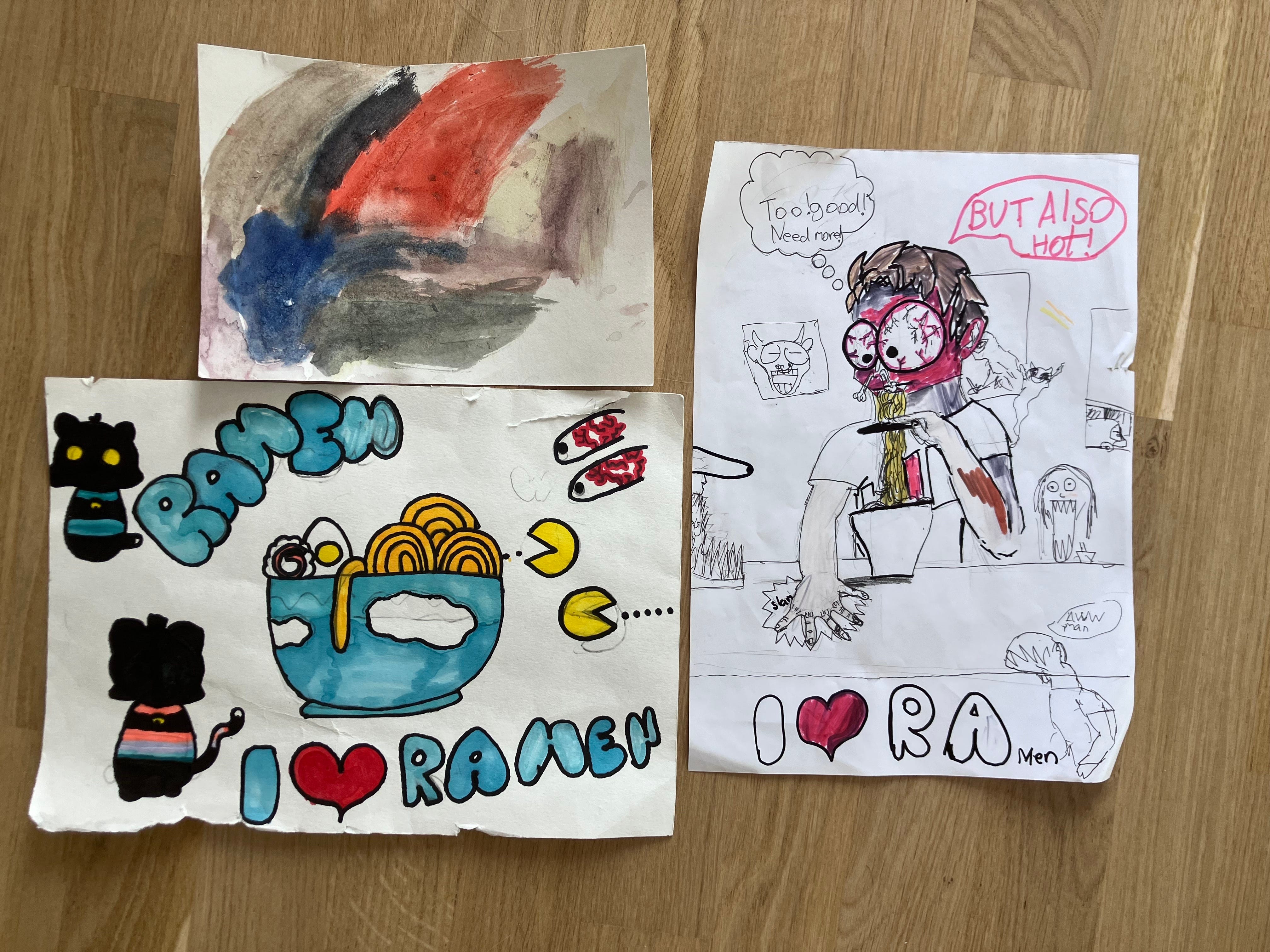
Educational outcome: three hours in one of Copenhagen's finest art museums, followed by a unanimous artistic tribute to lunch. Well, except for E’s masterpiece (top left panel) entitled Fire. I am unsure whether he was paying homage to Expressionism or simply wants to watch everything burn.
After that artistic debacle I remember my friends A and R recommending the children’s science museum Experimentarium and I decide to take them there. Of course, my idea was far from original and on this particular rainy day ALL of Copenhagen’s parents had the same brilliant thought.
What in my head had been planned as a day of absorbing science and the wonders of physical phenomena was transformed into a nightmare consisting of hordes of children shouting and pressing buttons. At some point, after my particular set of children had played a video game where one is supposed to activate first the innate and then the adaptive immune system to fight off an infection I ask them, “So, what have you learned?” They stare back at me with the blank expression of people who have not realised there was anything to be learned.
After that I give up, sit on the floor in a quieter corner, give them specific instructions on where to find me, let them loose in the jungle, and ruminate on how the museum's idea of learning clearly clashes with mine, and on the downfall of Western civilisation.
Since then, a number of rather pressing questions have been occupying my mind. No doubt we have replaced contemplation with interaction, but I was wholly unaware that we have come to believe that pressing buttons is inherently educational.
My summer has also been devoted to reading Philip Kerr’s Bernie Gunther’s series. When I first picked up the Berlin Noir saga I was baffled that I had missed this author completely until now. Philip Kerr is the perfect blend of Eric Ambler, Raymond Chandler and Graham Greene. His hero detective works in Nazi Germany and is full of flaws.
What I particularly like is that, in the novels set after the war, Bernie keeps returning to the same question: How could we let this happen? He realises that, although he tried hard to preserve his integrity (I won't spoil the books for you), he survived because he turned a blind eye. That made him complicit, and that is his torment. At one point Kerr expresses an idea that strongly echoes Viktor Frankl: the truly good people did not survive.
Kerr's novels have had me questioning the nature of evil and, ever the rabbit-hole digger, I wanted to learn more. That led me to Hannah Arendt, who, after attending Eichmann's trial in Jerusalem, articulated one of the most unsettling ideas of the twentieth century: evil does not always wear the face of a monster. Most of the time it looks alarmingly ordinary.
The trouble with Eichmann was precisely that so many were like him, and that the many were neither perverted nor sadistic, that they were, and still are, terribly and terrifyingly normal.
Hannah Arendt. Eichmann in Jerusalem: A Report on the Banality of Evil
I have not read Arendt. C suggested that perhaps I should not just yet because I had started spotting escaped Nazis in the supermarket. Instead I have taken a more edifying and hopeful turn. The thing is that one of Bernie’s struggles is how to keep a sliver of decency despite all that was happening around him. So the question “How do ordinary people become complicit in evil?” has been substituted with a more hopeful one: “How do ordinary people remain decent?” and since I fear twenty-first-century children are not going to find these answers in the interactive, albeit useless modern museums, it has become a more pressing one. This is how I stumbled upon Cicero's On Duties.
Now, before embarking on this journey, I needed some historical context. This is how I learned that Cicero is another controversial historical figure who tried with all his might to keep the Roman Republic a republic. As a Roman consul he fiercely opposed autocratic rule and dictatorships (Sulla, the Triumvirs, Julius Caesar, Mark Antony’s attempts at stardom, and finally, the source of his demise- Octavian Augustus). He was also a deeply flawed individual: vain and incapable of compromise. Now, here is the ironic twist, when he spotted that, after Julius’ murder, Mark Antony was presenting himself as the new Caesar, he took Octavian, merely 18 years old at the time, under his wing, with the idea of laudandum adulescentem ornandum tollendum basically- praising him, honouring him and then setting him aside. How things turned out were not according to plan. Octavian made Mark Antony an ally who demanded Cicero be executed as retaliation for the multiple insults endured in the Philippics. Thus, Cicero died2.
This made me curious about Octavian. The boy was cunning, determined, and, nepotism aside (he was Julius Caesar’s great-nephew and adopted heir, after all), by the age of sixteen he was accompanying Julius on campaign in Spain (Hispania back then), so one could argue he was also brave.
The comparisons with today’s youth are unfair but also totally depressing.
I was reading up on these feats when I overheard my eleven-year-old son arguing with his father that he could not possibly set the table for dinner. I heard myself pronounce, with indignation: “P, Octavian Augustus was invading Spain at the age of sixteen. What are you doing with your life?”
C’s raised eyebrow made me realise that my choice of role model is somewhat questionable.
Parenting is hard.
And now E wants to go back to Experimentarium for his birthday.

Apologies to David Foster Wallace for shamelessly borrowing the title of his hilarious book.
Footnote for those who found my attempt at compressing Roman politics slightly confusing: Mark Antony did not murder Julius Caesar. He did, however, want the power Caesar left behind. Cicero was horrified by the prospect of another strongman and insisted that Rome remain a republic. He therefore wrote a series of speeches, the Philippics, in which he subjected Mark Antony to a level of public abuse that would make modern politicians reach for their lawyers.
Antony eventually formed an alliance with Caesar’s heir, Octavian (the precocious child), and demanded that Cicero pay for those insults with his life. Octavian, who had every reason to be grateful to Cicero and, by most accounts, even liked him, replied, “OK.” Cicero was duly murdered.
If you think twenty-first-century politics is entertaining... oh boy, are you in for a treat with Roman history. More here.
Comments
Nothing yet. Say the first thing.
Sign in to join the conversation.