
I am excited to dive into poop transplants today. As someone that did a 2 week FMT regiment in the Bahamas in 2015—I have a personal stake in this discussion too.
FMT in the functional medicine and holistic world is viewed as the best way to rebalance your gut. FMT is often presented as the “golden ticket” out of the IBS hell hole patients may have been stuck in for decades. FMT is many patient’s last hope.
But, will FMT correct your IBS long term? I want to dive into this question from both my personal experience having done FMT treatment, from my patient experiences AND from the research perspective. If you are debating on hopping on a plane to find the perfect poop to transplant, I want you to have all the information.
One of the stickiest parts of evaluating if FMT is helpful for IBS is that the donors, stool collection methods, amount of stool used, delivery methods and post procedure strategies DIFFER widely in studies and in my experience working with patients.
For donors—some are “super donors” picked for specific characteristics in their microbiome. Where I did my FMT, they would have donors try to eat 100s of different plant varieties in each month. But, then I know other people who use family member donors that likely share a similar environment and lifestyle. The donor microbial profile could make a HUGE difference.
In addition, when stool is exposed to oxygen in the air, many microbes can die. How the stool is collected and processed matters A LOT. I have heard patients have friends poop in blenders and deliver it to their house. While that is such a good friend, the way they handled the stool likely leads to less ideal microbial profile.
Looking at studies, you also see different delivery methods—some are delivered in oral capsules and some are delivered during a colonoscopy. I believe there is still debate on what the best delivery method is, but will provide more insights a little later on.
Lastly—I believe that one of the most important determinants for long term success post FMT is how the new microbes are being fostered. The environment you create with your diet and lifestyle will dictate if the new microbes can survive and build a diverse community.
For instance, I was advised during and after my FMT to try to eat as diverse a diet as possible. Plus, the team would provide GOS prebiotic powder to take each day I was receiving FMT, which is a prebiotic that feeds many good microbes. But, in almost all the FMT IBS studies, their was no dietary guidance given.
Because their is no standardized practices, I believe it skews outcomes in research studies as well as in practice with my patients. It’s good to understand some of these nuances before we dive into the meat of our discussion.
In 2024, a meta-analysis came out looking at 10 randomized controlled studies concluded “a notable positive influence of FMT on short-term IBS-SSS and IBS-QoL. However, the long-term efficacy remains uncertain.”
Lets breakdown some of the other big findings and insights:
FMT via more invasive strategies such as during a colonoscopy, gastroscopy or nasojejunal tube led to better outcomes than oral (capsule) FMT. More adverse effects were also seen in the oral route
There are indications that FMT seems to lose efficacy across time and repeated doses help to continue symptom benefits for many. The authors suggest that repeated FMTs could be something to explore for long term IBS management
Depression did not improve in IBS patients following FMT
Most studies didn’t have tight donor criteria. They looked to for healthy individuals, but did not look for microbial characteristics that may help IBS patients.
I want to discuss each of these points in more detail.
First, the delivery route matters. Unfortunately, it appears that more invasive approaches benefited patients most. Logistically and financially, capsule FMT delivered orally could make FMT cheaper and easier to do. But, something about the capsule route didn’t work as well.
I hypothesize that the way the capsules were processed may have changed the microbial communities. For instance, the FMT capsules could have been exposed to more oxygen than the other FMT methods. Most of the beneficial microbes in your gut thrive in low oxygen environments. The change in processing and delivery could have led to certain probiotic bugs dying before they ever reach the participant’s colon.
Based on these studies—the oral route underperformed. I would opt for the gastroscopy route as this seemed to perform the best. But, I haven’t really seen this method being used often. If gastroscopy isn’t available, then I would use colonoscopy route. While these are more invasive routes, at least you avoid the gross factor of swallowing a bunch of poop pills.
Second, the authors point out that both benefits and microbial changes from FMT seem to be short term.
To me, this highlights that IBS is strictly not a microbiome problem. Many will argue until they are blue in the face that fixing the microbiome will fix IBS. But, the microbiome is an ecosystem that shifts based on many environmental variables. The microbiome is not static.
The microbiome needs the right conditions to thrive. It is like a garden. For a healthy garden you need nutrient rich soil, complimentary plants, weed control, water, sunlight and physical protection from predators like gates or fencing.
Microbiomes often become imbalanced due to gut brain axis dysfunction. To continue the analogy—a healthy gut lining and immune system serve as your microbiomes weed control and support good microbes. Your diet helps provide the gut lining and nervous system with the nutrients it needs to function optimally. Fiber/nutrients directly feed microbes. Your lifestyle can also nourish your gut brain connection to further optimize the environment for growth.
Yes, microbial disturbances can further disrupt the gut brain. Strategies like FMT could help shift the microbes in the gut to help with symptoms short term. But, unless fundamental breakdowns in the gut brain connection are addressed, the benefits of FMT will likely fade over time.
I have seen this with patients as well as my own case. Simply throwing new bacteria into the mix will not automatically fix your gut brain connection and send your IBS into long term remission. In my case, I felt like FMT was a jump start to my recovery. It reduced symptoms by about 50% so that I could focus on other strategies that were necessary for long term relief.
For instance, my diet was too restrictive and my stress was high. Once I had all these new microbes in the mix, I wanted to foster them. I became much braver about trialing new foods. I was taking supplemental prebiotics to keep my new microbes happy.
I also was in the process of restoring my weight after a significant drop the previous year due to restrictive eating and gut symptoms. I struggled with hormonal issues related to this weight loss like amenorrhea, hypothyroidism and elevated stress hormones. All of which resolved once my weight was stable. The symptom relief from FMT helped with this process too as I could eat more foods and gain weight more easily.
My life revolved around my gut symptoms pre-FMT. And after FMT, I felt more confident to go to restaurants and hang with my friends. I was also able to slowly add more exercise in as well.
When I went into FMT—I felt like I had tried everything. But, in reality, I had fundamental GAPS in my gut brain connection. While I found FMT was a helpful jumpstart, I believe if I would have directed more attention to the fundamentals, I would have achieved remission without FMT.
Like me, many of my patients who have done FMT as their HAIL MARY. I would say about 50% of the time, they are disappointed by the FMT result. The functional medicine myth that if you fix the microbiome that all your health woes will go away really sets FMT patients up for disappointment. FMT is not a miracle cure.
That doesn’t mean FMT couldn’t help reduce symptoms and jumpstart your journey. But, you have to have to give your gut brain connection what it needs to thrive. Throwing a bunch of new microbes into a garden with bad soil, too much shade and not enough rain will lead your microbiome to revert back to imbalance over time.
I wanted to add this in as an insight because many of my patients also blame their depression or anxiety on their poor gut heath or their crappy microbiomes. But, you can put in some shiny new microbes and still not see changes in mental health.
Depression and anxiety are multifactorial. The microbiome is almost never the primary driver for my IBS patients. There can be many factors leading to these conditions. The microbiome may be a small part in these symptoms, but in practice I do not usually see strong changes in mental health just from microbiome interventions (whether FMT, probiotics, prebiotics, etc).
Reducing gut symptoms could help reduce anxiety and depression for individual participants, but this didn’t seem to bear fruit across the board. You still have to support the unsexy basics to help with mental health challenges. Often times my patients benefit a lot from interventions that help them respond differently to their symptoms like CBT, mindfulness based stress reduction and hypnosis. Seeking out professional support in these areas can be a key component to tackling both your IBS and mental health.
One of the biggest problems with the data we have on FMTs for IBS is the lack of ideal donors. As mentioned above—the processing and methods matter for FMT, donors matter just as much (maybe even more).
Only 1 study tried to find a “super donor” with specific microbiome characteristics. And the participants of this study the best short and long term outcomes.
This study was a randomized controlled trial and participants were either given a one time 30 g FMT, 60 g FMT or placebo (sample of own stool). The researchers tracked these cohorts over a number of years for follow up.
This appears to be the only study where the researchers had the donor perform a stool test to determine if his microbiome profile was good. I have no idea why the other researchers didn’t try to find the a great donor.
Stool testing isn’t overwhelmingly expensive at this point. Running a stool test on 10-15 healthy people that meet other health criteria and selecting the best one seems like a reasonable thing to do before doing the FMT, but it appears that this was not the norm in most of these studies. In my opinion, lack of super donors in all the FMT studies likely led to FMT underperforming in the meta-analysis.
This study had the best results. Lets first look at the initial results that tracked the participants outcomes at 3 months after FMT or placebo for both the 30g and 60 g groups. I also want to post the IBS-SSS (IBS symptom severity scale) breakdown to give you an overview of what the scores mean.
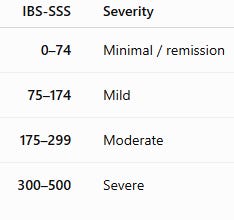
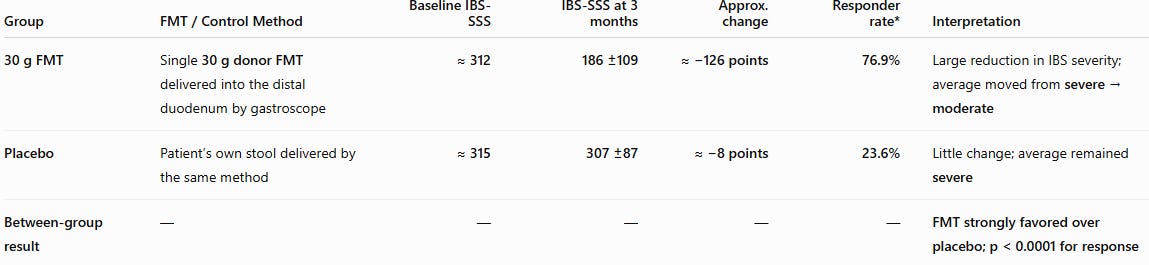
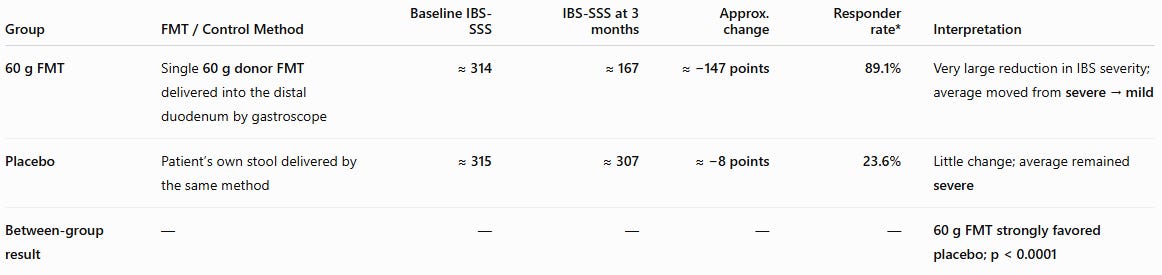
I believe it is important to point out that the participants of this study have severe IBS. Both the 30 gram and 60 gram interventions had significant reduction in IBS severity. Placebo did not change at all.
The responder rate (>50 point reduction in IBS-SSS) being almost 90% in the 60 gram group is IMPRESSIVE. Low FODMAP isn’t even close to that that. Usually responder rate for low FODMAP is somewhere between 50-70% and typically the degree of change in IBS-SSS is not as steep.
But, what was interesting—these participants did have sustained effects across time. The researchers looked specifically at responders in a follow up study and they found at the one year mark that the responders were still maintaining their FMT benefits.
Why do these FMT patients have more sustained benefits compared to other studies?
I think it could be multifactorial, but the initial symptom improvement was greater than any of the other studies—likely due to a better donor. This trial was the outlier compared to the other FMT for IBS studies.
The trial participants in this study were not given any diet advice to follow post treatment. However, there was a major shift in responders food avoidance behavior at the 3 month and 12 month check ins. The FMT responders started to eat more foods and didn’t restrict as much. They likely felt more confident with foods as symptoms were reduced.
We don’t know exactly what the food expansion looked like. But, I would assume that many of these participants would be eating more prebiotic foods as they expanded their diets. More diet diversity is usually better for microbiome stability. I wish we had more concrete data about what the dietary patterns were like.
Symptom reduction improved quality of life, which likely helped participants show up more in their day to day life. They were likely able to be more present connecting to loved ones and enjoying hobbies/passions more.
I still believe that likely many who achieved more long term benefit were able to fuel their gut brain better due to the initial symptom reduction from the FMT treatment. It was like a booster to make IBS proofing strategies much easier.
It’s also important to state that IBS severity, on average, didn’t go into remission from these treatments. Symptom reduction was really positive, but IBS was still present at the end of the study for many patients. On average, the IBS severity went from severe to mild, which is HUGE. Within responders—some could have had more modest reductions and others may have actual achieved remission.
The lingering symptoms that many patients still may have post FMT could be related to other gut brain deficiencies that need support.
I believe with the right donor and methods FMT can be helpful to reduce symptoms in IBS. FMT can help to band-aid gut brain axis issues. For sustained relief, you still have to make sure that you are nourishing the gut brain connection. FMT can make it easier to focus on IBS proofing like diet diversity and lifestyle change.
For many with IBS, FMT could jump start recovery and help you ride the wave of relief while strengthening your gut brain connection for long term microbiome and IBS wins.
That being said—FMT is not widely available in the US and is strictly reserved for C. Diff infections. Donors are often not exceptional. There are many other IBS approaches that reduce symptoms.
Don’t feel like you are doomed if you can’t get FMT. I have worked with severe IBS cases and have many tricks up my sleeve for stubborn cases. Like I said earlier, I believe I could have achieved the same outcome without FMT, especially with the right strategies to help me manage symptoms and focus on nurturing my gut brain connection. These strategies are much cheaper and don’t involve traveling to the Bahamas for poop lol.
And I still had symptoms post FMT that were significant. It took another couple of years shifting habits to really feel 100%. I still had to do the work. FMT was a short cut that helped me get closer to my goals, but didn’t reverse my IBS by itself.
I would love to hear your thoughts or experiences with FMT. Please leave in the comments below.
If you are struggling with IBS and looking for more support, set up a free discovery call to see if we make a good fit.
No posts
Comments
Nothing yet. Say the first thing.
Sign in to join the conversation.