
Earlier this year, I wrote an essay on my experiences of dissociative episodes.1 I reflected on a particularly intense episode back in autumn of 2025, and realised afterwards that it was the first time I had properly tried to put such an experience into words. I found myself questioning why this was: I feel quite comfortable talking about other aspects of my mental health, which I’ve struggled with, like anxiety and depression. I feel like I can be very open with my friends and partner about these things, and have spoken about them in academic and social media settings too. But something about dissociation feels different for me.
I don’t think I’m the only person who finds this hard to talk about. One review of the research estimated that at least a quarter of people will experience a dissociative episode at some point in their lives2. Despite this, I seldom hear people speak about their experiences of dissociation. I’ve spoken to many friends, colleagues, and acquaintances over the years who have opened up about other mental health problems, but we’ve never touched on this. Statistically, at least some of these people have probably experienced dissociative episodes. I suspect it’s common to find this hard to verbalise, despite openness to discussions around mental health in general.
So why do we feel this way?
Like with most questions in psychology, I don’t think there’s a single definitive answer. I have spent quite a while mulling over my own feelings about it, and had some very thoughtful and interesting comments on my previous post and the related video I had shared on TikTok3.
Below, I try to explain some of the interconnected reasons behind my hesitation to open up.

1. There is something inherently difficult about putting my dream-like state into words.
I experience dissociation as a floating, foggy state that I can’t step out of. I can function within it, but it just feels so weird that it sort of evades description. Or rather, any description that I can come up with sounds abstract and poetic, overladen with metaphors, and is not the sort of thing I can casually drop into conversation. “How are you today, Amy?” “Ah, well, I feel like I am floating through the day, propelled by the current of a river, surrounded by fog with noise-cancelling headphones on. Thanks for asking. How are you?”
Whereas I do feel like I could say, “I’m feeling really anxious lately, and that feels quite hard to deal with today”. There’s something more concrete in that, or at least more baked into our day-to-day language. I can feel fairly certain that the other person will know what I’m talking about, and can probably relate to some degree.
I’m not the only one who feels this way: A 2020 qualitative study4 interviewed twelve people who had experienced dissociation in the context of psychosis, and found that participants struggled to put their experiences into words, contributing to a difficulty in opening up with others. It makes a lot of sense that an experience defined by a sense of strangeness and otherness is tricky to verbalise.
2. There’s a fear of stigma or judgement attached to dissociative experiences.
I think a part of that difficulty comes from a fear of judgement. There is definitely a part of me thinking, “I can’t say that, because I will sound batsh*t crazy if I do”. Of the people in my immediate circle, I’d be hard-pressed to find someone who doesn’t have a basic understanding of what ‘anxiety’ means, but I can’t say the same about dissociation.5 That lack of awareness certainly sits at the back of my mind when I consider talking about my experiences and how that might be received. It can be really exhausting talking about one’s mental health, and that is particularly true when you also have to explain the basics of the thing you’re experiencing.
Of course, this creates a vicious cycle:
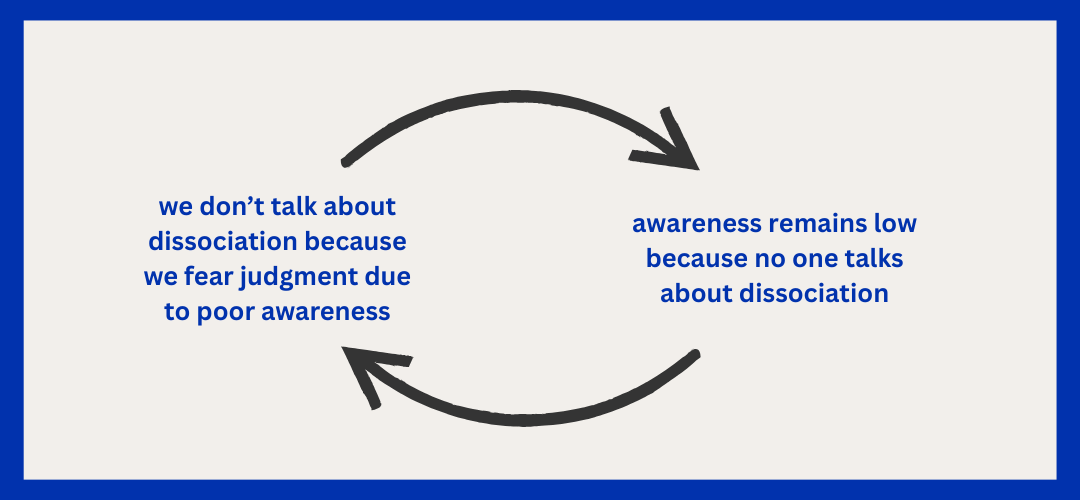
This is part of the reason that I decided to open up a little about my own experiences online—to open up an avenue of conversation, and to hopefully connect with others who had experienced similar things.
3. There is huge diversity in our lived experiences of dissociation, which might make it harder to connect with others.
‘Dissociation’ is not one experience, but a family of related ones. Various words exist to describe different ‘types’ or ‘categories’ of dissociation: depersonalisation, derealisation, detachment, compartmentalisation, felt sense of anomaly, etc. I won’t go into the details here, but in short: it’s quite confusing, there’s some degree of overlap between different terms, and definitions can be fuzzy in daily conversation, mental healthcare settings, and research settings alike.
Even within one ‘type’ of dissociation, two people’s experiences could differ dramatically. Take derealisation, for example, which is what I experience. This describes a disconnect from one’s surroundings, which might incorporate other people and/or the environment around oneself. One person might describe feeling like they’re viewing the world through a glass screen or thick fog. Another might describe a sense of unfamiliarity with people they know (even close friends and family) while in this state.
Sometimes when reading other people's descriptions of derealisation, I find myself thinking: yes, but that isn't quite what it feels like for me.
I think this contributes to some of our difficulty in talking about our experiences: perhaps we fear that we won’t be understood even by others who identify with the term ‘dissociation’, or fear that our own experiences are somehow either ‘weirder’ or less ‘severe’ and worthy of support compared to those of others.
4. There is something very vulnerable about being in a dissociative state, so silence can be self-preservation.
The final reason I could pinpoint was the sheer vulnerability of these experiences. It’s hard to emphasise how unnerving I have found my own dissociative episodes in the past, and I have felt a strong sense of protectiveness over myself during, and following, these. It feels like during the episodes, my brain is withdrawing me from my surroundings as self-preservation; after the episodes, maybe my hesitation to talk about what’s just happened is an extension of that self-preservation.
When I posted my last piece and shared a short companion video on TikTok, several people shared their own experiences in the comments. A theme that came up was dissociation happening during particularly vulnerable periods: pregnancy, postpartum, grief, and emigrating to a foreign country were all mentioned. It makes sense to me that we try to self-preserve during such times by going inwards rather than vocalising how we’re feeling to others.
While I’ve been writing this piece, I feel very aware that there are probably important reasons that I have missed. I also know that there are people with vastly different experiences of dissociation than mine (see point 3). I can’t speak for them, and I don’t want to.
But this highlights the importance of opening up this conversation. If dissociation is genuinely as common as the research suggests, then many of us are having these experiences in silence, perhaps feeling much more alone than we need to be.
I felt really moved and validated by many of the comments on my previous essay and videos. If you have thoughts that you would be willing to share, I would love to hear them in the comments.
Thank you for reading this piece. Amy Catriona is a reader-supported publication. To receive new posts on mental health and support my work, consider becoming a free or paid subscriber ★
If you’re looking for support resources related to dissociation / depersonalisation, I have found this site very helpful for trustworthy, practical advice: https://www.midlands-ddc.com/for-you
after the fog: an attempt to describe my dissociation. Published 08-03-2026 on @amycatriona.
The epidemiology of depersonalisation and derealisation. A systematic review. Hunter, Sierra & David, 2004. (NB: this review was published over 20 years ago.)
https://vm.tiktok.com/ZNRua83B9/ . Posted 08-03-2026 on @amycatriona.
Describing the indescribable: A qualitative study of dissociative experiences in psychosis. Černis, Freeman & Ehlers, 2020.
This is not to say that it is always easy to speak about anxiety, and there is certainly still a lot of stigma around even the most common mental health problems within many communities. However, in my own experience, it has been easier to have both surface-level and in-depth conversations about my anxiety than my dissociation.
Comments
Nothing yet. Say the first thing.
Sign in to join the conversation.