

An uber-important earnings season is upon us. Sandisk’s Q3 earnings was important in shaping the outlook for the memory/storage industry.
Join us as we help hundreds of investors navigate the rapidly evolving AI innovation landscape amid a potentially tricky Q1 earnings season, identify rock-solid businesses with strong growth trajectories & operational grit and deliver proven alpha-generating returns.
Since March, the TPO Portfolio delivered returns of 18%, significantly outperforming the broader indices.
We just finished our first major week of earnings last week, which showed America’s tech companies are belligerently churning out strong profits, while markets have largely stopped caring about the Iran war.
Earnings calls from last week did bring up some whispers about oil prices, the war, and an increasingly chaotic global supply chain, but the consensus was clear among all tech CEOs: memory/storage is a problem.
It’s not just tech CEOs. Even frontier model companies are beginning to think about solutions in their frontier AI models. DeepSeek dropped its latest v4 model, which demonstrated an immense focus on optimizing memory utilization and shows that there is a concerted effort in finding consensus solutions to the memory bottleneck.
How is that impacting the prices of memory components and the demand for these products? And what does this mean for shares of Sandisk SNDK 0.00%↑ and Micron MU 0.00%↑ that have gotten fat with gains in investors’ portfolios? More importantly, why is Sandisk choosing to diversify its business model now?
We update our outlook on Sandisk and Micron below by weighing tech earnings, new frontier models, and some surprising trends in the prices of DRAM and NAND Flash.
📌The TPO Portfolio has staged an impressive rally since March 1, now up 18% 💪, significantly beating the S&P 500 and benchmark ETFs that include AIQ AIQ 0.00%↑, GRNY GRNY 0.00%↑, IVES IVES 0.00%↑ and SPRX SPRX 0.00%↑ during this period of time.
You can track our entire portfolio and all our live trades in the AI Stock Tracker 2.0 tool using the link below. 👇
Unlock Access to The TPO Portfolio
(Paid Members can access the AI Stock Tracker 2.0 directly from here)
Hyperscalers & AI Infrastructure spoke mainly about 3 bottlenecks in their supply chain, and one common theme stood out: prices of memory and storage components.

For example, Meta Platforms META 0.00%↑ explained that a big reason for the social media giant to hike its CY26 capex budget by another 16% to $145B was due to higher component costs, “particularly memory pricing.”
Microsoft MSFT 0.00%↑ echoed a similar line of reasoning to raise its own capex but went further ahead. Microsoft’s Amy Hood said that the company was also raising its own CY26 capex budget to $190B, an increase of ~$50B from prior capex budget projections. But Hood also revealed that half of the ~$50B was due to “the impact of higher component pricing,” seen in components like memory.
Amazon AMZN 0.00%↑ had an entire section of its Q1 call last week dedicated to discussing memory and storage prices. Amazon’s Andy Jassy acknowledged that the entire AI industry is in a stage where “there’s just not enough capacity for the amount of demand,” when it comes to memory & storage.
Even semiconductor and AI infrastructure players like Intel INTC 0.00%↑ and Celestica CLS 0.00%↑ acknowledged the potential impact of higher memory component prices on their respective margin profiles. While Celestica affirmed the same concerns that hyperscalers noted earlier—labeling “custom silicon and memory” as “constrained commodities”—Intel warned that “key components like memory, wafers, and substrates are driving higher costs,” which could impact demand later this year.
However, among all this concern about rising memory prices, Alphabet’s Google has remained surprisingly silent on the impact of memory prices so far this year. Apart from only calling out “energy” costs, Google has largely refrained from talking about memory or other component cost headwinds that Google’s peers were seeing.
That makes us wonder whether Google has already worked far in advance to secure its supply chain. Or is it the possibility of seeing tangible results from that dreaded TurboQuant paper that hit memory stocks? Especially when DeepSeek’s v4 dropped last week and showed the immense focus on optimizing memory utilization? Also, at a time when NAND/DRAM prices have finally stopped growing? (Yes, they have, and we’ll show this chart later in this post.)
Upgrade To Premium For Just $13.33/Month
DeepSeek dropped the latest v4 model ~2 weeks ago, coinciding with the launch of Anthropic’s Claude Opus 4.7. Both these models demonstrated powerful upgrades, but we thought DV4 (DeepSeek v4) was a lot more interesting from the perspective of memory utilization.
We suspect DV4 was written with one goal in mind: reduce TCO.
We went through DV4’s whitepaper and we recently elaborated our views here on that DV4 whitepaper. Without getting too deep in the technical end of the whitepaper, we believe DV4 was a strong attempt and probably the first commercial attempt by a major frontier AI lab to build on the theoretical efficiencies that the Google TurboQuant paper posited.
DV4’s paper claims to have made significant advances in memory utilization by compressing KV cache, the shorter-term memory of an AI model where these models actually think and reason, by up to 98%. Yet, at the same time, DV4 boasts a larger context window, the cheat sheet used by AI models to quicken the pace of thinking and reasoning, to a whopping 1M token window, a 7-8x increase over most other standard operating models.
These memory optimization advantages that DV4 claims via KV cache compression are similar to the goals of Google’s TurboQuant algorithm. DV4’s approach to compressing KV cache is different from the quantization approach that TurboQuant adopts, but what matters is the end goal is the same: KV cache efficiencies.
We believe that the significant compression in KV cache as purported by DV4, accompanied by the rapid increase in context windows, allows for the AI model to carry out its reasoning on accelerator chips itself. This might create some form of a divergence in demand for the HBM and Flash products sold by Micron and Sandisk.
Before we explain our views further, we quickly wanted to elaborate on Sandisk’s radical new way of doing business.
Sandisk created a silent storm last week, not because of the spectacular numbers the company put up in its Q3 FY26 ER.
Last week, Sandisk’s management said that they were making rapid advancements in diversifying towards their New Business Model or NBM (yes, that’s really what they call it… we know, such a boring name). Sandisk had already signed 3 NBM contracts with major customers representing $41.6B of forward revenue commitments over the next many years. 15% of that $41.6B is expected over the next 12 months. Sandisk also revealed that they recently signed 2 additional major customers already in the current quarter, taking the total tally of NBM customers up to 5. And management now expects NBM to account for 33% of Sandisk’s FY27 revenue base.
Before we explain NBMs from our perspective and the positive/negative impact on Sandisk, here’s a chart we made for investors to understand.
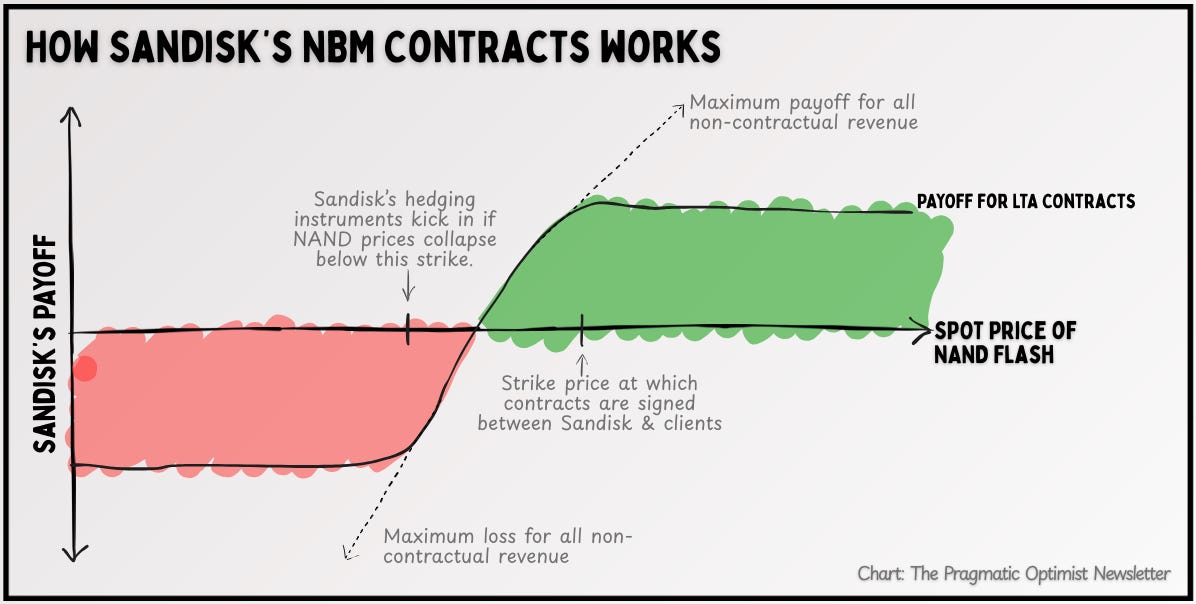
Here’s how these NBM contracts work and the changes to Sandisk’s business model which will impact how we view the company’s outlook.
Comments
Nothing yet. Say the first thing.
Sign in to join the conversation.