
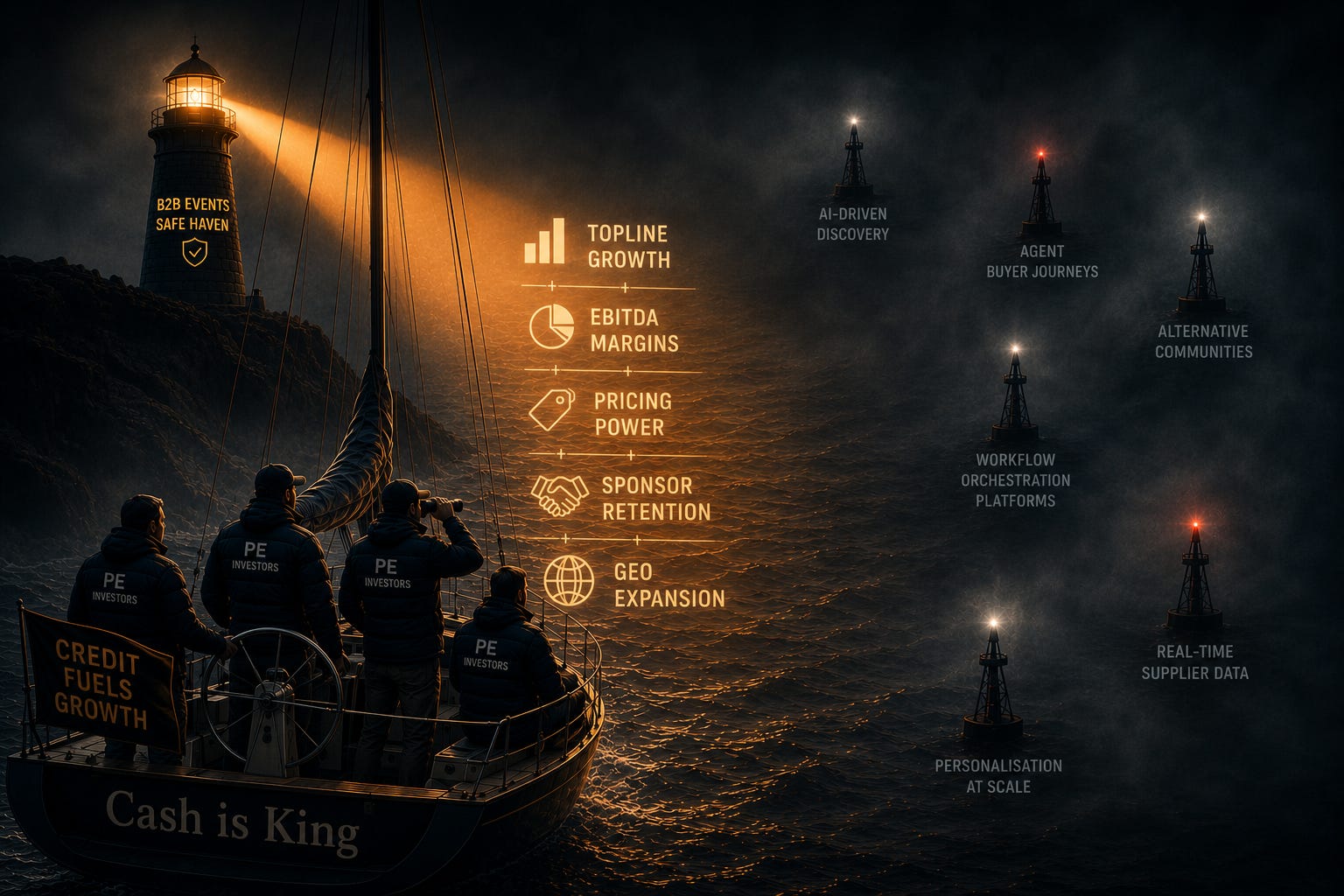
Three landmark B2B events deals have just been announced at strong valuations, and the only AI thesis any of them needed was that they don't need one. The market has no framework yet for pricing AI exposure in events, so the uncertainty that froze software and data M&A curdles into its opposite here: an illusion of certainty sold as an "AI-proof" story. That gap, more than any genuine immunity, is what made these exits so clean. The next ones won't be.
A year ago, the consensus was that no PE-backed B2B events business could be taken to market without a convincing AI story, and every CEO heading for an exit was rehearsing theirs. It turns out none of them needed one. Five weeks, three landmark deals: Searchlight buying into CloserStill alongside Providence at £1.35bn; Apollo taking Emerald at an EV of about $1.5bn plus Questex for an undisclosed sum; Hellman & Friedman taking Hyve off Providence and Searchlight for $1.8bn, triple what was paid in 2023.
New capital, rich valuations, and one thesis threading through all of them: events are the safe haven while AI disrupts the rest of information services. The performance behind the prices is real: Hyve delivered four straight years of double-digit organic growth, CloserStill grew fivefold under Providence and Emerald grew revenue 16% in 2025 while expanding EBITDA 25% (though for both much of that top-line came from acquisitions rather than organic growth, a roll-up engine more than a reinvention). These are well-run businesses, and the capital chasing them knew what it was buying.
What the buyers underwrote is a defensive bet on human contact.
Hunter Philbrick of H&F, on Hyve: “As AI reshapes global commerce, we believe the ability to foster human connections and bring people together will be more valuable to businesses than ever.” Mark Shashoua, Hyve’s chief executive: “the more that AI is dominating and proliferating our world... the more you want to engage with real people.” All true, as far as it goes.
Where AI appeared as offense, the language outran the substance. Hyve powered 160,000 "AI-enabled" meetings in 2025. Questex brought a "365-day digital engagement model". CloserStill broadened into one-to-one meetings and lead-enrichment products. Strip the vocabulary and "AI-enabled" matchmaking is a thin LLM layer on top of demographic filters, self-reported goals, and scheduling logic that has existed in some form for a while. The “365-day model” is real but the execution has typically fragmented into adjacent products (content, webinars, digital media) that orbit the show without changing what the P&L depends on. None of these platforms have made structural investment in agentic infrastructure, real-time data activation, or genuine workflow intelligence that turns the event into a milestone in a commercial process orchestrated year-round.
Investors let it slide.
Software and events face the same underlying challenge - AI is changing how buyers discover, evaluate and transact - yet they trade in opposite directions. In software the AI risk is visible: new distribution routes, agents that erase seat-based pricing, products a model can (in theory) replicate; and visible risk creates valuation uncertainty that freezes transactions. Software buyouts collapsed to $50bn in the first five months of 2026, down from $88bn a year earlier and the weakest start since the pandemic. Arma’s Paul-Noël Guély put the mechanism plainly: “Until an investor knows what a business may be worth post-AI adoption, it’s impossible for them to make a case to their investment committee.”
In events, similar risk exists but they are far harder to measure. No data-room dashboard carries a line for the share of attendance now mediated by an agent, or the share of sponsor spend migrating to AI-driven lead generation, so the uncertainty that froze software stays hidden. Against collapsed SaaS and data multiples events looked resilient; the agentic pressure on their model hadn’t surfaced in any number a buyer could point to, and a matchmaking feature plus a year-round ambition were enough. The deals closed.
Every one of these prices was set by a financial sponsor selling to another financial sponsor, or in CloserStill’s case a recapitalisation where Providence stays in and Searchlight buys alongside: no strategic acquirer, no IPO, no public-market test. The safe-haven premium is being validated inside the private equity echo chamber, by buyers who need to deploy capital, already believe the thesis they are paying for, and are buying it from each other at rising marks. The industry is marking its own homework.
AI is just as absent from the deal still to come. Clarion has stalled since 2024 (a roughly £2bn process drew no real offer) on a China business buyers want carved out and price expectations that were not matched, neither of which has anything to do with AI. Clean up and the process runs again. The buyer, as ever, will be another sponsor.
The dangerous read: events proved themselves AI-resistant, the market confirmed it, so AI is a side story. Strategy slide decks and AI investment papers that never reached the operating plan can go back in the drawer. Reading it that way mistakes the absence of visible damage for structural immunity, when the reality is that pressure is already in motion - from every side:
Buyers now consistently run pre-event discovery and vendor evaluation through AI: 60% of B2B buyers say they consulted GenAI tools or chatbots for a recent purchase decision, and the emerging pattern is the agent builds the shortlist and the human only confirms it later. So an attendee or sponsor weighing your show is already asking an agent whether it is worth the budget. Every event is therefore already curating information for agents, whether its organiser realises it or not; the only question is whether you shape that verdict or leave the agent to assemble it from third-party scraps. And most event platforms and assets, built for human audiences, are barely legible to one at all.
Attendees and sponsors arrive with the expectations AI has set everywhere else. Attendees want a programme curated to their goals and the right conversations surfaced before they land; they get a grid of sessions attended one at a time and matchmaking that rarely runs past topic tags. Sponsors want to act on who walked the floor and what they signalled while it still matters; they get a badge-scan CSV three weeks later. Events sit on the richest first-party intent data in B2B and hand it back too coarse and too late to act on.
The sharpest threat comes from outside the category: the platforms already positioning themselves as year-round orchestrators of the buyer/seller relationship, from LinkedIn to revenue-orchestration engines like 6sense and Demandbase, for whom a physical gathering is one touchpoint in a workflow they own.
I appreciate none of this has fully landed. A sceptic can fairly ask for the receipts: the attendance lost to an agent, the loyal regular whose sense of value erodes year on year while still turning up, the sponsor budget that moved, the event disintermediated. As of today the honest answer is that the revenue lines of the businesses that just sold show none of it. But the mechanism is observable even where the damage isn't yet measurable. The advantage (for sellers) is that events stretch that lag with an annual cadence that hides slow deterioration until it surfaces late.
The question is no longer "what is our 365 strategy" - the content calendar that kept delegates warm between shows. It is whether the event owner becomes infrastructure the buyer uses to decide, once agents mediate how they find and select suppliers: the structured record of who supplies what in a category, queried to build a shortlist; the post-event personalised validation pack; the subscription intelligence priced on deal velocity. Build that and the gathering becomes the high-intensity moment in a buying process you operate year-round; decide you don't need it and you are a venue an attendee's agent can skip.
The 2027 and 2028 exits will be judged against that question in a way the 2026 vintage was not. Are attendees finding your events through the channels where buying decisions now start, or living off an email list and a habit? Can sponsors activate the data you hold inside the timeframes their commercial cycles demand? Do you hold a credible position in the workflow your buyers and sellers run for the eleven months between shows? The recent buyers did not have to answer any of that seriously but the next ones will.
Events keep genuine advantages: the density of commercial intent in a room, the relationships that form across a table, the “you have to be there” authority the best shows cultivate over decades.
But “more insulated” does not mean “permission to wait”.
About
I analyse AI progress beyond the headlines, focusing on enterprise execution, incentives, and real-world economic impact.
No posts
Comments
Nothing yet. Say the first thing.
Sign in to join the conversation.